
Yes, dolphins strand all the time, but not like this. As shown below in the figure from the National Marine Fisheries Service, strandings have skyrocketed this year, especially in Virginia and fanning out north and south, with large numbers in Maryland, New Jersey and North Carolina.
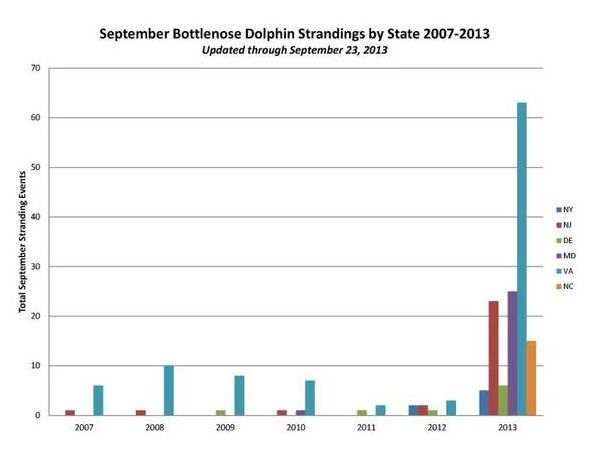
© NOAAFigure from NOAA Fisheries' landing page regarding "2013 Bottlenose Dolphin Unusual Mortality Event in the Mid-Atlantic."
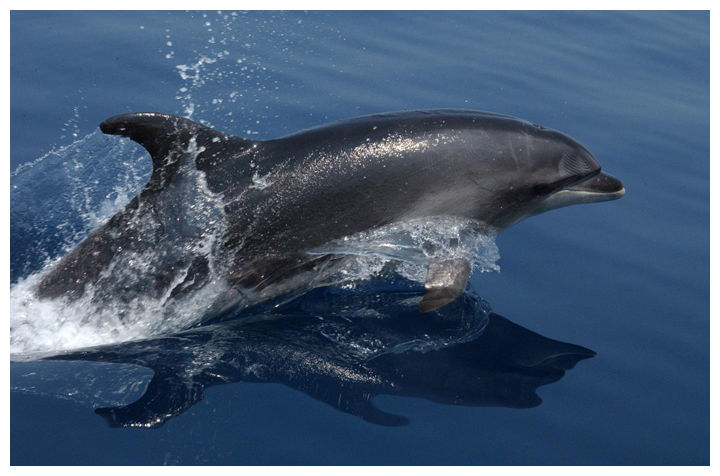
© Wayne Hoggard, NOAA/NMFS/SEFSCA bottlenose dolphin.
Humans have been degrading the coastal environment for decades, with agricultural runoff, oil spills, noise pollution, biotoxin accumulation, etc. Even if the morbillivirus is the chief culprit, are these dolphins succumbing to the virus now because their immune systems have been degraded by an environmental onslaught?
For example, as Dina Fine Maron explains in a Scientific American article earlier this month, dolphins sickened by the virus may have skipped a few meals if they didn't feel up to foraging, relying on their fat stores. Bad idea: biotoxins accumulated in fat would have then released, subjecting the dolphins' immune systems to toxins that could have hampered their immune responses.
Unfortunately, scientists collect little to no data on dolphin biotoxin accumulation, infection rates, or other indicators of a sickened ecosystem. And, as Maron notes, "that's a problem because more could be happening than we know with potential lasting consequences for oceans."
My colleague, Michael Jasny, has written about the 2010 to 2013 Gulf of Mexico bottlenose dolphin die-off that is still ongoing and roughly coincides with the BP Deepwater Horizon disaster. As the National Marine Fisheries Service notes, the majority of recent unusual mortality events have been caused by biotoxin accumulation from harmful algal blooms. Here, the toxins are produced by living organisms (algal blooms), not sourced from human pollution, but it's a distinction without much meaning as the number and intensity of algal blooms will likely rise as a result of climate change, which is caused by human pollution.
So, what are the "sentinels of ocean health" telling people? Seems to me that the writing on the wall keeps getting larger and bolder - society can't continue to degrade coastal environments and pour climate-change-producing pollution into the air and not expect our oceans and dolphins to give out.




"...the number and intensity of algal blooms will likely rise as a result of climate change, which is caused by human pollution."
My understanding is that algal blooms are caused by fertilization from agricultural run-off.