
There are now over 3,000 sinkholes around the Dead Sea on the Israeli side
This compares to 40 in 1990, with the first sinkhole appearing in the 1980s
The Dead Sea is drying up at an incredible rate leaving huge chasms of empty space in its wake.
These chasms appear in the form of large, devastating sinkholes and are increasing in number throughout the region.
Experts claim they are now forming at a rate of nearly one a day, but have no way of knowing when or how they will show up.
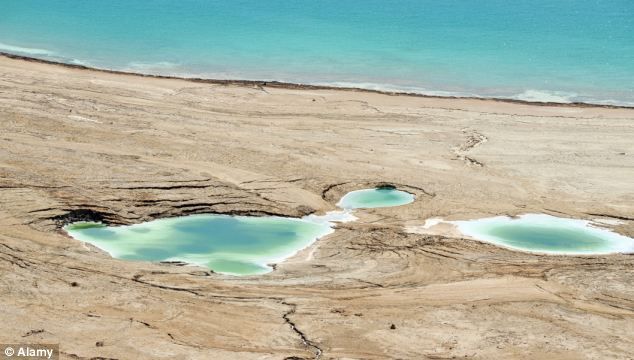
The Dead Sea is drying up at an incredible rate leaving huge chasms of empty space in its wake
This compares to just 40 counted in 1990, with the first sinkhole appearing in the 1980s.
The Dead Sea spans more than 60 miles through Israel, the West Bank, and Jordan.
Its waters are 10 times saltier than the northern Atlantic Ocean because it has no outlet. This means that any minerals that flow there, stay there.
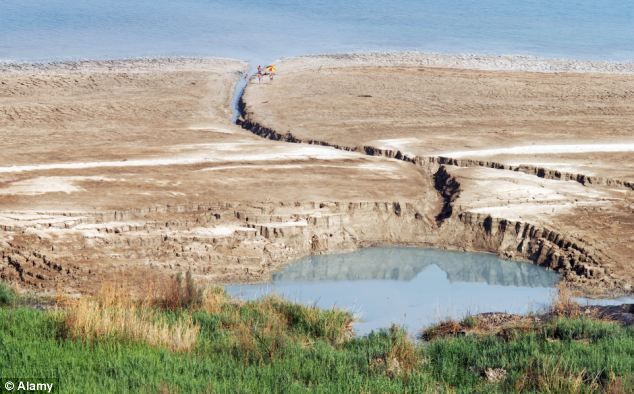
The Dead Sea spans more than 60 miles through Israel, the West Bank, and Jordan. Its waters are 10 times saltier than the northern Atlantic Ocean because it has no outlet. This means that any minerals that flow there, stay there
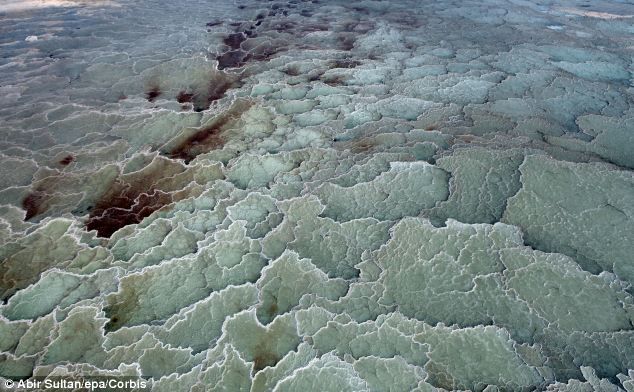
An aerial view shows a close up of a salt formation inside a large sinkhole on the shores of the Dead Sea. The increase in sinkholes is directly related to the Dead Sea drying up at a rate of one meter per year
Sinkholes are basically bowl-shaped features that form when an empty space under the ground creates a depression.
The depression is the result of a reaction between freshwater and salt buried in a subterranean level beneath the surface.
When the freshwater dissolves the salt, it creates a void, causing the landscape around and above it to suddenly collapse.
Over the last few decades, increasing numbers of people have been drawn to the Dead Sea causing its salt water to dry up.
This leaves more fresh water in the area to dissolve the salt and create more cavities.
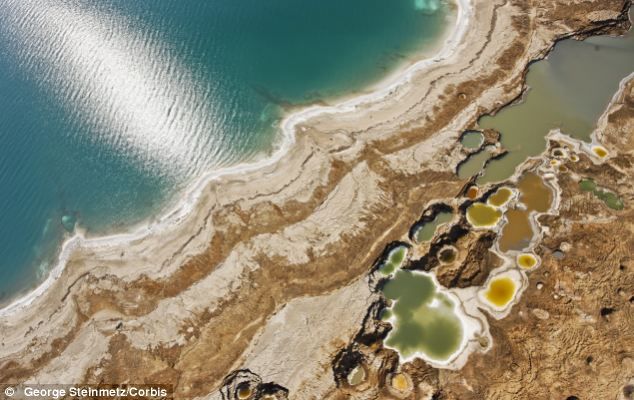
Sinkholes pock-mark the emerging shoreline of the Dead Sea near Ein Gedi. The sinkholes are caused by fresh groundwater dissolving subterranean salt deposits that once formed the bottom of the Dead Sea
But environmentalists warn that doing this could spell the end for the Dead Sea.
Experts believe more needs to be done to highlight the plight of the Dead Sea and come up with a solution.
For instance to bring the world's attention to the challenge artist Spencer Tunick shot the first mass nude shoot in the Dead Sea in 2011.
'Human intervention has just about killed the Dead Sea,' Alon Tal, professor in the Department of Desert Ecology at Ben-Gurion University of the Negev, told Moment magazine.
'It will take extraordinary human measures - careful, wise intervention and positive regional cooperation - to save it.'
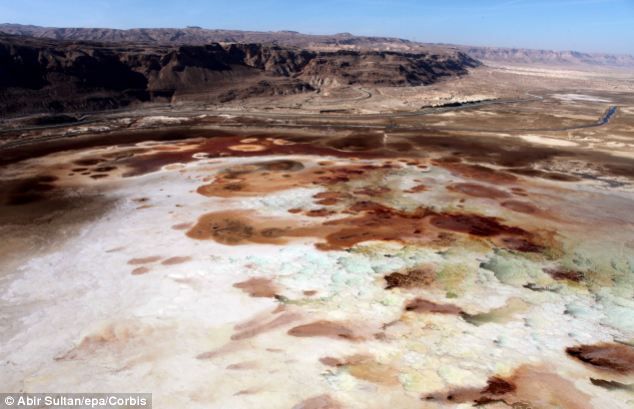
Estimates suggest that, on the Israeli side alone, there are now over 3,000 sinkholes around the Dead Sea



Reader Comments
to our Newsletter