
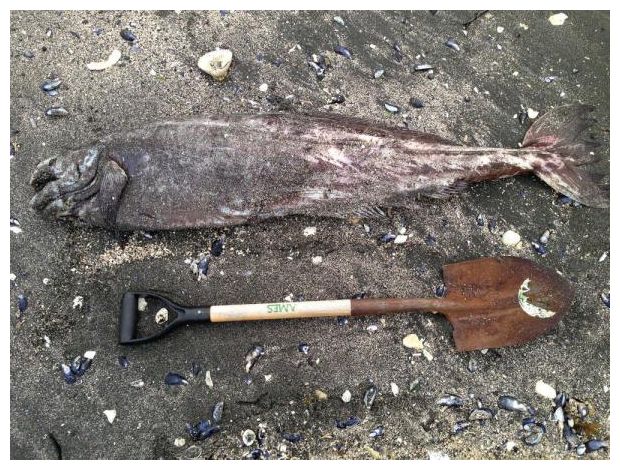
© Michael HaysThis ragfish washed up on the shore of Lena Beach early in the month of August. According to Mary Willson, a retired professor of ecology, ragfish are very distantly related to perch and bass, but they are characterized by a skeleton that is mostly cartilage and flabby flesh. Juveniles look quite different from adults in body shape and fin shape, and adults have no body scales.
It was longer than a shovel, battered and looking less than appealing. However, this particular specimen is small for its size - ragfish can reach an astounding 7 feet in length, National Oceanic and Atmospheric Administration biologist Dave Csepp said.
The fish are widespread throughout Alaska waters off the Bering Sea slope, hanging out deep, around 1,420 meters. However, they're not as common near Juneau - NOAA's Auke Bay Laboratories usually only get a few sightings of the fish each year, Csepp said in an email. They're most commonly caught in trawl nets or while trolling, and not very often found on beaches.
Yet another, larger fish, was found earlier this year. Mary Willson and Richard Carstensen encountered a dead ragfish in February, also on Lena Beach.
Although they don't look it, ragfish are floppy and limp like a rag, hence their name, Csepp said. These fish have mainly cartilaginous skeletons, and if you tried to bop one on the head with a salmon club, the club would go straight through. Ragfish have no scales, NOAA's Julie Speegle said. Their bodies are soft, their skin not unlike a squid's: a dark top layer can be easily removed to reveal smooth, white flesh underneath, Csepp said. They feed on small fish and cephalopods, and are food for sperm whales.
Besides what we know about the ragfish's colossal size and bizarre anatomy, not much is known about this species, Csepp said.
So, if you come across one on the beach, take some photos. You're one of the lucky few to come in contact with this mysterious fish.



Reader Comments
to our Newsletter