
It has been developed by searchers at the University of Maryland and received funding from the U.S. Army
Has the potential to be used as a drone for reconnaissance and surveillance
Researchers at the University of Maryland have developed a breakthrough in engineering technology that allows a robot to successfully achieve the complex aerobatic maneuvers of a bird.
The artificial bird is destined to have a military or surveillance purpose, the UMD Robotics Center, which sits within the University of Maryland, has received funding from the U.S. Army Research Laboratory.
The robot bird has the potential to become a more advanced type of drone, it includes a tiny video camera and could be used for reconnaissance and surveillance.
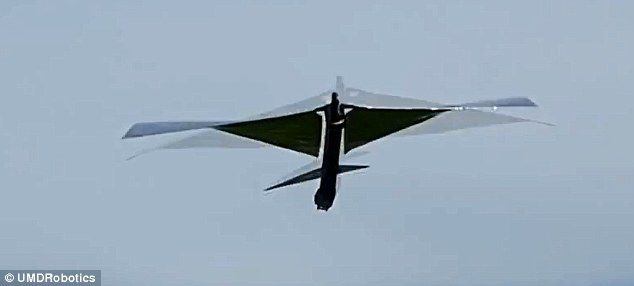
The robot bird includes a tiny video camera and could be used for reconnaissance and surveillance by the army
It is made out of carbon fiber, 3D-printed lightweight thermal-resistant plastic, Mylar foil and foam and weighs less than a can of soda.
The bird uses one motor to flap both wings together in simple motions.
Robot birds have been a labor of love for University of Maryland Professor S. K. Gupta for nearly a decade.
Along with fellow mechanical engineering professor Hugh Bruck and their graduate students, Gupta first successfully demonstrated a flapping-wing bird in 2007.
By 2010, the design had evolved through four successive models to the latest, which carries a tiny video camera.
'Nobody has flown anything with independent wing control,' before, Gupta told The Baltimore Sun.
It can also be launched from a ground robot that ARL researchers have created called the Lynchbot, which can fly in winds up to 10 mph.
From a distance, the 'Robo Raven' looks like a bird and it has even fooled a hawk, which has attacked the robot in mid-flight on more than one occasion.
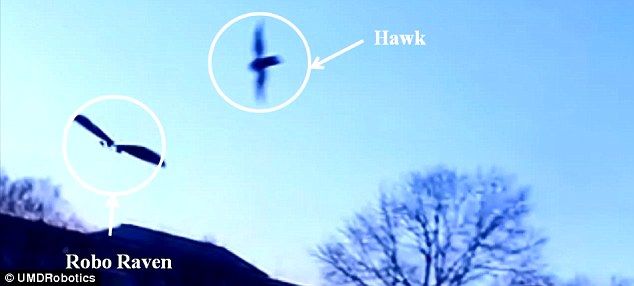
The 'Robo Raven' looks like a bird and has even fooled a hawk, which has attacked the robot in mid-flight on more than one occasion


thought he is going to get some meat catching the raven and instead lo and behold it is an empty mechanical creature not unlike a psychopath.
Poor hawks have now to learn how to deal with the psychopathic creatures.