
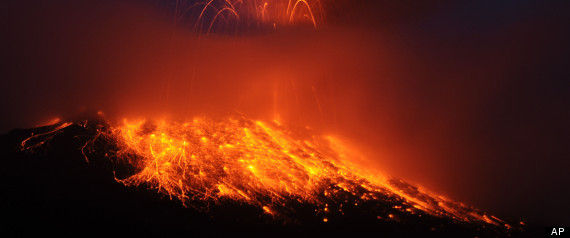
Scientists have confirmed that two continent-sized chemical blobs of partially melted rock are converging in the Pacific, and look set to create a massive new volcano which could prove cataclysmic to life on Earth. (In 100 million years.)
Geologist Michael Thorne at the University of Utah reports in Earth and Planetary Science that the collision is slowly happening 1,800 miles beneath the ocean.
He says that the collision could lead in two possible directions - both of which are bad, and would wipe out millions of species.
One is just a massive single eruption, which would kill us all, the other is a thousand-year flood basalt eruption, which would also kill us.
The problem is that two enormous "thermochemical piles" of molten rock about 3,000 miles across are moving towards each other at the bottom of the Earth's mantle.
The piles have been known about for decades, but it was originally thought they were static.
But after extensive study with seismic waves, Thorne is convinced they're in fact moving together. The result is a massive, molten blob that will one day be created beneath the ocean, creating a huge amount of pressure that will eventually blow up in our face.
"What we may be detecting is the start of one of these large eruptive events that - if it ever happens - could cause very massive destruction on Earth," said Thorne.
Luckily the process is slow - it shouldn't happen for another 100 million years or so.
And anyway, there are other super volcanoes to worry about first.




THE CORIOLIS EFFECT
DECONSTRUCTED
by Miles Mathis
...
But back to the Earth. This must imply that the northern hemisphere should have more charge. Do we have any indication of that? Yes, we have many hurricanes in the North Atlantic, and almost none in the South Atlantic. Local magnetic fields hit a minimum in the southern hemisphere, in South Africa and South America.** We have more storms to the north overall, and although this used to be explained due to less detection in the south, this is no longer true. With satellite coverage of the entire Earth, we have found that there is indeed more "weather" in the north. This has also been attributed to greater landmasses in the north, but it may be that both the greater landmasses and the greater weather is caused by the same thing: more charge. Just as the planets inhabit the plane of greatest charge in the Solar System, it is probable that the land inhabits the area of greatest charge on the Earth. I will give you more reasons for that as my papers on charge continue to unfold.
I have said in many papers that celestial bodies emit more charge near the equator and less near the poles. In previous papers I provided a link from NASA of actual footage of the spinning Sun, and it is clear from a glance that more charge is being emitted near the Solar equator. Do we have any similar glaring evidence on the Earth? Yes. We have known since the 1960's that the ionosphere is considerably weaker near the poles.
...
I have said that charge drives ions, and here we have direct and longstanding data that we have fewer electrons being driven near the poles. That is direct proof that we have less charge at the poles. The only way to deny it is to say that E/M isn't driven by charge. That would be novel, since all of QM and QED and QCD is based on the idea that E/M IS based on charge. I have never disagreed with mainstream theory in this, I have simply given charge a real presence, rather than a virtual presence. And I have given it a real presence at both the quantum and macro levels. We know from data of these charge holes at the poles, but they have never been explained. I have never seen an explanation attempted. But, as you see, it is a natural outcome of my theory of charge recycling. We have less charge at the poles because charge is coming in there, not being emitted there. So we wouldn't expect ions to be driven up. They would be driven down at the poles, if anything. And these ions moving toward the Earth would not impede incoming cosmic radiation like ions moving up.
...
This would create spin even if we only had photons coming in at one pole, but photons coming in both poles doubles the effect. Since I have shown we have more photons than antiphotons, we must have more flattening at one pole than the other. In fact, this is precisely what we find. The south pole has a fraction more flattening than the north pole, and this is the cause. The south pole is being flattened by the same cause that obliterates the nearside crust of the Moon: charge photon bombardment. Interestingly, I predicted this flattening before I knew of it. I wrote it into this paper, and only then Googled on it. Fortunately, I found this and much more. If you prefer the current answer to greater radius at the equator, consult the current answer for an explanation of more flattening at the south pole. The Earth's angular momentum obviously can't answer that one, nor can centrifugal forces. And gravity from the Moon can't answer it either. Charge is the pretty obvious answer, to this as well as to many other questions.
...
[Link]