
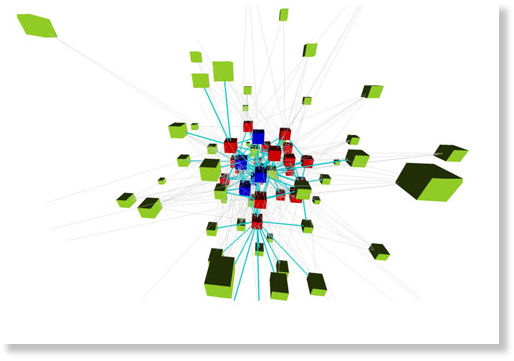
© UCSD JacobsA graph showing interactions between 82 students during the last week of a course. High performing students are in dark blue and form a core where the highest density of persistent interactions can be observed. Mid-performing students are in red and low-performing student sin green. Persistent interactions are shown in thick blue edges, while dotted thin grey edges indicate transient interactions.
"Elite groups of highly connected individuals formed in the first days of the course," said Cebrian, who also is a Senior Researcher at National ICT Australia Ltd, Australia's Information and Communications Technology Research Centre of Excellence. "For the first time, we showed that there is a very strong correspondence between social interaction and exchange of information - a 72 percent correlation," he said "but almost equally interesting is the fact that these high-performing students form 'rich-clubs', which shield themselves from low-performing students, despite the significant efforts by these lower-ranking students to join them. The weaker students try hard to engage with the elite group intensively, but can't. This ends up having a marked correlation with their dropout rates."
This study co-authored by Luis M. Vaquero, based at Hewlett-Packard UK Labs, shows a way that we might better identify patterns in the classroom that can trigger early dropout alarms, allowing more time for educators to help the student and, ideally, reduce those rates through appropriate social network interventions.
Cebrian's work is part of UC San Diego's wider research effort at the intersection of the computer and social sciences, led by Prof. James H. Fowler, to enhance our understanding of the ways in which people share information and how this impacts areas of national significance, such as the spread of health-related or political behavior.




not a question of working alone or not. I got good grades both when I was working alone and when we were doing team work. It's a matter of performing well in both cases.