
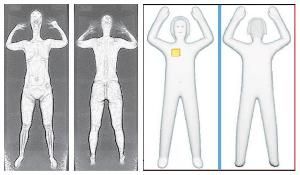
© AP Photo/Transportation Security AdministrationWhat TSA officers see on monitors when passengers pass through airport body scanners with backscatter on the left and millimeter wave with new software on the right.
The software adaptation can't be developed in time, according to the Transportation Safety Administration, so the $40 million contract will be canceled and the machines returned to their manufacturer. Software adjustments were successfully completed for the millimeter wave scanners, which are already in about half of the nation's airports, and will eventually replace the backscatter machines.
The reason I'm relieved that backscatter machines are going to be scrapped is because of their potential radiation risks, which radiation health experts expressed concerns about back in 2010 when the full body scanners first came to Logan and 29 other airports.
Four radiation scientists from academic institutions sent a letter of concern to the White House questioning "the extent to which the safety of this scanning device has been adequately demonstrated," especially for frequent fliers who are going through them on a daily basis. The American Pilots Association told its members to opt for pat downs rather than risk the cumulative dose of radiation.
Radiation accumulates in the body over a lifetime, and excess exposure can damage DNA, giving rise to a variety of cancers.
I went through a few pat-downs myself at Logan airport to avoid any radiation exposure from the machines. I was particularly concerned about the potential for a machine malfunction that could expose me to more radiation than originally intended.
Ann Davis, a TSA spokeswoman, told me in a 2010 interview that the machines were inspected regularly at Logan and elsewhere and that all the radiation surveys that had been conducted at Logan, up to that point in time, "have found radiation emissions to be below the applicable national standard."
But European Union countries were concerned enough about the radiation risks to ban backscatter machines in 2011; they only use millimeter wave scanners in their airports.
A TSA contractor who spoke with the Washington Post on the condition of anonymity speculated that concerns about radiation risks contributed to the decision to remove the machines from US airports. "I suspect they may have had additional concerns that they're not talking about," the person told the Post. "I believe they feel politically uncomfortable going back on their previous statements."
I suspect he's right, though TSA officials insist that the radiation safety question wasn't a factor.



Reader Comments
to our Newsletter