
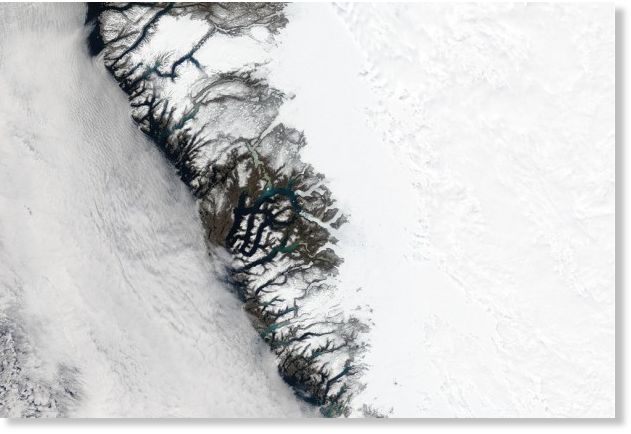
© NASA Visible EarthImage of southwest Greenland by Jacques Descloitres, MODIS Land Rapid Response Team
Previously, scientists had been unable to "locate any suites of volcanic rocks with compositions comparable to modern mid-ocean ridge or oceanic island magmas that were older than 3 billion years and were also free from contamination by continental crust," they added. However, rocks discovered by Jenner's team are the "missing piece of the puzzle" because they are comparable to modern-day samples obtained from oceanic islands.
The subduction process takes place at plate boundaries, and begins when the upwelling and melting of the mantle at mid-ocean ridges and the eruption of new seafloor magmas spur on the continued production of oceanic crust, the researchers explain. As that crust moves away from mid-ocean ridges, it cools and becomes denser than the mantle beneath it, ultimately sinking back into the mantle and triggering additional eruptions.
"Volcanic eruptions that are triggered by subduction of oceanic crust are chemically distinct from those erupting at mid-ocean ridges and oceanic island chains, such as Hawaii," representatives from the Institution said. "The differences between the chemistry of magmas produced at each of these tectonic settings provide 'geochemical fingerprints' that can be used to try to identify the types of tectonic activity taking place early in the Earth's history."
"The Innersuartuut samples may represent the world's oldest recognized suite of oceanic island basalts, free from contamination by continental crust," added Jenner said. "This evidence strengthens previous arguments that subduction of oceanic crust into the mantle has been taking place since at least 3.8 billion years ago."



Reader Comments
to our Newsletter