
For Geoffrey Donovan, a research forester at the Forest Service's Pacific Northwest Research Station, and his colleagues, the loss of 100 million trees in the eastern and midwestern United States was an unprecedented opportunity to study the impact of a major change in the natural environment on human health.
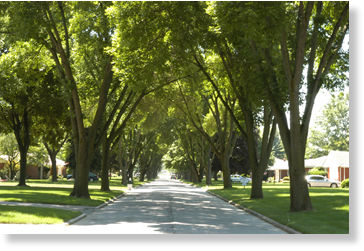
© USDA Forest ServiceA tree-lined street in Toledo, Ohio in 2006, before emerald ash borer infestation. Credit: Dan Herms, Ohio State University
The researchers analyzed demographic, human mortality, and forest health data at the county level between 1990 and 2007. The data came from counties in states with at least one confirmed case of the emerald ash borer in 2010. The findings - which hold true after accounting for the influence of demographic differences, like income, race, and education - are published in the current issue of the American Journal of Preventive Medicine.
"There's a natural tendency to see our findings and conclude that, surely, the higher mortality rates are because of some confounding variable, like income or education, and not the loss of trees," said Donovan. "But we saw the same pattern repeated over and over in counties with very different demographic makeups."
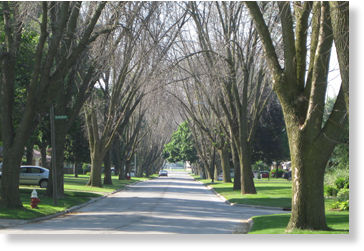
© USDA Forest ServiceThree years later, in 2009, after the invasive insect spread to the neighborhood. Credit: Dan Herms, Ohio State University
The emerald ash borer was first discovered near Detroit, Michigan, in 2002. The borer attacks all 22 species of North American ash and kills virtually all of the trees it infests.
The study was conducted in collaboration with David Butry, with the National Institute of Standards and Technology; Yvonne Michael, with Drexel University; and Jeffrey Prestemon, Andrew Liebhold, Demetrios Gatziolis, and Megan Mao, with the Forest Service's Southern, Northern, and Pacific Northwest Research Stations.



Reader Comments
to our Newsletter