
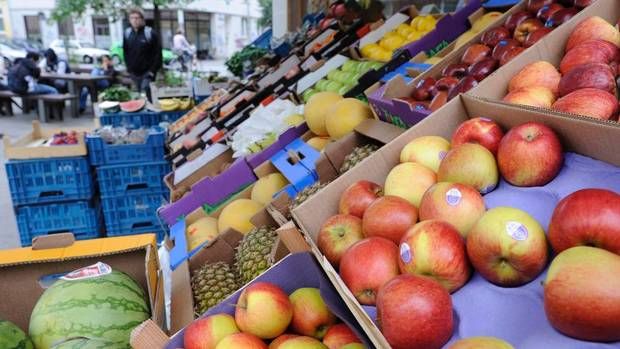
© Fabian Bimmer/ReutersFruits and vegetables are offered at a grocer's shop in Hamburg in this file photo.
Compared to the prior year period, prices increased by 2.1 per cent in the final month of 2012, preliminary data from the Federal Statistics Office showed. On the month, consumer prices rose 0.9 per cent.
Economists surveyed by Reuters had been expecting more modest rises of 1.9 per cent year-on-year and 0.7 per cent on a monthly basis.
"Food prices, hotels and package holidays were the key culprits for an inflation increase in December in Germany," said Christian Schulz, senior economist at Berenberg.
"The data are unlikely to affect the ECB's interest rate decision next week much, although it may add a little bit more weight to the arguments of those on the Governing Council opposing further monetary stimulus," he added.
Euro zone inflation in December is forecast at 2.1 per cent on the year, a slight fall from November's 2.2 per cent.
Germany's inflation rate remained above the ECB's broader euro zone target of close to but below 2.0 per cent for much of 2012 as its economy outperformed European peers, fuelling robust wage rises.
The government and the country's central bank have both hinted they would tolerate higher prices as long as euro-wide inflation remains under control. That could help ailing euro zone countries boost their competitiveness.
A Reuters poll conducted late last year showed that economists were evenly divided about whether the ECB hold its main refinancing rate steady at a record low of 0.75 per cent through the first quarter of the year or cut the rate to 0.5 per cent.



Back in August we paid £7 for a 25Kg sack of potatoes. This week we have just paid £10.50 for the same sack... over 30% increase in 4 months.