
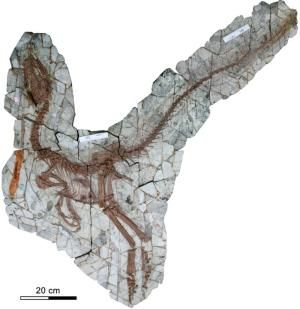
© Xing et alHolotype of Sinocalliopteryx gigas.
The U of A paleontology team found the fossilized remains of three flying dinosaurs in the belly of a raptor-like predator called Sinocalliopteryx. Sinocalliopteryx was about two meters in length and roughly the size of a modern-day wolf.
Sinocalliopteryx's flying meals were three Confuciusornis. Confuciusornis was one of the earliest birds and had a crude version of a modern bird's skeleton and muscles. The researchers say such primitive birds were probably limited to slow take-offs and short flights.
According to the researchers, this is the first time a predator has been linked to the killing of multiple flying dinosaurs.
Scott Persons, a U of A paleontology student and research coauthor, says Sinocalliopteryx may have used stealth to stock the flyers. "Sinocalliopteryx didn't have wings or the physical tools needed to be an adept tree climber," said Persons.
Persons explains Sinocalliopteryx had feathers or hair-like fuzz covering its body creating a level of insulation that helped maintain a warm body temperature and high metabolism that required a lot of food to fuel.
"The fact that this Sinocalliopteryx had, not one, but three undigested birds in its stomach indicate it was a voracious eater and a very active hunter," said Persons.
This find was made in China's Liaoning province, and U of A researchers analyzed stomach contents of a second Sinocalliopteryx fossil discovery from that area. The researchers identified this Sinocalliopteryx's last meal as a Sinornithosaurus, a small feathered meat-eater about the size of a house cat that may have been able to fly or glide short distances.
"Sinornithosaurus is a relative of Velociraptor which means this is the first direct evidence of a raptor becoming another predatory dinosaur's meal," said Persons.
Journal Reference:
Lida Xing, Phil R. Bell, W. Scott Persons, Shuan Ji, Tetsuto Miyashita, Michael E. Burns, Qiang Ji, Philip J. Currie. ''Abdominal Contents from Two Large Early Cretaceous Compsognathids (Dinosauria: Theropoda) Demonstrate Feeding on Confuciusornithids and Dromaeosaurids.'' PLoS ONE, 2012; 7 (8): e44012 DOI: 10.1371/journal.pone.0044012




More Catastrophism proof?
How did the predator die? Like buttercups in a Mammoth?
How is it that a critter healthy enough to chase down and eat three birds - two quite recently - is found dead, with no obvious trauma? I see no guess at the predator's cause of death. I read the link, too, which simply tended to rule out an overeating-caused death, e.g., 14 ft Portheus fossil fish with 6 ft fish inside; or, the recently gator exploded python in the Everglades.
Although these critters are of an earlier era, IMHO, this find seems analogous to famous finds of mastadons and mammoths who still had greens and buttercups in their stomachs and mouths, which was and is indicative of a quick and externally caused death - if they slowly died out from starvation, climate, or man, such finds would be unlikely. See generally, LKJ's references/discussions of the Younger Dryas Event ("YDE") in particular and Catastrophism in general, e.g., February 2012 "The Triumphant Beast," at www.sott.net/article/241181-The-Triumphant-Beast, or this, “A Different Kind of Catastrophe,” by Cox, at [Link] Also, in this case, there were other such predators' fossils in the same place.
Thus, I would submit that this find, too, tends to be probative of catastrophism theory in general.
Quite interesting, and yet another example I'll use to tell folks why they should read SOTT.
R.C.