Earth is exiting the debris stream of Comet Swift-Tuttle, source of the annual Perseid meteor shower. According to the International Meteor Organization, the shower peaked on August 12th with ~120 meteors per hour. NASA's network of
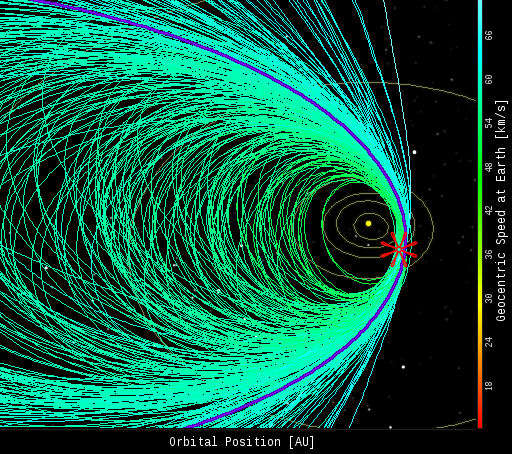
all-sky meteor cameras photographed and measured the orbits of nearly 300 Perseid fireballs:
© NASA
In the diagram, above, the location of Earth is denoted by a red splat. The orbit of parent comet Swift-Tuttle is traced in purple. The comet itself does not intersect Earth (good thing), but many of its meteoroids do hit our planet.
"The plot contains data from July 26th to the present," says Bill Cooke, the head of NASA's Meteoroid Environment Office. "There are 289 fireballs, 183 on peak night alone." To illustrate the intensity of the shower, Cooke offers a composite image of
all the fireballs over the Marshall Space Flight Center on August 12th. "It was a great show."
For more snapshots from around the world, browse the
Realtime Perseid Photo Gallery.




If equipment at NASA and similar everywhere wasn't commanded to look for asteroids like crazy for a couple of years to create an early alarm system. That's what i would do if given their equipment.
Also the best protection for the Super-Rich could be to go into Hollow Earth as was written about in several sources. Earths crust surely offers better protection against cometary bombardment averaging in 30km thickness, compared to the shielding of bunkers or military bases under lousy mountains.
The C's said if i remember correctly that surface quakes and upheavals are not felt down there by the civilizations of Hollow Earth, also they said there is light and warmth.
Just in theory, not that i'm interested of what goes on under the crust, wouldn't really wanna go there. Prefer higher densities.