
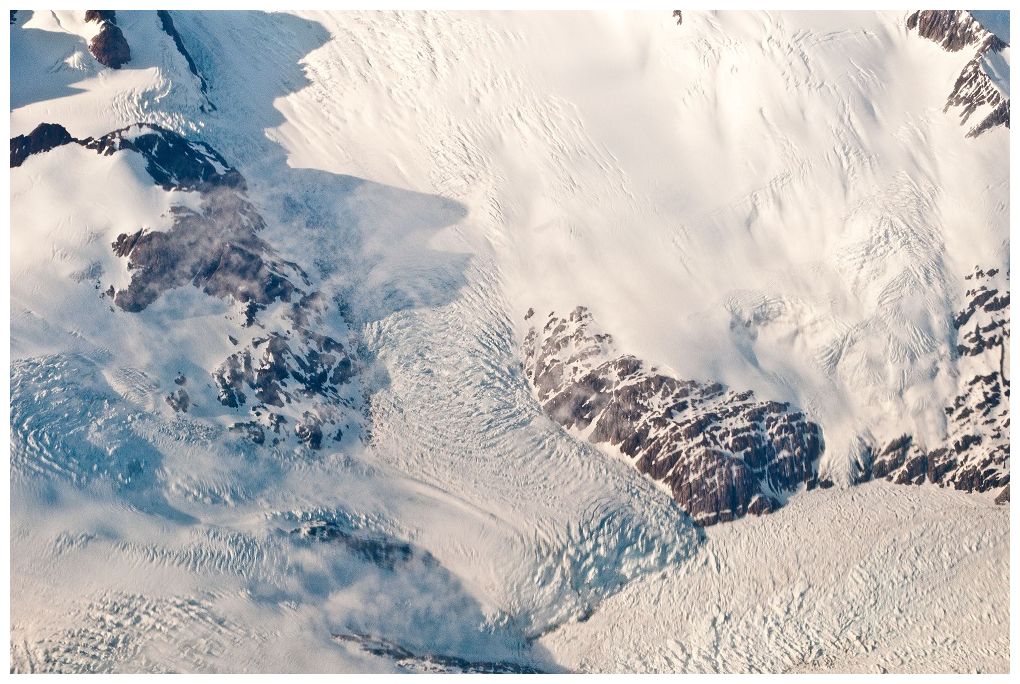
© Ian Joughin and Science / AAASThe heavily crevassed ice on this small Greenland outlet glacier cascades down to the fjord water (bottom right), which is filled with icebergs and small bits of ice.
Greenland and Antarctica are home to the two biggest blocks of ice on Earth. As climate changes, these glacier are shrinking and the water contained in them is moving into the oceans, adding to the already rising sea level.
A glacier's velocity is a measure of how fast the ice on the surface of the sheet is flowing toward the edges of the sheet.
This flow can be faster or slower, depending on how much the glacier is melting. The faster the flow, the more water and ice mass is lost from the glacier.
"You can think of the Greenland ice sheet as a really large lake that has hundreds of those little outlet streams that are acting like conveyor belts to move ice from the middle of the ice sheet, where it's getting added by precipitation, to the edges," study researcher Twila Moon, a graduate student at the University of Washington, told LiveScience.
Great glaciers
The researchers analyzed satellite images of the Greenland glaciers taken between 2000 and 2010. These annual images were put through a computer program to detect how quickly the ice is moving. In general, the glacial flow has sped up by 30 percent over the 10 years, Moon said.

© Ian Joughin and Science / AAASIn part because the large Jakobshavn Isbrae moves so quickly, it is difficult to tell the glacier ice (right and top) from the many icebergs it has calved off (center front) into the fjord.
The researchers saw that the glacier's type has a big impact on how quickly it flows. Land-ending ice sheets can move 30 to 325 feet (9 to 99 meters) per year, while glaciers that terminate in ice shelves move much faster, from 1,000 to more than 5,000 feet (305 to 1,600 m) per year.
The glaciers that drop off into the sea are flowing the fastest, Moon said, up to 7 miles (11 kilometers) per year and their speeds are accelerating. "The areas where the ice sheet loses the most ice are also the areas we are seeing the biggest changes," Moon said.
Where and why
The ice flow depends on the glacier's location, and therefore the local climate. Most of the high-velocity glaciers are in the northwest and southeast of Greenland, and these are also the calving, ocean-ending glaciers.

© Ian Joughin and Science / AAASThis relatively small outlet glacier is just one of hundreds (there are many much larger) that move ice from the interior of the Greenland ice sheet out to the ocean.
There's no reason to think, from the new data, that the glaciers won't continue to gain speed. The result would be an increasing amount of ice and water adding to the sea level. Scientists see some good news: This average flow is actually slower than previous estimates suggested, meaning climate and sea-level rise models need to be tweaked.
"A lot of the drive behind current Greenland ice sheet and Antarctica studies is to ask, 'What sea-level rise can we expect?'" Moon said. "Both of these areas hold vast amounts of ice and the potential for very large sea-level rises. We need to understand what's happening on them to see what potential scenario will be realized."
The study is to be published tomorrow (May 4) in the journal Science.

I'll run to the hills when Al Gore abandons his beachfront mansion in the Carolinas.