LAURA KNIGHT-JADCZYK AND JOE QUINN
Since the 9/11 attacks, no book has provided a satisfactory answer as to WHY the attacks occurred and who was ultimately responsible for carrying them out - until now.
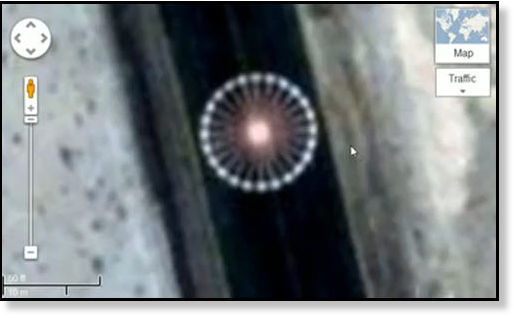
a helicopter:
-a helicopter doesn't come with 24 blades
-helicopter blades don't have lights on their end
-much less a bright light above the rotor axis
-usually helicopters don't land or takeoff from a runway, or use a taxiway
just sayin'...
asino, I mean no harm to you, I just want to clear up some things that were not entirely correct.
:-)
[quoted from asino]
"a helicopter:
"-a helicopter doesn't come with 24 blades "
>DEBUNK: No, but the rotors move at a rate that is in the hundreds of MPH. So depending on the rate of rotor turn & the time of exposure allowed for the picture, it can appear that there are more rotor blades than is what is usually seen. Also, rotor blades have to be "tracked", in other words they have to be "tuned" so that they follow in each others' "track"much like timing the engine of a vehicle. The sound you sometimes hear of "whup , whup", is blades either "out of track" or being forced "out of track" by the flight controls/manuevering of the aircraft, & air conditions". When the blades are in "track" they do not make as much noise as they follow each other in the vacuum created by the previous ones' track. ( They have to follow each other as closely as possible in their turning plane, so that they do not disrupt each others "plane of attack" thru the air.)
"-helicopter blades don't have lights on their end"
>DEBUNK: Yes they do. It is an integral part of every helo I have every worked on, including military. Some even have "de-icer" circuits like many aircraft.
"-much less a bright light above the rotor axis"
>Not sure of what your statement means, so I will not comment on this.
"-usually helicopters don't land or takeoff from a runway, or use a taxiway"
>DEBUNK: yes they do, it is part of the training of most helo pilots.but not necessarily required. "Touch & Go's" are another part of helo pilot training.
"just sayin'..."
^ you shouldn't.
;-)
{Just to give the qualifications for my reply here, I spent most of my time in the U.S.M.C. as a mechanic & crew chief/airman on CH-46 SeaKnight helicopters. I was trained to do the mechanics fore & aft/top to bottom, including Flight control system R&R , In-flight troubleshooting( including "tracking of the rotor blades", Corrosion Control, Quality Assurance, Aircrew duties ( In-flight control of the aircraft & crew, Aerial gunnery, etc. As part of those duties I could "order" the higher ranked pilots to "ground" the aircraft, even during/in flight , regardless of their rank being higher than mine.) I also attended A & P school. ( Airframes & Powerplant) in order to work on any aircraft, anywhere in the world at that time. I only point this info out to "back up" my information source., Not to "sound off/blow my trumpet". I just dis-like disinformation.}
I cannot fix any mistakes I made typing , but I think this comment is good enuff.
Enjoy!
:-)
No, there are no lights on the ends of a helicopter's rotor blades. But many large helicopters have the tips of their rotors painted white. And while in the image, there appears to be 24 blades, the real number of blades is only six. The exaggerated number of blades is an artifact of the camera that took the image. And at 60 feet wide, the diameter of the rotor system is the real clue that tells us what we are looking at. What you see on the runway there is a Sikorsky Flying crane. The Military designation is Sikorsky CH-54 Tarhe (The civilian version is called the S64E) [Link]
The resolution of the image is too blurry to be certain. But considering which airfield it’s working from, and the orangish color at the center of the rotor disk, I’d say it is probably one of the firefighting water tankers that belong to a company called Erickson Air Crane. Since their aircraft are all painted in orange, and white.
And sometimes when fully loaded they need to build up some speed before they can transition from a hover out of ‘ground effect’. This is because as the helicopter tilts forward, and begins to accelerate, the forward motion of the aircraft helps pull more air into the rotor system, and thus increases lift at takeoff. During Viet Nam, a common army slang term for fully loaded UH-1 gunships struggling to get off the ground was “doin’ the full tilt boogey”. And sometimes we had to use the whole damn runway to build up enough speed to get away from the ground.
So they most certainly do use the taxiways, and runways.
Here's another link showing Erickson's Sky crane fighting the 'Big Meadow' fire in Yosemite National Park. Note the orange paint job. [Link]
From your comment, " No, there are no lights on the ends of a helicopter's rotor blades. "
You are incorrect.
Here is a picture:
[Link]
Thanks for the anal reply. Some aircraft might use them. But there are no lights on the end of a Sikorsky Sky Crane's rotors.
Besides, the Google image was taken in broad daylight from a satellite. A cute little fingertip sized light is most certainly not bright enough to be visible in the daytime from space. But painting the outermost 5 feet of the rotor white is.
Also MnSportsman ,
The DOD and the U.S. Office of Naval Research only awarded a phase-one Small Business Innovation Research contract to design and build a nighttime lightweight rotor blade tip lighting system that could be modulated to provide red, green, and white navigation lights in 2010.
Helicopter rotor blade tip safety lighting systems are still experimental. And are most certainly not a common feature on production aircraft yet.
"anal" reply?
Grow up...
Taken (verbatim) from the 1980 NavAir 0-250HDC-1 NATOPS FLIGHT MANUAL(Navy Model) CH-46E
page 1-111
Rotor Blade Tip Lights
A tiplight is install on each rotor blade to enable night formation flight. Intensity of all 6 tip lights is controlled by six-position rotary switch, marked BLADE TIP LT- OFF-1-2-3-4-BRT, located with thr formation light controls on the overhead console.
& so on...
There is more to that particular section, but my point is made.
---------------------------------------------
"Anal" you say.
I say you need to do some more studying to further your knowledge.
Have a nice day.
The silly argument about helicopters, and lights on their rotors is a moot point. I'm feeling a bit silly myself right about now.
Since I use Google Earth Pro as well as a commercial account with Geo Eye in my own research. I've got ready access to much better satellite imagery. I could've settled this from the beginning.
When the location is viewed in a high resolution image with almost perfect focus, it turns out it's not a helicopter at all. It's just a helicopter landing pattern that's painted on the taxiway, instead of the traditional 'H' in the middle of a circle we're used to seeing. [Link]
Thanks for that. People do sometimes get their knicks in a twist over nothing do they not.
Redman Did you even bother to look at the improved Hi Resolution satellite image I provided of that location? [Link]It's not a UFO or helicopter. It's only a graphic pattern that's painted on the taxiway..
. . . look at the linked pic . . .
its not a choppah
Ok, so chopper aside, what about the bright light in the center?
I haven't looked at that link yet, can't, blocked at work here...
But I'm guessing it doesn't explain the light in the center?
Do they illuminate spots for choppers to land with extremely bright pinkish lights in the center of the circles? Is that standard practice?
And why a helipad on a landing strip? Aren't those generally in a different spot from the landing strips?
Isn't that a really odd spot to put the landing spot for the chopper?
I appreciate healthy skepticism, but you seem to be rushing to conclusions without asking any other questions that are relevant to the oddity of positioning, illumination intensity, etc...
Come on, we can do better than lights on the tips of the wings, and a shiny central whatchamakalit in the center? I'm not convinced skeptics, please elaborate!
a helicopter preparing to take off or after it just landed. The starburst is the lights on the end of the rotor blades.
osit.