
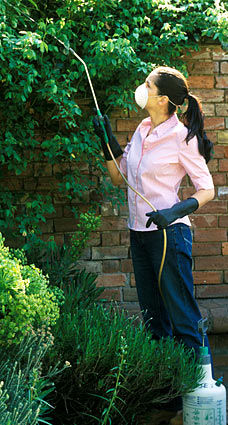
Warning: The risk of developing Parkinson's increases according to the level of exposure to pesticides.
The study showed that people who used either rotenone or paraquat are about two-and-a-half times more likely to develop Parkinson's than people who never used either pesticide.
Pesticides were long suspected to be tied to Parkinson's, at least in part because of the high rate of the disease among farmworkers. Scientists have also been aware for many years that both paraquat and rotenone are neurotoxins that, when given to animals, reproduce features of Parkinson's in the brain.
Paraquat is a weedkiller that is known to increase the production of certain proteins in the brain that damages cells that produce dopamine. People with Parkinson's have a dopamine shortage which causes the motor problems, muscle tremors and rigidity that characterize Parkinson's.
Rotenone inhibits the function of mitochondria in the brain, which is responsible for regenerating certain brain cells. Both pesticides are largely restricted, due to concerns about links to Parkinson's. Paraquat is restricted to certified applicators and rotenone is only permitted to kill invasive fish species.
Other studies, including one published in July 2006, claim that even low levels of exposure to household pesticides can increase the risk of developing Parkinson's disease.



Pox and associated resurgent, mutant shingles; precipitating it and affiliated diabetes as these viruses degrade the body's insulin.