
© stock photo/spekulator
One of the best ways to look at long-term temperatures is with isotope data from the GISP2 Greenland ice core, from which temperatures for thousands of years can be determined. The ice core isotope data were obtained by Minze Stuiver and Peter Grootes from nuclear accelerator measurements of thousands of oxygen isotope ratios (16O/18O), which are a measure of paleo-temperatures at the time snow fell that was later converted to glacial ice. The age of such temperatures can be accurately measured from annual layers of accumulation of rock debris marking each summer's melting of ice and concentration of rock debris on the glacier.
The past century
Two episodes of global warming and two episodes of global cooling occurred during the past century:
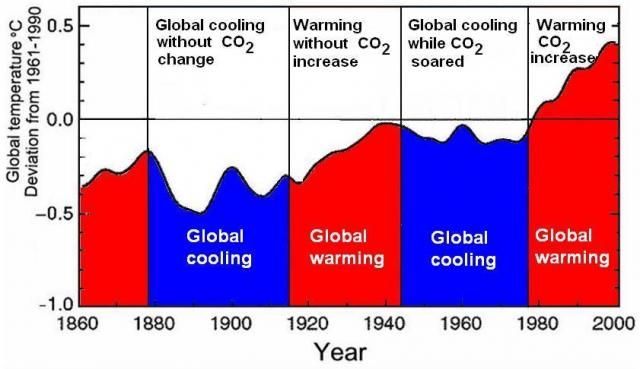
© Don J. EasterbrookFigure 1. Two periods of global warming and two periods of global cooling since 1880
1915 to 1945 warm period. Global temperatures rose steadily in the 1920s, 1930s, and early 1940s. By the mid-1940s, global temperatures were about 0.5 °C (0.9° F) warmer than they had been at the turn of the century. More high temperature records for the century were recorded in the 1930s than in any other decade of the 20th century. Glaciers during this warm period retreated, temperatures in the 1930s in Greenland were warmer than at present, and rates of warming were higher (warming 4°C (7° F) in two decades). All of this occurred before CO2 emissions began to soar after 1945, so at least half of the warming of the past century cannot have been caused by manmade CO2.
1945 to 1977 cool period. Global temperatures began to cool in the mid - 1940's at the point when CO2 emissions began to soar. Global temperatures in the Northern Hemisphere dropped about 0.5° C (0.9° F) from the mid-1940s until 1977 and temperatures globally cooled about 0.2° C (0.4° F). Many of the world's glaciers advanced during this time and recovered a good deal of the ice lost during the 1915 - 1945 warm period. Many examples of glacial recession cited in the news media show contrasting terminal positions beginning with the maximum extent at the end of the 1880-1915 year cool period and ending with the minimum extent of the recent 20 year warm period (1977-1998). A much better gauge of the effect of climate on glaciers would be to compare glacier terminal positions between the ends of successive cool periods or the ends of successive warm periods.
1977 to 1998 global warming. The global cooling that prevailed from ~1945 to 1977 ended abruptly in 1977 when the Pacific Ocean shifted from its cool mode to its warm mode in a single year and global temperatures began to rise, initiating two decades of global warming. This sudden reversal of climate in 1977 has been called the "Great Pacific Climate Shift" because it happened so abruptly. During this warm period, alpine glaciers retreated, Arctic sea ice diminished, melting of the Greenland Ice Sheet occur.
The abruptness of the shift in Pacific sea surface temperatures and corresponding change from global cooling to global warming in 1977 is highly significant and strongly suggests a cause-and-effect relationship. The rise of atmospheric CO2, which accelerated after 1945 shows no sudden change that could account for the "Great Pacific Climate Shift".
1999 to 2010 global cooling. No global warming has occurred above the 1998 level and temperatures have declined slightly.
The past 500 years
Temperature oscillations recorded in Greenland ice cores over the past 500 years (Fig. 2) are truly remarkable. At least 40 periods of warming and cooling have occurred since 1480 AD, all well before CO2 emissions could have been a factor.

© Don J. EasterbrookFigure 2. Warming and cooling periods from 1480 to 1960 AD
Figure 3 shows oxygen isotope ratios from the GISP2 Greenland ice core for the past 5,000 years. Note that temperatures were significantly warmer than present from 1500 to 5000 years ago.
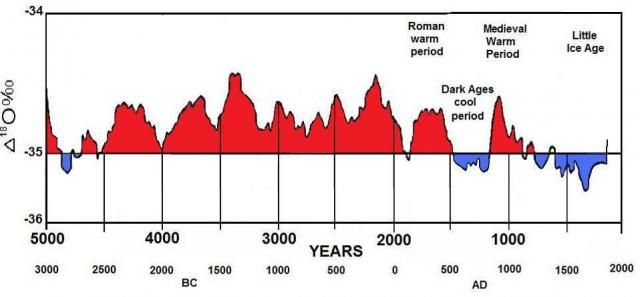
© Don J. EasterbrookFigure 3. Oxygen isotope ratios for the past 5,000 years. Red areas are warm periods, blue areas are cool periods
Most of the past 10,000 have been warmer than the present. Figure 4 shows temperatures from the GISP2 Greenland ice core. With the exception of a brief cool period about 8,200 years ago, the entire period from 1,500 to 10,500 years ago was significantly warmer than present.
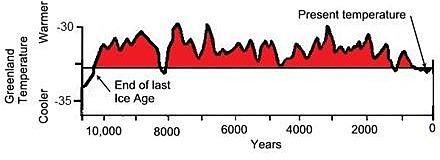
© Don J. EasterbrookFigure 4. Temperatures over the past 10,500 years recorded in the GISP2 Greenland ice core. (Modified from Cuffy and Clow, 1997)
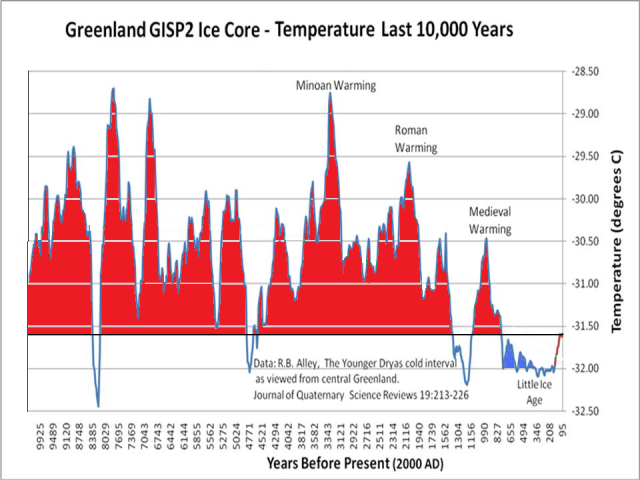
© Don J. EasterbrookFigure 5. Temperatures over the past 10,000 years recorded in the GISP2 Greenland ice core
The climate has been warming slowly since the Little Ice Age (Fig. 5), but it has quite a ways to go yet before reaching the temperature levels that persisted for nearly all of the past 10,500 years.
It's really much to do about nothing.



The Global Warming alarmists have fear on their side to blind much of the population from seeing this information. The same technique has worked for religions--maybe this judgmental God doesn't really exist, but do you want to chance it? A lot of people fall for it.
When it comes time for the general population to take some sort of political "action" (in quotes because the most political action that ever comes out of the general population is casting a vote) they will likely vote their fears: what if...maybe global warming isn't true, but what if...?
I know, all of that sounds pretty dismal and defeatist. But I haven't seen anything to give me hope that anything else will happen.