|
|
Signs Supplement: Climate
and Earth Changes
December 2003
| NEW YORK (Reuters) - This year's
Atlantic hurricane season, which ended on Sunday, exceeded the norm
and produced 14 named tropical storms, specialists from the nation's
hurricane monitoring group said on Monday. [...] |
| A freak hailstorm caused extensive
damage to cars and houses as it swept through Lilydale, in Melbourne's
east.
Locals said the 20-minute storm hit the suburb about 4pm (AEDT)
with hailstones the size of golf balls smashing windscreens, denting
cars and damaging skylights. [...]
"There could be as many as 1,000 cars in the town that have been
damaged," he said.
Mr Donohue said the storm was "totally bizarre". [...]
A State Emergency Service (SES) spokeswoman said they received
more 30 calls for help, most of them in Lilydale.
Bureau of Meteorology senior forecaster Ward Ronney said reports
of hail up to 3cm in diameter had been recorded, with the majority
reported in Lilydale.
"When hail is that large it tends to be concentrated in one area,"
he said. [...] |
| France was forced to shut two nuclear
reactors on Monday as storms swept across the south of the country.
At least two people were killed or swept away and French television
said thousands of people were being moved from their homes by
boat.
The southern city of Marseilles was among the worst hit, with
500 emergency calls for flood-related incidents and up to 1,000
people evacuated.
Many roads were flooded and schools closed for the day.
The two nuclear reactors were shut down at the Cruas-Meysse plant
in the Ardeche region, where officials feared the flooded Rhone
river could sweep branches and other obstructions into the cooling
system.
The two 900-megawatt reactors are among four at the plant.
A spokeswoman for government nuclear safety authority ASN described
the shutdown as a "preventative measure".
Storm victims:
One woman in her 50s was swept from a bridge in Virigneux in
the central Loire region, reportedly as she tried to push her
car to safety.
The other person who died is believed to have been found in a
road tunnel in Marseilles.
In Charlieu, in the south-east France, flooding left 750 students
with a day off after their school shut.
Seventeen of France's administrative departments have been placed
on alert until Thursday amid forecasts that heavy rain will continue.
Officials are anxiously watching the situation in the Rhone Valley
amid fears of further flooding.
The country is also battling a flu outbreak. Officials said two
million cases were expected by the end of the week.
Some emergency departments in the Paris area have been filled
to overflowing with flu victims, many of them children. |
| LYON, France (Reuters) - Torrential
rain drenching parts of southeastern France threatened Wednesday
to worsen flash floods that have cost at least three lives and forced
about 4,000 people to evacuate their homes.
Flooding along the Rhone River from Lyon to Marseille was due
to hit its peak during the day, while winds of up to 93 mph were
expected to lash the Mediterranean coast, officials said. Two
people were still missing in the floods.
Heavy rain moving west also set off flood alerts reaching as
far as the Pyrenees Mountains.
"Today we're faced with what could be the floods of the century,"
government spokesman Jean-Francois Cope told Europe 1 radio. "We
have to mobilize all our resources." [...] |
| Geophysicists in Finland and Germany
have calculated that the Sun is more magnetically active now than
it has been for over a 1000 years. Ilya Usoskin and colleagues at
the University of Oulu and the Max-Planck Institute for Aeronomy
say that their technique - which relies on a radioactive dating
technique - is the first direct quantitative reconstruction of solar
activity based on physical, rather than statistical, models. [...]
Using modelling techniques, the Finnish team was able to extend
data on solar activity back to 850 AD.
The researchers found that there has been a sharp increase in
the number of sunspots since the beginning of the 20th century.
They calculated that the average number was about 30 per year
between 850 and 1900, and then increased to 60 between 1900 and
1944, and is now at its highest ever value of 76.
"We need to understand this unprecedented level of activity,"
Usoskin told PhysicsWeb. "Is it is a rare event that happens once
a millennium - which means that the Sun will return to normal
- or is it a new dynamic state that will keep solar activity levels
high?" The Finnish-German team also speculates that increased
solar activity may be having an effect on the Earth's climate,
but more work is needed to clarify this. [...] |
PHNOM PENH, Cambodia (AP) --Zeb
Hogan plunges into the muddy brown waters of the Tonle Sap River
and grabs hold of a 321-pound silvery giant catfish that has just
slid out of a blue tarp held by several Cambodian fisherman. [...]
The Mekong giant catfish -- whose Cambodian name means "the king
of fish" -- is a rare find in these waters, a Mekong River tributary.
Its sharp fall in numbers -- only eight were reported caught
last year, down from about 80 a decade ago -- led to its recent
listing as critically endangered, and has researchers concerned
about the health of the mighty Mekong. [...] |
| HALIFAX - Some environmental groups
are trying to stop a company in Nova Scotia from conducting seismic
tests in the Atlantic Ocean.
Corridor Resources of Halifax is an oil and gas exploration company.
It has permission from the Offshore Petroleum Board to begin six
days of undersea testing over 500 kilometres, starting as early
as Dec. 4. |
| Forecasters have predicted better
weather as southern France reels from storms that killed five people,
forced thousands to evacuate their homes and crippled transport.
Just eight regions, down from 19 at the height of the flooding
on Tuesday, were covered by storm warnings early today from the
national weather service.
It forecast a "clear improvement in meteorological conditions"
for later in the day. [...] |
| France was warned yesterday that
it faced the "flood of the century" as thousands of people abandoned
their homes. The rising waters also forced the shutdown of nuclear
reactors and closed roads and railways.
Flooding along the Rhone River from Lyons to Marseilles was due
to reach its peak yesterday, as winds of up to 90mph were forecast
to strike the Mediterranean coast.
Several towns along the river and its tributaries were evacuated
and schools closed. When the Rhone reaches a depth of 5.5 metres,
it triggers an alert. It is now at 6.42 metres, its highest
recorded level.
Christian Fremont, the prefect of the Bouches-du-Rhone department,
said the authorities were on a "war footing" and braced for a
long crisis. [...] |
| WASHINGTON - Canadian businessman
and UN adviser Maurice Strong has become the first non-American
winner of a U.S. National Academy medal awarded to people who use
science to improve public welfare.
Strong won the award because he displays international leadership
on environmental concerns by linking scientific and technological
resources, said academy spokeswoman Barbara Rice.
The medal has been issued since 1914.
Strong, a long-time confidant and adviser to incoming prime minister
Paul Martin, first hired Martin as an executive assistant when
Strong ran Montreal's Power Corp.
Strong has also headed Petro-Canada and Ontario Hydro.
The Manitoba-born environmentalist organized the first UN Earth
Summit in Stockholm in 1972 and the 1992 Earth Summit in Rio de
Janeiro. |
| WASHINGTON (CP) - Canadian environmental
guru Maurice Strong, a primary force behind the Kyoto Protocol to
curb global warming, has won a prestigious U.S. award.
The U.S. National Academy of Sciences announced Wednesday that
Strong, 74, will receive this year's Public Welfare Medal awarded
annually since 1914 to people who best use science to advance
public welfare. |
| WASHINGTON (Reuters) - There can
be no doubt that global warming is real and is being caused by people,
two top U.S. government climate experts say.
Industrial emissions are a leading cause, they say -- contradicting
critics, already in the minority, who argue that climate change
could be caused by mostly natural forces. [...]
"The likely result is more frequent heat waves, droughts,
extreme precipitation events, and related impacts, e.g., wildfires,
heat stress, vegetation changes, and sea-level rise,"
they added in a commentary to be published in Friday's issue of
the journal Science.
Karl and Trenberth estimate that, between 1990 and 2100, there
is a 90 percent probability that average global temperatures will
rise by between 3.1 and 8.9 degrees Fahrenheit (1.7 and 4.9 degrees
Celsius) because of human influences on climate.
Such dramatic warming will further melt already crumbling glaciers,
inundating coastal areas. Many other groups have already shown
that ice in Greenland, the Arctic and Antarctica is melting quickly.
Karl and Trenberth noted that carbon dioxide levels in the atmosphere
have risen by 31 percent since preindustrial times. [...] |
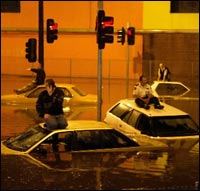 A once-in-a-lifetime storm
that hit Melbourne early yesterday has left a multimillion-dollar
trail of devastation, with hundreds of homes, shops, schools and
other properties sustaining serious flood damage. A once-in-a-lifetime storm
that hit Melbourne early yesterday has left a multimillion-dollar
trail of devastation, with hundreds of homes, shops, schools and
other properties sustaining serious flood damage.
Large areas of the city's north and east were under water after
a spectacular electrical storm dumped more than 100 millimetres
of rain - almost twice the entire December average - in just two
hours.
Emergency services were overwhelmed with calls for help from
people who woke in the middle of the night to find their homes
awash and from motorists left stranded by floodwaters blocking
major roads and freeways.
Among the worst-hit areas were Coburg, Northcote, Fitzroy and
Fairfield in the city's inner north, and Doncaster in the east,
where 107 millimetres of rain was recorded.
"In terms of the amount of rain that fell in a very short period
of time, it's a one-in-a-100-year type of event," the Bureau of
Meteorology's Jon Gill said. "For some people it's certainly the
worst they are likely to experience in their lifetime." |
With cheap flights to top ski
destinations readily available, having a week on the slopes is
a trend now common for winter vacationers across the world. Shame
then, that one of the biggest contributors to climate change,
aviation, could be shooting itself in the ski-clad foot, as hotter
temperatures mean less snow, and the winter sports industry is
likely to be hit hard by developing weather patterns, according
to a UNEP report out this week.
The report predicts that a warmer climate could in the future
present between 37-56% of ski destinations with such low levels
of snow that places such as the Swiss resorts of Wildhaus and
Unterwasser, will have acute difficulties in attracting tourists.
[...] |
| England and Wales could face water
shortages and drought in 2004 unless there is much higher than the
winter average rainfall, the Environment Agency has warned.
Despite the recent rain, England and Wales has experienced one
of the driest periods on record - the second driest since 1921
- putting water supplies under immense pressure and draining existing
reserves. The Agency estimates that it will take another four
weeks of persistent rainfall for river flows and groundwater levels
to begin a sustained recovery. [...] |
| Immense cracks the size of California
in our planet's magnetic field can remain open for hours, allowing
the solar wind to gush through and power stormy space weather.
Earth is surrounded by a magnetic force field--a bubble in space
called "the magnetosphere" tens of thousands of miles wide. Although
many people don't know it exists, the magnetosphere is familiar.
It's a far flung part of the same planetary magnetic field that
deflects compass needles here on Earth's surface.
And it's important. The magnetosphere acts as a shield that protects
us from solar storms.
According to new observations, however, from NASA's IMAGE spacecraft
and the joint NASA/European Space Agency Cluster satellites, immense
cracks sometimes develop in Earth's magnetosphere and remain open
for hours. This allows the solar wind to gush through and power
stormy space weather.
"We've discovered that our magnetic shield is drafty, like a
house with a window stuck open during a storm," says Harald Frey
of the University of California, Berkeley, lead author of a paper
on this research published Dec. 4 in Nature. "The house deflects
most of the storm, but the couch is ruined. Similarly, our magnetic
shield takes the brunt of space storms, but some energy slips
through its cracks, sometimes enough to cause problems with satellites,
radio communication, and power systems."
"The new knowledge that the cracks are open for long periods
can be incorporated into our space weather forecasting computer
models to more accurately predict how our space weather is influenced
by violent events on the Sun," adds Tai Phan, also of UC Berkeley,
co-author of the Nature paper.
The solar wind is a fast-moving stream of electrically charged
particles (electrons and ions) blown constantly from the Sun.
The wind can get gusty during violent solar events, like coronal
mass ejections (CMEs), which can shoot a billion tons of electrified
gas into space at millions of miles per hour.
Earth's magnetosphere generally does a good job of deflecting
the particles and snarled magnetic fields carried by CMEs. Even
so, space storms and their vivid effects, like auroras which light
up the sky over the polar regions with more than a hundred million
watts of power, have long indicated that the shield was not impenetrable.
In 1961, Jim Dungey of the Imperial College, United Kingdom,
predicted that cracks might form in the magnetic shield when the
solar wind contained a magnetic field that was oriented in the
opposite direction to a portion of the Earth's field. In these
regions, the two magnetic fields would interconnect through a
process known as "magnetic reconnection," forming a crack in the
shield through which the electrically charged particles of the
solar wind could flow.
In 1979, Goetz Paschmann of the Max Planck Institute for Extraterrestrial
Physics in Germany detected the cracks using the International
Sun Earth Explorer (ISEE) spacecraft. However, since this spacecraft
only briefly passed through the cracks during its orbit, it was
unknown if the cracks were temporary features or if they were
stable for long periods.
In the new observations, the Imager for Magnetopause to Aurora
Global Exploration (IMAGE) satellite revealed an area almost the
size of California in the arctic upper atmosphere where a 75-megawatt
"proton aurora" flared for hours. A proton aurora is a form of
Northern Lights caused by heavy solar ions striking Earth's upper
atmosphere, causing it to emit ultraviolet light--invisible to
the human eye but detectable by the Far Ultraviolet Imager on
IMAGE. While this aurora was being recorded by IMAGE, the 4-satellite
Cluster constellation flew far above IMAGE, directly through the
crack, and detected solar wind ions streaming through it.
This stream of solar wind ions bombarded our atmosphere
in precisely the same region where IMAGE saw the proton aurora.
The fact that IMAGE was able to view the proton aurora for more
than 9 hours implies that the crack remained continuously open.
Researchers estimate that the crack was twice the size
of Earth at the boundary of our magnetic shield--about 38,000
miles (60,000 km) above the planet's surface. Since the magnetic
field converges as it enters the Earth in the polar regions, the
crack narrowed to about the size of California down near the upper
atmosphere.
Fortunately, these cracks don't expose Earth's surface to the
solar wind. Our atmosphere protects us, even when our magnetic
field doesn't. The effects of solar storms are felt mainly in
the high upper atmosphere and the region of space around Earth
where satellites orbit. |
| (AP) -- Meteorologists predicted
a storm that dropped up to 5 inches of snow on the Mid-Atlantic
states Thursday would move toward the Northeast into the weekend.
Meteorologists said 12 inches of snow could hit parts of the
East Coast this weekend with winds of 50 mph, according to Reuters.
"For early December, it's a heck of a storm," Joe Bastardi, meteorologist
with AccuWeather, told Reuters. "This is a major nor'easter,"
he said.
"This could be the worst storm since December of 1981
when we had 10 to 20 inches of snowfall whipped by high winds."
[...] |
| The first major snow storm of the
season brought blustery winds, rain, sleet and a blanket of snow
to the Northeast, delaying flights, wreaking havoc on the region's
highways and putting cleanup crews to work.
Forecasters said the system could hit even harder over the weekend,
with total snow accumulations of up to two feet in Massachusetts
and near-blizzard conditions in parts of Maine and New Hampshire.
[...] |
| CSIRO has predicted that there
will be an increase in extreme events in Australia, with coastal
areas particularly vulnerable. [...] |
| More than 100,000 people lost electricity
in Sweden after a winter snow storm downed power lines and caused
accidents on icy roads today.
A motorist was killed near Joenkoeping, 204 miles south-west
of Stockholm, when a tree fell on his car, Swedish media reported.
Heavy winds knocked out power to 100,000 people as the storm
swept across the central and southern parts of the Scandinavian
country.
Hundreds of utility workers were dispatched to repair lines,
but power companies said electricity was not likely to be fully
restored until Sunday.
In neighbouring Norway, thousands were without power and train
traffic came to a standstill in the southern part of the country,
the Norwegian news agency NTB reported. |
| LINCOLN CITY, Ore. - Thousands
of dead birds have washed up on West Coast beaches this fall in
a die-off that has stumped experts.
The birds are northern fulmars (a smaller cousin of the Albatross)
and beachgoers in Lincoln County have counted more than 400 dead
ones this fall. [...]
And experts don't know why. Some worry that man-made causes,
such as plastic or toxins are to blame. Others dismiss the die-off
as cyclical.
But this year's death toll dwarfs any other on record
in Oregon. [...] |
| WELLFLEET -- [...] So far, 83 cold-stunned
sea turtles have been stranded on Cape Cod beaches since late October,
most of them dinner-plate-sized Kemp's ridleys, considered the most
endangered sea turtle in the world. A few are green turtles or larger
loggerheads.
The turtles, almost all under 6 years old, are immobilized by
cold waters that on Wednesday dipped to 28 degrees near shore
in Orleans. Unable to paddle their flippers or even to feed, they
are at the mercy of ocean currents and wash up on shore when a
strong wind blows, as it has in recent weeks. [...]
Before the 1970s, reports of turtles washing up on Cape beaches
were rare. Scientists believed that the handful of turtles they
found, particularly the Kemp's ridleys, were "lost waifs" that
got caught in the Gulf Stream.
But since the 1970s, when Prescott began organizing volunteers
to walk the beaches, the numbers have steadily risen, hitting
an all-time high of 281 strandings in 1999. Numbers have dipped
slightly since then, but still remain high. [...] |
|
Click here to comment on this article |
| Highways and sidewalks turned treacherous
Saturday for the millions of people living in the Northeast as the
region's first big storm of the season piled up a foot of blowing
snow, grounding airline flights, taking a bite out of pre-Christmas
shopping, and canceling SAT exams.
At least eight deaths were blamed on the storm, and police urged
people to just stay home. [...]
Snow fell at a rate of about an inch an hour at Binghamton, N.Y.,
and the National Weather Service issued blizzard warnings for
parts of Maine, Connecticut, southeastern New York and New Jersey.
Stiff wind blew the snow sideways in places and whipped up rough
surf along the coast. [...]
"What we're seeing now is the tip of the iceberg," meteorologist
Roger Hill of Worcester, Vt., said Saturday morning. "The beast
is going to be here shortly." [...] |
| A huge snow storm has blanketed
much of the eastern United States, causing hazardous conditions.
At least three people were reported to have died in weather-related
accidents and hundreds of flights were cancelled.
Up to two feet (0.6m) of snow is expected to fall over several
states - including Massachusetts and Vermont - on Sunday, forecasters
have warned.
The National Weather Service said heavy snow and strong winds
would continue until the storm headed out to sea.
'Worse to come'
Massachusetts saw some of the heaviest snow fall and Boston's
Logan Airport was forced to cancel hundreds of flights.
"We've gone through the hors d'oeuvres of this storm but the
main course is still to come," public affairs officer for Massachusetts
Emergency Management Agency Peter Judge told Reuters news agency.
"The ugly part will get us tonight." |
cbc.ca
Last Updated Sun, 07 Dec 2003 0:20:45 |
| HALIFAX - The storm that has blasted
the U.S. Northeast on Saturday is expected to make life miserable
in the Maritimes on Sunday.
"We could get a heavy snowstorm of up to 30 centimetres in many
parts of Nova Scotia, New Brunswick and P.E.I.," said Environment
Canada meteorologist Doug Steeves. |
| Thousands have abandoned their
homes as Tropical Storm Odette lashed the Dominican Republic with
torrential rains.
Odette was expected to see up to 15 inches of rain falling on
parts of the Dominican Republic and neighbouring Haiti. [...]
More than 10,000 people were evacuated from low-lying south-western
areas, said Julian Pena, governor of Barahona province.
It was the second time in less than a month that heavy rains
have forced Dominicans from their homes.
Three weeks ago, rainstorms soaked the Dominican Republic and
Puerto Rico, overflowing rivers banks and creating landslides
and flash floods that killed seven people and forced thousands
to leave. |
| Measures to fight global warming
will have to be at least four times stronger than the Kyoto Protocol
if they are to avoid the melting of the polar ice caps, inundating
central London and many of the world's biggest cities, concludes
a new official report.
The report, by a German government body, says that even if it
is fully implemented, the protocol will only have a "marginal
attenuating effect" on the climate change. But last week even
this was thrown into doubt amid contradictory signals from the
Russian government as to whether it will allow the treaty to come
into effect. [...] |
| MILAN, Italy (AP) -- Western Europe
might actually get colder as a result of global warming, because
the melting Arctic ice cap is cooling off the warm ocean current
that is largely responsible for Europe's mild weather, scientists
and environmentalists said.
If the ice cap in Greenland and the Arctic continues to melt
at its current rate, Europe's temperatures would take a sharp
dip after five or more decades of increasingly warm weather. That
turnaround could spell trouble for regions that by then will have
adapted to more tropical conditions, the experts told reporters
Friday at a U.N. climate change conference here. [...]
Bamber also said that in the next five years, Europe could expect
increasingly hazardous conditions in the Alps. Last summer was
the first ever that the Matterhorn and Mont Blanc were closed
for fear of rocks loosened by melted ice and snow.
And during Europe's record heat wave this summer, 10 percent
of the "permanent" ice in the Italian Alps melted away, said Damiano
Di Simine, president of the Italian chapter of the International
Commission for the Protection of the Alps.
He told reporters that 53 billion cubic feet of fresh water had
been lost, a resource critical to northern Italy's water-intensive
crops, like rice.
"But every year we lose large quotas of water, between 5 and
10 percent of the Alpine ice, so within about 20 or 30 years,
well lose it all," he said.
Earlier this week, the United Nations Environment Program issued
a report saying that global warming was threatening the world's
ski resorts, with melting snow at lower altitudes forcing the
sport to move higher and higher up mountains, and threatening
to make downhill skiing disappear altogether at some resorts.
[...]
"The hardest and most fundamental problem to be overcome is the
U.S. at present," Hare said. "And unless and until the U.S. starts
to move, everyone else will be that much slower." |
| HALIFAX - A snowstorm pounded Atlantic
Canada Sunday, toppling power lines, grounding planes and turning
some roads into ice rinks.
New Brunswick bore the brunt of the storm. In some places, a
half metre of snow blanketed streets and buried cars. No major
accidents were reported, despite whiteout conditions on many highways.
About 3,000 people lost their power, mostly in the Bouctouche
to Shediac area. It'll likely be Monday before everyone gets their
electricity back, NB Power said.
Environment Canada said by the time the snow tapers off in Moncton
Monday, the city could receive between 60 and 70 centimetres of
snow.
Winds of up to 100 km/hr whipped southern New Brunswick. Gusts
of 85 km/hr were reported in Prince Edward Island, strong enough
to prompt Northumberland ferries to suspend their runs for the
day. |
| The northeastern United States
on Sunday dug out from under a storm that dumped massive amounts
of snow on several states, killing at least eight, closing airports
and snarling traffic.
Boston's Logan Airport closed temporarily after a snowstorm clogged
runways and caused major delays, but reopened after 10:00 am (1500
GMT). Flight delays and cancellations were reported Saturday at
the three New York-area airports.
New York and other major northeastern cities such as Philadelphia,
Pennsylvania, and Baltimore, Maryland, received a significant
amount of snowfall. [...] |
| Freezing weather and winds settled
over much of France Sunday, hitting rescue and mop up efforts in
the wake of devastating floods that killed seven people over the
past week.
Although waters had receded in many of the southern and southeastern
regions inundated since Monday, operations were continuing in
the town of Arles, between Marseille and Montpellier, to evacuate
residents, and rain-swelled rivers endangered towns in the centre
of the country. [...] |
| It was the summer, scientists now
realise, when global warming at last made itself unmistakably felt.
We knew that summer 2003 was remarkable: Britain experienced
its record high temperature and continental Europe saw forest
fires raging out of control, great rivers drying to a trickle
and thousands of heat-related deaths. But just how remarkable
is only now becoming clear.
The three months of June, July and August were the warmest
ever recorded in western and central Europe, with record national
highs in Portugal, Germany and Switzerland as well as in Britain.
And they were the warmest by a very long way.
Over a great rectangular block of the earth stretching
from west of Paris to northern Italy, taking in Switzerland and
southern Germany, the average temperature for the summer months
was 3.78C above the long-term norm, said the Climatic Research
Unit (CRU) of the University of East Anglia in Norwich, which
is one of the world's leading institutions for the monitoring
and analysis of temperature records.
That excess might not seem a lot until you are aware of the context
- but then you realise it is enormous. There is nothing
like this in previous data, anywhere.
It is considered so exceptional that Professor Phil Jones,
the CRU's director, is prepared to say openly - in a way few scientists
have done before - that the 2003 extreme may be directly attributed,
not to natural climate variability, but to global warming caused
by human actions. Meteorologists have hitherto contented themselves
with the formula that recent high temperatures are "consistent
with predictions" of climate change. [...]
Over a large swath of the western part of the European continent,
records were broken in all three months, not just monthly averages,
but for daily extremes and the lengths of spells above thresholds.
New national records were set in at least four countries. Britain
experienced its record high on 10 August when the mercury registered
38.5 C(101.3F) at Faversham in Kent - the first time the British
Isles had recorded a three-figure Fahrenheit temperature.
Germany had a new record of 40.8C (105.4), Switzerland
one of 41.5C (106.7F) - Swiss data show the summer as the hottest
since at least 1500 - and Portugal a quite astonishing 47.3C (117.1F).
Although France did not see a new national record - that still
stands at the 44C (111.2F) registered at Toulouse on 8 August
1923 - the country suffered severely from La Canicule, the heat
wave, which was headline news for most of the late summer. In
southern and eastern France, according to Professor Jones, 29
sites recorded temperatures exceeding 40C (104F) during August,
with the record being 42.6C (108.7F) at Orange in the Rhone valley.
[...]
Continental Europe in summer 2003 had a taste of what global
warming will really be like: unpleasant and dangerous. |
| Once again, world leaders meet
to hear of new threats posed by global warming. Once again, they
appear unable to act. George Marshall and Mark Lynas explain why.
[...] First, let us remind ourselves of the magnitude of the
threat. Global warming is already well under way: even if all
greenhouse gas emissions stopped tomorrow, we would see a rise
in planetary temperatures of 1.1 degrees C, twice the warming
experienced over the past century, and enough to wipe out most
of the world's tropical coral reefs as well as a good proportion
of mountain glaciers. Bad as that is, it is still an unrealistically
optimistic scenario. It is projected that greenhouse gas emissions
will go on rising for decades; the IPCC predicts a global temperature
rise of between 1.4 degrees and 5.8 degrees by 2100. At the lower
end of this scale, large areas of agriculturally productive land
will be destroyed; entire countries will disappear through rapid
sea-level rise; and entire regions in the arid subtropics will
become uninhabitable. [...]
Yet as if in a parallel universe, plans continue to be made for
business as usual, with rapid economic growth projected to continue
unabated, still largely driven by fossil-fuel energy: oil consumption
will increase by 50 per cent over the next two decades. Some calculations
show emissions of countries from the south alone breaking through
the safe "corridor" (within which we could avoid major climate
impacts) in as little as a decade.
These dangerous trends continue almost unchallenged. Why? Because
we appear to be experiencing a disastrous form of collective denial,
more typically found among societies suffering major institutional
human rights abuses - such as apartheid South Africa or Nazi Germany
- where individuals may understand the reality of the problems,
but refuse to accept the implications. In his book States of Denial,
the sociologist Stanley Cohen terms this condition "implicatory
denial" and identifies it as a natural defence that humans tend
to adopt when faced with a morally unthinkable situation. It has
resulted in, to borrow another term from psychology, "cognitive
dissonance" among opinion-formers and the public. Nearly everyone
professes to care about global warming while simultaneously continuing
with set patterns of behaviour that make the problem worse. [...] |
| Hungry elephants have gone on the
rampage in eastern Thailand, ransacking villagers' plantations and
forcing sugarcane trucks to stop so they can raid their goods, a
report said Sunday.
Dry-season shortages have forced the 130 elephants from Ang Lue
Nai wildlife sanctuary, which sprawls over five provinces, to
seek food and water in nearby settlements, the sanctuary's chief
Yoo Senatham told the Bangkok Post.
Yoo said the elephants had learned to pick up sugarcane dropped
by drivers who took pity on them, but that the practice had taught
them dangerous new habits.
He told the daily of incidents where the leader of the herd had
stood in the road to block the vehicle while the others unloaded
the produce with their trunks. [...] |
| A SUDDEN storm has lashed the Queensland
city of Gladstone with large hailstones and flash flooding causing
widespread damage to property.
The storm late yesterday also brought down powerlines and caused
the evacuation of a big shopping centre in the central Queensland
industrial city.
The district manager of the counter disaster rescue service,
Brad Lutton, said he understood it was the worst storm in a decade
to hit the city, but at this stage the extent of damage was not
known. [...] |
| KATHMANDU, Dec 9 (OneWorld) - Although
Nepal's share in the global emission of greenhouse gases is almost
nil, the consequences of global warming and climate change - receding
snowlines, lake bursts and flash floods - threaten to wash away
vast areas of the country, including the region that's home to Mount
Everest. [...] |
| LAKE ARROWHEAD, California (AP)
-- Drought- and beetle-ravaged trees in this mountain community
stick up like matchsticks in the San Bernardino National Forest,
bypassed by the fires still smoldering, but left like kindling for
the next big blaze.
Welcome to the future.
Fires that charred nearly three-quarters of a million acres could
presage increasingly severe fire danger as global warming weakens
more forests through disease and drought, experts warn. |
| The future of the Kyoto protocol
on global warming may still be uncertain, but scientists at a Milan
conference said this summer's heat wave showed that climate change
is fast becoming a reality.
Evidence of global warming is mounting: The last decade was the
warmest in a century, 1998 went down as the hottest year in recorded
memory and the trend continues. Scientists estimate that the globe's
average temperature has risen by 0.6 degrees Celsius (1.08 degrees
Fahrenheit) since pre-industrial times.
"It's very difficult to link each single event and each single
variable with actions carried out by human society," said Rajendra
Pachauri, who chairs the United Nation's Intergovernmental Panel
on Climate Change (IPCC). "But I think the scientific basis is
strong enough for us to take action."
Melting glaciers, rising oceans
The melting of glacial ice would be one result of warmer temperatures.
It's already happening: Alaskan glaciers melted twice as fast
during the past five to seven years as before, according to the
environmental organization World Wildlife Fund (WWF). Scientists
are also alarmed by the situation in the European alps. There,
glacial ice has shrunk by 10 to 20 percent during the last two
decades.
"We're talking about disappearing glaciers," said Jennifer Morgan,
WWF's climate director, adding that according to her organization's
estimates, glaciers would be a thing of the past should temperatures
rise by another 4 degrees Celsius. "That's significant," Morgan
said. "I don't think that the politicians here have yet come to
grasps with what that means."
According to recent scientific studies, many humans alive today
will witness the melting of glaciers in their lifetime unless
climate change can be stopped. IPCC scientists predict that temperatures
will have risen by 1.4 to 5.8 degrees Celsius by the end of this
century.
Large parts of Tokyo could be submerged under water should temperatures
continue to rise, scientists say. Should this happen, "dangerous
climatic changes" will become "highly probable," according to
a recent report by the German Advisory Council on Global Change.
The West Antarctic ice sheet and the Greenland ice cap would begin
melting and eventually lead to a rise in sea levels of up to nine
meters (30 feet). London, New York, Shanghai and Tokyo, among
others, would be largely submerged as a result, according to the
government body's report.
Developing countries hit first and hardest
Coral reefs would die as a result of the rising water temperatures,
numerous species would become extinct because they could not move
to cooler areas quickly enough. Heat waves, droughts and floods
would occur more frequently. Tropical diseases such as malaria,
West Nile Virus and dengue fever would appear in regions where
they have not been known so far.
Northern and Central Europe will remain relatively untouched
by all of this -- at least in the beginning. Poor countries in
Africa and Asia will have to bear the brunt of the change.
Developing countries will be hit first and hardest by climate
change. "There is an equity issue that is involved over here,"
Pachauri said. "The bulk of the problem in increased concentration
of greenhouse gases has come from the past patterns of development
of the developed countries and unfortunately the worst impacts
are likely to be felt by the developing countries." |
| In its most distant forecast to
date, the United Nations has projected a population of nine billion
people by 2300, if the current trend toward smaller families continues.
But if fertility levels in the developing world remain at today's
levels, the global population would reach 244 billion in 2150
and 134 trillion in 2300, according to the report, "World Population
in 2300". At present, there are 6.3 billion people.
The report released on Tuesday forecast that the Japanese would
live to the age of 108. Africa's population would explode while
the Europeans could turn into a dwindling species, it said.
"It's like the Titanic with an iceberg ahead," said Joseph Chamie,
director of the population division. "You sink because the rates
are so low or you simply grow too rapidly because the rates are
too high. Either way you have to change course." |
| BARCELONA, Spain -- A Spanish-American
scientific team will be scanning the United States this winter for
what might be one of the weirdest byproducts of global warming:
great balls of ice that fall from the sky.
The baffling phenomenon was first detected in Spain three years
ago and has since been reported in a number of other countries,
including the United States. So scientists now plan to monitor
in a systematic way what they call "megacryometeors" -- or great
balls of ice that fall from the sky.
"I'm not worried that a block of ice may fall on your head,"
said Dr. Jesus Martinez-Frias of the Center for Astrobiology in
Madrid. "I'm worried that great blocks of ice are forming where
they shouldn't exist."
Ice balls, which generally weigh 25 to 35 pounds but can be much
bigger, have punched holes in the roofs of houses, smashed through
car windshields, and whizzed right past people's heads.
Incidents like those may be just the beginning, according to
Dr. David Travis, who chairs the department of geography and geology
at the University of Wisconsin-Whitewater.
"If megacryometeor formation is linked to global warming, as
we suspect, then it is fair to assume that these events may increase
in the future," Travis said.
Martinez-Frias pioneered research on megacryometeors
in January 2000, after ice chunks weighing up to 6.6 pounds rained
on Spain for 10 days.
At first, scientists thought the phenomenon was unique to Spain.
During the past three years, however, they've accumulated strong
evidence that megacryometeors are falling all around the globe.
More than 50 falls have been confirmed, and researchers believe
that's a small fraction of the actual number, since others may
hit unoccupied areas or melt before discovery.
Travis said most megacrymeteor falls occur in January, February
and March.
Researchers were able to analyze ice samples from the 2000 incidents,
thanks to witnesses who kept the material cold. Martinez's team
quickly ruled out obvious explanations.
The ice balls, for instance, were not frozen water from toilets
flushed on jetliners. The ice contained no human waste and none
of the blue disinfectant used in airplane toilets. Air traffic
control records showed that no planes flew over the areas near
the ice falls, so the ice had not been shed from aircraft wings.
Chunks of debris from a comet? Again, lab tests showed that ice
in megacryometeors had the distinctive chemical signature of ice
in ordinary terrestrial hailstones.
Hail forms in the updrafts and downdrafts of thunderstorms. The
updrafts carry droplets of super-cooled water, which freeze. More
droplets hit the frozen particles as winds toss them around. The
water freezes instantly and the hailstone grows, layer by layer.
Most hailstones weigh a fraction of an ounce, with 27 ounces
the U. S. record.
Megacryometeors show the telltale onionskin layering seen in
hailstones. They also contain dust particles and air pockets found
in hail. But they are formed in cloudless skies, a notion that
defies research on hail formation.
"Scientists are naturally reluctant to say something never can
happen," said Charles Knight, a hail expert at the University
Corporation for Atmospheric Research in Boulder, Colo. "But oh,
dear. I would be tempted to say 'never' on this."
Knight has reviewed scientific papers on megacryometeors, and
thinks the explanation that cites unusual atmospheric conditions
possibly linked to global warming, is probably wrong, although
he doesn't have a better one.
Global warming involves higher temperatures on Earth's surface,
but creates colder conditions in the stratosphere, the uppermost
layer of the atmosphere, according to Travis.
He has linked megacryometeor events to unusual conditions in
the "tropopause," the boundary between the troposphere (the lower
atmosphere) and the stratosphere. Located 5 to 9 miles above the
surface, the tropopause marks the limit of clouds and is important
in the development of storms.
Global warming may be making the tropopause colder, moister and
more turbulent, Travis said, creating conditions in which ice
crystals grow like ordinary hailstones in thunderclouds. |
| It is one of mankind's final frontiers,
a place of extreme cold and extraordinary beauty. But the North
Pole's icecap is thawing fast. And many of us will live
to see it disappear altogether [...] |
| After one of the hottest summers
in recorded history, Germany's forests have barely had time to
recover before more bad news follows. The recently published Federal
Forest Report states that only one third of all trees in Germany's
woods are healthy, around 31 percent of the country's forestation,
down from 35 percent 2002. High temperatures, long persistent
dryness of soil and increasing ozone levels have particularly
hit the nation's oak trees with a reported 83 percent falling
ill, an increase of 10 percent on 2002.
The report ominously states that although things look bleak now
the full extent of the damage will only be known in the next few
years with tree damaging parasites boosted by this year's weather
conditions increasing in numbers. |
| SAN FRANCISCO, Dec. 11 In last
spring's movie "The Core," Earth's molten core stops spinning, with
dire effects on the magnetic field that protects the planet from
energy-charged particles from the Sun. People with pacemakers fall
dead in the street; the Golden Gate Bridge collapses.
Scientists have known for some time that the magnetic field is
in fact collapsing, at a rate faster than it would if flows of
molten iron in the core had stopped completely.
And while the consequences would be nowhere near as catastrophic
as those in the movie, geophysicists increasingly wonder whether
the magnetic field has begun one of its occasional reversals that
in the next few thousand years might lead to compasses pointing
south instead of north.
At a meeting of the American Geophysical Union here on Thursday,
scientists presented research investigating the cause of the decline,
its possible effects on the planet and what might be learned from
geological records of earlier reversals.
The decline, as measured by magnetometers on Earth's surface,
is 10 percent in the last 150 years. "We're seeing it's actually
decreasing at a fairly impressive rate," said Dr. John A. Tarduno,
a professor of geophysics at the University of Rochester. [...] |
| More than 2,500 people have
been evacuated from Costa Rica's Caribbean zone as four days of
persistent rains wiped out bridges and roads and left at least
one person dead and another missing, officials said Saturday.
[...] |
| Rio de Janeiro - Four children
died on Thursday in southern Brazil when a tornado destroyed a school
building where the children were rehearsing a theatre play, local
media reported. Twelve others were injured. [...] |
| TEHRAN (AFP) - Forty homeless people
froze to death in a single night in the Iranian capital Tehran,
a report said, adding that officials also blamed drugs for some
of the deaths. [...] |
| BERLIN (AFP) - At least one person
was killed and 17 injured as snow falls and icy roads caused numerous
traffic accidents across Germany, police said. [...]
Police reported at least 100 road accidents in the southern states
of Bavaria and Baden-Wurttemberg amid transport chaos caused by
snow and ice. [...] |
| BEIJING, (AFP) - China, Mongolia,
Japan, and the two Koreas have vowed to tackle annual dust and sandstorms
together as deserts continue their march across the region.
Every year from March to May strong cold winds from Siberia blow
up huge volumes of yellow dust from the Gobi desert in Kazakhstan,
Mongolia and north China, sending it as far as the Korean peninsula
and Japan.
The storms, which hit capitals like Beijing and Seoul, can be
so severe that they disrupt air flights and force schools to cancel
classes while clinics are often crowded with people complaining
of eye and respiratory illnesses. [...]
Chinese statistics show that dust storms have got worse in recent
years due to continuous droughts in northwest China and Mongolia.
In 2000, the storms hit 12 times, surging to 32 in 2001. [...] |
| [...] Records show that over
the past 50 years the average amount of sunlight reaching the
ground has gone down by almost 3% a decade. It's too small an
effect to see with the naked eye, but it has implications for
everything from climate change to solar power and even the future
sustainability of plant photosynthesis. In fact, global dimming
seems to be so important that you're probably wondering why you've
never heard of it before. [...] |
| MANILA, Dec. 20 (Xinhuanet) --
Nearly 100 people were feared killed in landslides triggered by
days of heavy rains in the central Philippines, officials said Saturday.
At least 13 people have been confirmed dead and over 80 others
reported missing and feared buried alive in landslides in the
towns of Liloan and San Francisco in the island province of Southern
Leyte since late Friday, officials of the National Disaster Coordinating
Council said. |
| At least four people died in traffic
accidents Friday as dense fog blanketed northern India, crippling
road and rail traffic, and the mercury dipped below normal, officials
said. [...] |
| A PLAGUE of "killer" wasps
could strike Victoria in the next few weeks. [...] |
| LILOAN, Philippines Dec. 22 - Searchers
have dug up the bodies of entire families huddled together following
weekend mudslides in the Philippines, where the death toll rose
Monday to at least 119. The nation's president asked the United
States to send helicopters to help rescue efforts.
Authorities blamed illegal logging for the disaster, which was
triggered by six days of pounding rains in provinces near the
Pacific Ocean late Friday to early Saturday. The deforestation
has led to soil erosion on nearby slopes. [...] |
| NOTRE-DAME-DE-MONTAUBAN, QUE.
- Quebec civil security officials were closely watching floodwaters
in the Mauricie region, where about three dozen families were
forced out of their homes on the weekend.
Water levels on the Batiscan River, which had stabilized late
Saturday, suddenly rose by more than 13 centimetres by Sunday.
[...] |
| The death toll from flash floods
and landslides in Vietnam's central provinces has climbed to 58.
Another person is still missing after severe floods hit nine
provinces cutting off several villages and burying sleeping people
alive.
An official said tens of thousands houses were submerged and
over 3,000 collapsed or were completely destroyed. |
Continue
to January 2004
Remember,
we need your help to collect information on what is going on in
your part of the world!
We also need help to keep
the Signs of the Times online.
Send
your comments and article suggestions to us 
Fair Use Policy Contact Webmaster at signs-of-the-times.org
Cassiopaean materials Copyright ©1994-2014 Arkadiusz Jadczyk and Laura Knight-Jadczyk. All rights reserved. "Cassiopaea, Cassiopaean, Cassiopaeans," is a registered trademark of Arkadiusz Jadczyk and Laura Knight-Jadczyk.
Letters addressed to Cassiopaea, Quantum Future School, Ark or Laura, become the property of Arkadiusz Jadczyk and Laura Knight-Jadczyk
Republication and re-dissemination of our copyrighted material in any manner is expressly prohibited without prior written consent.
|