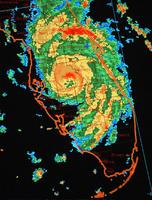
|
|
Signs Supplement: Climate
and Earth Changes
August 2004
| COLUMBIA, S.C. - Tropical storm
warnings stretched across both Carolina coasts early Monday as the
first named storm of the Atlantic hurricane season swirled far off
the beaches of South Carolina.
The center of Tropical Storm Alex was about 100 miles south-southeast
of Charleston, S.C., early Monday. Later in the day it was predicted
to move a little closer to the North and South Carolina coasts.
Its winds were blowing up to 40 mph, forecasters said.
The tropical storm's center was expected to reach the Carolinas
early Tuesday.
The National Hurricane Center issued a tropical storm warning
from Cape Hatteras, N.C., to the South Santee River, north of Charleston.
A tropical storm watch was levied from Cape Hatteras to Oregon Inlet,
N.C., and from the South Santee River to Edisto Beach. [...] |
| LONDON (AFP) - A 14-year-old
boy was killed by lightning as violent storms swept across Britain
causing flooding in the capital and closing down sections of London's
underground train system, police said.
The youngster was killed when lightning struck as he played in
the garden of his home in the Staffordshire town of Bloxwich.
In London, four 15-year-old girls were rushed to hospital after
they were struck by lightning at Speakers' Corner in Hyde Park,
police said.
The storms later spread south where they then lashed the capital.
The sudden rise in water levels in the streets of London after
torrential downpours caused several underground stations to close
and hail damaged several houses and commercial buildings in the
centre of the city, British Transport Police said.
The flood waters notably swept through the ground floor of the
BBC television centre in west London, disrupting the recording of
at least one daily news magazine programme. |
| GENEVA (AFP) - Freak weather
conditions since June have led to widespread flooding in much of
East and South Asia, the World Meteorological Organization (WMO)
reported.
"The floods and and the associated mountain torrents, landslides
and mud-rock flows caused loss of life, destroyed houses, roads,
railways and farmlands," the WMO, a United Nations specialized
agency, said in a statement.
Among the countries worst hit are Bangladesh, China, India, Japan,
both Koreas, Nepal, the Philippines and Vietnam.
"The intensification of the Bai-u front (which brings seasonal
heavy rain to southern Japan and parts of China) in June and July,
the Indian monsoon and the tropical cyclones in the southwest Pacific
were the cause of the heavy rains and floods," the statement
said.
"Continued heavy rain and floods are expected in some countries
into August."
Each of these weather conditions is abnormal,
the WMO continued, "but with the combination
of monsoonal rains, the intensity of the Bai-u front and tropical
cyclones, the abormalities have resulted in disasters." [...] |
| Heavy rains and floods have devastated
swathes of North Korea, leaving hundreds of people homeless and
severely damaging crops, reports say.
The North's official news agency, KCNA, said at least 100,000
hectares (247,105 acres) of farmland had been washed away by the
unusually strong monsoon rains.
It said homes of more than 1,000 families were destroyed in July
alone.
Some five million North Koreans depend on foreign food aid, and
famine has caused many to flee the country.
"At least 100,000 hectares of paddy and non-paddy fields
were submerged or washed away and dwelling houses for more than
1,000 families and public buildings destroyed," KCNA said.
"It is hard to expect any harvest from the fields washed
away and silted. Harvest in many fields is expected to drop 30%,"
the agency added.
It said hundreds of sections of roads and railways were destroyed
and communications links affected, without providing any details
on casualties. [...] |
| AHMEDABAD, India (AFP) - At least
25 people have been killed in torrential rains which destroyed mud
homes and washed away 50,000 hectares (123,500 acres) of farmland
in the western Indian state of Gujarat, police and officials said.
"It has been raining for four days and this has created havoc
in southern Gujarat," said a police spokesman in Gujarat's
commercial capital Ahmedabad, adding the death toll had risen to
25 in the past 24 hours.
The bodies of two adults and three children were found after a
mud house caved in Monday in Halasa village in the state's Anand
district, the spokesman said.
"Another woman died Tuesday when a mud wall collapsed on
her in Gujarat's Bharuch district," he added.
Two women were killed when house collapsed in the Mankni village
of Baroda district and two men were swept away in the creeks in
Udhna in Surat district late on Tuesday.
The driving rain also caused road accidents. In one incident,
a van carrying four people was swept away by the rain-fed Karjan
river in Bharuch district. [...]
The local meteorological department has forecast more monsoon
rain for the region overnight Tuesday and on Wednesday. [...]
The official said about 382 villages were affected by the rains
and about 26,000 people had been evacuated to relief camps in Surat
district. [...] |
| 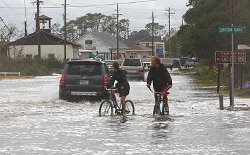 BUXTON,
N.C. - Hurricane Alex, stronger than expected but sparing the North
Carolina coast a direct hit, brought plenty of wind, rain and flooding
to the Outer Banks, cutting power to thousands and flooding Hatteras
Island's only link to the mainland. BUXTON,
N.C. - Hurricane Alex, stronger than expected but sparing the North
Carolina coast a direct hit, brought plenty of wind, rain and flooding
to the Outer Banks, cutting power to thousands and flooding Hatteras
Island's only link to the mainland.
Now the communities of North Carolina's barrier islands must clean
up after the storm brushed the coast Tuesday. Winds reached 100
mph, sending trash bins and other debris floating along a flooded
Highway 12.
"It blew a whole lot harder than what people expected,"
said Ollie Jarvis, who owns Dillon's Corner, a souvenir and tackle
shop. "Last week we weren't even thinking about it. It came
up on us quick."
The storm's glancing blow was a blessing for some communities
still recovering from last year's devastating Hurricane Isabel.
That storm made landfall Sept. 18, 2003, damaging more than 53,000
homes. [...] |
Vancouver — It was a close
call for the University of British Columbia as a wildfire ripped
through the forested area surrounding the campus early Sunday morning.
Forty firefighters, eight trucks and three helicopters responded
to the blaze, which scorched four square kilometres on the cliffs
overlooking Wreck Beach, a popular bonfire and party spot.
Officials said the fire was likely sparked by people, rather than
natural causes such as lightning, but hadn't determined exactly
how it was lit just after 3 a.m.
The blaze was another example of the effects of a drought and
soaring temperatures that have settled over the province in recent
weeks.
There were 324 wildfires burning in B.C.'s tinder-dry interior
on Sunday and hundreds of firefighters from Eastern Canada and the
United States arrived over the weekend to help put them out.
Information officer Steve Bachup said Sunday that crews continued
to make progress on the province's largest fire at Lonesome Lake,
which has promoted the evacuation of dozens of people and consumed
a pioneer lodge. [...] |
| Police will step up patrols in
the North Seattle neighborhoods hit by a series of fires early yesterday
that drew hundreds of people into the streets and stretched firefighters
to their limits, officials said.
At least five of the seven blazes were intentionally set, Mayor
Greg Nickels said. [...] |
| Days of torrential rains across
Sierra Leone have washed away any doubts about the massive need in
Freetown to rebuild the crumbled infrastructure and disrepair plaguing
the war-ravaged west African capital. |
|  AHMEDABAD,
India (AFP) - Relentless monsoon rains lashed India as troops and
the air force rescued more people marooned by flooding and the nationwide
death toll neared 1,000. AHMEDABAD,
India (AFP) - Relentless monsoon rains lashed India as troops and
the air force rescued more people marooned by flooding and the nationwide
death toll neared 1,000.
The north and west of the agriculture-dependent country had been
facing the spectre of drought but have now been inundated by the
rains which have wreaked havoc in many parts of South Asia, officials
said on Friday.
Eleven construction workers were killed Friday when a landslide
triggered by heavy rains crushed the shed in which they were sleeping
in the northern Indian state of Jammu and Kashmir near an important
Hindu pilgrimage route.
Countrywide, the death toll was at least 994.
The rains in India, Bangladesh and Nepal have triggered landslides,
devastated crops, washed away roads and homes, left millions homeless
and killed at least 1,815 people, according to an AFP tally since
July 10 based on official figures. [...] |
| (India) Thirty-six more people
have died in floods in Bihar taking the toll in the recent spell
to 641 even as the situation was likely to aggravate with rain fed
rivers rising in some districts on Saturday.
State Disaster Management Department said that fresh deaths were
reported from Darbhanga (15), Sitamarhi (10), Muzaffarpur (six)
and Samastipur (five) in the last two days taking the toll so far
to 641.
Gandak, Kosi and Bagmati rivers, which had started receding, suddenly
began to rise following incessant rains in their catchment areas,
which could aggravate the situation in Sitamarhi, Samastipur, Muzaffarpur
and Darbhanga districts, a Central Water Commission report said.
[...] |
NEW YORK (Reuters) - El Nino,
the weather phenomenon which has killed hundreds and wreaked havoc
in the Asia-Pacific region over the years, will develop anew in
late 2004, the Climate Prediction Center of the U.S. National Oceanic
Atmospheric Administration said.
In a monthly report issued late Thursday, the Center said sea
surface temperatures have risen sharply in the central Pacific Ocean
which may signal the start of the weather anomaly.
"El Nino conditions are expected to develop during the next
three months," the Center said on its web
site.
El Nino is a weather phenomenon which leads to an abnormal warming
of waters in the equatorial Pacific Ocean. It usually occurs once
every three years.
The anomaly was first noticed by Latin American anchovy fishermen
in the 19th century and was named in honor of the Christ child because
it would take place around the year-end Christmas holiday season.
Severe El Ninos, as happened in 1997/98, would cause searing drought
in Australia, the Philippines and Indonesia while spawning rampant
flooding in Chile, Ecuador and Bolivia.
The warming of Pacific Ocean waters can cause floods and drought
as far as South Africa and trigger severe winter storms in California.
El Nino killed hundreds of people in 1997/98 and caused billions
of dollars in damages. |
| Sunspot 649, which unleashed
five X-class solar flares in July, has returned, and it's growing
again. Witness this 3-day (Aug. 6th - 8th) animation from the Solar
and Heliospheric Observatory: [Link]
Sunspot 649 is the one on the left. If the active region continues
to develop, it could soon pose a renewed threat for strong solar
flares. |
| JOHANNESBURG (AFP) - South African
relief services said that they were feeding about 15,000 people
in emergency shelters after heavy rains hit low-lying shantytowns
in Cape Town.
"The number of people affected is about 15,000 going by the
fact that we are providing meals for that number," Johann Minnie,
spokesman for the city's disaster management centre told AFP by
telephone Monday.
But he added: "We don't have a European-style flood situation
with fast flowing water but only rising ground water after heavy
rains which started last night and are continuing today."
Disaster management set up 12 emergency shelters in affected areas
including the shantytowns, and the Red Cross, the Salvation Army
and several Muslim-based non-governmental organisations were helping
to feed people, Minnie said.
Weather forecasters said the rains would stop on Monday night
but resume on Friday, he added. |
| Four Ukrainian and Czech mountaineers
were plucked to safety high in the Central Asian peaks of Kyrgyzstan,
but many more may still be trapped in avalanches that killed 11,
officials warned.
Forty Russians were unaccounted for as a helicopter lifted out
four Ukrainian and Czech survivors and the bodies of three mountaineers
after three days of snow and fog hampered rescue attempts.
"We cannot rule out the possibility that more may have been
trapped," said Emil Akhmatov, spokesman of the emergencies
agency in Kyrgyzstan, a mountainous former Soviet constituent republic.
There was virtually no chance anyone would still be found alive,
he said.
"There is no way to survive in such conditions -- we don't
expect more survivors," Akhmatov told AFP. [...] |
| MIAMI - Tropical Storm Charley
formed in the Caribbean on Tuesday and moved toward Jamaica while
Tropical Storm Bonnie was headed across the Gulf of Mexico toward
the U.S. Gulf Coast, meteorologists said.
Bonnie, which grew to tropical storm status Monday, could hit
the Gulf Coast anywhere from Louisiana to the Big Bend of Florida,
said Navy Lt. Dave Roberts, a meteorologist at the National Hurricane
Center.
A tropical storm watch could be issued for that area later Tuesday,
he said. The storm could possibly make landfall by Thursday, said
James Franklin, a specialist at the hurricane center.
At 11 a.m. EDT, Bonnie was centered about 350 miles south-southwest
of the mouth of Mississippi River, with sustained wind blowing at
nearly 60 mph. But it was a small system with tropical storm-force
wind of at least 39 mph extending only 30 miles from the center.
The wind was expected to strengthen over the next day.
Bonnie was moving toward the northwest at about 8 mph, with a
gradual turn toward the north likely late Monday.
Charley was centered about 350 miles south-southeast of Santo
Domingo in the Dominican Republic and was speeding toward the west-northwest
at about 24 mph, the hurricane center said.
A tropical storm watch was posted for Jamaica.
Charley had maximum sustained wind of about 45 mph and was expected
to strengthen. Unlike Bonnie, tropical storm-force wind extended
105 miles from the center.
Bonnie and Charley are the second and third named storms of the
Atlantic hurricane season, which runs from June 1 to Nov. 30. |
| Borden-Carleton, PEI - Passengers
on the Confederation Bridge were forced to stop around midday Monday
as a rare waterspout crossed the span between the Island and New
Brunswick.
The gyrating column of water and spray, formed by a whirlwind
between sea and cloud, crossed right over the bridge around 12:30
p.m.
Michel le Chasseur, bridge general manager, said staff first noticed
strange patterns on the water from some of the 20 cameras that are
constantly scanning the structure.
"The bridge controller started to see something on water,
like water movement, spinning, like dust, and it all of a sudden
became a funnel," said le Chasseur.
"It stayed in position quite a long time before it started
to move. When it started to travel, they were not sure what would
happen. We decided to close for about three minutes to allow it
to cross."
Debbie Campbell of Stratford, PEI, was on the bridge at the time
and said she was frightened at first.
But after realizing conditions were safe, she said it was a real
treat to see such a phenomenon up close.
Meteorologist Tim Bullock said while waterspouts are not as powerful
as tornadoes, they can still pack a punch.
The spouts can reach speeds of about 80 to 100 kilometres per
hour, which could easily toss a small boat.
Mr. Bullock said it's rare to see a waterspout because they normally
form out at sea when a cold front lands over warm water.
There were no reports of damage from Monday's funnel. |
| Cargo ship traffic has been brought
to a halt on the Elbe river in eastern Germany as dry weather forces
down water levels and the authorities said Wednesday that they expect
the problem to get worse.
"No shipments are in place in the ports of Riesa, Dresden
and Torgau," said a spokesman for the Saxony state inland ports.
Several Czech freighter ships were stuck in port in Magdeburg
waiting for the water to start rising, water and navigation authorities
there said.
Levels on the Elbe sat at 87 centimetres (34.25 inches), compared
to the summer average of 189 centimetres (74.4 inches), and are
expected to drop to 65 centimetres (25.6 inches) by Monday, they
said.
Traffic was last halted on the Elbe in 2003 amid record summer
temperatures.
Water levels are also low on the Rhine river in western Germany
and while a tanker carrying 1,500 tonnes of fuel ran aground there
on Tuesday, water authorities said it was probably due to navigator
error. |
| A small tornado tore through
a camping site on an island off France's Atlantic coast Wednesday,
tossing several people into the air including an 18-year-old man
who died of multiple injuries, firemen called to the scene said.
"Several people were really lifted off the ground, some of
them were thrown up to 20 metres (66 feet). A young woman fell on
the sand, but the young man, he fell on the cliff," one of
the fire officers said.
The violent wind hit the island of Houat before dawn, carrying
off some people sleeping in their tents, devastating the campsite
and sinking five boats in the port.
Eight people were injured. The surviving 80 campers were taken
to a municipal building in shock and were being transported back
to the mainland.
An alert for a force seven gale, considered moderate but dangerous,
was issued for the area later in the day.
The phenomenon struck during France's peak summer vacation period,
when many holidaymakers were on the island. |
| ON THE AMUNDSEN ICEBREAKER -
Scientists on a research icebreaker in the high Arctic say melting
permafrost could be causing a massive slump on the seafloor of the
Mackenzie shelf.
The slump, or underwater landslide, is located about 125 kilometres
northwest of Tuktoyaktuk under the Beaufort Sea.
Researchers say it could cause major problems for companies with
oil and gas leases in that area.
Scientists on the Amundsen icebreaker discovered the slump when
they were surveying the MacKenzie shelf with a multi-beam sonar.
David Scott of Dalhousie University in Halifax says if the slump
completely gives way, it would transfer tens of cubic kilometers
of sediment to the deep sea.
Scott says that could pose a problem for oil and gas exploration
in the area.
"[It's] a huge, just a huge slump and nobody knew about it,
there's an oil lease in the middle of that for example, you wouldn't
ever want to be drilling in something like that because you could
lose part of the ocean floor pretty quickly."
Andre Rochon says the slump is similar to those that occur when
frozen ground begins to melt and creep.
"It's probably being caused by the thawing of the permafrost,
what we can see on the image tells us it's a process that's been
going on for quite some time," says Rochon, who's with the
University of Quebec in Rimouski.
"We have no way of saying if it's being accelerated by the
actual warming that we observe today."
Scott and Rochon say scientists will return the area next year
to try and determine the extent of the slump, and how fast it's
moving. |
| More than 29 people were killed
and some 1,500 injured as a powerful typhoon slammed eastern China,
whipping through coastal cities early Friday, weather officials
and state media said.
Among some 1,500 injured, more than 100 had been seriously hurt
late Thursday, while some 60 people had been trapped aboard beached
fishing boats as waves pounded the shore, the official Xinhua news
agency reported.
Some 400,000 people were evacuated from coastal areas as the most
powerful typhoon in seven years slammed east China, it said. |
| Heavy seasonal rains in eastern
Nigeria triggered the worst floods in recent memory, killing at
least 23 people and leaving more than 2,500 people homeless, a government
spokesman said Thursday.
"We have 500 families that have been displaced by the flood
camped in the primary school in Song," Willie Zalwalie, spokesman
for the Adamawa State government, told AFP by telephone from the
state capital Yola.
Heavy rains overnight on Tuesday triggered a flash flood which
devastated the farming village of Loko, in the Song local government
area 50 kilometres (30 miles) north of Yola, he said. |
| MIAMI (AP) - Florida braced for
a potential double dose of hurricanes Thursday, ordering Florida
Keys visitors to move out of hurricane Charley's path and preparing
for possible flooding as tropical storm Bonnie approached the already
soaked Panhandle.
Bonnie, which was approaching hurricane strength Wednesday, was
forecast to hit the state early Thursday, at least 12 hours earlier
than Charley. The prospect of back-to-back hurricanes prompted Gov.
Jeb Bush to declare a state of emergency for all of Florida as schools
and government offices announced closures and forecasters warned
residents to prepare for the worst.
Such a double-whammy hasn't happened in Florida since Oct. 17,
1906, when two tropical storms hit the state, said Ken Reeves, senior
meteorologist at AccuWeather, a commercial forecasting centre. |
| MIAMI - Hundreds of thousands
of people in the Tampa Bay area have been ordered to leave their
homes as Hurricane Charley churns toward the Florida coast.
[...] Officials ordered 380,000 people in the Tampa Bay area to
leave coastal and low-lying areas as the storm approaches. It's
the largest peacetime evacuation in the history of the state. |
| Tokyo continued to swelter in
a heatwave Wednesday, the 37th consecutive day temperatures had
reached 30 Degrees Celsius, equalling a record set in 1995, the
Meteorological Agency said.
There was no immediate prospect of relief either as the agency
forecast that the baking weather would continue for at least for
the next seven days.
"The record is most likely to be broken tomorrow," an
agency official said. The 37-day heatwave is the longest on record
for Tokyo's financial district since the agency began recording
data in 1876. |
| Heat waves in the 21st Century
will be more intense, more frequent and longer lasting, US experts
report in the journal Science.
Scientists from the National Center for Atmospheric Research (NCAR)
used climate modelling to predict geographic patterns of future
heat waves.
Future heat waves in some areas of Europe and North America will
become more common and extreme in the second half of the 21st Century.
The research shows greenhouse emissions are likely to exacerbate
the problem. |
| People choose to believe
the climate change deniers because the truth is harder to accept
"We live," the cover story of the current Spectator tells
us, "in the happiest, healthiest and most peaceful era in human
history." And who in the rich world would dare to deny it?
The aristocrats, the cardinals, Prince Charles, the National Front,
perhaps: those, in other words, whose former social dominance has
been usurped by the times. But the rest of us? Step forward the
man or woman who would exchange modern medicine for the leech, sewerage
for the gutter, the washing machine for the mangle, European Union
for European wars, relative democracy for absolute monarchy. Not
many takers, then.
But the party is over. In 2,000 words, the Spectator provides
plenty of evidence to support its first contention: "Now is
good." It provides none to support its second: "The future
will be better." Ours are the most fortunate generations that
have ever lived. They are also the most fortunate generations that
ever will.
Let me lay before you three lines of evidence. The first is that
we are living off the political capital accumulated by previous
generations, and that this capital is almost spent. The massive
redistribution which raised the living standards of the working
class after the New Deal and the second world war is over. Inequality
is rising almost everywhere, and the result is a global resource
grab by the rich. The entire land mass of Britain, Europe
and the United States is being re-engineered to accommodate the
upper middle classes. They are buying second and third homes where
others have none. Playing fields are being replaced with health
clubs, public transport budgets with subsidies for roads and airports.
Inequality of outcome, in other words, leads inexorably to inequality
of opportunity.
The second line of evidence is that our economic gains are being
offset by social losses. A recent study by the New Economics Foundation
suggests that the costs of crime have risen by 13 times in the past
50 years, and the costs of family breakdown fourfold. The money
we spend on such disasters is included in the official measure of
human happiness: gross domestic product. Extract these costs and
you discover, the study says, that our quality of life peaked in
1976.
But neither of these problems compares to the third one: the threat
of climate change. In common with all those generations which have
contemplated catastrophe, we appear to be incapable of understanding
what confronts us.
Three wholly unexpected sets of findings now suggest that the
problem could be much graver than anyone had imagined. Work by the
Nobel laureate Paul Crutzen suggests that the screening effect produced
by particles of soot and smoke in the atmosphere is stronger than
climatologists thought; one variety of man-made filth, in other
words, has been protecting us from the effects of another. As ancient
smokestacks are closed down or replaced with cleaner technology,
climate change, paradoxically, will intensify.
At the same time, rising levels of carbon dioxide appear to be
breaking down the world's peat bogs. Research by Chris Freeman at
the University of Bangor shows that the gas stimulates bacteria
which dissolve the peat. Peat bogs are more or less solid carbon.
When they go into solution the carbon turns into carbon dioxide,
which in turn dissolves more peat. The bogs of Europe, Siberia and
North America, New Scientist reports, contain the equivalent of
70 years of global industrial carbon emissions.
Worse still are the possible effects of changes in cloud cover.
Until recently, climatologists assumed that, because higher temperatures
would raise the rate of evaporation, more clouds would form. By
blocking some of the heat from the sun, they would reduce the rate
of global warming. But now it seems that higher temperatures may
instead burn off the clouds. Research by Bruce Wielicki of Nasa
suggests that some parts of the tropics are already less cloudy
than they were in the 1980s.
The result of all this is that the maximum temperature
rise proposed by the Intergovernmental Panel on Climate Change in
2001 may be a grave underestimate. Rather than a possible 5.8 degrees
of warming this century, we could be looking at a maximum of 10
or 12. Goodbye, kind world.
Like every impending disaster (think of the rise of Hitler or
the fall of Rome), this one has generated a voluble industry of
denial. Few people are now foolish enough to claim that man-made
climate change isn't happening at all, but the few are still granted
plenty of scope to make idiots of themselves in public. Last month
they were joined by the former environmentalist David Bellamy.
Writing in the Daily Mail, Bellamy asserted that "the link
between the burning of fossil fuels and global warming is a myth".
Like almost all the climate change deniers, he based his claim on
a petition produced in 1998 by the Oregon Institute of Science and
Medicine and "signed by over 18,000 scientists". Had Bellamy
studied the signatories, he would have discovered that the
"scientists" included Ginger Spice and the cast of MASH.
The Oregon Institute is run by a fundamentalist Christian called
Arthur Robinson. Its petition was attached to what purported to
be a scientific paper, printed in the font and format of the Proceedings
of the National Academy of Sciences. In fact, the paper
had not been peer-reviewed or published in any scientific journal.
Anyone could sign the petition, and anyone did: only a handful of
the signatories are experts in climatology, and quite a few of them
appear to have believed that they were signing a genuine paper.
And yet, six years later, this petition is still being wheeled out
to suggest that climatologists say global warming isn't happening.
But most of those who urge inaction have given up denying the
science, and now seek instead to suggest that climate change is
taking place, but it's no big deal. Their champion is the Danish
statistician Bjorn Lomborg. Writing in the Times in May, Lomborg
claimed to have calculated that global warming will cause $5 trillion
of damage, and would cost $4 trillion to ameliorate. The money,
he insisted, would be better spent elsewhere.
The idea that we can attach a single, meaningful figure to the
costs incurred by global warming is laughable. Climate change is
a non-linear process, whose likely impacts
cannot be totted up like the expenses for a works outing to the
seaside. Even those outcomes we can predict are impossible to cost.
We now know, for example, that the Himalayan glaciers which feed
the Ganges, the Brahmaputra, the Mekong, the Yangtze and the other
great Asian rivers are likely to disappear within 40 years. If these
rivers dry up during the irrigation season, then the rice production
which currently feeds over one third of humanity collapses, and
the world goes into net food deficit. If Lomborg believes
he can put a price on that, he has plainly spent too much of his
life with his calculator and not enough with human beings.
But people listen to this nonsense because the
alternative is to accept what no one wants to believe.
We live in the happiest, healthiest and most peaceful era in human
history. And it will not last long. |
NEW YORK - A young couple who
leapt from their car as a flash flood engulfed it at a New York
City intersection were electrocuted by a downed power line, authorities
said.
Witnesses said the passenger, 19-year-old Alana Berenson, sprang
from the car first Wednesday and was swept into the waist-high torrent.
Her boyfriend, 23-year-old Joseph Cheethman, jumped out after her.
Authorities believe the couple, both students at SUNY Maritime
College, were electrocuted by a downed power line at the intersection
in the borough of Queens.
"It was awful," said a witness, Igor Yerokhin. "I
wanted to help them because she was screaming. ... But it was too
dangerous."
The freakish storms that moved through the city all afternoon
also were responsible for lightning strikes near two boys, ages
8 and 13, who were hospitalized. Neither was seriously injured. |
Unseasonal heavy rain has caused
flooding in parts of south Wales and a severe weather warning is
in place.
Five fire crews were sent to Neath following reports of flooding
in the town centre, where several shops were closed.
Rain has caused a landslide on the railway between Abercynon and
Aberdare, with delays expected for a few hours.
South Wales Fire Service says it was getting up to four emergency
calls a minute and more heavy rain is forecast.
In Neath, Safeway supermarket was closed after a ceiling collapsed.
Another town centre store, Wilkinsons, is also closed because of
flooding.
South Wales Fire Service were taking up to four flooding calls
a minute early in the afternoon.
Two people were trapped in a car outside a fire station in The
Basin, Abercynon, where the water has been reported as being two
feet high.
A landslide on the rail line between Penrhiwceiber and Abercynon
initially blocked the Aberdare-Abercynon line.
It later re-opened, but a spokesman for Arriva Trains Wales said
trains were only running at 5mph and continued delays were expected.
Replacement bus services had also experienced delays because roads
in the region were flooded, he added.
Fire crews were also sent to Cowbridge in the Vale of Glamorgan,
where the High Street was reported to be under six inches of water.
Crews also dealt with flooding incidents in Cilfynydd near Pontypridd,
Maindy Road in the Rhondda and Pontypridd.
Warning
The A4119 between Tonypandy and Clydach Vale in the Rhondda was
reportedly flooded, and a caravan site in Kenfig Hill was also affected,
as well as The Bear Inn in Llanharry.
Fire crews also pumped water from a house in North Cornelly.
Meanwhile, water has subsided from the Girls and Boys Club in
Williamstown in the Rhondda and The New Globe public house in Llantwit
Major.
Parts of Powys were also hit by storms. Lightning struck and damaged
the roof of a house at Crickhowell.
A Met office severe weather warning was put in place and BBC Wales
meteorologist Derek Brockway said more heavy rain was on the way
before it dies out later on Thursday night. |
| TONOPAH, Ariz. -- A dust storm
caused a string of fiery chain-reaction crashes involving dozens
of vehicles on an interstate highway, killing at least two people
and injuring 32 others, authorities said.
The pileup Wednesday night about 45 miles west of Phoenix involved
a loaded passenger bus and six tractor-trailers, and started when
a passenger vehicle had stopped in the middle of the road.
"This dust storm came in pretty quick," said Officer
Erick Anspach of the Arizona Department of Public Safety. "Some
drivers reported having only a second or two until impact."
Both lanes of Interstate 10 were blocked and emergency crews initially
had a tough time reaching the crash scene. "We could see nothing
but dust and smoke" upon arriving, said firefighter Nate Ryan.
One of the dead victims was in a car that had become wedged under
a truck, DPS spokesman Steve Volden said. The second fatality was
a truck driver.
Ambulances and numerous helicopters transported victims to nearby
hospitals, Volden said. The injuries ranged from cuts and scrapes
to life-threatening.
Several vehicles caught fire after the collisions, said Volden.
Early Thursday, officers could be seen walking on the quarter-mile
line of wreckage, looking for victims with flashlights.
Volden said 24 people were on the bus, including two drivers.
Officers didn't know how many passengers were injured. |
| (CNN) -- Firefighters Thursday
are battling two fast-moving wildfires in Northern California that
left more than 40 structures damaged or destroyed and forced the
evacuation of more than 100 residences.
A fire in the Jones Valley area, about 20 miles northeast of Redding
near Shasta Lake, blazed across 1,000 acres -- mostly in two hours
-- leaving 40 structures damaged or destroyed, according to the
California Department of Forestry and Fire Protection. It was not
clear whether any of the buildings were residences, department spokesman
Kent Hiemforth said.
Some 700 fire personnel have been summoned to help control the
blaze, which was 20 percent contained by early Thursday, Hiemforth
said. Air tankers and helicopters will be dispatched after sunrise,
he said.
Area residents were evacuated to a nearby elementary school.
Sparks from a lawn mower caused the blaze, state forestry officials
told The Associated Press.
In addition, firefighters worked overnight to control a fast-moving
fire about 100 miles away near Oroville, according to Cyndi Wilson,
a spokeswoman for the Department of Forestry and Fire Protection.
That fire destroyed one residence after officials ordered the evacuation
of more than 100 homes in the wildfire's path, Wilson said.
News helicopters captured a scene of flames marching toward a
number of buildings in the largely rural area.
The fire was reported Wednesday afternoon and had consumed 750
acres by early Thursday, Wilson said. About 30 percent of the fire
has been contained, she said. Evacuees were taken to a local college.
The blaze was northeast of Oroville, about 75 miles north of Sacramento,
and was moving north toward the historic town of Cherokee, Wilson
said. More than 200 firefighters were battling the fire, with more
on the way.
The cause of the fire is under investigation, said Janet Marshall,
spokeswoman for the Butte County Fire Rescue. |
| TAMPA, Fla. - With a "scary,
scary" Hurricane Charley zeroing in on Florida's west coast
Friday, state officials urged about a million tourists and residents
to evacuate and avoid the path of a storm that could submerge parts
of this city's downtown and other neighboring areas.
Charley's expected 120 mph top sustained winds and massive storm
surge could devastate coastal and low-lying areas in Tampa and St.
Petersburg. Everything from waterfront condominium towers to vulnerable
mobile homes were in danger on the Gulf Coast.
Charley's center was expected to pass west of the Florida Keys
early Friday before hitting the Tampa Bay area later in the day,
dumping heavy rain and possibly spawning sporadic tornadoes, Hugh
Cobb, a meteorologist at the National Hurricane Center in Miami,
said Thursday. About 6.5 million of Florida's 17 million residents
were in Charley's projected path, the U.S. Census Bureau reported.
"It does have the potential of devastating impact. ... This
is a scary, scary thing," said Gov. Jeb Bush, who had declared
a state of emergency. [...] |
ROCKY POINT, N.C. - Tornadoes
spun off a tropical system and touched down in eastern North Carolina
early Friday, killing three people and injuring more than two dozen
others, officials said. Buildings also were damaged, and power outages
were reported.
One of the victims, a girl, was killed at a trailer park in Rocky
Point, north of Wilmington, said Andie Thomas, director of the emergency
department at Pender Memorial Hospital. She said at least 15 people
were hurt in the trailer park, including the girl's parents.
Ingar Sidbury, 27, said he and his wife and cousin, along with
three young children, piled into the bathroom for shelter just before
the tornado "sucked the roof right off" of his house in
Pender County.
Sidbury was awakened when the power went off. "Then I heard
a whistling noise like a train coming," he said.
A shelter was set up at a school for about 100 residents of destroyed
houses and trailers. Officials said 25 homes had major damage, and
Gov. Mike Easley planned to tour the damaged area.
Sheriff Carson Smith said he expected some weather effects from
Hurricane Charley now that the remnants of Tropical Storm Bonnie
had passed.
"Bonnie came right over the top of us," Smith said.
"Hopefully we'll have most of our emergency operations over
by the time it (Charley) gets here."
Identities of the three victims who were killed were not immediately
available, said Scott Whisnant, spokesman for Cape Fear Hospital
in Wilmington. A mass casualty plan was activated to treat the injuries.
Tornadoes were also reported in other communities Friday, with
injuries and building damage. At least five homes in Harnett County
were destroyed Thursday by severe weather when the remnants of Tropical
Storm Bonnie blew across the state. |
| SHANGHAI (AFP) - At least 63
people were killed and more than 1,800 injured when a powerful typhoon
ripped through eastern China, leaving massive destruction in its
wake, local officials said.
Typhoon Rananim, one of the strongest storms in years, hit land
in Wenling city on the coast of Zhejiang province, about 135 kilometres
(85 miles) south of Shanghai, late Thursday.
Provincial officials said Friday 42,400 homes were destroyed and
88,000 were damaged while 260,000 hectares (642,000 acres) of farmland
was ruined and thousands of trees uprooted.
The death toll was likely to rise as the storm roared its way
through the province.
"Initial statistics show that at least 63 are dead and 185
are seriously injured," an official from the disaster relief
section of the Zhejiang provincial civil affairs bureau told AFP.
The bureau said 1,800 people had been injured. More than 31,000
head of livestock also perished.
Another official at the same office, surnamed Su, said at least
15 people were missing and the death toll was likely to rise.
"The conditions are very bad and because we are still gathering
information this figure is likely to increase," the official
said.
There was no immediate news on the fate of more than 60 people
stranded at sea on board fishing boats as the storm hit.
"The typhoon hit the city badly," a Wenling civil affairs
bureau official surnamed Wang told AFP.
"Everywhere there are uprooted trees. Some trees have even
been cut off in the middle. Virtually all the traffic signs have
been blown over and are on the roads," she said.
"There's flooding and most of the roads are closed. Windows
are shattered and walls have collapsed, houses have been destroyed."
The city was without power for most of the night although it had
been restored by Friday morning.
Some 510,000 people were evacuated from coastal areas in the province
before the typhoon, which was packing winds clocked at 160 kilometres
per hour (99 mph), whipped in off the sea.
The Wenling Meteorological Bureau said Rananim had now been downgraded
to a tropical storm but was still blowing force nine winds as it
made its way west into Jiangxi and Hunan provinces.
"The eye of the typhoon has moved to Changshan county and
lessened to a tropical storm," said spokesman Xu Huihuang.
"At the centre the wind is now force nine and over the next
few days it will move to Jiangxi and Hunan provinces, bringing heavy
rain."
An official at the Zhejiang anti flood and drought headquarters
added: "The dangerous period had passed. Today the wind speed
has reduced a lot but it is still blowing, it is still raining.
"Today's situation is better but it's not over yet."
East China is prone to typhoons and has been pummeled by at least
14 over the past 50 years.
The worst on record was in 1997 when 236 people were killed. |
| [...] Two years ago when local
fishermen started hauling up pots filled with dead crabs, scientists
figured out that a huge mass of sub-Arctic water with very low levels
of oxygen and high levels of nutrients had welled up from the ocean's
depths and settled in for the summer on the Continental Shelf off
central Oregon.
The Dead Zone dissipated that fall, and based on 40 years of ocean
monitoring and local fishing lore, many thought they would never
see it again. This summer, the Dead Zone came back.
"What I think we are seeing is a tipping of the balance of
the ecosystem," said Jack Barth, a professor of oceanography
at Oregon State University. "We don't fully understand what
the cause of that is. We have some good ideas that it is related
to some fundamental changes in circulation and the source of water
for the Oregon Continental Shelf."
There are more than 30 man-caused dead zones -- scientists call
them hypoxic or low-oxygen events -- around the world in enclosed
waters, including Hood Canal in Puget Sound, the Mississippi River
delta and Chesapeake Bay.
There, excess fertilizer from farm fields washing down rivers
fuels a surge in microscopic plants called phytoplankton. When they
die, bacteria decompose them, using up the oxygen in the water and
leaving fish, crabs and other sea life to suffocate.
Naturally caused dead zones in open water, like the one off Oregon,
are rare and less well understood. Others have been found off the
coasts of Peru and South Africa. |
| |
Hurricane
Charley covers Florida, the Rigged Election State. |
PUNTA GORDA, Fla. (AP) - Hurricane Charley struck west-central Florida
with a wicked mix of wind and water Friday, ravaging oceanfront homes
and trailer parks, tearing apart small planes and inundating the coast
before moving inland to assault Orlando and Daytona Beach. Three people
died during the storm and dozens were injured.
The Category 4 storm was stronger than expected when the eye reached
the mainland Friday afternoon at Charlotte Harbor, pummeling the
coast with winds reaching 145 mph and a surge of sea water of 13
to 15 feet. More than a million customers were without power statewide.
President Bush declared a major disaster area
in Florida. His brother, Gov. Jeb Bush, projected damage from Charley
could exceed $15 billion, but that estimate was preliminary.
Damage was especially heavy in downtown Punta Gorda on Charlotte
Harbor.
"It looks like a war zone -
power lines down everywhere, street signs, pieces of roofs blown
off, huge trees uprooted," said Buddy Martin, managing editor
of the Charlotte Sun.
Martin said he saw homes ripped apart at two trailer parks. "There
were four or five overturned semi trucks - 18-wheelers - on the
side of the road," he said.
Extensive damage was also reported on exclusive Captiva Island,
a narrow strip of sand west of Fort Myers.
The hurricane rapidly gained strength in the Gulf of Mexico after
crossing Cuba and swinging around the Florida Keys as a more moderate
Category 2 storm Friday morning. An estimated 1.4 million people
evacuated in anticipation of the strongest hurricane to strike Florida
since Andrew in 1992.
By midnight, the center of the storm had moved offshore into the
Atlantic Ocean northeast of Daytona Beach.
Charley reached landfall at 3:45 p.m. EDT, when the eye passed
over barrier islands off Fort Myers and Punta Gorda, some 110 miles
southeast of the Tampa Bay area.
Wayne Sallade, director of emergency management in Charlotte County,
was angry that forecasters underestimated the intensity of the storm
until shortly before landfall.
"They told us for years they don't forecast hurricane intensity
well, and unfortunately we know that now," he said. "This
magnitude storm was never predicted."
Florida Emergency Management Director Craig Fugate was adamant
that local officials should have been prepared but acknowledged:
"Hurricane forecasting is not a perfect science."
The president's declaration made federal money available to Charlotte,
Lee, Manatee and Sarasota counties. "Our prayers are with you
and your families tonight," Bush said from Seattle.
About 138,000 customers lost electricity in Lee County - including
the emergency management center.
A crash on Interstate 75 in Sarasota County killed one person,
and a wind gust caused a truck to collide with a car in Orange County,
killing a young girl. A man who stepped outside his house to smoke
a cigarette died when a banyan tree fell on him in Fort Myers, authorities
said.
Anne Correia spent a harrowing two hours alone in a closet in
her Punta Gorda apartment.
"I could hear the nails coming out of the roof," she
said. "The walls were shaking violently, back and forth, back
and forth. It was just the most amazing and terrifying thing. I
just kept praying to God. I prayed with my whole heart."
Don Paterson of Punta Gorda rode out the hurricane in his trailer.
It began to rock, a flying microwave oven hit him in the head, and
then the refrigerator fell on him. He spent the rest of the storm
hiding behind a lawnmower, as his home was demolished.
"Happy Friday the 13th," he said.
As an airplane hangar at the Charlotte County airport flew apart
around him and his wife, "It sounded like a calypso band gone
crazy," said Jim Morgan.
The eye of the hurricane passed directly over Punta Gorda, a city
of 15,000. At the county airport, wind tore apart small planes,
and one flew down the runway as if it were taking off. The storm
spun a parked pickup truck 180 degrees, blew the windows out of
a sheriff's deputy's car and ripped the roof off an 80- by 100-foot
building.
At Charlotte Regional Medical Center in Punta Gorda, up to 50
people came in with storm injuries. The hospital was so badly damaged
that patients were being transferred to other hospitals on Coast
Guard helicopters.
"There's a lot of crush injuries," hospital CEO Josh
Putter said. "Things have fallen on people, crushed their legs,
crushed their pelvis - a lot of bleeding."
In Arcadia, 20 miles inland, one wall collapsed at a civic center
serving as a shelter for 1,200 people. Only one person was hurt,
and her injuries were minor.
The wall "started peeling back," said one evacuee, Alida
Dejongh. "It lifted, and you could just see more and more light.
You could hear this popping and zipping noise like a giant Ziploc
bag."
On Sanibel Island and in Cape Coral, streets were flooded, trees
uprooted and power lines down, but there were no reports of major
damage. In Desoto County outside Arcadia, several dead cows, wrapped
in barbed wire, littered the roadside.
On Fort Myers Beach, sea water swamped the barrier island. At
least 20 people sought treatment at a hospital in Fort Myers.
"We're going under," said Lucy Hunter, a hotel operator.
"When the ocean decides to meet my bay, that's a lot of water.
It's already in my pool."
At 11 p.m. EDT, the center of the storm was about 10 miles southwest
of Daytona Beach and moving north-northeast near 25 mph, with an
increase expected. Maximum sustained winds were near 85 mph with
higher gusts.
The center was expected to move into the Atlantic Ocean near Daytona
Beach, then approach the South Carolina coast Saturday morning.
A hurricane warning was in effect from Cocoa Beach to North Carolina.
About a million people in the Tampa Bay area had been told to
leave their homes. Some drove east, only to find themselves in the
path of the storm as it moved north.
"I feel like the biggest fool," said Robert Angel of
Tarpon Springs, who sought safety in a Lakeland motel. "I spent
hundreds of dollars to be in the center of a hurricane. Our home
is safe, but now I'm in danger."
The storm forced the closing of Orlando theme parks Walt Disney
World, Universal Orlando, SeaWorld and Animal Kingdom. The only
previous time the parks closed for a hurricane was in 1999 for Floyd.
Charley was the strongest hurricane to
hit Florida since the Category 5 Andrew hit south of Miami in 1992.
Hurricane Mitch, which stalled over Honduras in 1998, also was Category
5 with sustained wind over 155 mph. Mitch killed some 10,000 people
in Central America.
Charley was expected to slide along Georgia's coast on Saturday.
Farther north, hurricane warnings and watches were raised along
the South Carolina coast. |
| CHARLESTON, S.C. - Tourists and
residents fled inland in droves as a slightly weaker Hurricane Charley
bore down on the South Carolina coast after smashing into Florida.
Roads clogged Friday night as some of the 180,000 vacationers
and inhabitants of the state's Grand Strand — beaches and
high-dollar homes and hotels — heeded a mandatory evacuation
order as Hurricane Charley's path swung toward South Carolina.
Gov. Mark Sanford had urged voluntary evacuation earlier Friday.
Then the Hurricane's strength increased and it veered to the east
as it made landfall in Florida with 145 mph winds.
"This has proven to be an unpredictable storm," Sanford
said as he ordered the mandatory evacuation.
Early Saturday, the center of the storm was in the Atlantic Ocean,
about 190 miles south-southwest of Charleston, S.C., and moving
north-northeast at 25 mph. Forecasters expected Charley to increase
in speed. Maximum sustained winds were near 85 mph with higher gusts.
[...] |
| The sediment sampler was hammered
into the ground under the ice in order to recover sediment samples.
It is here filled with a mixture of mud and ice.
A team of international researchers working on the North Greenland
Ice Core Project recently recovered what appear to be plant remnants
nearly two miles below the surface between the bottom of the glacial
ice and the bedrock.
Researchers from the project, known as NGRIP, said particles found
in clumps of reddish material recovered from the frozen, muddy ice
in late July look like pine needles, bark or blades of grass. Thought
to date to several million years ago before the last ice age during
the Pleistocene epoch smothered Greenland, the material will be
analyzed in several laboratories, said researchers.
The suspected plant material under about
10,400 feet of ice indicates the Greenland Ice Sheet "formed
very fast," said NGRIP project leader Dorthe Dahl-Jensen,
a professor at the University of Copenhagen's Niels Bohr Institute.
"There is a big possibility that this material is several million
years old -- from a time when trees covered Greenland," she
said.
People are pulling and pushing to guide the 3 ton winch up through
the narrow passage to the surface from 8 meters depth. In the other
end, the camp bulldozer is pulling hard.
"Several of the pieces look very much like blades of grass
or pine needles," said University of Colorado at Boulder geological
sciences Professor James White, a NGRIP principal investigator.
"If confirmed, this will be the first organic material ever
recovered from a deep ice-core drilling project," said White,
also a fellow of CU-Boulder's Institute of Arctic and Alpine Research.
The ice cores in which the reddish material was found also contain
a high content of trapped gas, which is expected to help researchers
determine what the area's climate history was like on an annual
basis during the past 123,000 years.
Each yearly record of ice can reveal past temperatures and precipitation
levels, the content of ancient atmospheres and even evidence for
the timing, direction and magnitude of distant storms, fires and
volcanic eruptions, said White.
NGRIP is an international project with participants from Denmark,
Germany, Japan, the United States, Switzerland, France, Sweden,
Belgium and Iceland. NGRIP is funded by the participating countries,
including the U.S. National Science Foundation.
The cores from NGRIP are cylinders of ice four inches in diameter
that were brought to the surface in 11.5-foot lengths. Developed
by the NGRIP research team, the specialized deep ice drill has been
used to bore several deep ice cores.
The NGRIP drilling site is located roughly in the middle of Greenland
at an elevation of about 9,850 feet. The temperature in the subsurface
trenches where ice-core scientists worked is minus 22 degrees Fahrenheit.
CU-Boulder doctoral student Trevor Popp of INSTAAR was the lead
driller on the 2004 NGRIP effort. Another CU-Boulder graduate student,
Annalisa Schilla, also participated in the 2004 NGRIP field season. |
| PUNTA GORDA, Fla. - As the remnants
of Hurricane Charley disintegrated off the New England coast on
Sunday, Florida residents began the massive task of cleaning up
from a storm that state officials estimated caused damages as high
as $11 billion for insured homes alone.
President Bush flew over the most heavily damaged areas in a Marine
helicopter Sunday before landing in this retirement haven of 15,000
people, which was devastated by Charley. The storm killed at least
13 people in Florida — including a man who was crushed outside
his home when a banyan tree fell on him — and left thousands
temporarily homeless. [...] |
| REDDING, Calif. - A wind-fueled
wildfire roared through an old mining town near Redding on Sunday,
destroying 20 homes and forcing nearly 125 residents to flee, officials
said. The blaze broke out Saturday afternoon and quickly grew to
2,500 acres, sweeping through the mountain community of French Gulch,
about 20 miles east of Redding, said Linda Galvan, spokeswoman for
the California Department of Forestry and Fire Protection.
The fire threatened nearly 100 homes and destroyed two commercial
buildings.
"It didn't take long for this one to move through,"
Galvan said. "The winds are very erratic and going in every
direction."
About 450 personnel worked to contain the fire, which was burning
out of control and could expand to 5,000 acres by late Sunday morning,
officials said. Firefighters were able to save several buildings,
including a church, post office and elementary school, from the
flames.
The cause was still under investigation. [...] |
|  Beyond
our best calculations lies a force over which we have no control Beyond
our best calculations lies a force over which we have no control
I live in a mobile home. It leaks. The ants really own it and I
just rent it from them.
In many ways it suits a messy bachelor like myself. It's kind
of like a little boat, but because it's jammed with so many books
and things, I'm tired of bumping into stuff. Maybe someday I'll
move into a yurt.
Low maintenance living allows me to spend virtually all my time
reading and writing on the Internet. It's such an honor for me to
have made so many genuine friends because of that. And I dearly
appreciate all those recent inquiries about my well-being that my
sudden unscheduled absence from the e-mail circuit has triggered.
Probably the major drawback about living in a mobile home is its
fragility, especially in regard to heavy weather. Florida is hurricane
country, and I always watch the weather forecasts with a keen interest.
The 70-foot-tall pine tree that shelters my lanai with scented boughs
and numerous sapling offspring is, in high winds, a potential bomb.
So when the Weather Channel tells me five days in advance that
a tropical depression named Charley somewhere down around St. Kitts
is on track to arrive in my hometown, I do take notice.
We in South Florida were more than adequately warned that a major
disaster could befall us on Friday the 13th. The forecasters were
soothsayers, in this instance.
Trouble is, everybody in this neighborhood has been lulled into
a false sense of security. Hurricanes never come here. They sometimes
fake like they're going to, but always veer off or vaporize before
they actually hit. Many people suspect some kind of geomagnetic
magic protects this region from harm.
It was probably this kind of thinking that cost a good many people
their lives in Punta Gorda and Port Charlotte on this savage Friday
the 13th, August 2004.
I've experienced numerous hurricanes, as a child in Massachusetts,
as a young adult in Texas, and more recently in Florida, with the
dreadful Andrew. So they scare me. I know what the power of those
winds is like. Like an airplane taking off, when it shifts into
second gear, is what.
I packed my car with books, papers, mementos and my computer,
and by mid- Thursday evening was ready to roll on out of here, not
far, just to higher ground and stronger walls, my sister's house,
just up the road in western Port Charlotte.
I watched the local news station until 1 a.m. (Channel 2 in Fort
Myers, excellent weather guys), and noticed that the leading edge
of thunderstorms was about a half hour south of Marco Island, more
than a hundred miles to the south of me. Time to get some sleep.
A series of loud thunder salvos woke me at 3 a.m. and I bolted
upright. Visons of Armageddon danced in my brain. Visions of drowning.
The leading edge was moving fast, but it passed, and a grim calm
followed. I obsessed about storm surge as Charley churned closer,
and at 4 a.m. called my sister and told her we had about a two-hour
window to get the hell out of here and bolt across the state to
West Palm Beach.
Then, the TV guys reported the storm had moved a tenth of a degree
of longitude to the west, and I calmed down a little. It was a good
indication. After packing my computer and the last of my things,
I headed to my sister's at 6 a.m. She was riveted to the TV. We
talked it over, decided the storm would pass to the west of us about
60 miles out to sea, and decided to stay.
I slept for three hours. When I awoke, neighbors were chatting,
and everyone seemed calm. Tense hours passed with edgy banter. At
2 p.m., as Charley's eye came careening over Captiva Island (created
a new island as it did by cutting the existing island in half),
the forecast changed radically. The fairly threatening Category
Two storm had been upgraded to a monster Category Four, with winds
of 145 mph (on TV tonight they say the killer winds that hit Punta
Gorda might have been 155). The fairly threatening storm surge prediction
of 7- 10 feet had been boosted to 10-15 feet (elevation of my sister's
house is 13 feet, about a mile from the Myakka River, which near
its mouth is the western half of Charlotte Harbor; she lives about
a mile from the water).
And worse — the new predicted track had it aimed right at
us. I was panicking. Repetitive calculations flitted through my
brain like a jukebox gone mad. I had serious visions of being up
to my chest in water — in her kitchen! — by 8 p.m. Then
my sister came up with a great idea. Her office. It was on the fifth
floor in the solidest building in Port Charlotte, a five- story
cement behemoth on the main drag, Route 41.
So off we went, armed with peanut butter sandwiches and a weather
radio (but not a flashlight) as the storm cycled closer.
For awhile we were content, if nervous. At least we were safe
from the storm surge (which never actually happened). But as the
day wore on — second by second — we began to realize
that even the most rational, well-considered decision ultimately
meant nothing when arrayed against the unfathomable and momentous
caprice of Nature, which forever moves at her own speed, in her
own direction, for reasons no one can ever anticipate.
We knew we were in real trouble when we noticed the pictures hanging
on the wall of this formidably solid concrete building swinging
back and forth like a pendulum. Looking out the windows we soon
tired of the random debris amongst white foam flitting spastically
across our field of vision.
The came the giant crunches. Roof blowing off. And the creaks
and groans and the building rocking so hard that we had to hang
onto something. More slams from the roof, and my sister saying,
"We've got to go down a floor, in case the whole roof goes."
It was still dry at that point, but when we made our way down the
stairwell, water was dripping down the middle all the way from the
roof to the ground, the wind whistled like that groaning man in
the Munsch painting, and an occasional crunch from above rattled
the fillings in my teeth. We hid in a fourth floor men's room, but
only for a few moments, as water seeped through the ceiling, and
we heard the distant sounds of heavy crashes.
"Let's keep heading down," my sister urged. "We
can't stay here." I had to agree, and once again we were back
in the leaky stairwell, negotiating the treacherous steps. At some
point the fire alarm began its incessant blaring as we made it down
to the second floor.
My sister was so brave. Hobbled by sciatica, wielding my metal
baseball bat as a crutch, she plodded forth through pain in every
step and suppressed panic in every step. We made it to the second
floor, and thankfully found a family comfortably ensconced in the
regional headquarters of a delicatessen chain — Obee's —
and they welcomed us in.
Blissfully, we could barely hear the fire alarm, which filled
the rest of the building with the banshee howl of the apocalypse.
We kicked back a bit and got on the cellphones to assorted relatives
and friends, all of whom were safe in unmolested locations.
Even more blissfully, it was at this point that the winds began
to subside. We wouldn't learn until much later that we were only
three miles from where literally dozens of mobile parks, close to
the edge of lower Charlotte Harbor, were reduced to rubble by 120-mile-per-hour
winds. TV reports said rescuers couldn't even get in to find the
bodies.
With the winds lessening, I chanced a return to the fifth floor
to retrieve our gear. My sister had been right. The floor was covered
with water and most of the ceiling tiles had fallen. Two of the
Obee's teens helped me cart our stuff back down to our second-floor
sanctuary.
As time passed and the winds lessened, I poked my head outside
from the ground floor, checked out my sister's car and saw that
an Airborne delivery box had bashed out the back window. The box
lay nearby. I tried to move it. It weighed about 300 pounds. Finally
with the help of a muscular teenager also seeking shelter in the
building, we managed to move it out of the way.
About that time the fire department arrived. I tried to tell them
what I knew but they stoically didn't want to hear it. They had
their own procedures. But the lead firefighter ordered me not to
go back in the building. Yeah right, with my hobbled sister in there.
I snuck around to another door, used her key, and found my way back
to her before the fireguys found her in our comfortable sanctuary
at Obee's. We gathered up our stuff and crept down the watery stairwell.
Then the firefighters helped us down, and we got the hell out of
there.
We speculated that the building would be condemned, for all the
swaying it had undergone surely had destroyed its structural integrity.
My sister, a Realtor, kvetched about all the real estate records
and personal items she would have liked to retrieve from her office,
now likely unobtainable if the building were to be condemned.
So we drove through lots of broken glass, shattered tree limbs
and downed traffic lights back to her house, which was undamaged
but without power. My nephew, who had been safely ensconced with
his girlfriend up in North Port, arrived, and we went out and cut
some brush that blocked the entrance to my sister's subdivision.
Finally, he stood guard at my sister's while I reloaded my car
and drove off to check the status of my humble abode. It was a relief
to see virtually no damage and only scrambled tree branches in my
driveway. The fact that my power was still out was a very minor
irritant. Even though I was sweating like a pig with no A/C, I had
no trouble falling asleep.
Due to the medical needs of my sister, I wasn't able to re-hook-up
my computer for another 24 hours, and then when I did it took me
another four hours to start it. But start it did. And here I am.
Even though Hurricane Charley scared the living feces out of us,
our ordeal seems trivial compared to the shocking savagery of nature
that cost at least 15 people their lives in circumstances we could
totally relate to only a few miles from where we were doing our
crazy dance with the elements.
It's easy to second-guess these kinds of panicky decisions. Stay
or go. Fight or flight. But with a hurricane, the right decision
can still be wrong, and vice versa.
I am still in a placid kind of shock, as I dash off this diary
to reassure my friends that I am safe. Two immediate reflections
come to mind.
The first was shared by both me and my sister — but not spoken
— while we were stuck on that fifth floor, feeling that building
sway back and forth like some amusement park ride from hell. The
thought was like we would soon be riding the building down to the
ground, just like some towering inferno or — and I say this
meaning no disrespect — a World Trade Center tower.
The second was the last look I took out the fifth floor window
as we headed toward the stairwell on our journey toward safety —
and sanity. What I saw was a kind of ethereal washing machine, a
white churning mist, not unlike surf, flecked with fragments of
flying rubble, tree limbs, pieces of signs, debris. It was a vision
of hell I hope I never see again.
We were lucky. Others, not so far away from us and just as innocent,
were not.
Let us now say a little prayer for all those who surely made logistical
decisions as well-considered as mine, but who, opposed by the cold
impartiality of ever-inscrutable nature, were unable to escape the
vicious twist of meteorological fate that will forever be known
as Hurricane Charley.
John Kaminski is a writer who lives on the west coast of Florida,
which normally is very pleasant place to live. His new book, "The
Perfect Enemy," will hopefully be available in a few weeks. |
| ON THE AMUNDSEN ICEBREAKER IN
QUEEN MAUD GULF - Scientists are peering into the muck of an Arctic
seabed, looking for ancient clues about present-day climate change.
[...] By looking at the six-metre long samples from top to bottom,
researchers may also find clues about today's climate, and if the
Arctic ice cover is being harmed by climate change.
"Current thinking is the ice cover is actually decreasing,"
said Dalhousie Prof. David Scott, one of the scientists in charge
of the research project.
"We should be able to tell if that's a natural cycle, 100-year
cycle, 200-year cycle, or whether this is totally out of line with
what's happened over the last 10,000 years."
The researchers have taken several samples along the Mackenzie
Shelf. Their next step is to analyze the sediments to reconstruct
what the Arctic was like over the last 10,000 years. |
| The UK's Royal Society has launched
an investigation into the rising acidity of the world's oceans due
to pollution from the greenhouse gas carbon dioxide.
The change could have catastrophic consequences for marine life.
Oceans mop up carbon dioxide from the atmosphere, lowering the
water's pH value - an effect that may be exacerbated by burning
of fossil fuels. |
| What an eye awakening day this
was. I thought that I had seen it all having been involved from
Viet Nam to the beginning of Desert Storm in my military and civilian
law enforcement career, but today I learned about a new part of
the shame game.
For those who won't bother to read all this report, let me spell
out the body counts that 6 of us (all retired military and/or law
enforcement) went out to confirm today in different areas. These
are confirmed bodies in the trucks, restaurant refers, or refer
vans, and they are NOT 'missing persons' or animals:
Charlotte Harbor areas - 58 dead as of 5pm today; Fort Myers &
the barrier islands - 21 deaths as of 3pm today; Punta Gorda - 275+
deaths and escalating each hour; Desoto County - 36 deaths, expected
to increase;
These figures came from our own eyes, medical personnel, various
county sheriff's deputies, and eye witnesses or residents from the
worst devastated areas. CNN and the rest of the world biased and
controlled media are fooling none of us who live here. The
current CONFIRMED body count in our 3 county area on the west coast
of Florida is near 400 as I write this.
Readers should know right up front who is doing their best and
who fails to pass the grade:
Honors awards to those people who have given and done the most:
1. City of North Port Police Department 2. Charlotte County Deputies
3. Desoto County Deputies 4. Visiting Pinellas County Deputies 5.
Florida Power and Light
All of the above have gone beyond the call of duty. They are showing
us what real cops and utility workers used to be... humanitarians.
Failing grades go to:
1. FEMA, the government loan people. 2. John Ellis Bush (JEB,
the corporate Governor of Florida). 3. The untrained and unequipped
remnants of the Florida National Guard. 4. George Walker Bush, the
non-elected and appointed U.S. President. 5. Recycling firms who
are stealing aluminum siding from destroyed mobile homes. 6. Those
selling bags of ice for $10. 7. Thieves from Miami taking personal
belongings from demolished homes. 8. Those thieves demanding money
up front to file fake insurance claims.
Here's some of what went on today...
There are staging areas for FEMA (with their red and white signs
to let you know they are 'there'), et al, that we could not openly
enter into with photo and movie cameras having been 'discovered'
in our vehicles... our cars and pick-ups were searched in the 'sensitive'
areas where the worst devastation took place and where we were then
refused entry. None-the-less, we still walked into most of these
"off limits" areas at waterfront motels, I-75 restaurant/commercial
areas, destroyed mobile home parks, and the temporary Charlotte
morgue... to name a few. This is how we came up with the above figures
for body counts. We spoke with medical personnel who have come from
Miami to work triage and other temporary facilities, ambulance drivers
(a special thanks to the Ambutrans people), homeless residents,
and deputies from many different counties.
Considering most of the trained and experienced personnel and
modern equipment from the Florida National Guard are now in the
Middle East, JEB THE BUSH dared to send us antiquated equipment
that broke down on I-75 driven by untrained personnel who have no
idea what to do. Worse is that there were no water purification
trucks (erdilators) sent, just old water tankers and old communications
and storage trailers. It was a circus show and a true military cluster
puck. There is no Florida National Guard...
all the necessary equipment we need is sitting in Iraq or Kuwait
right now.
A professional group of electronic thieves intercepted telephone
calls from Lee and Charlotte counties to the special Allstate and
State Farm insurance claims lines. They demanded credit card numbers
and up-front payments from those calling in claims stating that
they could guarantee 24 hour payment for all damages if the victims
would pay $250-500 to them. [...]
As of this morning, our area has found the need to organize our
own security 24/7. Last night and early this
morning, we had thieves driving our streets stealing personal belongings
and clothes that had not yet been collected from those neighbors
who hadn't made it back here yet. We now warn all the Miami
and Tampa gangs roaming our streets that if you dare to once again
trespass in our community, you will deal with better armed resistance
from us than you would from the local police and Sheriff's Departments.
Other areas are now doing the same as we are. We will personally
protect ourselves and what possessions we have left. We have been
through far too much to be victims of prey. [...] |
| CHARLOTTE COUNTY - Two refrigerated
trucks sat in the wind-torn parking lot of the Best Western Water
Front Inn off the tranquil waters of Charlotte Harbor, serving as
a temporary morgue for the casualties of Hurricane Charley.
Four people may have been killed by the storm in Charlotte County,
some reports indicate, and Charley led to at least 16 deaths statewide
during its forceful push Friday through Florida.
With ongoing search and rescue efforts stretching into the evening
hours Sunday, Charlotte County emergency officials declined to confirm
the county's fatalities.
"We've never dealt with a mass casualty event, and we're
not yet prepared to (verify) or acknowledge the number of fatalities,"
said Wayne Sallade, director of Charlotte County's emergency management.
"Yes, there are fatalities. Yes, there are people in those
refrigerated trucks at the temporary morgue, but we're not prepared
to say how many. At this point, I'm not sure that I have the accurate
number. [...]
|
| FLASH floods sparked a massive
rescue operation yesterday as a 10ft wave of water crashed through
a town.
Seven helicopters, two lifeboats and more than 20 fire engines
were scrambled to Boscastle, Cornwall, after 4ins of rain fell in
minutes.
Buildings collapsed and 30 cars were swept into the harbour, where
the water met the rising tide and the River Valancy burst its banks.
Dozens of people were airlifted from rooftops and trees and others
were rescued from cars, including two adults and a baby. Some lit
fires to attract rescuers. RAF Kinloss, co-ordinating the operation,
said: "All down that river bank we are picking people out of
trees, picking them off the bank and taking them out of cars."
One person was plucked out by helicopter after a suspected heart
attack. A kidney dialysis patient was lifted from his house. |
| HANOI (AFP) - Torrential rains
and rising river waters have damaged more than 100,000 hectares
of rice and subsidiary food crops this month in Vietnam's southern
Mekong Delta region.
An Giang province, 150 kilometres (nearly 100 miles) west of the
southern business capital of Ho Chi Minh City, was among the worst
affected, with 63,000 hectares of rice fields under water, the ruling
Communist Party's Nhan Dan newspaper said Wednesday.
Rice is the Southeast Asian nation's top agricultural export earner
and the Mekong Delta region is the main source of the staple.
However, the area is also prone to seasonal flooding which often
causes widespread devastation and loss of human life. In 2002 around
170 people, the majority of them children, died from severe flooding
in the region. |
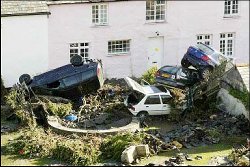 PARIS
(AFP) - Freak storms packing howling winds and heavy rain that lashed
Britain and France this week were set to continue, after already
causing significant destruction and the deaths of at least four
people. PARIS
(AFP) - Freak storms packing howling winds and heavy rain that lashed
Britain and France this week were set to continue, after already
causing significant destruction and the deaths of at least four
people.
Rescuers in southern France resumed searches for at least five
swimmers caught by surprise by the sudden change in the weather
that occurred Tuesday, roiling waters into huge waves and pushing
out powerful gusts of up to 80 kilometres (50 miles) per hour.
The four people confirmed killed -- a 41-year-old woman on vacation
with her family, a 46-year-old man, 36-year-old man and a 19-year-old
woman -- drowned as they swam off separate beaches and in a river.
In Britain, residents of Boscastle, a coastal village in north
Cornwall, were bracing for more rain two days after flash floods
sent a wall of water tearing through the place, collapsing buildings
and sweeping more than 50 automobiles into the sea.
Although no deaths were reported from the Boscastle disaster,
police continued to search for more than a dozen people who remained
unaccounted for.
In western Switzerland, the storms caused property damage but
no casualties, according to police. Fallen trees crushed one building,
and several houses had their roofs ripped off, while flooding swamped
at least eight villages.
Weather forecasts said France could expect more storms later Wednesday
with hail, lightning and very strong winds, prompting authorities
to issue a warning for Paris just one level below its maximum alert.
In Britain, torrential and thundery rain was also expected. [...] |
| ANCHORAGE, Alaska (Reuters) -
Wildfires have scorched over 5 million acres in Alaska as of Tuesday,
forestry officials said, a new record that signals possible changes
in climate conditions and the composition of the vast forests.
"We will definitely not have the same kind of forest and
landscape that we're familiar with today if this keeps up,"
Glenn Juday, a forest-sciences professor at the University of Alaska
Fairbanks, said.
While it is common for vast sections of Alaska wild lands to ignite
and smolder under the extended summer daylight, this year's fires
have been driven by unusually hot and parched weather and plentiful
lightning strikes.
In a typical summer, 500,000 to 1.5 million Alaska acres burn,
according to statistics from past years. And usually, fire is part
of the natural cycle that clears black spruce and white spruce,
slender, fast-growing conifers with high levels of flammable resin,
out of the way for slower-growing hardwood trees like birch and
aspen.
Six hundred fires have burned during the summer,
topping the 4.94 million acres charred in 1957, the previous record
Alaska wildfire season.
As of Tuesday, 103 fires were still burning, including the 1.1
million-acre Taylor Complex fire that was created when several blazes
merged. About 50 buildings had been lost, including seven homes,
and 1,075 firefighters were on duty, with about $30 million spent
fighting the fires so far.
Fire managers were still waiting for the heavy rains that usually
douse Alaska's blazes by August.
"We didn't get that ground-soaking, long-duration rain,"
said Andy Alexandrou, a fire information officer with the federal-state
Alaska Interagency Coordination Center.
Scientists warned that Alaska's trend is for
increased wildfires of this magnitude.
"Most of the explanations trace themselves
back to the climate change," Juday said. |
HONG KONG (AFP) - Hong Kong issued
a health alert as air pollution reached critical levels for the
second consecutive day.
With city air pollution index levels in the "very high"
category, the government advised people with heart or respiratory
illnesses to avoid outdoor activities.
The city appeared cloaked in dense smog Wednesday as the pollution
index reached 111 on a 1-200 scale. On Tuesday it hit 115.
A spokesman for the Environmental Protection Department said the
high readings were partly the result of calm air subsiding around
Typhoon Megi, which is hovering over the northwest Pacific Ocean.
"Pollutants are trapped under the calm wind conditions,"
the spokesman said.
The pollution resulted from smog forming in the neighbouring heavily
industrialised Pearl River Delta region of southern China.
Air quality was expected to improve as Megi moves further north
and winds pick up, the spokesman added.
A study by the University of Hong Kong in 2000 found air pollution
was responsible for accelerating the deaths of up to 550 people
every year in the territory. |
| As we go on pumping carbon dioxide
into the air, we might borrow a line from financial planners. Past
performance is no guide to future results.
The buildup of carbon dioxide (CO2) is forcing scientists to rethink
their expectations - not only about the buildup of heat on Earth
but also about the implications for the natural world far beyond
warming.
Take those powerful Alaskan earthquakes. We expect land to rise
as the weight of glaciers melts away. Should we also adjust our
assessment of earthquake risk?
Two geophysicists say "yes." Glaciers hold down earthquake
action even in a seismically active region like Alaska, argue Jeanne
Sauber with NASA's Goddard Space Flight Center in Greenbelt, Md.,
and Bruce Molnia with the US Geological Survey in Reston, Va. They
use history and current data to make their case.
For example, earthquake action picked up in places where the ice
masses retreated some 10,000 years ago, Dr. Sauber notes. Scandinavia
had major quakes back then. Canada also had many moderate quakes
as its glaciers melted.
Melting glaciers do not cause earthquakes: Quakes are created
when forces within the crust build up strain in rock until something
slips. Alaska is seismically active because a North Pacific crustal
plate is ramming into southern Alaska, creating pressures that must
be relieved at some point.
However, these pressures do push up high mountains where glaciers
form - and the weight of the glaciers pushing down can stabilize
the situation, if not eliminate the risk altogether. Remove that
weight, and the likelihood of a quake goes up as the strain accumulates.
That's what happened with the 7.2 magnitude quake in Alaska's
St. Elias region in 1979, Sauber and Dr. Molnia believe. Photographs
show how glaciers in the fault area had thinned substantially during
the 80 years since the previous earthquake activity.
Sauber says it now is clear that "in areas like Alaska where
earthquakes occur and glaciers are changing, their relationship
must be considered to better assess earthquake hazard." She
adds that satellites are helping seismologists do this "by
tracking the changes in extent and volume of the ice and movement
of the Earth."
Another nonwarming implication of global warming is plant growth.
Because plants use the carbon in CO2 to make their food and structures,
they should grow faster as concentrations of the greenhouse gas
go up. Many experts hope this will take some of the excess CO2 out
of the air. They count on increased nitrogen fixation to supply
the extra nitrogen to fertilize the plants.
Not so fast, warn Bruce Hungate at Northern Arizona University
in Flagstaff. The experiments of Dr. Hungate and his collaborators
show that this expected boon soon turns sour.
After burgeoning for a couple of years, the nitrogen fixers begin
to lose their fixing ability. It looks as though molybdenum - a
key nutrient - becomes less available as elevated CO2 levels change
soil chemistry.
"Our results ... caution against expecting increased biological
[nitrogen] fixation to fuel terrestrial [carbon] accumulation,"
the team warned in reporting its results in the journal Science
last spring. The results also show the need for scientists to broaden
their perspective when trying to foresee how Earth's ecosystems
will respond to global change, the team added.
To adapt the financial guru's mantra, the way things worked in
the past is an unreliable guide for expectations of how our planet
will respond as humans force more unnatural change upon it. |
| WELLINGTON - A powerful winter
storm battered central New Zealand yesterday, ripping a section
of the roof from the capital's main airport and blocking key highways
and railroads with snow and debris, the authorities said.
Wellington's airport and passenger ferry services were closed
down because of the gale-force winds and pounding seas.
Gusts of winds blowing at up to 180kmh downed several trees and
power lines, said police spokesman Andre Kowalczyk.
Floods, mudslides and fallen trees created traffic snarls in Wellington,
he said. On major highways in some areas, traffic was reduced to
a single lane.
There were no reports of deaths.
New Zealand has been repeatedly hit by wild weather this year,
with heavy snowfalls on South Island triggering avalanches last
week and torrential rainfall causing devastating flooding in February
and last month.
Yesterday, waves up to 14.5m high were recorded just outside Wellington's
harbour, said the harbour master, Captain Mike Pryce.
The first reported injury in the storm was that of a seaman who
broke a leg on a freight ferry crossing Cook Strait between North
and South islands early yesterday.
Overnight winds stripped off part of the main airport terminal's
roof, blowing debris across the closed runway.
Dozens of other roofs were also damaged, police said.
Storm-force winds and high tides dumped seaweed and debris on
coastal roads, adding to the hazardous driving conditions.
Across southern North Island, heavy snow closed scores of highways
and smaller roads, cutting access to some rural areas.
The Wairarapa farming region north of the capital was on flood
alert after up to 200mm of rain fell and swollen rivers threatened
to overflow.
Weather forecaster Augie Auer said the storm had virtually brought
the east coast to a standstill, and it would 'be a long slow clearance...with
the very strong winds easing only slowly during the day'. |
| SEOUL, South Korea (AP) - Typhoon
Megi swept across the southwestern tip of South Korea, leaving thousands
of people homeless and at least one person missing, emergency officials
said Thursday.
The typhoon first hit Wednesday, bringing heavy rains to the southwestern
South Korea and leaving more than 2,400 people homeless, said Park
Min-ju, an official at the country's disaster agency. More than
1,200 homes were flooded or destroyed.
Park said a 74-year-old man remained missing after he was apparently
swept away while working on a farm in Naju, about 280 kilometres
south of the capital Seoul.
Officials said they were investigating reports another man was
missing in the typhoon.
More damage was predicted as the typhoon headed northeast, Park
said and it was expected to complete its pass over the Korean Peninsula
by later Thursday.
The heavy weather shut down seven airports and caused the cancellation
of 41 domestic flights.
Earlier, heavy rain fuelled by the typhoon lashed southern Japan,
leaving at least eight people dead and causing landslides and blackouts,
officials said. Two people were missing.
Megi brushed the main southern islands Kyushu and Shikoku, the
Japanese Meteorological Agency said.
In Kagawa state in Shikoku, a 74-year-old farmer was found dead
after he fell into a swollen canal Tuesday. Three more elderly people
were killed by flooding rivers, police said.
In nearby Ehime, three men and a woman were killed, one by drowning
and the others in mudslides, local police said.
More than 4,700 people were ordered to evacuate their homes in
Kagawa, and nearly 300 in Ehime. Japanese national broadcaster NHK
reported more than 600 homes had been flooded in Shikoku. |
| PRINCETON, B.C. - An overnight
thunderstorm has caused more than a dozen landslides that have blocked
Highway 3 between Princeton and Hedley in B.C.'s Similkameen Valley.
The hardest hit area was around Princeton, where
the rain fell so hard the earth just gave way – completely
closing the highway.
The slides stranded dozens of people. About 20 vehicles were stranded
on the highway – and a provincial campground is also cut off
from road access. [...] |
Ice cream is melting in freezers
in Skagway. Anchorage city gardeners are watering the hanging baskets
downtown not once but twice daily. And even some of Alaska's fish
are stressed out.
Yes, it is hot.
In fact, Tuesday tied the record for most days over 70 degrees
in an Anchorage summer -- 43 days -- and it's only the middle of
August. The last time we had so many 70-plus days was 1936.
It's also exceptionally dry in Anchorage and the rest of Southcentral.
"It's getting down to near desert conditions," National
Weather Service meteorologist Sam Miller said, though the humidity
rises at night. [...] |
For Canadians who have spent the
summer asking where summer has gone, new satellite observations
show we're not alone.
According to an analysis by scientists at the University of Alabama
at Huntsville, July was the coldest worldwide since 1992. That year's
cool spell was precipitated by the eruption of the Philippine volcano
Pinatubo, which spewed 20 to 30 million tonnes of sunlight-deflecting
dust into the atmosphere.
But scientists don't know why the Earth's thermostat
has dropped this year.
In the Northern Hemisphere, July's temperatures were below the
20-year average by .14 degrees Celsius and in the Southern Hemisphere
by .29 degrees. Both the tropics and Antarctica showed marked coolness.
The July weather tracks a drop in average worldwide temperature
that has been going on since March, said John Christy, a professor
of atmospheric science at the Alabama university.
What is not clear is whether a single physical phenomenon is responsible
for the downward trend.
"There haven't been any new volcanoes or anything like that,"
Prof. Christy said, "so I think we just have to chalk this
up to the natural variability of the system. Just as the hottest
year in the past 20 years has to occur sometimes, the coolest summer
in the last 10 years also has to occur sometimes."
Rick Walls, a meteorologist at Environment Canada in Winnipeg,
said: "In the eastern Prairies it looks
like it is going to be the coldest summer on record since data started
being collected in the 19th century."
How cold did it get? In Saskatoon on July 29, the overnight low
was .07 degrees, breaking weather records that had been started
in 1892. In Winnipeg on July 23, the overnight low was three degrees,
the lowest recorded since 1872.
It was the cold in the Prairies that may have been the most impressive.
For May through mid-August, temperatures were on average three degrees
below normal, beating records that go back to 1872.
But Dave Phillips, chief meteorologist for Environment Canada,
pointed out that the cold wasn't just slightly beating the past.
In weather terms it completely eclipsed lows of 14.2 C which were
recorded in 1883 and 1907.
"A half of a degree average difference is like somebody in
the hundred-metre dash in the Olympics not beating the former world
record by the usual tenths of a second, but by a full second,"
he said. "It is really quite startling."
July hasn't been marked by bizarre weather, Mr. Phillips said.
"We haven't had any frosts or freak snowfalls in July. The
central fact of the whole summer has not been that it has been so
cold; it is just that it hasn't been so hot."
However, a portion of coastal British Columbia
has been experiencing one of its hottest summers on record, he said,
noting that Victoria and Vancouver had their second-warmest July
on record.
In Victoria, July was the second warmest in records that go back
to 1898, and a similar record-setting month was experienced in Vancouver,
where temperatures were on average 2.2 degrees above the monthly
average. [...] |
BRITONS were yesterday warned
to brace themselves for more weather catastrophes.
After the disasters in Boscastle and Lochearnhead, the European
Environment Agency said there were growing signs of climate change
affecting the continent.
EEA Executive Director, Professor Jacqueline
McGlade, said there was a "wealth of evidence" indicating
climate change.
She added: "What is new is the speed of change.
Strategies are needed, at European, regional, national and local
level, to adapt to climate change.
"If we go on as we are, we have less
than 50 years before we encounter conditions which will be uncharted
and hazardous."
She was backed by Met Office forecaster Clive Burlton who said
disasters like Boscastle and Lochearnhead would become more common.
He said: "The expectation is that there are going to be more
heatwaves and more extreme events.
"These sort of events are expected to increase and there
will be more extremes than in the past."
Serious flooding across Europe in August 2002 killed about 80
people and caused economic losses of at least £10billion.
In 2003, a heatwave in western and southern Europe was responsible
for more than 20,000 "excess deaths", particularly of
the elderly.
The EEA warn northern Europe is likely to see wetter conditions
while the south gets drier.
Friends of the Earth campaigns director Mike Childs warned: "The
consequences of climate change are a real and dangerous threat.
"Yet international leaders seem to pay little heed to the
warning bells. The Prime Minister must convince his fellow world
leaders that climate change is as big a threat to people and the
planet as international terrorism."
Europe is warming up faster than the global average with temperatures
rising by an average 0.95C over the last 100 years.
Temperatures are expected to rise by 2.0C to 6.3C over the next
century - due mainly to greenhouse gas emissions.
The resulting wetter conditions in northern Europe and drier weather
around the Mediterranean threaten to melt three-quarters of glaciers
in the Swiss Alps.
Cold winters would disappear while hot summers, droughts and heavy
rain become more common.
Carbon dioxide levels are at their highest for 420,000 years and
a third higher than before the Industrial Revolution in the 18th
century.
|
| European winters will disappear
by 2080 and extreme weather will become more common unless global
warming across the continent is slowed, warns a major new report.
Europe is warming more quickly than the rest of the world with
potentially devastating consequences, including more frequent heatwaves,
flooding, rising sea levels and melting glaciers, says the European
Environment Agency (EEA) document, launched on Wednesday.
The changes are happening at such a pace that Europeans must put
in place strategies to adapt to an unfamiliar climate, the researchers
write, although they stress the importance of the Kyoto Protocol
in cutting greenhouse gas emissions.
"Europe has to continue to lead worldwide efforts to reduce
greenhouse gas emissions, but this report also underlines that strategies
are needed at European, regional, national and local level to adapt
to climate change," says Jacqueline McGlade, executive director
of the EEA, based in Denmark. "This is a phenomenon that will
considerably affect our societies and environments for decades and
centuries to come,"
"What the report shows is that, if we go on as we are, we
have less than 50 years before we encounter conditions which will
be uncharted and potentially hazardous," she told the BBC.
Alpine glaciers
The report paints a dismal picture of Europe's future, based on
climatic changes since the Industrial Revolution, which have accelerated
over the last 50 years. The concentration of the main greenhouse
gas, carbon dioxide, in the lower atmosphere is at its highest for
possibly 20 million years, and stands 34 per cent higher than its
pre-Industrial Revolution level.
The global warming rate is now almost 0.2°C per decade, and
temperatures in Europe are projected to climb by a further 2 to
6.3 degrees this century, due to the build-up of greenhouse gases.
Picture postcard European snowscapes are destined to become consigned
to history books before the end of the century, and 75 per cent
of Alpine glaciers will have melted by 2050 – melting reduced
the glaciers by one-tenth in 2003 alone, the study found.
Sea levels are predicted to rise for centuries to come, at a rate
of up to four times faster than during the last century –
a particular concern in low-lying countries such as the Netherlands,
where half the population lives below sea-level. [...]
|
WINNIPEG - A band of wild summer
weather has settled over Manitoba, handing the province severe thunderstorms,
snow pellets and frost.
People living in southern Manitoba woke up Friday morning to frost
on their lawns, fields and windshields, said an Environment Canada
spokesperson.
Wayne Miskolczi said the temperature dipped to zero degrees around
Brandon and one degree below freezing in areas outside of the city.
At least seven records for cold were set overnight, including
one in Winnipeg. There the mercury fell to zero at 3 a.m., breaking
a record set in 1895.
[...] "Around July 16, there was a killing frost in a small
area south of Brandon," says Scott Day, Manitoba Agriculture
representative. "It looks like this year could be one of the
very few years – the first year I've ever heard of –
that we've had a frost in every month of the year."
On Wednesday, snow pellets fell on parts of downtown Winnipeg,
said meteorologists. Environment Canada spokesperson Rick Walls
says the office has no previous evidence of snow falling in August.
Earlier Wednesday, severe thunderstorms with winds of almost 65
km/hr knocked out power, toppled trees and doused parts of the province
with rain. |
A plague of biblical proportions
threatens the fragile agricultural communities of west and central
Africa: the culprit is a six-legged munching machine called Schistocerca
gregaria, the desert locust.
The Food and Agriculture Organisation (FAO) in Rome has warned
repeatedly that not enough is being done to contain the immense
swarms of locusts eating their way through vast swaths of food crops
stretching from Mauritania in the west to Chad in the east.
Dense clouds up to 25 miles long and containing billions of insects
have been sighted in southern Mauritania, northern Senegal, Mali
and Niger. The FAO said there was a high risk of them spreading
to Burkina Faso and the troubled Darfur region of western Sudan.
Further south, Gambia has declared an national emergency. [...] |
| COPENHAGEN, Denmark (AP) - A
Danish cattle farmer lost 31 of his 85 Jersey dairy cows when lightning
struck the trees under which they had sought shelter during a rain
storm.
The cattle were found dead Tuesday afternoon on farmer Kurt Nielsen's
land near Assing, about 270 kilometres west of Copenhagen.
"This seems to be one of nature's caprices," Nielsen
told Denmark's TV2 network, adding that lightning struck several
times Tuesday morning around his farm and the lights went out briefly.
That day, the Danish Meteorological Institute recorded 5,808 lightning
strikes across central Denmark.
Veterinarian Johannes Kejser told the Jyllands-Posten newspaper
that the cows were killed instantly.
The Danish Insurance Information Service said it had never heard
of so many cows being killed by lightning at one time. Nielsen said
his insurance company had promised a compensation for the dead livestock
and lost milk income. |
AT least six people were killed
today when a bolt of lightning struck a junior grade school in the
eastern Indian state of Jharkhand, police said.
Twelve others were injured when the lightning struck a group,
among them a number of children, who had taken shelter in the school
during a downpour in Bhawanthpur village, the Press Trust of India
quoted police as saying. |
There is an environmental problem
that is just beginning to be recognised as being of global significance:
"Toyota-isation".
The surfaces of deserts are being broken up by four-wheel drive
vehicles such as the Toyota Land Cruiser, the Japanese version of
the Land Rover and a great favourite with drivers in the Sahel,
the dry states to the south of the Sahara, as well as many other
challenging places.
The surface disturbance is proceeding at such a rate in Africa,
the Middle East and Asia that it is contributing substantially to
a rise in dust storms, and to an increase in dust in the global
atmosphere generally, which could have serious climatic and health
repercussions. Andrew Goudie, the professor of geography at Oxford
University, told the International Geographical Congress in Glasgow
that annual dust production in some parts
of north Africa had increased ten-fold in the past 50 years, and
that across the Sahel, from the Sudan to the Gulf of Guinea, it
had increased six-fold since the 1960s.
Global dust emissions were between two and three billion tons
a year, and this was even being felt in Britain, Professor Goudie
said, with an increase in episodes of "blood rain" - the
deposition of dust from the Sahara on the British land mass. "The
world is getting a lot dustier," he said. The reasons included
land use changes caused by growing populations, such as deforestation
and overgrazing, but Toyota-isation, a word coined by him to mean
disturbance by 4x4s, was a specific cause, the professor said.
"If you take almost any desert now, people go all over it
in four-wheel drives," he said. "The
number of four-wheel drives in the south-west US and indeed in the
Middle East is staggering.
"The desert surfaces have been stable for thousands of years
because they usually have a thin layer of lichen or algae, or gravel
from which the fine sand has blown away. Once these surfaces are
breached you get down to the fine sand again, which can be picked
up by the wind."
The effect was particularly bad near cities. "If you take
a city like Nouakchott, the capital of Mauritania, there are tracks
leading out across the desert in all directions," he said.
Sand is often carried by the wind at the base of the storm. A
typical storm could move on a front 100 kilometres or more across,
and contain 30 to 40 million tons of dust. It was possible that
disease-causing organisms - such as those responsible for foot-and-mouth
disease - could be transported with it, the professor said. |
POUGHKEEPSIE, N.Y. -- Weekend
storms battered parts of eastern New York, knocking down trees,
flooding roads and leaving thousands of residents without power.
Police reported minor accidents on the New York State Thruway,
the Taconic Parkway, the Newburgh-Beacon Bridge and throughout the
mid-Hudson Valley. Emergency crews blocked off parts of Route 216
and Route 218 in Orange and Dutchess counties after the storms dumped
more than 2 1/2 inches of rain there.
Crews that worked to restore power to about 7,000 people early
Friday evening had to return after 11 p.m. to respond to 4,800 outages.
By Saturday evening, about 1,500 people were still waiting for power. |
Firefighters are working overtime
as the Taylor Creek fire near Vernon has grown from 30 hectares
to 200 hectares in less than a day.
Fire information officer Dale Bojara says the fire is in steep
terrain and winds aren't helping matters.
But, even with 50 firefighters, heavy equipment, helicopters and
air tanker support, holding the fireline proved next to impossible.
Bojara says for the time being the crews have been pulled off
the line because the situation is too dangerous.
He says a new battle plan will be put in place today. |
More than 750 people were killed
by air pollution in last year's record temperatures, a government-funded
study has revealed.
The sudden surge in deaths occurred last August as most Britons
were basking in the highest summer temperatures since records began.
The study suggests there will be further increases in the numbers
of pollution-related deaths as global warming takes effect.
The findings, which will be presented at an international air-quality
conference in London on Tuesday, are likely to lead to even stronger
warnings about the risks of ill-health during heatwaves.
Dr John Stedman, the study's author, said his findings suggested
more stringent measures were needed, such as banning cars from city
centres in heatwaves and keeping people indoors.
Tim Brown, from the National Society for Clean Air, said about
2,000 people were thought to have died directly because of last
August's heatwave and that up to 40 per cent of those were killed
by air pollution.
"We need to be much more aware of air pollution levels when
there's a heatwave going on. When air pollution episodes like this
happen, the Government needs to redouble its warnings," he
said. |
The boast made earlier this year
by Tung Chee-hwa, Hong Kong's chief executive, about improved air
quality under his administration was left sounding hollow this week
after the territory was blanketed in toxic smog from power stations,
vehicles and factories in the Pearl River Delta.
Air pollution was so severe on Thursday that visibility in the
harbour fell to as little as 550m and officials said the smog contributed
to collisions on the water involving eight vessels. In some areas,
people with heart problems or respiratory ailments were advised
to stay indoors.
The smog, much of which comes from neighbouring Guangdong province
in southern China, is only the latest sign of the heavy environmental
price paid by Chinese city-dwellers for the country's rapid economic
growth.
On Wednesday the coal mining province of Shanxi became the first
area in China to calculate its "green GDP". It concluded
that its sustainable gross domestic product - economic output minus
environmental costs - had barely grown in the past two decades.
Hong Kong government officials yesterday blamed the latest smog
on the weather. They said two typhoons in the Pacific had caused
very stable atmospheric conditions over Hong Kong and prevented
pollutants being blown away in the usual way. [...] |
Record lows temperatures were
recorded this morning in Minneapolis, St. Cloud and Little Falls.
The National Weather Service says the temperature dipped to 33
degrees in St. Cloud this morning -- the coldest Aug. 21 on record
there. The previous record was 42 degrees,
set in 1923.
The St. Cloud temperature tied that city's previous all-time low,
set on Aug. 31, 1974.
The 44-degree reading in Minneapolis broke the old record of 50
degrees set on this date in 1956 and 1920.
Little Falls set a new record for today, too, with a low of 34
degrees. That broke the old record of 40 degrees, set in 1956.
The Weather Service says the record cold will soon give way to
more normal weather. Gusty south winds and warmer temps are on the
way. Highs today are expected from the mid-60s in the Arrowhead
to the upper 70s in western Minnesota. |
The globe's rising temperatures
are threatening Europe's premier wine-producing regions and could
change them irrevocably within decades, three American climatologists
have warned, the Italian daily La Repubblica reported Monday.
"We estimate that within 50 years temperatures in the region
of Chianti, where summers are already very hot, will rise by an
average of two degrees Celsius (3.6 degrees Fahrenheit)," Gregory
Jones, of the Southern Oregon University, said at an international
conference.
Legendary vineyards in Bordeaux and Chianti may come to resemble
those in northern Africa, and the ideal growing environments that
made them prosper could shift northward.
|
Global warming is causing China's
highland glaciers, including those covering Mount Everest, to shrink
by an amount equivalent to all the water in the Yellow River every
year, state media said Monday.
A staggering seven percent of the country's glaciers vanish annually
under the sweltering sun, enough to fill its second-largest river
to the brim, the Xinhua news agency reported.
Xinhua, quoting leading glacier expert Yan Tandong, said this
has been going on for the past four decades.
This would seem to imply that the glaciers regain some of their
losses during the cold months of the year, or there would be very
little of them left by now.
The issue is of particular concern to Tibet, home to nearly all
the country's glaciers, and even Mount Everest has been found to
be suffering, Xinhua reported.
A potential silver lining in the form of additional water for
China's arid north and west has not materialized, according to the
agency.
Much of the melted glacier water vaporizes long before it reaches
the country's drought-stricken farmers and again global warming
is to blame, it reported. |
| KANSAS CITY, Mo. - Thunderstorms
raked parts of the Midwest early Tuesday, a day after flash flooding
swamped basements, stranded motorists and left some cars floating
in water.
The National Weather Service reported some Kansas roadways under
6 inches of water on Monday, when several motorists had to be rescued
from their cars.
"It was a very dangerous flash-flood situation," meteorologist
Curt Holderbach said.
Thunderstorms in North Dakota downed trees, flooded streets and
knocked out power to several thousand people Monday. Golf-ball sized
hail was reported in Bismarck, and winds of 70 mph were reported
in Riverdale when the storm hit Monday night.
"With this kind of damage, it will take some time to get
the power restored," said Montana-Dakota Utilities spokeswoman
Cathi Christopherson.
The storm also brought hail and high wind to Kansas and spawned
some funnel clouds, a few of which touched down but didn't cause
significant damage, Holderbach said.
Small hail and rain fell across parts of eastern and central South
Dakota on Monday night and thunderstorms moved across Nebraska on
Tuesday, but there were no reports of damage.
In northwest Missouri near the Iowa line, as much as 4 inches
of rain fell early Tuesday. Strong to severe thunderstorms were
expected to move across the Great Plains and Midwest later in the
day, bringing heavy rainfall, severe hail and high wind.
At least 3,200 customers lost power in Kansas at the height of
Monday's storm, Westar Energy spokeswoman Karla Olsen said.
On Sunday and early Monday, as much as 15 inches of rain fell in
Texas between San Antonio and Laredo, causing flash-flooding that
forced a few residents to flee their homes. Officials closed Interstate
35 for most of the day Monday. |
HAVANA (Reuters) - Hurricane Charley
caused more than $1 billion in damage to Havana and its surrounding
provinces when it roared through western Cuba on Aug. 13, killing
four people, a leader of the ruling Communist Party said on Wednesday.
The storm demolished 4,177 houses and damaged almost 70,000 other
homes, Politburo member Pedro Saez said in comments published by
Cuban newspapers Granma and Rebel Youth.
Charley has been nicknamed the "lumberjack" hurricane
because its 105 mph (169 kph) winds uprooted or snapped more than
8,000 trees in Havana, and destroyed 300 hectares (7,400 acres)
of tree plantations outside the city, he said.
It was the worst storm to hit Cuba since Hurricane Michelle in
2001 plowed through the center of the island in 2001, leaving 200,000
homeless and $1.8 billion in damages.
Saez, the party's first secretary for Havana, said Charley's most
painful impact was to leave 2 million inhabitants without water
for days on end because pumping facilities had no power.
Large parts of the city's westside, as well as Havana and Pinar
del Rio provinces had no electricity for 11 days due to the downing
of 28 high-voltage towers from a power plant in Mariel.
Some 23,000 hectares (56,800 acres) of bananas, citrus and other
fruit were flattened in Havana province, where cattle, chicken and
pig farms were badly damaged.
Cuba rejected an offer of $50,000 in aid made by the State Department,
calling the amount a "ridiculous and humiliating charity."
A government statement issued on Sunday called the U.S. gesture
"hypocritical" in view of the economic sanctions Washington
has maintained against Cuba for four decades. |
East China's Zhejiang province
has evacuated some 249,000 people as Typhoon Aere is forecast to
make landfall in the coastal province Wednesday, state media said.
Xinhua news agency said nearly 31,500 fishing boats in the province
were also called back to port as a precaution. |
Farmers are driving Asian countries
towards an environmental catastrophe, using tube wells that are
sucking groundwater reserves dry, New Scientist says.
Tens of millions of these wells have been drilled over the past
decade, many of them beyond any official control, and powerful electric
pumps are being used to haul up the water at a rate that far outstrips
replenishment by rainfall, the British weekly says in next Saturday's
issue.
The extraction is providing many countries with a lavish harvest
in thirsty crops like rice, sugar cane and alfalfa, but the boom
is bound to be shortlived, it says.
Indeed, water tables are falling so dramatically that within a
short time, some landscapes could become arid or even be transformed
into desert, it says, quoting scientists at a worldwide water conference. |
One third of the nation's lake
waters and one-quarter of its riverways are contaminated with mercury
and other pollutants that could cause health problems for children
and pregnant women who eat too much fish, the Environmental Protection
Agency said Tuesday.
States issued warnings for mercury and other pollutants in 2003
for nearly 850,000 miles of U.S. rivers — a
65% increase over 2002 — and 14 million acres of lakes.
The warning level is the highest ever reported by the EPA. It is
partly a result of states taking a more aggressive role in monitoring
for mercury, according to environmental officials.
The warnings do not apply to fish caught in the deep seas that
are sold in stores and restaurants. An extremely small percentage
of commercially sold fish come from inland lakes and rivers.
"This is about trout, not tuna. It's about what you catch
on the shore, not what you buy on the shelf," said EPA Administrator
Michael Leavitt. "This is about the health of pregnant mothers
and small children."
Adults seldom suffer health problems from eating fish laden with
mercury. But a diet rich in mercury-tainted fish can severely damage
the nervous systems of children and fetuses. That's why states issue
fish warnings not only to children but also to women young enough
to have children. Many states advise that women and children eat
no fish at all from the most heavily contaminated lakes and rivers,
which are listed in state Web sites. Recommended consumption limits
on fish from other water bodies range from once a week to once every
two months.
Eighteen states have issued warnings on eating fish caught from
all lakes and rivers. In Minnesota and Michigan the advisories apply
only to lakes and in Indiana only to rivers.
Another 23 states warn that fish caught in some lakes and rivers
could be contaminated. Utah, Wyoming, Iowa, Oklahoma, Hawaii and
Alaska issued no mercury warnings.
The warnings apply to well-known water bodies ranging from Lake
Champlain and Lake Michigan to San Francisco Bay and the Columbia
River in the Pacific Northwest.
Mercury is emitted primarily by incinerators and power plants
that burn coal. The EPA plans to publish rules restricting mercury
from power plants by mid-2005, although environmentalists say the
preliminary draft of those rules does not go far enough.
The statistics released Tuesday are based on data the EPA collected
from states for 2003. The states are responsible for issuing warnings
about fish caught in local streams and lakes. |
| The UN says the world faces a
silent emergency because of the continued lack of clean water and
sanitation.
A new report reveals that more than 40% of the world's population
does not have even the most basic sanitation.
More than one billion people have no access to clean water sources,
the document adds.
The report was prepared by the UN's children's fund, Unicef, and
the World Health Organisation to assess progress towards reaching
millennium goals.
A key development goal is to cut by half the number of people
without clean water and sanitation by the year 2015.
The report makes depressing reading.
If things continue as they are, half a billion people will still
have no sanitation nine years from now.
[...] Unicef points out that it is the young who suffer most.
Some 4,000 children die every day from illnesses caused by lack
of clean water. |
The world has barely begun to
recognise the danger of setting off rapid and irreversible changes
in some crucial natural systems, a scientist says.
Professor John Schellnhuber says the most important environmental
issues for humans are among the least understood.
He told a briefing in Sweden that the Asian monsoon was one of
the "tipping points" that could change very quickly.
He said a better understanding of the risks was as important as
the programme to prevent collisions with asteroids.
Professor Schellnhuber is research director of the UK's Tyndall
Centre for Climate Change Research.
High stakes
He was speaking at the EuroScience Forum in Stockholm, at a briefing
by the International Geosphere-Biosphere Programme entitled Beyond
Global Warming: Where On Earth Are We Going?
Professor Schellnhuber said 12 "hotspots"
had been identified so far, areas which acted like massive regulators
of the Earth's environment.
If these critical regions were subjected to stress,
they could trigger large-scale, rapid changes across the entire
planet. But not enough was known about them to be able to predict
when the limits of tolerance were reached.
"We have so far completely underestimated
the importance of these locations," he said.
"What we do know is that going beyond
critical thresholds in these regions could have dramatic consequences
for humans and other life forms."
One example of a hotspot was the North Atlantic
current, the ocean circulation pattern responsible for bringing
warmer air to northern Europe, the collapse of which could lead
to a very large regional climate shift.
Faltering monsoon
Others were the West Antarctic ice sheet, the Sahara desert, and
the forests of the Amazon basin. Yet another hotspot, Professor
Schellnhuber said, was the Asian monsoon system.
[...] "That means we have to know where they are, and they've
been off the radar screen for far too long.
"Scientists have begun to realise that change
could be sudden, not gradual - in some cases it could happen within
a few decades."
Professor Schellnhuber urged a coordinated global effort to improve
understanding and monitoring of Earth's "Achilles' heels".
He said: "Such an effort is every bit as important as Nasa's
valuable asteroid-spotting programme designed to protect the planet
from collisions.
"If we can afford to gaze up at the sky looking for asteroids,
we should be able to watch our own planet with as much care." |
| RENO, Nev. - A wind-whipped wildfire
sparked by a target shooter erupted near Reno and quickly spread
to at least 2,600 acres, destroying at least four homes, threatening
hundreds of others and forcing evacuations.
At least 16 structures, including the homes, burned Wednesday
in the Pleasant Valley area, about seven miles from Reno, according
to fire officials. Because of dense smoke, it was not immediately
known exactly how many of the structures were homes or outbuildings.
"When we left, the flames were coming right down the canyon,"
resident Joseph Martin said. "They were just saying, 'You might
have to evacuate,' and 10 minutes later, they said, 'You got to
get the hell out of there.'"
At least 350 homes were threatened by the fire, which was being
whipped by winds gusting to 35 mph.
Firefighting crews on the ground were being assisted by helicopters
and air tankers, officials said.
"They're doing a great job, but it's kicking our butt right
now," Reno Fire Marshal Larry Farr said.
Farr said the fire was sparked by a man who was target shooting
and fired a bullet that ricocheted off a rock.
Residents were urged to evacuate. Crews cut electricity to the
area to help decrease the possibility of power lines snapping and
sparking more fires.
A section of U.S. 395, which links Reno with Carson City, was
closed for several hours before reopening at nightfall. |
JERUSALEM (Reuters) - Some 200
storks migrating from Europe to Africa flew to their deaths in Israel
Monday, landing in an acid-filled pool of waste outside a chemical
plant, veterinary officials said.
Media reports said the chemical dump, in the southern town of
Dimona, is covered during the migration season to prevent such accidents
but the storks made their stopover in Israel early this year.
|
WESTERN BUREAU - A freak storm
on Monday swept across Anchovy and Roehampton in St James, leaving
thousands of dollars worth of damage.
Residents said the storm tore off roofs, uprooted trees and flattened
acres of crops, including bananas.
Egbert Kerr, an 83 year-old farmer of Bueno Vista in Roehampton,
told the Observer that his crop of 150 banana plants, most of which
were due for harvesting in weeks, were wiped out by the wind. He
said he lost more than $50,000 in crop damage.
Vaughn Birch, 25, of Spring Bottom, also in Roehampton, said a
tree fell on his house and that a section of the roof was torn off
by the wind. He also lost his Digital Satellite System (DSS) dish.
"I was at work when the storm past through, and when I got
home I saw the tree on top of my house. A whole lot of things inside
the house were damaged," Birch said.
Birch said he was yet to find out if all the electrical appliances
in his house were working, as the wind caused trees to fall on power
lines which left the more than 80 residents in the communities without
electricity.
Ireta Robinson, 55, said a one-room house which she had just completed
a few days ago was blown from its spot. A huge ackee tree in Robinson's
yard was also uprooted by the strong wind. She said no one was in
the house at the time of the incident.
Beres Housen, a farmer and father of six, said he was at Granville,
about eight miles away, when he received a phone call that his house
at Anchovy was affected by the freak storm. According to Housen,
when he reached home, he saw sections of his roof blown off and
his family apparently in a state of shock. [...] |
| MIAMI (Reuters) - Hurricane Frances
was born in the Atlantic Ocean on Thursday but the rapidly growing
storm was many days from threatening any populated area.
The fourth hurricane of the Atlantic season was on a track that
would put it well north of Antigua, Anguilla and the other vulnerable
islands of the northeastern Caribbean by next Tuesday.
At 5 p.m. (2100 GMT), the center of Hurricane Frances was 1,005
miles east of the Lesser Antilles at latitude 13.7 north and longitude
46.4 west, the U.S. National Hurricane Center (news - web sites)
said.
The storm system was moving to the west-northwest at about 16
mph (26 kph). Its top sustained winds were 80 mph (129 kph) and
could be near 100 mph (160 kph) by Friday, forecasters said.
Forecasters have predicted the 2004 Atlantic hurricane season,
which runs from June 1 to Nov. 30, would be a busy one. Already,
six tropical storms or hurricanes have formed and the busiest part
of the season, from late August to early October, has just begun.
An average hurricane season sees about 10 tropical storms, with
about six becoming hurricanes.
Frances formed as a tropical storm on Wednesday, just 12 days
after Hurricane Charley struck southwest Florida. Charley was the
worst hurricane to hit the state in 12 years and caused an estimated
$7.4 billion in insured damages. |
| NEW DELHI - Indian military helicopters
have been plucking survivors out of the water after flash-floods
swept away 29 people on Thursday morning in the northern Indian
state of Uttaranchal.
But more than 20 of those people, feared dead in the rushing waters
of the Kailashu river at Akrouli village, have been rescued. The
bodies of two others have been recovered.
They had been sleeping outdoors and had taken refuge from the
rushing waters in a trolley, when the vehicle itself was washed
away.
Of 30 people who were in the trolley, one managed to escape and
swim to safety.
Officials in the area say the river continues to rise because
of heavy rains.
Hundreds of people have died this year and millions have been
affected by monsoon flooding in parts of India, Nepal and Bangladesh.
People who live in the area say flooding, a regular occurrence
during monsoon season, could be controlled if governments would
co-operate on managing water resources. |
| Shanghai — Typhoon Aere
crashed into mainland China on Thursday, unleashing torrential rains
and prompting the nearly a million people to seek safety, as the
death toll climbed to 35 after a mudslide killed 15 villagers in
Taiwan.
Aere came ashore on the mainland late Wednesday after battering
northern Taiwan, where up to 1,500 millimetres (1.5 meters) of rain
fell over the past 21⁄2 days in some areas. State television
in China showed footage of howling winds and pounding rain. Cars
plowed through flooded streets littered with uprooted metal barriers.
Officials in Taiwan said the mudslide in a remote northern mountain
village buried all of the homes in just 10 seconds, killing 15.
The island's death toll rose to 30 after officials reported a man
died when flood waters washed away his riverside home in central
Taiwan.
Another five people were reported dead in the Philippines.
Apart from one man reported missing in eastern China's Zhejiang
province, no casualties were reported on the mainland.
It was the second-strongest storm to hit China this season after
Typhoon Rananim, which killed 164 people and devastated the southern
Chinese coast. [...] |
Intense downpours flooded several
streets and intersections around Anchorage late Thursday afternoon,
stranding a few motorists in rising water, according to Anchorage
police. Residents, commuters and patrol officers were calling in
dozens of reports to police dispatch, including one of "a large
lake" at A Street and Benson Boulevard near Wal-Mart.
The National Weather Service issued an urban flood watch for Anchorage
for the evening. [...] |
Super Typhoon Chaba pounded the
southern Japanese island of Amami-Oshima Sunday with heavy rain
and strong winds, cutting off electricity to some 5,800 households,
officials said.
Chaba, meaning hibiscus in Thai, is moving slowly northwest and
generating maximum windspeeds of around 160 kilometers (100 miles)
per hour, the Japan Meteorological Agency said.
Due to the typhoon, some 5,800 households had no electricity in
the island, 1,300 kilometers (800 miles) south of Tokyo, police
in Amami-Oshima said.
The typhoon is likely to hit parts of Kyushu island in southwestern
Japan by early Monday and dump up to 800 millimeters (32 inches)
of rain in the region, the Meteorological Agency said.
Waves in Kyushu could reach as high as eight meters, the agency
added.
At least 27 flights from Tokyo to Kyushu were cancelled Sunday
due to the typhoon, an airport official said. |
| Thirty-two people have been killed
and more than a million other people received assistance amid massive
floods, civil defense officials said Sunday.
More than 100 towns and cities of the main island of Luzon went
under water or were isolated by landslides following last week's
heavy southwest monsoon rains induced by Typhoon Aere, they said.
The extreme weather killed 24 people, mainly drowning victims
or buried by landslides, the civil defense office said. Eight other
people are presumed dead after being carried off by rampaging floodwaters
last week.
Portions of the main north-south Luzon highway were cut off after
the Pampanga and Tarlac rivers burst dikes, while landslides blocked
key arteries in the upland Cordillera region of northern Luzon.
Civil defense officials said 1.12 million million people out of
the national population of 84 million received relief assistance
worth 7.96 million pesos (about 142 million dollars).
Of that number, more than 6,000 lost their homes and sought refuge
at government-run evacuation centers.
Although the heavy rains have stopped and floods are receding,
Red Cross spokeswoman Tess Usapdin said the affected population
would need a week more of food and medical support before things
could return to normal.
"The waters are subsiding. Hopefully, there would be no typhoons
arriving soon that could induce more monsoon rains," Defense
Secretary and civil defense chief Avelino Cruz said over DZBB radio. |
| 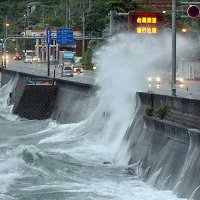 TOKYO
(Reuters) - Powerful Typhoon Chaba was racing toward the northern
Japanese island of Hokkaido on Tuesday, leaving at least seven people
dead and four missing after torrential rains that forced thousands
into shelters. TOKYO
(Reuters) - Powerful Typhoon Chaba was racing toward the northern
Japanese island of Hokkaido on Tuesday, leaving at least seven people
dead and four missing after torrential rains that forced thousands
into shelters.
Chaba, one of the strongest storms to hit Japan this year, had
generated winds of up to 130 miles per hour at one point on Monday
as it crossed the southwestern island of Kyushu, near the highest
on record for the area.
The typhoon was traveling over the Sea of Japan on Tuesday and
was expected to reach Hokkaido later in the day.
As of 10 a.m. (2100 EDT), the center of the storm was off the
western coast of Aomori prefecture, which is just below Hokkaido,
the Meteorological Agency said.
It was traveling northeast at 40 miles per hour.
An 82-year-old woman was found dead early on Tuesday in her flooded
home in Okayama prefecture in western Japan, Kyodo news agency said,
raising the number of people killed in the storm to seven.
A man was also found dead in Takamatsu, western Japan, trapped in
a car on a flooded street, police said.
The others who have died include an elderly man who fell from
a storehouse roof and two men who died when their truck was washed
away.
Four crew members of a Vietnamese cargo ship were missing after
the vessel ran aground on Monday near Shikoku island.
Some 8 to 10 inches of rain was forecast to fall on some areas
of Hokkaido by Wednesday morning, public broadcaster NHK said.
Some 2,700 people had left their homes to be safe from the storm,
and local authorities had also urged 4,800 people to evacuate, NHK
said, adding that over 200 around the country had been injured by
the typhoon.
Tohoku Electric Power said the typhoon had caused blackouts in
around 16,000 homes in northern Japan as of 9 a.m. (2000 EDT).
The typhoon caused fresh disruptions to transport, with 140 domestic
flights in and out of northern Japan already canceled on Tuesday
and more cancellations possible, NHK said.
More than 750 domestic flights were canceled on Monday.
Some bullet train services in northern Japan were operating at a
reduced speed, causing minor delays, NHK said, adding that a number
of local train lines in northern Japan including Hokkaido had stopped
services.
Japan Energy Corp. said it had shut its Mizushima oil refinery
in western Japan due to flooding caused by the typhoon.
The northwest Pacific is regularly hit by typhoons at this time
of the year and Chaba -- which means "hibiscus" in Thai
-- is the 16th to affect the region this year.
The arrival of the storm coincides with the highest tides of the
year, increasing concerns about flood damage.
Chaba is following a similar route to Typhoon Megi, which set
off landslides and flooding that killed 10 people in Japan and at
least three in South Korea earlier this month.
Another storm, Typhoon Songda, is brewing in
the Pacific and also appears to be headed for southern Japan in
the next week. |
MIAMI (AFP) - Florida and several
Caribbean islands were keeping a close eye on Hurricane Frances,
a powerful storm packing winds of over 200 kilometers (125 miles)
per hour.
Tropical storm warnings were in effect for several Caribbean islands,
including Puerto Rico, the British and US Virgin Islands, Antigua
and Barbuda, the US National Hurricane Center (NHC) said.
A tropical warning means sustained winds of at 63 to 118 kilometers
(39-73 miles) per hour are possible in the area within 24 hours.
At 8:00 pm (midnight GMT), the center of Hurricane Frances was
located 305 kilometers (190 miles) northeast of the northern Leeward
Islands.
The system packed winds of 205 kilometers (125 miles) per hour,
and was moving toward the west at 22 kilometers (14 miles) per hour,
the NHC said.
The long-range forecast, which is subject to a large margin of
error, calls for the storm to hit Florida's southeastern coast on
Saturday with winds around 220 kilometers (140 miles) per hour.
The southeastern US state is still trying to recover from Hurricane
Charley, which hit earlier this month, killing at least 20 people.
Officials in coastal areas, including Miami, pointed out such
storms were largely unpredictable but get ready for the hurricane
by stocking up on water, canned food and batteries.
"We are keeping a close eye on this, and everyone else should,"
said Carlos Castillo, Miami's emergency management director.
"Long week ahead," said Max Mayfield of the NHC. |
| RICHMOND, Va. (AP) - The remnants
of tropical storm Gaston battered parts of Virginia with torrential
rain Monday, sending cars floating down streets and stranding people
in downtown buildings.
Virginia Gov. Mark Warner declared a state of emergency due to
flooding in central Virginia, making state resources available and
putting the Virginia National Guard on standby. "It looks like
rapids outside our building," said Nick Baughan, who was stranded
with about 20 other people on the second floor of the Bottoms Up
pizza restaurant in Richmond.
"All of our cars have floated away."
The first floor was under more than three metres of water, Baughan
said.
About 28 centimetres of rain fell in Richmond, causing cars to
float down flooded streets and ram into the restaurant and other
buildings in the Shockoe Bottom district, a popular entertainment
area. [...]
About 82,000 Dominion Virginia Power customers in the Richmond
area and southeastern Virginia were without service Monday night.
Farther south, residents and officials in the Carolinas on Monday
were cleaning up from Gaston - and keeping their eyes on hurricane
Frances.
At 8 p.m. EDT on Monday, Frances was centred about 305 kilometres
east- northeast of the northern Leeward Islands and was moving west
at about 23 kilometres an hour. [...]
Gaston, which came ashore Sunday just under hurricane strength
with winds of 113 km/h, brought rains estimated at 33 centimetres
in places in South Carolina.
The storm flooded areas already saturated by hurricane Charley
earlier this month and cut power to 172,000 electric customers in
the state. Fewer than 29,000 customers remained without power Monday.
In Berkeley County, where damage from Gaston was severe, 10 houses
were completely flooded and more than two dozen people had to be
rescued from flood waters, said Jim Rozier, a county supervisor.
"It just seemed to rain forever," he said. |
Continue
to September 2004
Remember,
we need your help to collect information on what is going on in
your part of the world!
We also need help to keep
the Signs of the Times online.
Send
your comments and article suggestions to us 
Fair Use Policy Contact Webmaster at signs-of-the-times.org
Cassiopaean materials Copyright ©1994-2014 Arkadiusz Jadczyk and Laura Knight-Jadczyk. All rights reserved. "Cassiopaea, Cassiopaean, Cassiopaeans," is a registered trademark of Arkadiusz Jadczyk and Laura Knight-Jadczyk.
Letters addressed to Cassiopaea, Quantum Future School, Ark or Laura, become the property of Arkadiusz Jadczyk and Laura Knight-Jadczyk
Republication and re-dissemination of our copyrighted material in any manner is expressly prohibited without prior written consent.
|