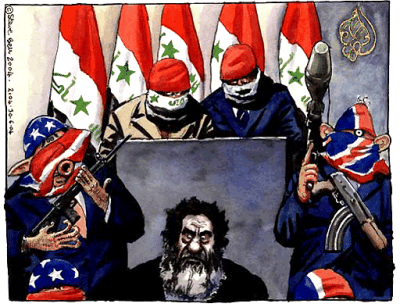
|
By Anne Penketh, Diplomatic Editor
28 December 2006 The Bush administration welcomed the confirmation of the death penalty against Saddam Hussein, reopening the divide with the European Union and the United Nations, which are opposed to execution.
Human rights groups, including Amnesty International and Human Rights Watch, said Saddam should not be hanged for crimes against humanity because his trial had been flawed and was marred by political interference by the Iraqi government. A spokeswoman for Amnesty said: "We are against the death penalty as a matter of principle but particularly in this case because it comes after a flawed trial." Richard Dicker, director of the International Justice Programme at Human Rights Watch, said: "Imposing the death penalty, indefensible in any case, is especially wrong after such unfair proceedings. That a judicial decision was first announced by Iraq's National Security Adviser underlines the political interference that marred Saddam Hussein's trial." Iraq's US-appointed interim government reinstated the death penalty in August 2004, causing friction with its coalition partner, Britain. The former top British representative in Iraq, Sir Jeremy Greenstock, said the UK would not participate in a tribunal or legal process that could lead to execution. A Foreign Office spokesman said yesterday that while the execution of Saddam was "a matter for the Iraqis", Britain remained opposed to the death penalty, and had made representations to the government on that score. The outgoing UN secretary general, Kofi Annan, has expressed opposition to imposing the death penalty on Saddam on principle. But the deputy White House press secretary, Scott Stanzel, struck a different note. "Today marks an important milestone in the Iraqi people's efforts to replace the rule of a tyrant with the rule of law," he told reporters aboard Air Force One. "Saddam Hussein has received due process and legal rights that he denied the Iraqi people for so long." |
|
AFP
27 Dec 06 Iraq was preparing for the rapid execution of former dictator Saddam Hussein, with the US-backed government eager to bring his chapter in the country's bloody history to an end.
As another deadly car bomb hit Baghdad Wednesday and the shooting of a Shiite politician triggered anti-American protests, the fate of the ousted tyrant threatened to deepen still further the rift between Sunnis and Shiites. Justice Minister Hashem al-Shibli said Saddam's death sentence for crimes against humanity -- upheld by an Iraqi appeal court on Tuesday -- would be rubber stamped by the presidency and the prison service would hang him. In a defiant open letter to his former subjects, the man who ruled Iraq with an iron first from 1979 until the 2003 US-led invasion said he would go to the gallows as a "sacrifice" and urged Iraqis to unite against their enemies. "I sacrifice myself. If God wills it, He will place me among the true men and martyrs," wrote Saddam in the letter, which his lawyer said was penned last month for release if his death sentence was upheld. Judges have ordered that Saddam die within 30 days but, while Shibli said the execution process will get underway rapidly, it could be delayed by the onset of the four-day Eid al-Adha holiday, due to start at the end of the week. Saddam and two regime cohorts were convicted of crimes against humanity on November 5, after a court heard they ordered the deaths of 148 Shiite men from the village of Dujail in an act of collective punishment. Shiite politicians welcomed Saddam's imminent demise as a blow to his remaining supporters that could take the heat out of the Sunni-led insurgency. Shiite lawmaker Baha al-Araji from radical cleric Moqtada al-Sadr's bloc called for Saddam to be hanged this week as an "Eid present for Iraqis". But Sheikh Khalaf al-Ilayan, whose National Dialogue Council is part of the main Sunni alliance in parliament, accused Iran and the United States of putting pressure on the court and predicted more bloodshed. Saddam's disbanded Baath Party also threatened to attack US interests and "retaliate by any means, anywhere in the world, if the US administration undertakes its crime" of dispatching the 68-year-old to the gallows. In Iraq, eight civilians were killed and 10 more wounded in a car bomb attack near a restaurant in mainly Shiite northeastern Baghdad. Three Iraqi soldiers died in a roadside bombing south of the capital. Tension was boiling up further south in the holy city of Najaf after an American soldier killed a senior ally of Sadr during a raid on his house. Sadr supporters and local police told AFP that US and Iraqi soldiers had stormed the family home of Sahib al-Ameri, the president of a pro-Sadr political foundation in the holy city of Najaf, and shot him dead. The US military confirmed one of its troops had shot Ameri in an overnight raid by Iraqi forces, backed up by coalition military advisers. A statement said Ameri was implicated in recent bomb attacks on US and Iraqi forces, and was shot by an adviser after he fled to the roof of his house and aimed an assault rifle at an Iraqi soldier. Hundreds of mourners marched from Sadr's office in Najaf to the revered shrine of Imam Ali chanting anti-American slogans and denouncing Iraq's Prime Minister Nuri al-Maliki as a traitor for working with US officials. Caldwell also confirmed that US forces are holding two Iranians detained last week in the Iraqi capital on suspicion of weapons smuggling, in a move set to exacerbate tensions in the delicate balance of Iranian-Iraqi-US relations. Ten people were arrested and "documents, maps, photographs and videos" seized in the raid, which linked them to "illegal activities", he said. After interrogation it was discovered that two of them were Iranians, he added. Iraqi leaders cited by the New York Times, which broke the story last week, said the Iranians were detained at the compound of powerful Shiite leader Abdul Aziz al-Hakim who met US President Bush at the White House this month. A spokesman for Hakim denied that the raid took place at his compound, but the site of the arrests marked on a map handed out by the US military was consistent with being in or near the fortified compound. US commanders in Iraq regularly accuse Iran of fomenting unrest in its troubled neighbour, but the Shiite-led Baghdad government has insisted on pursuing a policy of closer security ties with Tehran. If US authorities produce evidence against the detainees it could be the first proof of their longstanding charge that Iranian agents are stirring violence in Iraq by arming and training illegal militias. The commander of British troops in Iraq, the second biggest foreign force in the country, said that his soldiers needed more support and resources from home, stressing that currently he can only offer a "60 percent solution". In the latest criticism of resources for troops based around the southern city of Basra, Major General Richard Shirreff singled out key issues including training, infrastructure and accommodation for soldiers on duty. |
|
AP
27 Dec 06 AMMAN, Jordan: Saddam Hussein's Baath Party threatened Wednesday to retaliate if the ousted Iraqi leader is executed, warning in an Internet posting it would target U.S. interests anywhere.
The statement appeared on a Web site known to represent the Baath, which was disbanded after U.S.-led forces overthrew Saddam in 2003. The site is believed to be run from Yemen, where a number of exiled members of the party are based. On Tuesday, Iraq's highest court rejected Saddam's appeal against a conviction and death sentence for the killing of 148 people who were detained after an attempt to assassinate in Dujail, northern Iraq, in 1982. The court said the former president should be hanged within 30 days. "Our party warns again of the consequences of executing Mr. President and his comrades," the statement said. "The Baath and the resistance are determined to retaliate, with all means and everywhere, to harm America and its interests if it commits this crime," the statement added, referring to Baath fighters as "the resistance." "The American Administration will be held responsible for any harm inflicted on the president because the United States is the decision-maker (in Iraq) and not the puppet Iraqi government." The statement said that if the execution takes place, it would be impossible for the Baath to take part in any prospective negotiations with U.S. and Iraqi officials to reduce the violence in Iraq. Saddam's defense lawyers, who are based in Amman, called on Arab governments and the United Nations to intervene to stop the execution. "Otherwise, all may be participating in what is going on, either actually or due to their silence in face of the crimes, which are being committed in Iraq in the name of democracy," the lawyers said in a statement in English that was e-mailed to The Associated Press bureau. The statement, signed by "the Defense Committee for President Saddam Hussein," said the court's rejection of Saddam's appeal was part of the "continued shedding of pure Iraqi blood by the current regime in Iraq, which (is) directly connected with the American occupation." One of Saddam's counsel, Najib al-Nueimi, a former justice minister in the Gulf state of Qatar, said it was now time for Saddam's family to appeal to Iraqi President Jalal Talabani. "The defense team has exhausted all the legal channels to appeal this decision, so it is up to the president's family to present an appeal for clemency to the current president, asking him not to sign the execution papers," al-Nueimi said, speaking in a phone interview from Qatar. Saddam's wife, Sajda, lives in Qatar, and his daughter Raghad, who has supervised his defense team, lives in Amman. Asked whether the family would appeal to Talabani, al-Nueimi would only say: "It's up to them." Later in the day, the lawyer of the former Iraqi Deputy Prime Minister Tareq Aziz condemned the verdict saying it was a flagrant violation of the regulations of the court. He believes that court regulations require that an execution occur after 30 days - not within this period, as the court announced. Badee Izzat Aref told the AP in a telephone call from Dubai that he met Saddam and Aziz last week in Baghdad and understood from them that Aziz will testify in court for the benefit of Saddam in his ongoing trial. Saddam is currently on trial for the military campaign, codenamed Operation Anfal, that took place during the 1980-88 Iraq-Iran war. An estimated 180,000 Kurds died during the campaign. "He has very important issues to reveal during the trial," Aref said. "He will uncover the involvement of many important foreign and local personalities." "The Iraqi government wants to accelerate the execution process to avoid the testimony of Tariq Aziz," Aref said. Noting that Iraqi President Jalal Talabani he was against the death penalty, whether against Saddam or anybody else, Aref said, "If he gives authority to his vice president to sign the execution order, he will face great embarrassment before his party and the Kurdish people." |
|
By CHRISTOPHER TORCHIA
Associated Press 27 Dec 06 BAGHDAD, Iraq - Saddam Hussein called on Iraqis not to hate the U.S.-led forces that invaded Iraq in 2003 in a farewell letter posted on a Web site Wednesday, a day after an appeals court upheld the former dictator's death sentence and ordered him to be hanged within one month.
One of Saddam's attorneys, Issam Ghazzawi, confirmed to The Associated Press in Jordan that the letter was authentic, saying it was written by Saddam on Nov. 5 _ the day he was convicted by an Iraqi tribunal for ordering the killings of scores of Shiite Muslims in the city of Dujail in 1982. "I call on you not to hate because hate does not leave space for a person to be fair and it makes you blind and closes all doors of thinking," the letter said. Ghazzawi said the letter was released on Tuesday and published on Saddam's former Baath Party's Web site on Wednesday. The deposed leader said he was writing the letter because his lawyers had told him the Iraqi High Tribunal which tried his case would give him an opportunity to say a final word. "But that court and its chief judge did not give us the chance to say a word, and issued its verdict without explanation and read out the sentence _ dictated by the invaders _ without presenting the evidence," Saddam wrote. "Dear faithful people," Saddam added, "I say goodbye to you, but I will be with the merciful God who helps those who take refuge in him and who will never disappoint any honest believer." The letter was released as Saddam's last legal means of avoiding execution came under question. A spokesman for President Jalal Talabani said Wednesday the appeals court order upholding the death sentence might not require Talabani's approval to carry out the execution. Iraqi officials had said such a decision must be ratified by Talabani and Iraq's two vice presidents. But presidential spokesman Hiwa Osman said that was not necessarily the case. "Some people believe there is no need for his approval," Osman said. "We still have to hear from the court as to how the procedure can be carried out." Meanwhile, some Saddam loyalists threatened to retaliate if the ousted Iraqi leader is executed, warning in a posting on the same Baath Party Web site that carried Saddam's letter they would target U.S. interests anywhere. "The Baath and the resistance are determined to retaliate, with all means and everywhere, to harm America and its interests if it commits this crime," the statement said, referring to Baath fighters as "the resistance." The Baath Party was disbanded after U.S.-led forces overthrew Saddam in 2003. The Web site is believed to be run from Yemen, where a number of exiled members of the party are based. In its ruling Tuesday, the appeals court said Saddam must be hanged within 30 days for his role in the Dujail killings. The appeals court also affirmed death sentences for two of Saddam's co-defendants, including his half brother. It ruled that life imprisonment for a third was too lenient and demanded he too be sentenced to death. Some Iraqis said Saddam should be hanged immediately, but others feared Iraq's bloodletting could escalate if the former dictator is executed at a time when sectarian attacks are already on the rise. "Executing him now is dangerous. The situation is very bad. Things need to be calmer," said Saadia Mohamed Majed, a 60-year-old Shiite in Baghdad who wants the penalty to be postponed for at least three years. Shiites endured persecution under Saddam and his fellow Sunni Arab leaders, and many are eager to remove a symbol of the old regime. The court's decision came on a particularly bloody day in Baghdad, when at least 54 Iraqis died in bombings and police discovered 49 apparent victims of sectarian reprisal killings. Many Baghdad neighborhoods were jittery on Wednesday amid fears that Sunni Arab insurgents would target Shiite areas in revenge attacks. There was a heavy police presence in the downtown area of Karrada, and parents picked up their children from a school after reports of a car bomb in the area. Violence appeared to be relatively minimal, though, with one car bomb explosion killing eight civilians and wounding 10 near an Iraqi army checkpoint in the capital, police said. Two Latvian soldiers were also killed and three were wounded when a roadside bomb exploded under their Humvee, the Latvian Defense Ministry said. Latvia has about 130 troops serving with a Polish contingent in Diwaniyah, 80 miles south of Baghdad. Saddam's defense lawyers, who are based in Amman, Jordan, urged Arab governments and the United Nations to intervene to stop the execution. "Otherwise, all may be participating in what is going on, either actually or due to their silence in face of the crimes, which are being committed in Iraq in the name of democracy," the lawyers said in an e-mail statement to The Associated Press. The statement signed by "the Defense Committee for President Saddam Hussein" said the court's rejection of Saddam's appeal was part of the "continued shedding of pure Iraqi blood by the current regime in Iraq, which (is) directly connected with the American occupation." An expert on war crimes speculated the sentence might be carried out very quickly. "I won't be surprised if there's just an announcement in several days saying the sentence has been carried out. The ruling says the sentence has to be carried out within 30 days, but it doesn't say you need to wait," said Michael Scharf, a professor at Case Western Reserve University School of Law. Human Rights Watch, which opposes the execution, said the law creating the Iraqi High Tribunal mandates that death sentences can never be commuted. However, international law says that when a death sentence is given, there must be an opportunity for it to be commuted, the group said. "There's some real confusion as to who has the authority to ratify the death sentence," said Richard Dicker, director of the group's International Justice Program. The legal maneuvering in Baghdad was of little concern in the northern Kurdish city of Irbil, where people who suffered under Saddam's brutal rule celebrated the decision upholding his death sentence. Saddam is currently in the midst of another trial, charged with genocide and other crimes during a 1987-88 military crackdown on Kurds in northern Iraq. An estimated 180,000 Kurds died during the operation. That trial was adjourned until Jan. 8, but experts have said the trial of Saddam's co-defendants is likely to continue even if he is executed. Saddam is being held at Camp Cropper, an American military prison close to Baghdad's airport. U.S. military officials did not say whether the former dictator will now be turned over to the Iraqis in anticipation of his execution. Saddam was captured while hiding in a hole in the ground near his home village north of Baghdad in December 2003, eight months after he fled the capital ahead of advancing American troops. |
|
Burhan al-Chalabi
Thursday December 28, 2006 The Guardian The imminent execution of Saddam Hussein is nothing but a smokescreen - a diversion in a series of diversions that will do nothing to address the price of the occupation of Iraq. If the Bush administration truly wanted to curb the cycle of bloodshed, it would come clean and share with the US public, the Iraqi people, and the international community the real goals of this disastrous neoconservative adventure.
The invasion and occupation of Iraq was an act of US imperialism, marketed as a war of liberation. Iraq was chosen ahead of Iran or Syria because it had been weakened by 13 years of sanctions. It provided the opportunity to station US bases in the Middle East, and a vantage point to monitor Iran. Control of the massive oil reserves was not to be sniffed at, either. It was assumed that Iraqis' distaste for Saddam would somehow make occupation acceptable. It has, of course, proved to be anything but acceptable. It has proven unacceptable to the people of Iraq, the Middle East, and the world over. Today, a country is occupied and its sovereignty violated. The UN's legal and moral authority has been undermined. Iraq's cultural heritage is in tatters, its natural resources squandered, its infrastructure destroyed. Safety, security and the rule of law are nonexistent. Terrorism is on the rise. This is borne out even in Washington's own reports. More than 3 million Iraqis have fled their homes. More than 600,000 civilians have been killed. Officials of the former regime are judged and punished - sometimes with death sentences as in Saddam Hussein's case. Regardless of the nature of the crimes, it is only right that allegations should be tested by a properly constituted court of law that meets the basic requirements of justice, fairness and independence. These qualities could not be found in the court in Iraq, established by US viceroy Paul Bremer, who appointed its judges in direct contravention of international law. This death sentence lacks the legality that might make it worthy of respect. It also makes it less likely that those who still support Saddam Hussein will participate in the political process being called for by the US president and the Iraqi prime minister. So it is not surprising that few Iraqis believe such an illegitimate execution will help heal wounds. The US presents the Iraqi people with this phoney act of accountability, but no one has been held accountable for invading and occupying Iraq or the mass human rights abuses carried out in the process. If this generation of Iraqis is not able to get justice, future generations will make sure they do. They will look to the established system of international justice to recognise these atrocities and hold people accountable retrospectively. The occupying forces continue to peddle the nonsense that they cannot withdraw immediately - that this would only spark civil war. I am convinced that the opposite is true: when the occupiers leave, the prevailing civil war will subside. Ordinary Iraqis will have to choose between killing each other or rebuilding the country - which they can only do in an independent, sovereign Iraq. The US and its allies should apologise to the Iraqi people for the suffering the war has caused. It should offer compensation based on criteria used in Kuwait after the first Gulf war. Under the auspices of the UN, it must end the occupation and hand over power to a sovereign Iraqi government mandated to respect human rights. - Dr Burhan al-Chalabi is a former chairman of the British Iraqi Foundation and a member of the Royal Institute of International Affairs bmcltd@aol.com |
|
Associated Press
December 28, 2006 ROME - A top Vatican official condemned the death sentence against Saddam Hussein in a newspaper interview published Thursday, acknowledging the crimes of the ousted Iraqi leader but reiterating that capital punishment goes against the teachings of the Roman Catholic Church.
Cardinal Renato Martino, Pope Benedict XVI's top prelate for justice issues and a former Vatican envoy to the United Nations, said that Saddam's execution would punish "a crime with another crime'' and expressed hope that the sentence would not be carried out. In the interview with Rome daily La Repubblica, Martino reiterated the Vatican's staunch opposition to the death penalty, saying that life must be safeguarded from its beginning to its "natural'' end. "The death penalty is not a natural death. And no one can give death, not even the State,'' he said. On Tuesday, Iraq's highest court rejected Saddam's appeal against a conviction and death sentence for the killing of 148 people in Dujail, in northern Iraq, in 1982. The court said the former president should be hanged within 30 days. |
|
By CHRISTOPHER TORCHIA
Associated Press December 28, 2006 BAGHDAD, Iraq - In a farewell letter to the Iraqi people, Saddam Hussein urged his countrymen not to hate the people of the nations that toppled his regime nearly four years ago and said he was offering "my soul to God as a sacrifice.''
The letter was posted on a Web site Wednesday, a day after Iraq's highest court upheld his death sentence and ordered him hanged within 30 days. A top government official, meanwhile, said Saddam's execution could proceed without the approval of Iraq's president, meaning there were no more legal obstacles to sending the deposed dictator to the gallows. One of Saddam's attorneys, Issam Ghazzawi, confirmed to The Associated Press in Jordan that the Internet letter was authentic, saying it was written by Saddam on Nov. 5 - the day he was convicted by an Iraqi tribunal for ordering the 1982 killings of 148 Shiite Muslims in Dujail. "I call on you not to hate because hate does not leave space for a person to be fair and it makes you blind and closes all doors of thinking,'' said the letter, which was written in Arabic and translated by the AP. "I also call on you not to hate the people of the other countries that attacked us,'' it added, referring to the invasion that toppled his regime. Despite his calls for conciliation among Iraqis, Saddam's legacy is brutal. He put suspected foes to death without trial, oppressed Kurds and Shiites, waged war on Iran and twice fought U.S.-led armies. He left an impoverished nation now gripped by sectarian bloodshed and an insurgency against the U.S. presence. On Thursday, three bombs killed 23 Iraqis in Baghdad, and the U.S. military announced the deaths of three American soldiers. Against the backdrop of sectarian killings that have dragged Sunni Arabs and Shiite Muslims into civil warfare over the past year, Saddam urged his countrymen to "remember that God has enabled you to become an example of love, forgiveness and brotherly coexistence.'' But he also voiced support for the Sunni Arab-dominated insurgency, saying: "Long live jihad and the mujahedeen.'' He urged Iraqis to be patient and rely on God's help in fighting "against the unjust nations.'' Saddam said he was giving his life for his country as part of that struggle. "Here, I offer my soul to God as a sacrifice, and if he wants, he will send it to heaven with the martyrs,'' he said. An official from Prime Minister Nouri al-Maliki's Dawa Party, speaking on condition of anonymity because he was not authorized to talk to the media, said that "the government wants Saddam executed as soon as possible.'' Another official close to al-Maliki, who also refused to be quoted by name, said the execution would take place before the end of the 30-day period. Ghazzawi, the defense lawyer, said the letter by Saddam was released Tuesday and published Wednesday on the Web site of Saddam's former Baath Party. Some Saddam loyalists threatened to retaliate if he is executed, warning in a posting on the same Web site that they would target U.S. interests. "The Baath and the resistance are determined to retaliate, with all means and everywhere, to harm America and its interests if it commits this crime,'' the statement said, referring to Baath fighters as "the resistance.'' The Baath Party was disbanded after U.S.-led forces overthrew Saddam in 2003. The Web site is believed to be run from Yemen, where a number of exiled members of the party are based. Some Iraqis said Saddam should be hanged immediately, but others feared Iraq's bloodletting could escalate if the former dictator is executed at a time when sectarian attacks are already on the rise. "Executing him now is dangerous. The situation is very bad. Things need to be calmer,'' said Saadia Mohamed Majed, a 60-year-old Shiite in Baghdad who wants the penalty to be postponed for at least three years. Saddam is in the midst of another trial, charged with genocide and other crimes during a 1987-88 military crackdown on Kurds in northern Iraq. An estimated 180,000 Kurds died during the operation. That trial was adjourned until Jan. 8, but experts have said the trial of Saddam's co-defendants is likely to continue even if he is executed. |
|
Adrian Hamilton
UK Independent 28 Dec 06 There won't be many people who mourn Saddam Hussein's imminent death - if he hasn't been executed already - any more than there were many who mourned the death of Slobodan Milosevic this year. They were both tyrants of the worst sort, ruling by fear and the word of the informant. Both were responsible for war on their neighbours as well as oppression of their own people.
The Serbian dictator managed at least to cheat the judge of the international court in The Hague by passing away from natural courses. Saddam Hussein hasn't managed that. But, like Milosevic, he has been able to turn what was meant to be a grand cathartic ceremony of closure and reconciliation into a desultory almost meaningless damp squib of a trial. His hanging, when it comes, discreetly and without ceremony, will produce neither a sense of universal relief nor outrage. It will simply happen, to be announced after the event, an event out of time and even place. The occupying powers were always wrong, of course, to see the capture and trial of Saddam Hussein and his closest creatures as some kind of replay of the Nuremberg and Tokyo trials, just as the international community was wrong to see Milosevic's extradition to the international court in The Hague as some huge triumph of global justice. It's an historical misreading for a start. Nuremberg was always victor's judgment dressed up as judicial decency. It was right that the accused were made to face the consequences of their actions. No one should doubt that. And Nuremberg at least had the pragmatic benefit of drawing a line under the number of Nazis to be punished for their misdeeds so the work of reconstruction could go on. But the trials never really acted as a process of truth and reconciliation in the manner that South Africa has sought. Effectively they allowed the Germans to get on with the next phases with the feeling, however unsubstantiated, that Nazism was now over and done with. If the object of the Milosevic trial was to make the Serbs come to terms with their recent history, then it should never have been held outside the country. The fact that the international community - the victors of the Nato bombings and the intervention in Kosovo - felt it better to hold it abroad was as much an indication of their nervousness at Serbian popular feeling as an enthusiasm for international justice. And so it has proved. There has been no purging of the past in the former Yugoslavia, or any of its parts. Perhaps there can't be unless the justice is summary and unjust in the manner of the Romanians who simply shot Nicolai Ceaucescu and his wife in 1989, much in the manner of the Italian partisans who shot Mussolini and his mistress and then hung their bodies upside down in Milan, leaving the parish priest to climb a ladder and tie down Clara Petrucci's dress, to preserve some modesty. Certainly Winston Churchill seems to have thought that it would be better, should Adolf Hitler have been caught alive, to execute him summarily, preferably by electrocution. And he may well have been right. Victor's justice is better seen as just that, an act of immediate punishment so that society can proceed ahead regardless. Had the US troops done the same with Saddam Hussein, and shot him on sight, or in keeping with the man, thrown him to the relatives of his victims to do their worst, it would not only have saved the hangman his task, it would also have avoided the whole drawn-out charade of a trial that was neither fair nor purgative. They didn't because they didn't want Saddam to become a martyr of the Baathist cause and because they wanted his trial to act as means to destroy the old order and welcome in a new one. Both ideas reflected a total misunderstanding of the Iraqi dictator's personal position and power. Saddam Hussein was never personally popular, any more than Milosevic. He had made too many enemies, taken a life from too many families and tribes, for that. If he still has any resonance in the country, it is only because the insurgency has grown to a point when any nationalist symbol will be used to help their cause. Saddam Hussein held power because he had the security apparatus to do so, because the West and the Arab world preferred him there to the anarchy they feared would follow his demise, and because the UN sanctions debilitated his nation and increased his direct power through his control over the oil-for-food regime. When he fell the regime fell because there was nothing very much left behind it. But equally there was nothing to replace it because a decade of sanctions and three decades of his rule had hollowed out the structure of political society. The idea that Saddam's fall would be a great act of decapitation, the step that would automatically lead to a better society and a more cohesive country was always fanciful. Almost all the experts knew this and said so, on the few occasions that they were allowed to, so why did not the occupants of the White House and No 10? The answer is that President Bush and Tony Blair chose to take Saddam Hussein at his own evaluation. As a symbol of militaristic Iraq, he could be demonised and his fall greeted as an historic achievement for the force of Western arms. The point was not primarily to help the Iraqis but to make a demonstration that would change the face of the Middle East. The fall of the regime, the trial of a tyrant, the imposition of a new order were all part of a vision that was never grounded in the facts of Iraq, because the facts on the ground were secondary to the purpose. Had it been otherwise, there would have been a proper post-invasion plan. Instead we have the results of the latest opinion polls, so beloved of those who cheered on the invasion. According to a survey by the Iraq Centre for Research and Strategic Studies in November, 89.9 per cent of respondents felt that Iraq was worse today than when Saddam Hussein was in power. Just over 50 per cent wanted the multinational forces to leave immediately, with a further 20 per cent declaring that they wanted them to start to leave now on a set timetable. To those who still claim that the invasion was right, because it removed a tyrant, one has this simple question: "Did we do it to make ourselves feel better or to make things better for the Iraqis?" For, if we ever thought they were one and the same thing, then we have been cruelly deceiving ourselves and even more cruelly deceiving them. |
Flashback: LA Times: Bring back Saddam Hussein - Restoring the dictator to power may give Iraqis the jolt of authority they need. Have a better solution?
Jonathan Chait
LA Times
November 26, 2006THE DEBATE about Iraq has moved past the question of whether it was a mistake (everybody knows it was) to the more depressing question of whether it is possible to avert total disaster. Every self-respecting foreign policy analyst has his own plan for Iraq. The trouble is that these tracts are inevitably unconvincing, except when they argue why all the other plans would fail. It's all terribly grim.
So allow me to propose the unthinkable: Maybe, just maybe, our best option is to restore Saddam Hussein to power.
Yes, I know. Hussein is a psychotic mass murderer. Under his rule, Iraqis were shot, tortured and lived in constant fear. Bringing the dictator back would sound cruel if it weren't for the fact that all those things are also happening now, probably on a wider scale.
At the outset of the war, I had no high hopes for Iraqi democracy, but I paid no attention to the possibility that the Iraqis would end up with a worse government than the one they had. It turns out, however, that there is something more awful than totalitarianism, and that is endless chaos and civil war.
Nobody seems to foresee the possibility of restoring order to Iraq. Here is the basic dilemma: The government is run by Shiites, and the security agencies have been overrun by militias and death squads. The government is strong enough to terrorize the Sunnis into rebellion but not strong enough to crush this rebellion.
Meanwhile, we have admirably directed our efforts into training a professional and nonsectarian Iraqi police force and encouraging reconciliation between Sunnis and Shiites. But we haven't succeeded. We may be strong enough to stop large-scale warfare or genocide, but we're not strong enough to stop pervasive chaos.
Hussein, however, has a proven record in that department. It may well be possible to reconstitute the Iraqi army and state bureaucracy we disbanded, and if so, that may be the only force capable of imposing order in Iraq.
Chaos and order each have a powerful self-sustaining logic. When people perceive a lack of order, they act in ways that further the disorder. If a Sunni believes that he is in danger of being killed by Shiites, he will throw his support to Sunni insurgents who he sees as the only force that can protect him. The Sunni insurgents, in turn, will scare Shiites into supporting their own anti-Sunni militias.
And it's not just Iraqis who act this way. You could find a smaller-scale version of this dynamic in an urban riot here in the United States. But when there's an expectation of social order, people will act in a civilized fashion.
Restoring the expectation of order in Iraq will take some kind of large-scale psychological shock. The Iraqi elections were expected to offer that shock, but they didn't. The return of Saddam Hussein - a man every Iraqi knows, and whom many of them fear - would do the trick.
The disadvantages of reinstalling Hussein are obvious, but consider some of the upside. He would not allow the country to be dominated by Iran, which is the United States' major regional enemy, a sponsor of terrorism and an instigator of warfare between Lebanon and Israel. Hussein was extremely difficult to deal with before the war, in large part because he apparently believed that he could defeat any U.S. invasion if it came to that. Now he knows he can't. And he'd probably be amenable because his alternative is death by hanging.
I know why restoring a brutal tyrant to power is a bad idea. Somebody explain to me why it's worse than all the others.
Joe Quinn
Signs of the Times
06/11/2006
At the time, much was made of the capture of Saddam Hussein. Touted by the US government-controlled American mainstream press as a fatal blow to the insurgency that would lead to rejoicing in the streets of Baghdad, the reality, as we have seen, has turned out to rather different. Iraqis, logically enough, seem to be less concerned about Saddam's capture
and trial than about the fact that a brutal US military force of occupation has essentially taken possession of their country and its resources and has caused the deaths of 655,000 of their fellow citizens.At the time, much was made of the capture of Saddam Hussein. Touted by the US government-controlled American mainstream press as a fatal blow to the insurgency that would lead to rejoicing in the streets of Baghdad, the reality, as we have seen, has turned out to rather different. Iraqis, logically enough, seem to be less concerned about Saddam's capture and trial than about the fact that a brutal US military force of occupation has essentially taken possession of their country and its resources and has caused the deaths of 655,000 of their fellow citizens.
After his initial capture in December 2003, Saddam was paraded in front of the press at his first court appearance in July 2004 where he stood accused of up to 12 crimes, including the alleged gassing of the Kurdish town of Halabja in 1988. But fate (and in Iraq these days "fate" wears the red white and blue ) has decreed that "Saddam" will not suffer the ignominy of answering those particular charges because his first trial for the killing of 148 people in a Shiite town in 1982 was enough, it seems, to convict and sentence him to death. The sense of relief in the White House over the fact that the "gassing" allegation will not have to be dissected is surely palpable, given that, if Saddam gassed anyone, it was with the chemical weapons supplied to him by the US government.
When he first appeared in court in 2004, Saddam was weak and pale and could be hardly heard. Strangely, the US military instituted a severe clampdown on media coverage of the proceedings which were not broadcast live. Frustrated members of the press had to wait until after the event to receive just FOUR minutes of audio and just a few seconds of video of the occasion. Furthermore, Saddam's lawyers claimed that they had been denied access to their client and that they had received death threats from members of the Iraqi government. While no mainstream media outlet at the time offered an explanation of these strange occurrences, logic would suggest that there is something about the man that appeared in court that the US military did not want the Iraqi people and the rest of the world, to see, or hear. It is one thing to present a few seconds of specifically chosen footage of a possibly drugged or mind programmed Saddam lookalike on television and thereby half-convince Iraqis that knew Saddam that the person in court is the real deal. It is a much more difficult task however to make an impostor's voice sound like the real Saddam's. There is also the danger that the impostor might suddenly and unexpectedly reveal his true identity. It seems likely that it was for this reason that the US military had to limit and edit the audio coverage and then "clear" it for broadcast.
Saddam's second "public" appearance came in May 2005 in the form of sensationalist pictures of the former dictator in US custody in his underpants.
In US custody, half-naked Saddam
TIMES NEWS NETWORK
MAY 20, 2005
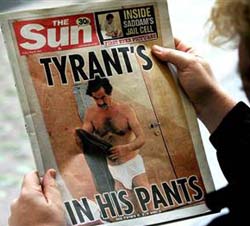
LONDON: A British tabloid has run a humiliating, half-naked photo feature on Saddam Hussein, the prisoner firmly in US military custody, sparking fears of an Arab backlash and an investigation into possible human rights abuses.
The US authorities have promised to investigate how and when the intimate photographs of the former Iraqi dictator wound up in The Sun , Britain's best-selling newspaper. The tabloid, frontpaged on Friday a photograph of a bare-chested Saddam standing in white underpants and folding a pair of trousers.
The photograph is headlined 'Tyrant's in his pants' and sets the tone for still more humble ones inside the tabloid. The inside photographs show the man who once had a palace in every part of Iraq meekly washing his clothes by hand. Yet another photograph shows Saddam asleep on his bed. The Sun , which refused on Friday, to reveal where, when and how it came by the sensational photographs of the Butcher of Baghdad, would only quote American military sources to say they handed over the photos in the hope of dealing a body blow to the resistance in Iraq.
"Saddam is not superman or God, he is now just an ageing and humble old man. It's important that the people of Iraq see him like that to destroy the myth," the American source is quoted to say. The source added, "Maybe, that will kill a bit of the passion in the fanatics who still follow him. It's over, guys. The evil days of Saddam's Baath Party are never coming back - and here's the proof." But a furore has erupted over the release of the photographs, with presumed American logistical support, from Saddam's American-run prison, at a compound near Baghdad since his December 2003 capture.
British military experts pointed out that the photographs, which may or may not be up to one year old, could still be deemed to have contravened Saddam's rights as a prisoner and could have violated the Geneva Convention.
West Asian observers said the photographs of the toppled dictator wearing nothing but white underpants risked re-igniting the Arab sense of burning rage over the Iraqi prisoner abuse scandal at Abu Ghraib. Under the Geneva Convention, Iraq's invaders, the US-UK-led military alliance, are not allowed release photographs and details about prisoners of war such as Saddam.
Saddam's status as a high-profile prisoner of the West makes the photographs particularly sensitive because Arabs might feel the West is poking fun at it.
Western diplomats said the photographs could spark a new wave of violence against the West.
The photos of Saddam also appeared in the New York Post, which - like the British tabloid 'The Sun' - is owned by die-hard Israeli supporter and media mogul Rupert Murdoch. It was also of note that the release of the pictures was designed to deal a "body blow" to the Iraq insurgency, the clear implication being that the Iraq insurgency is made up of Saddam loyalists, which is of course completely untrue. Since then, the insurgency has gone from strength to strength, despite the attempts by Israeli and US covert intelligence to demonise them through the use of "false flag" operations. Yet it suited the US and Israel very well for the world to believe the lie that the Iraqi insurgents are a fringe group of supporters of an evil tyrant rather than the truth: that they are, in fact, ordinary Iraqis attempting to oust a foreign occupying power.
At his second day in court (his third public appearance), again the world and even his lawyers were denied the opportunity to hear "Saddam" give evidence in his own words, and were provided with only short video segments with the former dictator's words interpreted for us by the US military.
Saddam Back In Court
Tuesday June 14, 2005
The GuardianAppearing by turns pensive and quizzical, Saddam Hussein returned to public view yesterday when Iraq's special tribunal released video images of the former president being interrogated.
The first official pictures since his court appearance last July were mute but a tribunal statement said he was being questioned about a 1982 massacre at a Shia village north of Baghdad, one of the cases expected to arise at his trial.
Saddam's chief lawyer, Khalil al-Duleimi, said he would have to view the video before commenting. The tribunal said Mr Duleimi was present during the filming.
However, a London-based member of the defence team, Giovanni di Stefano, said the former president was without legal assistance during the video and that it would be inadmissible in the trial.
The defence team has accused the tribunal of denying it proper access to the ousted dictator, withholding documents and leaking information to the press.
Since that time, the trial of "Saddam" has resembled a south American soap opera more than a credible trial, with constant adjournments and outbursts from just about everyone involved in the show, not to mention the untimely and suspicious deaths of several of "Saddam's" lawyers, the murder of the only witness to Saddam's alleged mass graves, and the testimony of one of Saddam's lawyers that he was psychologically disturbed, terrified about his possible execution, urinated on himself several times during the interview and broke into tears without reason. Par for the course, I suppose, in the judicial system of a country that is entirely controlled by the psychopathic leaders of another.
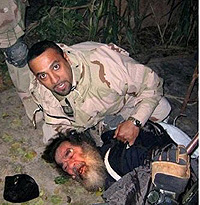
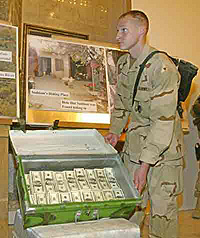
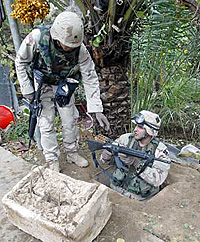
But let's back up a little to the time of the actual capture of "Saddam". You may remember images of the unearthing from a "rat hole" of some old bugger on a farm in the village of al-Dwar near Saddam's home town of Tikrit in December 2004. This, we were told, was "Saddam", finally captured more than 7 months after Bush had bravely declared "Mission Accomplished" from the safety of an American aircraft carrier docked in an American port. Images of the capture scene revealed a hole in the ground and a prone and disheveled santa-claus-type character with a burly American soldier poised over him for the 'money shot'. The money as it happens, was produced soon thereafter, $750,000 in crisp $100 dollar bills in a nice metal box, but it wasn't long before suspicions were raised by the presence of yellow dates on a tree at the entrance to the "rat hole" (below). You see, In Iraq, dates grow and ripen between March and August, with harvesting taking place between August and October. It is unlikely therefore that any variety of date would still be hanging on a tree in mid December in Iraq. At the very least, this information allows us to conclude that in all probability, "Saddam" was not captured in December as alleged by the US government, and that we are dealing with some sort of staged show for the general public.
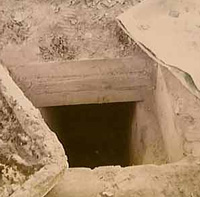
Indeed, it seems that a planned and staged "capture" of "Saddam" was common knowledge in political circles in Washington in 2004:
McDermott in Hot Water for Saddam Quip
By MATTHEW DALY
Associated Press Writer
December 15, 2003WASHINGTON -- Rep. Jim McDermott, D-Wash., who earned headlines across the globe last year for criticizing President Bush while in Baghdad, is enmeshed in a new controversy over remarks he made about the capture of Saddam Hussein.
In an interview Monday with a Seattle radio station, McDermott said the U.S. military could have found the former Iraqi dictator "a long time ago if they wanted."
Asked if he thought the weekend capture was timed to help Bush, McDermott chuckled and said, "Yeah. Oh, yeah."
McDermott went on to say, "There's too much by happenstance for it to be just a coincidental thing."
When interviewer Dave Ross asked again if he meant to imply the Bush administration timed the capture for political reasons, McDermott said: "I don't know that it was definitely planned on this weekend, but I know they've been in contact with people all along who knew basically where he was. It was just a matter of time till they'd find him.
"It's funny," McDermott added, "when they're having all this trouble, suddenly they have to roll out something."
State Republicans immediately condemned McDermott's remarks, saying the Seattle Democrat again was engaging in "crazy talk" about the Iraq war. [...]
In these troubled times, the truth is labeled "crazy talk". Remember that Mc Dermott wasn't the only US politician to hint that the was more to the capture of Saddam than the public were being told.
LaHood: Hussein's capture imminent
Pantagraph Staff
Tuesday, December 2, 2003
BLOOMINGTON -- U.S. Rep. Ray LaHood held his thumb and forefinger slightly apart and said, "We're this close" to catching Saddam Hussein." [...]A member of The Pantagraph editorial board -- not really expecting an answer -- asked LaHood for more details, saying, "Do you know something we don't?"
"Yes I do," replied LaHood. [...]
So on the 2nd December 2003, a full 11 days before "Saddam" was actually "captured" by US troops, LaHood all but admitted that Saddam had already been captured. Are we to believe that he was left lying in his "rat hole" under vegetables for so long? If not, where was he?
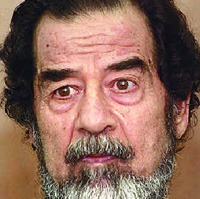
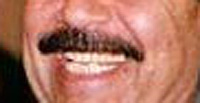
Let's pause for a moment and have a closer look at the physical evidence for the claim that the real Saddam was captured almost three years ago. Consider the following images of "Saddam" and Saddam, paying close attention to the teeth of both men:
Is this the same man? Check out the teeth
Notice anything?
Is this the same man? While I am not claiming that these images provide conclusive proof that we are dealing with two different men, it does seem reasonable to suggest that there is cause for significant doubt. The source of the problem here is the fact that the US government had only to claim that this man is the real Saddam for the vast majority of people to accept it as fact. In the months prior to his capture, news reports were increasingly informing the public that US troops were searching for Saddam and were "closing in" on him. Then, when anticipation was deemed to be at its height: "Bingo" "We got him!" With such a build up of expectation among the general population that Saddam would "soon be captured" there was no real chance that anyone was going to look closely at the details when the event finally occurred. The fact remains however that when all of the evidence IS scrutinized, we are led to the conclusion that it is highly improbable that the man that was "caught" in a "rat hole" in December 2003, appeared in court in July 2004, was splashed across the British tabloids in May 2005, and yesterday was sentenced to death, is in fact the real Saddam Hussein.
Indeed, is laughable to suggest that Saddam would ever have allowed himself to be demeaned in this way. Indeed, it is laughable that the Americans would have allowed Saddam to be demeaned in this way. While Saddam was a tyrant, and no worse than the many other tyrants that the US placed in power (or those currently in power in the US), he was first and foremost one of the power brokers of this world who controlled on one of the world's largest oil reserves. We should remember that Saddam was placed in power by the US and, for a long time, was flavor of the month in the US even receiving the keys to the city of Detroit in 1980 and serving as a US ally in the Middle East until 1991 when he was baited to invade Kuwait and provide justification for the first Gulf War. After that he was allowed to remain in power until he could be used again, and for the last time, as the boogey man to facilitate a direct US invasion of Iraq.
For such service there are surely some rewards. So if this is not the real Saddam but a useful idiot and stand in, where is the real Saddam? Well, if we are to believe the words of Donald Rumsfeld (for once) just prior to the 2003 Iraq invasion, the most plausible answer is that, for the last 3 years, the real Saddam has been living it up in Belorussia, having been flown out by the USAF just before Baghdad was "taken".
Iraqi Commander Swears he saw USAF fly Saddam out of Baghdad
Bill Dash
Alamo Christian Ministries Online
10/16/2003Film will soon be made public of an Iraqi Army officer describing how he saw a US Air Force transport fly Saddam Hussein out of Baghdad. The explosive eyewitness testimony was shot by independent filmmaker Patrick Dillon, who recently returned from a risky one-man odyssey in Iraq. In the film, the officer, who told Dillon that he commanded a special combat unit during the battle for Baghdad airport and whose identity is temporarily being withheld, explains in detail how he watched as the Iraqi dictator and members of his inner circle were evacuated from Iraq's capital by what he emphatically insists were United States Air Force cargo planes. [...]
Dillon says his film lends major support to what many have believed for years: that Saddam was little more than an american tool, a stage-managed "evildoer", just one in a long line of useful villains bought and paid for by the United States in order to better manipulate international politics and commerce. [...]
Hussein Given Safe Haven in Belarus?
The World Tribune - 25 April 2003
Iraqi President Saddam Hussein has obtained safe haven in Belarus, several intelligence agencies believe.
Western intelligence sources said several intelligence agencies in the Middle East and Europe base this assessment on new information about a March 29 flight from Baghdad to Minsk. They said the flight of a chartered cargo plane could have transported Saddam, his sons and much of his family to Belarus.
"There's no proof that Saddam was on the plane but we have proof that a plane left on that day from Baghdad airport and arrived in Minsk," a senior intelligence source said. "If you can think of anybody else who could obtain permission to fly out of Baghdad in the middle of a war, then please tell me."
U.S. officials and Iraqi opposition sources said Saddam and his sons appear to have escaped two assassination attempts during the war. But they did not confirm the registration of a cargo flight from Baghdad to Minsk on March 29, Middle East Newsline reported.
The sources said the cargo aircraft took off from an unspecified Baghdad-area airport and entered Iranian air space on the flight toward Minsk. They said Iran did not attempt to interfere with the Iraqi flight.
About two weeks later, a registration of the cargo flight was found by the U.S. military in wake of the capture of the airport and the rest of the Baghdad area. Baghdad International Airport was captured on April 4.
U.S. officials said Saddam had been exploring the prospect of fleeing to Belarus over the last year. They said the Iraqi ruler was in close contact with Belarus President Alexander Lukashenko and that Minsk became a major military supplier to Baghdad.
Within hours after the departure of the cargo flight to Minsk on March 29, the Saddam regime was awash with rumors that the president had escaped. Intelligence sources said the rumors spread rapidly throughout the military command and among field officers.
"There was a significant decline in Iraqi combat strength starting from around March 31," an intelligence source said. "In interviews with coalition interrogators, Iraqi commanders have attributed the decline in combat to the feeling that Saddam had fled."
While the above article is interesting and informative, it fails to draw one critical conclusion: Given that coalition forces had complete mastery over Iraqi airspace, the US government must have authorised Hussein's flight out of Iraq.
Saddam may find refuge in Belarus Says Rumsfeld
Ottawa Citizen
31.12.2002The former Soviet republic of Belarus has emerged as a possible refuge for Saddam Hussein after American officials hinted that the Iraqi leader might be allowed to flee into exile to avert a U.S. assault on Baghdad.
A visit to Iraq by a presidential delegation from Belarus last week coincided with a suggestion by U.S. Defence Secretary Donald Rumsfeld that Mr. Saddam and his family could "leave the country."
Mr. Rumsfeld said in a television interview: "If he doesn"t care to give up his weapons of mass destruction, then he"s got the choice of leaving."
As military preparations intensified with the mobilization of two more aircraft carrier battle groups and a 1,000-bed hospital ship, U.S. officials emphasized that no deal had been struck to allow Mr. Saddam to escape.
Mr. Rumsfeld's remark may have been no more than a psychological gambit intended to stir confusion in Baghdad.
Yet the Belarus visit heightened American suspicion that Mr. Saddam might be making contingency plans for a last-minute dash.
While it remains far from certain that the Iraqi dictator would flee, Mr. Rumsfeld recently singled out Belarus as one of the few countries that might offer him sanctuary.
"If Saddam Hussein is in a corner, it is because he has put himself there," he told a congressional committee.
"One choice he has is to take his family and key leaders and seek asylum elsewhere. Surely one of the 180-plus countries would take his regime - possibly Belarus."
The former Soviet republic has become a pariah state under the dictatorial rule of President Alexander Lukashenko and is suspected of violating United Nations sanctions against Iraq.
debka.com
However, according to our information, the deposed ruler and his sons were carried to safety in Minsk in late March aboard two chartered airliners. This week, the Polish news agency PAP sent a team of reporters to the Belarus capital to check on this account. They quote Natalia Pietkiewicz, spokesperson at President Aleksandr Lukashenko's bureau, as evading a direct reply when asked if the former Iraqi ruler was in the country. She said: "We have no information that Saddam Hussein is in Belarus." This is a long way from a flat denial.
The big question is how did the trio and its following of several hundred manage to elude coalition air forces, by then in full command of Iraqi skies, a question which leads to another: How did the men at the pinnacle of enemy power come to survive the two wars the Bush administration fought in less than two years?
This last question is an excellent one and goes right to the heart of the matter. The simple answer is that these "enemies" were not enemies at all, but either useful idiots or actual agents of the US government. As such, when they were no longer useful, they were retired from service, with an excellent pension.
Consider also the testimony of Former Russian Prime Minister Primakov that Saddam had made a "pre-war deal" with the US...
24/06/2004 - (SA)
News24.comMoscow - Former Iraqi leader Saddam Hussein cut a deal with the United States before the March 2003 invasion of Iraq, former Russian prime minister Yevgeny Primakov said in an interview published on Thursday.
"There was an understanding with the Americans, as paradoxical as it may seem," Primakov told the Russian daily Gazeta in a lengthy interview.
"Why weren't the bridges of the Tigris blown up when the American tanks approached Baghdad? Why weren't Iraqi aviation and tanks used, and where are they now?" asked Primakov, a former head of the Russian secret service and a specialist in Arab affairs who was formerly on good terms with Saddam.
"Why was there an immediate ceasefire? Why was there practically no resistance a year ago?" he added.
Primakov, who now heads Russia's chamber of trade and industry, also cast doubt on the authenticity of footage of Saddam's reported capture that circled the world on December 14.
"They showed two soldiers with guns with palm trees in the background near the hole (where Saddam was reportedly hiding). At that time of year, date palms are never in bloom," he said.
"Finally, any man can tell you that such a long beard (as Saddam had when he was reportedly caught) could not grow in seven months," he said.
"All evidence suggests that Saddam surrendered earlier and the story of the hole was invented later," he said.
Primakov, who was also Russian foreign minister, made two secret trips to Iraq at the request of President Vladimir Putin, shortly before the invasion by US and British troops.
Iran then backed up the Russian Prime Minister's story...
Iran Media Leaks Secret US Deal with Saddam
Gulf News Apr 15, 2003AN Iranian news agency close to top conservative military figures attributed the fall of Baghdad to a secret tripartite agreement between Saddam Hussein, Russia and the US.
According to the Baztab agency, 13 days after the start of the war, Saddam and Russian intelligence allegedly pledged to hand over Baghdad with minimal resistance to allied forces provided they spared the lives of Saddam and a hundred of his close relatives. The US, for its part, promised to safely send Saddam and his entourage to a third country.
Baztab added that Mohammed Saeed Al Sahaf, Iraqi Information Minister, was instructed to stay in Baghdad until the very last moments to lend the impression that everything in Saddam's camp was under control. The agency also claimed that Russia gained $5 billion to orchestrate this agreement. [...]
Saddam's wife could not recognize her husband
04/13/2004
Pravda.ruLast week, American authorities arranged a meeting of the former Iraqi dictator with his wife.
She was the first of Hussein's relatives to meet with the ex-leader of Iraq at a new place, at the American military base in Qatar. Accompanied by Sheikh Hamad Al-Tani, Sajida Heiralla Tuffah has arrived from Syria on his private jet in the end of March.
The outcome of their meeting turned out to be quite scandalous. Sajina claims that the person she encountered was not her husband, but his double. If someone were to say for sure that it was not insinuation, it would have been easy to believe the wife with a 25-year experience. It is also possible to assume that Saddam has simply changed since the day of his sons' deaths, June 24 2003. This however is highly unlikely. In case we believe Hussein's wife, all DNA testing of the ex-Iraqi leader should be considered a mere fake. Overall, today there remain more questions then there are answers.
It is of note that since his capture, and with the exception, or perhaps because, of the above meeting, "Saddam" has not been allowed to see any family members, friends, or lawyers of his choice. Saddam's daughter, also appearing to recognise that something was amiss, stated at the time that the images of "her father" in court led her to believe that he was drugged that he was "not fully conscious". A few days after his capture, ordinary Iraqis reacted skeptically to the news that this was indeed the real Saddam.
Iraqis doubt real Hussein behind barsGlobe and Mail
December 18, 2003Baghdad - Jassim Abu Ahmed almost spits his disgust at the television set showing yet another image of the dazed and bedraggled Saddam Hussein.
"It's not him," Mr. Ahmed says, waving his hand and looking away from the screen.
In an interview given to Deborah Moore in July 2004, one of Saddam's "lawyers", Giovanni Di Stefano, stated categorically that Saddam would not face execution and would not be handed over to Iranian authorities who are seeking his extradition for alleged war crimes during the Iran/Iraq war. When asked how he knew this he stated that he would not say anymore on the matter.
Interestingly, Di Stefano claims to have "the greatest respect" for Salem Chalabi, nephew of CIA asset and recently appointed Iraqi Deputy PM and "oil minister", Ahmed Chalabi. An article from the Arab-American Institute tell us that, not long after the "fall of Baghdad" (a misnomer if there ever was one):
Salem Chalabi established the Iraq International Law Group (IILG), which describes itself as "your professional gateway to the new Iraq." Assisting Salem in setting up the IILG was a partner Marc Zell (the IILG's website has been registered in Zell's name). Zell is an Israeli settler of the Gush Emunim (Bloc of the Faithful) stripe. Here the plot thickens.
Zell had for many years been Feith's partner in their Washington-Tel Aviv law firm, Feith and Zell (FANDZ). FANDZ had been set up when Feith left government to pursue the work of a "foreign agent" representing Turkey and some Israeli interests.
Following the Baghdad opening of the IILG, Zell soon opened, in the U.S., an office for Zell, Goldberg & Co., which promises to assist "American companies in their relations with the U.S. government in connection with Iraq's reconstruction projects." It is interesting to note that Zell, Goldberg still uses the website FANDZ, the site of the old Feith and Zell firm. So when Zell boasts his connections to government, businesses know exactly what is meant.
In the relatively short period of time since the fall of the Ba'ath Party regime, IILG and Zell, Goldberg have facilitated contracts in the tens, possibly hundreds of millions of dollars.
Salem Chalabi incidentally has also been appointed by the Coalition Provisional Authority to head the Iraqi tribunal that will investigate and prosecute the crimes Saddam and his cohorts committed against the Iraqi people. His uncle is meanwhile railing against the former regime's corruption and demanding the right to investigate profiteering and kick-backs he alleges occurred in the UN's food for oil program.
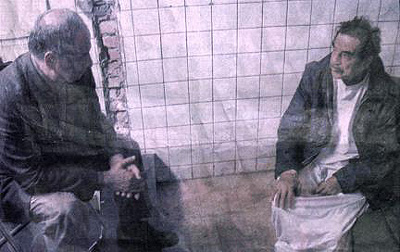
Feith and Calabi were at the forefront of the plundering of Iraq's resources in order to fill the coffers of American and Israeli big business. Feith also promised the Israelis and their U.S. supporters that, not only would post-Saddam Iraq trade with Israel, but it would resurrect the Iraq-Israel pipeline for oil export. Given that Chalabi is clearly in bed with the Neocons - the architects of the illegal Iraq war - AND the chief prosecutor of Saddam, it is a little troubling, although not at all surprising that one of Saddam's lawyers would have the "greatest respect" for Chalabi, or that Ahmed Chalabi met with "Saddam" for at least one little chat not long after he was "captured"
Ahmed Chalabi discusses the finer points of "acting under the influence" with "Saddam" Even less surprising is the news that Di Stefano is a convicted fraudster with a client list of mostly mass murderers, and with his praise for a liar and thief like Chalabi who could be shocked to learn that Di Stefano may not actually be a lawyer at all.
Such sordid relationships between repugnant reprobates simply add to our suspicions that the entire Saddam capture, trial and now death sentence is nothing more than a carefully planned publicity stunt, employing a fake Saddam periodically pulled out on stage in order to maintain the illusion. The producers of this dodgy drama are, however, extremely careful to limit the exposure of their lead actor lest the truth that he is an imposter should become more apparent than it already is.
Despite the fact that "Saddam" has been sentenced to death, there is a potentially lengthy appeal process to be suffered before it is decided if he will actually face the hangman's noose, so we must wait to see if Di Stefano had some "inside" information in this matter. Perhaps Saddam's appeal will take approximately 2 years, with an execution date just happening to coincide with the next US elections, or, perhaps the US government has decided that, with the intial guilty verdict, there is little more in the way of propaganda to be extracted out of "Saddam", and with the help of the American mainstream media, the "evil dictator" will now fade from our collective awareness, whether we like it or not.
Have a question or comment about the Signs page? Discuss it on the Signs of the Times news forum with the Signs Team.
Some icons appearing on this site were taken from the Crystal Package by Evarldo and other packages by: Yellowicon, Fernando Albuquerque, Tabtab, Mischa McLachlan, and Rhandros Dembicki.
Remember, we need your help to collect information on what is going on in your part of the world!
Send your article suggestions to:


![Validate my Atom 1.0 feed [Valid Atom 1.0]](http://signs-of-the-times.org/signs/images/valid-atom.png)