|
PETROPAVLOVSK-KAMCHATSKY, December 4 (RIA Novosti)
The Karymsky volcano on the Kamchatka peninsula in Russia's Far East has increased its activity, spewing ash up to an altitude of 6,900 meters (22,637 feet), the local emergencies center said Monday.


|
|
By Lucy Sherriff ? More by this author
Published Monday 4th December 2006 10:22 GMT Scientists have found evidence that the seeds of life may indeed have fallen from the sky.
Analysis of a meteorite that fell onto the frozen Tagish Lake in Canada in 2000 has shown the space rock to be riddled with organic material that is at least as old as the solar system itself. Researchers speculate that this kind of matter could have played a vital role in the development of early life on Earth.
|
|
By: Spaceweather.com
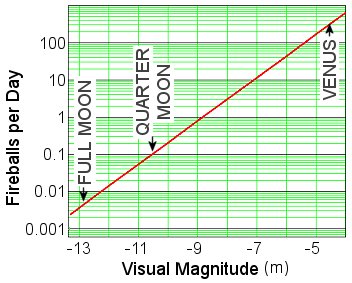
Published: Dec 4, 2006 at 07:03 Have you ever stepped outside after dinner to walk the dog--just in time to see a bright fireball streak across the sky? It makes you wonder, how often does that happen?
Pretty often, according to astronomer Bill Cooke of the Marshall Space Flight Center. Using a computer model of Earth's meteoroid environment, he made this plot showing the global number of fireballs per day vs. the brightness of the fireball:
Comment: So all of the reports in the newspapers? Furgettaboutit. Nothing important here, folks. Move along.
|

Have a question or comment about the Signs page? Discuss it on the Signs of the Times news forum with the Signs Team.
Some icons appearing on this site were taken from the Crystal Package by Evarldo and other packages by: Yellowicon, Fernando Albuquerque, Tabtab, Mischa McLachlan, and Rhandros Dembicki.

Remember, we need your help to collect information on what is going on in your part of the world!
Send your article suggestions to: 
Contact Webmaster at signs-of-the-times.org
Cassiopaean materials Copyright ©1994-2014 Arkadiusz Jadczyk and Laura Knight-Jadczyk. All rights reserved. "Cassiopaea, Cassiopaean, Cassiopaeans," is a registered trademark of Arkadiusz Jadczyk and Laura Knight-Jadczyk.
Letters addressed to Cassiopaea, Quantum Future School, Ark or Laura, become the property of Arkadiusz Jadczyk and Laura Knight-Jadczyk
Republication and re-dissemination of our copyrighted material in any manner is expressly prohibited without prior written consent.

![[Valid Atom 1.0]](/signs/images/valid-atom.png "Validate my Atom 1.0 feed")


The Gladiator: John Fitzgerald Kennedy
John F. Kennedy and All Those "isms"
John F. Kennedy, J. Edgar Hoover, Organized Crime and the Global Village
John F. Kennedy and the Psychopathology of Politics
John F. Kennedy and the Pigs of War
John F. Kennedy and the Titans
John F. Kennedy, Oil, and the War on Terror
John F. Kennedy, The Secret Service and Rich, Fascist Texans
Recent Articles:
New in French! La fin du monde tel que nous le connaissons
New in French! Le "fascisme islamique"
New in Arabic! العدوّ الحقيقي
New! Spiritual Predator: Prem Rawat AKA Maharaji - Henry See
Top Secret! Clear Evidence that Flight 77 Hit The Pentagon on 9/11: a Parody - Simon Sackville
Latest Signs of the Times Editorials
Executing Saddam Hussein was an Act of Vandalism
Latest Topics on the Signs Forum |
Signs Monthly News Roundups!
June 2005
July 2005
August 2005
September 2005
October 2005
November
2005
February 2006
March 2006
April 2006
May 2006
June 2006
July 2006
August 2006
September 2006
This
site best viewed
with Mozilla Firefox

Picture of the Day



by a QFS member
Seen by over 1 BILLION people!
Books by Signs of the Times
Books by Red Pill Press