Summary
Israeli violations of international law continued in the OPT during the reported period (9 - 15 November 2006):
Killing: During the reported period, IOF killed 6 Palestinians, including two children, and wounded 17 others, including 9 children.
In the Gaza Strip, on Sunday morning, 12 November 2006, IOF killed a Palestinian child, when they fired a surface-to-surface missile at a number of children, who were standing near a launcher of home-made rockets in the northern Gaza Strip town of Beit Lahia. Two other children were wounded. Four Palestinians, including 3 civilians, died from previous wounds they had sustained during the IOF offensive on the northern Gaza Strip. Also on Sunday morning, IOF fired at a Palestinian civilian, who suffers from a psychological disorder, in the east of Khan Yunis, wounding him. Thus, the number of Palestinians killed by IOF since the beginning of the offensive on the northern Gaza Strip has mounted to 83 Palestinians, including 54 civilians. In addition, 264 Palestinians, mostly civilians, including 76 children and 60 women, have been wounded.
IOF also launched 5 air strike on 4 houses and a commercial store in the Gaza City and Jabalya town. As a result, 3 of these houses and the store were destroyed and a number of neighboring houses were severely damaged. IOF often warn residents of houses of their intention to attack them a very short time prior to the attack.
In the west Bank, on Tuesday, 14 November 2006, IOF killed a member of the Palestinian resistance in 'Ein Beit al-Maa' refugee camp, west of Nablus. He bled to death as IOF prevented ambulances from entering the camp for several hours. In addition, 13 Palestinian civilians, including 8 children, were wounded by the IOF gunfire in the West Bank. Moreover, IOF wounded and arrested a Palestinian in Ramallah, claiming that he was wanted.
Incursions: During the reported period, IOF conducted at least 30 military incursions into Palestinian communities in the West Bank, during which they raided houses and arrested 55 Palestinian civilians, including 6 children and two women. IOF also raided, searched and closed offices of the Palestinian Center for Media and Studies in Tulkarm. They also raided offices of al-Ihsan Charitable Society in the town, which was closed last year.
In the Gaza Strip, IOF moved into al-Shouka village, east of Rafah. They raided and searched a number of houses and transformed 3 of them into military sites. They also gathered and interrogated Palestinian civilians aged 15-45.
Restrictions on Movement: IOF have continued to impose a tightened siege on the OPT and imposed severe restrictions on the movement of Palestinian civilians in the Gaza Strip and the West Bank, including Occupied East Jerusalem.
Gaza Strip
IOF have imposed a strict siege on the Gaza Strip. They have closed its border crossings as a form of collective punishment against Palestinian civilians.
IOF have closed Rafah International Crossing Point since 25 June 2006, even though they do not directly control it. During this period, the crossing point was reopened on 14 and 15 November 2006, and hundreds of Palestinian were able to travel through it. Since 15 June 2006, the crossing point has been opened for 20 separate days. On 15 November 2006, the Palestinian - Israeli agreement on border crossing, which was concluded under US and European supervision, expired. Under this agreement, IOF have maintained indirect control over of the crossing point. The European observation team working at the crossing point extended their mission for additional 6 months. IOF have imposed severe restrictions at commercial crossings of the Gaza Strip, especially al-Mentar (Karni) crossing. As a consequence, the economic situation inside the Gaza Strip has further deteriorated and many goods have been lacked in markets. During the reported period, IOF partially reopened Sofa crossing near Rafah for two days, while Kerem Shalom crossing has remained closed. IOF have also continued to close Erez crossing in the northern Gaza Strip. Hundreds of thousands of Palestinians from the Gaza Strip had been prevented from traveling through this crossing. IOF have allowed international workers to pass through the crossing. With this closure, only few Palestinian patients have been able to travel to hospitals in Israel and the West Bank. In addition, IOF have continued to prevent Palestinian fishermen from fishing for 5 months.
West Bank
IOF have tightened the siege imposed on Palestinian communities in the West Bank. They have isolated Jerusalem from the rest of the West Bank. IOF positioned at various checkpoints in the West Bank have continued to impose severe restrictions on the movement of Palestinian civilians. IOF have continued to separate between the north and south of the West Bank. On Saturday, 11 November 2006, IOF imposed severe restrictions on the movement of Palestinian civilians wishing to travel to Ramallah to participate in the commemoration of the second anniversary of the death of President Yasser Araafaf. During the reported period, IOF positioned at various checkpoints in the West Bank arrested 5 Palestinian civilians.
Annexation Wall: IOF have continued to construct the Annexation Wall inside the West Bank. During the reported period, IOF started to construct a new section of the Wall to the south of 'Azzoun-'Atma village, south of Qalqilya. The new section of the Wall is expected to isolate at least 4,000 donums[1] of agricultural land, 10 houses and a well. On Thursday morning, 9 November 2006, IOF surveillance teams started to survey on the lands of Um Salamouna village, south of Bethlehem. According to local sources, the surveyed areas of land would be razed to establish a crossing point separating the village from neighboring villages and from the Wall. On Sunday, 12 November 2006, IOF issued a military order seizing more areas of Palestinian land in 'Anata village, north of occupied Jerusalem, to establish "a security fence" north of "Ma'leh Adomim" settlement, east of Jerusalem. On Monday morning, 13 November 2006, IOF started to raze areas of land in Wadi Rahhal village, south of Bethlehem, to construct a new section of the Wall in the area.
Illegal Settler Activities: Israeli settlers in breach of international humanitarian law continue to reside in the OPT and have launched a series of attacks against Palestinian civilians and property. During the reported period, Israeli settlers attacked dozens of schoolchildren in al-Tawani village, south of Hebron, injuring a number of them. Israeli settlers also attacked a house in the center of Hebron. In addition, IOF prevented Palestinian farmers from reaching their agricultural land near "Ma'oun" settlement, south of Hebron. They also prevented a number of Palestinian civilians from reaching their agricultural land near "Tilim" settlement, west of Hebron, to cultivate olives.
The outcome of crimes committed by IOF since 25 June 2006:
o 434 Palestinians, 275 of whom are civilians, including 82 children and 25 women, have been killed by IOF.
o At least 1456 Palestinians, mostly civilians, including 424 children and 107 women, have been wounded by the IOF gunfire.
o At least 315 air-to-surface missiles and hundreds of artillery shells have been fired at Palestinian civilian and military targets in the Gaza Strip.
o Buildings of the Palestinian Ministry of Interior, the Ministry of Foreign Affairs and the Ministry of National economy, the office of the Palestinian Prime Minister and a number of educational institutions have been destroyed.
o The electricity generation plant, providing 45% of the electricity of the Gaza Strip, was destroyed, and electricity networks and transmitters have been repeatedly attacked.
o 6 bridges linking Gaza City with the central Gaza Strip and a number of roads have been destroyed.
o Hundreds of donums of agricultural land and dozens of houses have been destroyed.
o Hundreds of Palestinian civilians, including 10 ministers and 31 members of the Palestinian Legislative Council (PLC), including the Speaker, Deputy Speaker and Secretary, have been arrested. Minster of Prisoners' Affairs, Deputy Prime Minister, Minister of Labor and Second Deputy Speaker of the PLC were released.
o The Palestinian governmental compound in Nablus has been destroyed.
o Many families in Rafah, Beit Hanoun and Beit Lahia have been forced to leave their houses.
o IOF intelligence has warned some Palestinian civilians in the Gaza Strip by phone to evacuate their houses, which would be attacked.
o 61 houses belonging to activists of Palestinian factions have been destroyed by IOF warplanes.
o IOF have imposed a strict siege on the OPT, and have isolated the Gaza Strip from the outside world.
Israeli Violations Documented during the Reporting Period (9 - 15 November 2006)
1. Incursions into Palestinian Areas and Attacks on Palestinian Civilians and Property in the West Bank and the Gaza Strip
Thursday, 9 November 2006
- At approximately 01:00, IOF moved into al-Zeer neighborhood in the south of Bethlehem. They raided and searched a number of houses and arrested 3 Palestinian civilians:
1. Ibrahim Salim al-Zeer, 23;
2. Yasser Mahmoud 'Awadallah, 21; and
3. Mohammed Mahmoud 'Awadallah, 24.
- Also at approximately 01:00, IOF moved into Taqqou' village, southeast of Bethlehem. They raided and searched a house belonging to the family of Ahmed Salim al-Badan, 24, and arrested him.
- At approximately 02:00, IOF moved into Nablus and neighboring refugee camps. They raided and searched a number of houses and arrested 3 Palestinian civilians:
1. Rami Ghazi Zahran, 26;
2. Sa'id Mas'oud Khaled, 54; and
3. 'Aaa' Na'im al-Sourkaji, 24.
- At approximately 02:15, IOF moved into Jenin town and refugee camp. They raided and searched a number of houses and arrested 9 Palestinian civilians, including two children:
1. 'Emad Khaled al-Damaj, 32;
2. Mahmoud Khaled al-Damaj, 25;
3. Najeeb Khaled al-Damaj, 24;
4. Taher Mohammed al-Damaj, 27;
5. Ibrahim Mohammed al-Damaj, 23;
6. Isma'il Mohammed al-Damaj, 17;
7. Mohammed 'Afeef al-Damaj, 25;
8. 'Ali Mohammed al-Damaj, 16; and
9. Fadi Mahmoud 'Abdullah, 22.
- At approximately 03:30, IOF moved into Tammoun village, southeast of Jenin. They raided and searched a house belonging to 'Ali Samara Bani 'Ouda. They interrogated members of the family and threatened to kill the owner's son, 'Abdul Qader, if he didn't surrender to them. IOF also raided and searched a house belonging to the family of Mohammed Suleiman Bisharat, 27, and arrested him.
- At approximately 04:00, IOF moved into al-Sawahra village, southeast of occupied Jerusalem. They raided and searched a house belonging to the family of Mahmoud Jameel Ja'far, 22, and arrested him.
- At approximately 10:00, hundreds of Palestinian civilians organized demonstrations in Hebron in protest to the massacre committed by IOF in the northern Gaza Strip town of Beit Hanoun. A number of demonstrators threw stones at IOF vehicles. Immediately, IOF soldiers fired at the demonstrators, wounding 5 of them:
1. Ziad As'ad al-'Ajlouni, 20, seriously wounded by a live bullet to the chest;
2. fadi 'Abdul Rahman Harbawi, 17, wounded by a rubber-coated metal bullet to the face;
3. Fadi Wa'el Salhab, 20, wounded by a rubber-coated metal bullet to the forehead;
4. Mohammed Nazmi al-Swaiti, 18, wounded by a rubber-coated metal bullet to the left leg; and
5. Mohammed Mazen Kawahla, 13, wounded by a rubber-coated metal bullet to the right shoulder.
Friday, 10 November 2006
- At approximately 01:00, IOF moved into Habla village, south of Qalqilya. They detonated sound bombs near a number of houses, damaging a house belonging to 'Abdullah Mohammed ;Ouda. They then raided and searched two houses and arrested two Palestinian civilians:
1. Jaber Mohammed 'Ouda, 20; and
2. Adham Rabah 'Ouda, 22.
- At approximately 01:15, IOF moved into Wadi Ma'ali neighborhood in the south of Bethlehem. They raided and searched a number of houses and arrested two Palestinian civilians:
1. Ahmed Mustafa Abu al-Kamel, 45; and
2. Yasser 'Abdullah Eskafi, 42.
- At approximately 01:30, IOF moved into Abu Dis town, east of occupied Jerusalem. They raided and searched a house belonging to the family of 'Atiya Hanin 'Eraikat, 25, and arrested him.
- At approximately 02:00, IOF moved into al-Khader village, southwest of Bethlehem. They raided and searched a house belonging to Khaled Jameel al-Da'dou', 40, and arrested him.
- Also at approximately 02:00, IOF moved into Abu Rumman neighborhood in the southwest of Hebron. They raided and searched a house belonging to Kazem Mershed al-Qasrawi, 35, and arrested him.
- At approximately 10:00, Palestinian medical sources declared that Bassem 'Abdul Hadi al-Kafarna, 39, died at an Israeli hospital from a wound he had sustained on Wednesday morning, 8 November 2006, when IOF shelled houses in the northwest of Beit Hanoun. This attack killed 18 Palestinian civilians and wounded 56 others. Thus, the number of Palestinian civilians killed in the attack has increased to 19.
- At approximately 21:00, IOF moved into Beit 'Awa village, southwest of Hebron. They raided and searched a number of houses and arrested 5 Palestinian civilians:
1. Bassam Isma'il al-Shalaf, 25;
2. Mohammed 'Aqel al-Shalaf, 28;
3. Nasser 'Abdullah al-Masalma, 22;
4. Rezeq 'Ouda al-Masalma 31; and
5. Mahmoud 'Ali al-Swaiti, 19.
- At approximately 22:30, IOF moved into Nour Shams refugee camp, east of Tulkarm. They opened fire at houses, damaging a number of them. They withdrew from the camp later, and no casualties or arrests were reported.
Saturday, 11 November 2006
- At approximately 08:30, IOF moved into Housan village, west of Bethlehem. They patrolled in the streets and arrested two Palestinian children:
1. 'Ali Mohammed Shousha, 14; and
2. Fateem Mohammed Shousha, 14.
Sunday, 12 November 2006
- At approximately 01:00, IOF moved into Tulkarm. They broke into Da'bas Mall near Tulkarm Hospital. They raided offices of the Palestinian Center for Media and Studeis (Mass Press) on the second floor of the building, destroyed their contents and closed them. According to Mohammed Eshtaiwi, director of Mass Press, IOF soldiers confiscated two computer sets, television camera and a satellite receiver. It is worth noting that Mal Press provides media training courses. At the same time, IOF soldiers raided and searched the offices of al-Ihasan Charitable Society in 'Afeef Abu Safiya building in the east of the town. They damaged the contents of the office. IOF had closed the society last year.
- At approximately 02:00, IOF moved into Jenin town and refugee camp. They opened fire indiscriminately, and raided and searched a number of houses. They withdrew a few hours later, and no casualties or arrests were reported.
- Also at approximately 02:00, IOF positioned at the border between the Gaza Strip and Israel, east of Khan Yunis, fired at Bassem Jaber Abu Haleeb, 22, when he was walking near the border, he was wounded by a live bullet to the right foot. According to his family, he suffers from a psychological disorder.
- At approximately 08:00, Palestinian medical sources declared that Mohammed Nabeel Salim Abu Mo'awad, 18, from the northern Gaza Strip town of Beit Lahia, died from a wound he had sustained on Friday, 3 November 2006. According to PCHR's documentation, at approximately 21:30 on Friday, 3 November 2006, an IOF warplane fired a missile at a group of the Palestinian resistance and a number of Palestinian civilians in Be'r al-Na'ja area in the west of Beit Lahia, wounding a number of them. Half an hour later, an ambulance of Palestine Red Crescent Society arrived at the area to evacuate the wounded. Soon, an IOF warplane fired another missile at the area. As a result, two paramedics and 4 other Palestinians, including a child, were killed. In addition, 4 Palestinians, including Abu Mo'awad, were wounded.
- At approximately 08:55, IOF positioned at the border between the Gaza Strip and Israel, east of Jabalya, fired a surface-to-surface missile at a number of Palestinian children who were standing near a launcher of home-made rockets, nearly 400 meters away from Balsam Hospital in Beit Lahia. As a result, Mousa Ahmed Zuhod, 14, from Beit Lahia, was killed. Two other children were also wounded:
1. 'Abdullah 'Atiya Abu Namous, 17, wounded by shrapnel to the back and the left foot; and
2. Shadi Mahdi Zaher, 20, wounded by shrapnel throughout the body.
- At approximately 11:30, IOF moved into al-Zababda village, southeast of Jenin. They raided and searched a number of houses. They withdrew a few hours later and no arrests were reported.
- At approximately 12:00, medical sources at Shifa Hospital in Gaza City declared that Mahmoud Hassan Abu Hamada, 17, from Tal al-Za'tar area in Jabalya, died from a wound he had sustained on Monday, 6 November 2006. According to PCHR's documentation, at approximately 06:45 on Monday, 6 November 2006, IOF positioned at the border between the Gaza Strip and Israel, east of Beit Lahia town, fired a surface-to-surface missile at Jabalya Youth Club near Jabalya - Beit Lahia intersection. The missile fell nearly 15 meters away from a kindergarten bus that was at the intersection. A schoolchild was killed by shrapnel, and 16 others, including Abu Hamada, were wounded.
- At approximately 18:30, IOF moved into al-Doha village, southwest of Bethlehem. They raided and searched the building of al-Roa'a Television and a number of neighboring houses, and arrested Ma'ath 'Aatef Abu 'Akar, 15.
- At approximately 22:20, IOF moved into 'Ein Beit al-Maa' refugee camp, west of Nablus. They raided and searched a house belonging to the family of Mohammed Rafeeq Maraqa, 17, and arrested him.
- At night, Palestinian medical sources declared that Mohammed 'Abdullah Ibrahim Maqhaz, 21, a member of the Palestinian resistance, died at an Egyptian hospital from a wound he had sustained on Friday, 3 November 2006, when IOF soldiers positioned atop of houses in 'Izbat Beit Hanoun opened fire at a number of the Palestinian resistance.
Monday, 13 November 2006
- At approximately 00:00, IOF moved into Abu Snaina and Um al-Dalia neighborhood in the south and southwest of Hebron respectively. They raided and searched a number of houses and arrested two Palestinian civilians:
1. Hazem Ibrahim Abu Nijma, 25; and
2. Hamdi 'Abdul Qader al-Atrash, 27.
- At approximately 01:45, IOF moved into al-Rama neighborhood in the northeast of Hebron. They raided and searched a house belonging to Sami Is'haq al-Ja'bari, and arrested 3 of his sons: Mash'our, 21; Hamza, 24; and Hatem, 22.
- At approximately 03:00, IOF, reinforced by heavy military vehicles and helicopters, moved hundreds of meters into al-Shouka village, east of Rafah. They raided and searched a number of houses, and transformed them into a military sites. At approximately 09:00, IOF called through megaphones on residents of the area to get out of their houses and gather in one place. IOF soldiers interrogated them.
Tuesday, 14 November 2006
- At approximately 01:50, IOF, reinforced by a bulldozer and two helicopters, moved into 'Ein Beit al-Maa' refugee camp, west of Nablus. They patrolled in the streets and opened fire at houses. A number of members of the Palestinian resistances clashed with IOF. As a result of these clashes, a member of the resistance, 26-year-old Bahaa' Salah Khatari, was wounded by a live bullet to the left side. He bled to death. According to eyewitnesses, IOF prevented Palestinian medical crews until 11:40. During this incursion, IOF transformed the roofs of a number of houses into military sites. In the morning, a number of Palestinian civilians gathered and threw stones at IOF military vehicles. Immediately, IOF soldiers fired at these civilians, wounding 8 of them, including 6 children:
1. 'Obaida 'Abdullah Ghefari, 16, wounded by a live bullet to the right foot;
2. 'Emad Talal al-Barq, 16, wounded by a rubber-coated metal bullet to the chest;
3. Makkawi Sa'id Baghdadi, 16, wounded by two live bullets to the thighs;
4. Nidal Daman Qarqash, 16, wounded by a live bullet to the left thigh;
5. Israa' Ibrahim Salem, 17, wounded by a live bullet to the left thigh;
6. Rawhi Eyad Hourani, 18, wounded by a rubber-coated metal bullet to the testicles;
7. 'Aamer Dirar Barakat, 24, wounded by shrapnel to the left shoulder; and
8. Sabreen Ibrahim al-Damouni, 18, hit by a sound bomb to the face.
- At approximately 01:30, IOF moved into Shraim neighborhood in the center of Qaqlilya. They raided and searched a house belonging to Mahmoud 'Ali Shraim, 34. They forced him to accompany them to his shop in the center of the town, where he maintain computer sets. They confiscated at least 50 computer sets and arrested him. According to his family, IOF also confiscated at least 50,000 NIS (approximately US$ 11,700) and a number of cameras. Shraim is a cameraman of Reuters, and also maintain computer sets in his own shop.
- At approximately 02:00, an IOF warplane fired a missile at a store of used car parts belonging to Hashem Rabah al-Hatu in al-Zaytoun neighborhood in the east of Gaza City. The store was destroyed, a number of neighboring houses were damaged, and electricity was cut off.
- At approximately 02:30, IOF moved into Harmala village, southeast of Bethlehem. They raided and searched a number of houses and arrested 5 Palestinian civilians:
1. 'Abdullah Taleb 'Atallah, 27;
2. Waleed Taleb 'Atallah, 24;
3. Naji 'Ali 'Atallah, 28;
4. Rami Ahmed 'Atallah, 22; and
5. Mohammed 'Aadel 'Atallah, 21.
- Also at approximately 02:30, IOF moved into Taqqou' village, east of Bethlehem. They raided and searched a number of houses and arrested 3 Palestinian civilians:
1. Jom'a Ameen Sabbah, 20;
2. Haitham Yousef Sabbah, 18; and
3. Basheer Khaled Sabbah, 20.
Wednesday, 15 November 2006
- At approximately 01:30, IOF moved into al-Doha village, southwest of Bethlehem. They raided and searched a number of houses and arrested two Palestinian civilians:
1. Kifah Mahmoud al-Ja'fari, 33; and
2. Mohammed Tawfiq al-Zaghari, 27.
- At approximately 02:00, IOF moved into Jenin town and refugee camp. They raided and searched a number of houses and arrested two Palestinian civilians:
1. Haitham Ahmed al-Haj Saleh, 21; and
2. Ra'fat Ahmed al-Haj Saleh, 20.
- At approximately 02:30, IOF moved into al-Fawar refugee camp, south of Hebron. They raided and searched a number of houses and arrested Najah Mahmoud Abu Rabee', 33, a mother of 8 children.
- At approximately 16:00, an IOF undercover unit moved into Rukab Street in the center of Ramallah. Immediately, IOF soldiers opened fire at 'Omar al-Salfiti, 27. He was wounded and IOF soldiers arrested him. Israeli sources claimed that IOF arrested a wanted member of Hamas after seriously wounding him.
- At approximately 23:15, an IOF warplane fired two missiles at a 160-square-meter, 3-storey house, in which 16 people (3 families) live, belonging to 'Eissa Ahmed al-Shrafi in al-Shati refugee camp, west of Gaza City. As a result, the second floor of the house was totally destroyed, and other parts of the house were severely damaged. According to al-Shrafi's son, he received a call on his mobile phone from a person who introduced himself as an Israeli officer and told him that the house would be bombarded in 15 minutes.
- At approximately 23:30, an IOF fighter jet dropped a bomb on a 350-square-meter, 5-storey house, in which 43 people (10 families) live, belonging to Nehru Mahmoud Mas'oud and his brothers in Tal al-Za'tar area in the northern Gaza Strip town of Jabalya. The house was largely destroyed and 3 neighboring houses were severely damaged. According to a resident of the house, he received a call on his mobile phone from a person who introduced himself as an Israeli officer and told him that the house would be bombarded in 15 minutes.
- At approximately 23:55, an IOF fighter jet dropped a bomb on a 170-square-meter house, in which 10 people live, belonging to Nafez Mahmoud Salman in Tal al-Za'tar area in the northern Gaza Strip town of Jabalya. The house was destroyed and 12 neighboring houses were severely damaged. According to Salman, his wife received a call on her mobile phone from a person who introduced himself as an Israeli officer and told her that the house would be bombarded.
2. Continued Siege on the OPT
IOF have continued to impose a tightened siege on the OPT and imposed severe restrictions on the movement of Palestinian civilians in the Gaza Strip and the West Bank, including Occupied East Jerusalem.
Gaza Strip
Following an attack launched by Palestinian militants on 25 June 2006 near the Israeli-Egyptian border, southeast of Rafah, which left two IOF soldiers and two of the attackers dead and a third IOF soldier missing, IOF have closed all border crossings of the Gaza Strip:
- Rafah International Crossing Point: Rafah International Crossing Point on the Egyptian border is the sole outlet for the Gaza Strip to the outside world. IOF have closed Rafah International Crossing Point, even though they do not directly control it. They have prevented European observers working at the crossing point form reaching it. The crossing point, which has been closed since 25 June 2006, has been opened for only 18 separate days. On Tuesday and Wednesday, 14 and 15 November 2006, the crossing point was reopened and hundreds of Palestinians were able to travel through it.
On 15 November 2006, the Palestinian - Israeli agreement on border crossing, which was concluded under US and European supervision, expired. Under this agreement, IOF have maintained indirect control over of the crossing point. The European observation team working at the crossing point extended their task for additional 6 months. On 15 November 2005, the Palestinian National Authority (PNA) and Israel reached an agreement over the border crossings of the Gaza Strip. Under the agreement, on 25 November 2005, the Rafah International Crossing Point, on the Egyptian border in the south of the Gaza Strip, was opened for civilian travel to Egypt and the rest of the world. The Palestinians and European Union (EU) observers would run the Palestinian side of the crossing point. In addition, the EU observers would transmit live images to a joint control room several kilometers away. The EU observers repeated withdrew from the crossing following receiving warnings from IOF that there were threats to them. However, all warnings proved to be void, and the observers resumed their work.
- Beit Hanoun (Erez) Crossing: IOF have completely closed Beit Hanoun (Erez) crossing, which links the Gaza Strip with Israel and the West Bank. Before this latest closure, IOF had prevented Palestinian workers from reaching their work places inside Israel through Beit Hanoun (Erez) crossing since 12 March 2006. Hundreds of thousands of Palestinians from the Gaza Strip had been prevented from traveling through this crossing. IOF have allowed international workers to pass through the crossing. With this closure, few Palestinian patients have been able to travel to hospitals in Israel and the West Bank. Palestinian female patients aged under 40 from passing through the crossing, even though most of these patients are in serious conditions and suffer from serious diseases.
- Al-Mentar (Karni) Commercial Crossing: IOF have closed the crossing, which is the main commercial crossing for the Gaza Strip. As a consequence, the economic situation inside the Gaza Strip has further deteriorated and many goods have been lacked in markets. During the reported period, IOF partially reopened the crossing. They allowed the importation of foodstuffs and medicines into the Gaza Strip, and the exportation of some goods from the Gaza Strip to Israel and the West Bank. The number of trucks allowed into the Gaza Strip daily is 200, whereas only 30 trucks loaded with exported goods from the Gaza Strip are allowed to pass through the crossing. During the reported period, IOF reopened Sofa crossing, northeast of Rafah, for two days only. IOF have also continued to close Kerem Shalom crossings near Rafah.
The closure of border crossings deprives the Palestinian civilian population in the Gaza Strip of their right to freedom of movement, education and health.
IOF have continued to impose severe restrictions on fishing in the Gaza Strip. Following the attack on IOF on 25 June 2006, IOF prevented fishing. Approximately 35,000 people in and around Gaza's coastal communities rely on the fishing industry, including 2,500 fishermen, 2,500 support staff and their families. Fishermen have been subjected to intensive monitoring by IOF, which use helicopter gunships and gunboats to monitor the fishermen.
The West Bank
IOF have imposed a tightened siege on the West Bank. They have continued to impose severe restrictions on the movement of Palestinian civilians and imposed curfews on a number of Palestinian communities.
- Nablus: IOF have continued to impose severe restrictions on the movement of Palestinian civilians. On Thursday morning, 9 November 2006, IOF closed Beit Eiba checkpoint, west of Nablus, for an hour. On Saturday morning, 11 November 2006, IOF soldiers positioned at Za'tara checkpoint, south of Nablus, imposed additional restrictions on the movement of Palestinian civilians. They prevented dozens of buses, which were on their way to Ramallah to commemorate the second anniversary of the death of President Yasser Arafat, from passing through the checkpoint. IOF soldiers positioned at Hawara checkpoint, south of the city, imposed similar restrictions. Also on Saturday morning, IOF soldiers positioned at Beit Eiba checkpoint, west of Nablus, imposed additional restrictions on the movement of Palestinian civilians, especially those aged under 40. On Sunday morning, 12 November 2006, IOF held hundreds of Palestinian civilians at al-Bathan checkpoint, north of Nablus, which had been reopened a few days earlier following a 6-month closure.
- Tulkarm: IOF have continued to impose severe restrictions on the movement of Palestinian civilians. They have also continued to prevent Palestinians aged under 35 from crossing checkpoints around the town. On Thursday, 9 November 2006, IOF deployed on the roads linking Tulkarm with neighboring villages. They stopped and searched Palestinian civilians vehicles. On Friday evening, 10 November 2006, IOF erected a checkpoint on Tulkarm - Nablus road near the entrance to Nour Shams refugee camp. They stopped and searched Palestinian civilian vehicles. On Saturday, 11 November 2006, IOF closed Wad al-Teen checkpoint, south of Tulkarm, and Ennab checkpoint, east of the town, and prohibited the movement of Palestinian civilians. At approximately 05:00, IOF closed Wad al-Teen checkpoint, south of Tulkarm, and prohibited the movement of Palestinian civilians. IOF soldiers also pursued Palestinian civilians who resorted to alternative dirt roads. On Monday, 13 November 2006, IOF erected a checkpoint at Bala'a intersection, east of Tulkarm, and another one at Far'oun intersection, south of the town. They stopped and searched Palestinian civilian vehicles. On Tuesday, 14 November 2006, IOF reinforced their presence and erected additional checkpoints on the roads leading to villages in al-Sha'rawiya area, north of Tulkarm. They stopped and searched Palestinian civilians, and pursued young men who resorted to alternative dirt roads. On Wednesday, 15 November 2006, IOF soldiers positioned at Wad al-Teen checkpoint, south of Tulkarm, imposed additional restrictions on the movement of Palestinian civilians. They also closed the checkpoint from 10:00 until 12:00.
At approximately 09:00 on , 11 November 2006, IOF soldiers positioned at Wad al-Teen checkpoint, south of Tulkarm, arrested 4 Palestinian civilians:
1. Fadi Nasser al-Kuhla, 21, from Tulkarm;
2. Sami Ibrahim Abu Sheikha, 23, from Shwaika suburb;
3. Mahmoud Khader al-Jarad, 21, from 'Ezbat al-Jarad village; and
4. Murad Rasheed Ghanem, 20, from Deir al-Ghosoun village.
At approximately 17:00 on the same day, IOF soldiers positioned at Wad al-Teen checkpoint, south of Tulkarm, arrested Ashraf Billa al-Tabbal, 19.
- Jenin: IOF have continued to impose severe restrictions on the movement of Palestinian civilians in Jenin. On Thursday evening, 9 November 2006, IOF erected a checkpoint at Sanour intersection, southeast of Jenin. They stopped and searched Palestinian civilian vehicles. On Saturday morning, 11 November 2006, IOF erected a checkpoint on Tubas -al-Fara'a road, southeast of Jenin. They stopped and searched Palestinian civilian vehicles. On Sunday morning, 12 November 2006, IOF erected more checkpoints on the roads leading to Jenin. They obstructed the movement of Palestinian civilians on those roads.
- Hebron: IOF have continued to imposed severe restrictions on the movement of Palestinian civilians inside and outside Hebron. During the reported period, IOF erected a number of checkpoints inside the town and stopped and checked Palestinian civilians, allegedly to secure the movement of Israeli settlers. At approximately 17:00 on Thursday, 9 November 2006, IOF erected a checkpoint at Murra intersection in the east of Hebron. They stopped, checked and interrogated many Palestinian civilians. On Friday, 10 November 2006, IOF soldiers permanently positioned in the center and south of Hebron imposed additional restrictions on the movement of Palestinian civilians. They stopped, checked and interrogated Palestinian civilians, including women and children. At approximately 10:00 on Saturday, 11 November 2006, IOF erected a checkpoint at Wadi al-Quf intersection on the road leading to the old town. They erected another checkpoint on Dura - Ethna road, west of Hebron. They stopped, checked and interrogated Palestinian civilians.
- Bethlehem: At approximately 18:00 on Thursday, 9 November 2006, IOF imposed a curfew on Nahalin village, west of Bethlehem. They closed the entrances of the village and erected a number of checkpoints. At approximately 16:00 on Saturday, 11 November 2006, IOF erected a checkpoint at the entrance of tal-Iskan neighborhood in the west of Beit Jala, and another one at the eastern entrance of al-Khader village, southwest of Bethlehem. They stopped and searched Palestinian civilian vehicles.
3. Construction of the Annexation Wall
IOF have continued to construct the Annexation Wall inside West Bank territory.
- During the reported period, IOF started to construct a new section of the Wall to the south of 'Azzoun-'Atma village, south of Qalqilya. IOF informed the local council of the village that the Israeli High Court rejected petitions submitted to the court against the construction of the Wall. According to the local council of the village, IOF started to construct a new section of the Wall, imposing severe restrictions on access of Palestinian civilians to their land. The land seized for the construction of this section of the Wall includes 10 houses and a well. The new section of the Wall is expected to isolate at least 4,000 donums of agricultural land planted with olives and citrus, and a number of greenhouses. According to a number of residents of the village, they saw IOF on Sunday, 12 November 2006, establishing a fence in the southwest of the village, and that they confronted an Israeli contractor who started to construct the new section of the Wall. The contractor was forced to suspend work. Soon, IOF soldiers positioned at an iron gate established at the entrance of the village imposed additional restrictions of access of Palestinian civilians to their land to prevent them from confronting construction activities. The construction of this new section of the Wall will totally isolate the village. The local council of the village issued a press release calling on international humanitarian organizations to immediately intervene to stop Israeli plans to stop the construction of the new section of the Wall. It is worth noting that 1,500 Palestinians live in the village, which includes the most fertile agricultural land in Qaqlilya district, on which at least 1,000 greenhouses stand. There is also a school in the village, in which students from the neighboring village of Beit Ameen study.
- On Thursday morning, 9 November 2006, IOF surveillance teams started to survey on the lands of Um Salamouna village, south of Bethlehem. According to local sources, the surveyed areas of land would be razed to establish a crossing point separating the village from neighboring villages and from the Wall. The establishment of such crossing point will force residents of the village to use much longer roads to travel to Bethlehem.
- On Sunday, 12 November 2006, IOF issued a military order seizing more areas of Palestinian land in 'Anata village, north of occupied Jerusalem, to establish "a security fence" north of "Ma'leh Adomim" settlement, east of Jerusalem. When IOF establish this fence, will be closed on all directions. It is worth noting that 'Anata village is surrounded by "Pisgat Ze'ev" settlement and a section of the Wall in the north; "Antout" military post and another section of the Wall in the south; and an IOF checkpoint in the west. The village, in which approximately 18,000 Palestinians live, is the linking point between Jerusalem and the rest of the West Bank.
- On Monday morning, 13 November 2006, IOF started to raze areas of land in Wadi Rahhal village, south of Bethlehem, to construct a new section of the Wall in the area.
4. Settlement Activities and Attacks by Settlers against Palestinian Civilians and Property
Israeli settlers (living in the OPT in violation of international humanitarian law) have continued their attacks against Palestinian civilians and property:
- On Saturday noon, 11 November 2006, 6 armed Israeli settlers from "Aviga'il" settlement, south of Hebron, attacked at least 40 schoolchildren, aged 8-12, in al-Tawani village. A number of children sustained bruises. The settlers also took a number schoolbags from the children.
- At approximately 03:00 on Monday, 13 November 2006, a number of Israeli settlers from "Ramat Yishai" settlement in Tal Rumaida neighborhood in the center of Hebron attacked a house belonging to Mohammed Rateb Abu Haikal, 40, with stones and empty bottles. IOF did not intervene to stop the attack, and even arrested Abu Haikal claiming that he attacked the settler when he called for help. He was released in the evening.
- On Saturday afternoon, 11 November 2006, IOF prevented a number of Palestinian farmers from Yatta village, south of Hebron, from reaching their agricultural land, located nearly 3 kilometers away from "Ma'oun" settlement, southeast of the village.
- On Monday noon, 13 November 2006, IOF prevented Mohammed 'Abdul Salam Abu Eshkhaidem and his family, from Hebron, from reaching their land, which is located near "Tilim" settlement, west of Hebron, to cultivate olives. IOF also held 11 members of the family and 3 tractors for more than two and a half hours.
.....................................................................
Recommendations to the International Community
1. PCHR calls upon the High Contracting Parties to the Fourth Geneva Convention to fulfill their legal and moral obligations under Article 1 of the Convention to ensure Israel's respect for the Convention in the Occupied Palestinian Territory. PCHR believes that the conspiracy of silence practiced by the international community has encouraged Israel to act as if it is above the law and encourages Israel continue to violate international human rights and humanitarian law.
2. PCHR calls upon the High Contracting Parties to the Fourth Geneva Convention to convene a conference to take effective steps to ensure Israel's respect of the Convention in the OPT and to provide immediate protection for Palestinian civilians.
3. PCHR calls upon the High Contracting Parties to the Fourth Geneva Convention to comply with its legal obligations detailed in Article 146 of the Convention to search for and prosecute those responsible for grave breaches, namely war crimes.
4. PCHR recommends international civil society organizations, including human rights organizations, bar associations and NGOs to participate in the process of exposing those accused of grave breaches of international law and to urge their governments to bring these people to justice.
5. PCHR calls upon the European Union to activate Article 2 of the Euro-Israel Association Agreement, which provides that Israel must respect human rights as a precondition for economic cooperation between the EU states and Israel. PCHR further calls upon the EU states to prohibit import of goods produced in illegal Israeli settlements in the OPT.
6. PCHR calls upon the member States of the EU, and all other states, to adopt a voting pattern at the UN bodies, particularly the General Assembly, Security Council and Commission on Human Rights which is keeping with international law.
7. PCHR demands that the International Court of Justice Advisory Opinion be immediately implemented by the international community.
8. PCHR calls on the international community to recognize the Gaza disengagement plan, which was implemented last year, for what it is - not an end to occupation but a compounding of the occupation and the humanitarian crisis in the Gaza Strip.
9. In recognition of ICRC as the guardian of the Fourth Geneva Convention, PCHR calls upon the ICRC to increase its staff and activities in the OPT, including the facilitation of family visitations to Palestinian prisoners in Israeli jails.
10. PCHR appreciates the efforts of international civil society, including human rights organizations, bar associations, unions and NGOs, and urges them to continue their role in pressuring their governments to secure Israel's respect for human rights in the OPT and to end its attacks on Palestinian civilians.
11. In light of the severe restrictions imposed by the Israeli government and its occupying forces on access for international organizations to the OPT, PCHR calls upon European countries to deal with Israeli citizens in a similar manner.
12. PCHR reiterates that any political settlement not based on international human rights law and humanitarian law cannot lead to a peaceful and just solution of the Palestinian question. Rather, such an arrangement can only lead to further suffering and instability in the region. Any peace agreement or process must be based on respect for international law, including international human rights and humanitarian law.
[1] 1 donum is equal to 1,000 square meters.



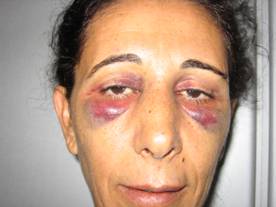 The following are two interviews with Tina and Michael Hannouneh. Tina is an American of Palestinian origin who was beaten by Israeli border guards, along with her son, Michael, at the Israeli-controlled Allenby Bridge border crossing between Jordan and the West Bank.





![[Valid Atom 1.0]](/signs/images/valid-atom.png "Validate my Atom 1.0 feed")