|
Muckraker Report
June 6, 2006 On June 5, 2006, the Muckraker Report contacted the FBI Headquarters, (202) 324-3000, to learn why Bin Laden's Most Wanted poster did not indicate that Usama was also wanted in connection with 9/11. The Muckraker Report spoke with Rex Tomb, Chief of Investigative Publicity for the FBI. When asked why there is no mention of 9/11 on Bin Laden's Most Wanted web page, Tomb said, "The reason why 9/11 is not mentioned on Usama Bin Laden's Most Wanted page is because the FBI has no hard evidence connecting Bin Laden to 9/11."


This past weekend, a thought provoking e-mail circulated through Internet news groups, bringing attention to the FBI's Most Wanted Terrorist web page for Usama Bin Laden.[1] (See bottom of this web page for Most Wanted page) In the e-mail, the question is asked, "Why doesn't Usama Bin Laden's Most Wanted poster make any direct connection with the events of September 11, 2001?" The FBI says on its Bin Laden web page that Usama Bin Laden is wanted in connection with the August 7, 1998 bombings of the United States Embassies in Dar es Salaam, Tanzania, and Nairobi, Kenya. According to the FBI, these attacks killed over 200 people. The FBI concludes its reason for "wanting" Bin Laden by saying, "In addition, Bin Laden is a suspect in other terrorists attacks throughout the world." On June 5, 2006, the Muckraker Report contacted the FBI Headquarters, (202) 324-3000, to learn why Bin Laden's Most Wanted poster did not indicate that Usama was also wanted in connection with 9/11. The Muckraker Report spoke with Rex Tomb, Chief of Investigative Publicity for the FBI. When asked why there is no mention of 9/11 on Bin Laden's Most Wanted web page, Tomb said, "The reason why 9/11 is not mentioned on Usama Bin Laden's Most Wanted page is because the FBI has no hard evidence connecting Bin Laden to 9/11." Surprised by the ease in which this FBI spokesman made such an astonishing statement, I asked, "How this was possible?" Tomb continued, "Bin Laden has not been formally charged in connection to 9/11." I asked, "How does that work?" Tomb continued, "The FBI gathers evidence. Once evidence is gathered, it is turned over to the Department of Justice. The Department of Justice than decides whether it has enough evidence to present to a federal grand jury. In the case of the 1998 United States Embassies being bombed, Bin Laden has been formally indicted and charged by a grand jury. He has not been formally indicted and charged in connection with 9/11 because the FBI has no hard evidence connected Bin Laden to 9/11." It shouldn't take long before the full meaning of these FBI statements start to prick your brain and raise your blood pressure. If you think the way I think, in quick order you will be wrestling with a barrage of very powerful questions that must be answered. First and foremost, if the U.S. government does not have enough hard evidence connecting Bin Laden to 9/11, how is it possible that it had enough evidence to invade Afghanistan to "smoke him out of his cave?" The federal government claims to have invaded Afghanistan to "root out" Bin Laden and the Taliban. Through the talking heads in the mainstream media, the Bush Administration told the American people that Usama Bin Laden was Public Enemy Number One and responsible for the deaths of nearly 3000 people on September 11, 2001. Yet nearly five years later, the FBI says that it has no hard evidence connecting Bin Laden to 9/11. Next is the Bin Laden "confession" video that was released by the U.S. government on December 13, 2001. Most Americans remember this video. It was the video showing Bin Laden with a few of his comrades recounting with delight the September 11 terrorist attacks against the United States. The Department of Defense issued a press release to accompany this video in which Secretary of Defense Donald H. Rumsfeld said, "There was no doubt of bin Laden's responsibility for the September 11 attacks before the tape was discovered."[2] What Rumsfeld implied by his statement was that Bin Laden was the known mastermind behind 9/11 even before the "confession video" and that the video simply served to confirm what the U.S. government already knew; that Bin Laden was responsible for the 9/11 attacks. In a BBC News article[3] reporting on the "9/11 confession video" release, President Bush is said to have been hesitant to release the tape because he knew it would be a vivid reminder to many people of their loss. But, he also knew it would be "a devastating declaration" of Bin Laden's guilt. "Were going to get him," said President Bush. "Dead or alive, it doesn't matter to me." In a CNN article[4] regarding the Bin Laden tape, then New York Mayor Rudy Giuliani said that "the tape removes any doubt that the U.S. military campaign targeting bin Laden and his associates is more than justified." Senator Richard Shelby, R-Alabama, the vice chairman of the Senate Intelligence Committee said, "The tape's release is central to informing people in the outside world who don't believe bin Laden was involved in the September 11 attacks." Shelby went on to say "I don't know how they can be in denial after they see this tape." Well Senator Shelby, apparently the Federal Bureau of Investigation isn't convinced by the taped confession, so why are you? The Muckraker Report attempted to secure a reference to the U.S. government authenticating the Bin Laden "confession video", to no avail. However, it is conclusive that the Bush Administration and U.S. Congress, along with the dead stream media, played the video as if it was authentic. So why doesn't the FBI view the "confession video" as hard evidence? After all, if the FBI is investigating a crime such as drug trafficking, and it discovers a video of members of a drug cartel opening talking about a successful distribution operation in the United States, that video would be presented to a federal grand jury. The identified participants of the video would be indicted, and if captured, the video alone would serve as sufficient evidence to net a conviction in a federal court. So why is the Bin Laden "confession video" not carrying the same weight with the FBI? Remember, on June 5, 2006, FBI spokesman, Chief of Investigative Publicity Rex Tomb said, "The FBI has no hard evidence connecting Usama Bin Laden to 9/11." This should be headline news worldwide. The challenge to the reader is to find out why it is not. Why has the U.S. media blindly read the government-provided 9/11 scripts, rather than investigate without passion, prejudice, or bias, the events of September 11, 2001? Why has the U.S. media blacklisted any guest that might speak of a government sponsored 9/11 cover-up, rather than seeking out those people who have something to say about 9/11 that is contrary to the government's account? And on those few rare occasions when a 9/11 dissenter has made it upon the airways, why has the mainstream media ridiculed the guest as a conspiracy nut, rather than listen to the evidence that clearly raises valid questions about the government's 9/11 account? Why is the Big Media Conglomeration blindly content with the government's 9/11 story when so much verifiable information to the contrary is available with a few clicks of a computer mouse? Who is it that is controlling the media message, and how is it that the U.S. media has indicted Usama Bin Laden for the events of September 11, 2001, but the U.S. government has not? How is it that the FBI has no "hard evidence" connecting Usama Bin Laden to the events of September 11, 2001, while the U.S. media has played the Bin Laden - 9/11 connection story for five years now as if it has conclusive evidence that Bin Laden is responsible for the collapse of the twin towers, the Pentagon attack, and the demise of United Flight 93? ...No hard evidence connecting Usama Bin Laden to 9/11... Think about it. [1] Federal Bureau of Investigation, Most Wanted Terrorists, Usama Bin Laden, http://www.fbi.gov/wanted/terrorists/terbinladen.htm, [Accessed May 31, 2006] [2] United States Department of Defense, News Release, U.S. Releases Videotape of Osama bin Laden, December 13, 2001, http://www.defenselink.mil/releases/2001/b12132001_bt630-01.html, [Accessed June 5, 2006] [3] BBC News, Bin Laden video angers New Yorkers, December 14, 2001, Peter Gould, http://news.bbc.co.uk/1/hi/world/americas/1711874.stm, [Accessed June 5, 2006] [4] CNN, Bin Laden on tape: Attacks 'benefited Islam greatly", December 14, 2001, http://archives.cnn.com/2001/US/12/13/ret.bin.laden.videotape, [Accessed June 5, 2006]  |
|
by Allan Uthman
Globalresearch.ca 4 June 06 1. The Internet Clampdown
One saving grace of alternative media in this age of unfettered corporate conglomeration has been the internet. While the masses are spoon-fed predigested news on TV and in mainstream print publications, the truth-seeking individual still has access to a broad array of investigative reporting and political opinion via the world-wide web. Of course, it was only a matter of time before the government moved to patch up this crack in the sky. Attempts to regulate and filter internet content are intensifying lately, coming both from telecommunications corporations (who are gearing up to pass legislation transferring ownership and regulation of the internet to themselves), and the Pentagon (which issued an "Information Operations Roadmap" in 2003, signed by Donald Rumsfeld, which outlines tactics such as network attacks and acknowledges, without suggesting a remedy, that US propaganda planted in other countries has easily found its way to Americans via the internet). One obvious tactic clearing the way for stifling regulation of internet content is the growing media frenzy over child pornography and "internet predators," which will surely lead to legislation that by far exceeds in its purview what is needed to fight such threats.
2. "The Long War" This little piece of clumsy marketing died off quickly, but it gave away what many already suspected: the War on Terror will never end, nor is it meant to end. It is designed to be perpetual. As with the War on Drugs, it outlines a goal that can never be fully attained -- as long as there are pissed off people and explosives. The Long War will eternally justify what are ostensibly temporary measures: suspension of civil liberties, military expansion, domestic spying, massive deficit spending and the like. This short-lived moniker told us all, "get used to it. Things aren't going to change any time soon." 3. The USA PATRIOT Act Did anyone really think this was going to be temporary? Yes, this disgusting power grab gives the government the right to sneak into your house, look through all your stuff and not tell you about it for weeks on a rubber stamp warrant. Yes, they can look at your medical records and library selections. Yes, they can pass along any information they find without probable cause for purposes of prosecution. No, they're not going to take it back, ever. 4. Prison Camps This last January the Army Corps of Engineers gave Halliburton subsidiary Kellogg Brown & Root nearly $400 million to build detention centers in the United States, for the purpose of unspecified "new programs." Of course, the obvious first guess would be that these new programs might involve rounding up Muslims or political dissenters -- I mean, obviously detention facilities are there to hold somebody. I wish I had more to tell you about this, but it's, you know... secret. 5. Touchscreen Voting Machines Despite clear, copious evidence that these nefarious contraptions are built to be tampered with, they continue to spread and dominate the voting landscape, thanks to Bush's "Help America Vote Act," the exploitation of corrupt elections officials, and the general public's enduring cluelessness. In Utah, Emery County Elections Director Bruce Funk witnessed security testing by an outside firm on Diebold voting machines which showed them to be a security risk. But his warnings fell on deaf ears. Instead Diebold attorneys were flown to Emery County on the governor's airplane to squelch the story. Funk was fired. In Florida, Leon County Supervisor of Elections Ion Sancho discovered an alarming security flaw in their Diebold system at the end of last year. Rather than fix the flaw, Diebold refused to fulfill its contract. Both of the other two touchscreen voting machine vendors, Sequoia and ES&S, now refuse to do business with Sancho, who is required by HAVA to implement a touchscreen system and will be sued by his own state if he doesn't. Diebold is said to be pressuring for Sancho's ouster before it will resume servicing the county. Stories like these and much worse abound, and yet TV news outlets have done less coverage of the new era of elections fraud than even 9/11 conspiracy theories. This is possibly the most important story of this century, but nobody seems to give a damn. As long as this issue is ignored, real American democracy will remain an illusion. The midterm elections will be an interesting test of the public's continuing gullibility about voting integrity, especially if the Democrats don't win substantial gains, as they almost surely will if everything is kosher. Bush just suggested that his brother Jeb would make a good president. We really need to fix this problem soon. 6. Signing Statements Bush has famously never vetoed a bill. This is because he prefers to simply nullify laws he doesn't like with "signing statements." Bush has issued over 700 such statements, twice as many as all previous presidents combined. A few examples of recently passed laws and their corresponding dismissals, courtesy of the Boston Globe: --Dec. 30, 2005: US interrogators cannot torture prisoners or otherwise subject them to cruel, inhuman, and degrading treatment. Bush's signing statement: The president, as commander in chief, can waive the torture ban if he decides that harsh interrogation techniques will assist in preventing terrorist attacks. --Dec. 30, 2005: When requested, scientific information ''prepared by government researchers and scientists shall be transmitted [to Congress] uncensored and without delay." Bush's signing statement: The president can tell researchers to withhold any information from Congress if he decides its disclosure could impair foreign relations, national security, or the workings of the executive branch. --Dec. 23, 2004: Forbids US troops in Colombia from participating in any combat against rebels, except in cases of self-defense. Caps the number of US troops allowed in Colombia at 800. Bush's signing statement: Only the president, as commander in chief, can place restrictions on the use of US armed forces, so the executive branch will construe the law ''as advisory in nature." Essentially, this administration is bypassing the judiciary and deciding for itself whether laws are constitutional or not. Somehow, I don't see the new Supreme Court lineup having much of a problem with that, though. So no matter what laws congress passes, Bush will simply choose to ignore the ones he doesn't care for. It's much quieter than a veto, and can't be overridden by a two-thirds majority. It's also totally absurd. 7. Warrantless Wiretapping Amazingly, the GOP sees this issue as a plus for them. How can this be? What are you, stupid? You find out the government is listening to the phone calls of US citizens, without even the weakest of judicial oversight and you think that's okay? Come on -- if you know anything about history, you know that no government can be trusted to handle something like this responsibly. One day they're listening for Osama, and the next they're listening in on Howard Dean. Think about it: this administration hates unauthorized leaks. With no judicial oversight, why on earth wouldn't they eavesdrop on, say, Seymour Hersh, to figure out who's spilling the beans? It's a no-brainer. Speaking of which, it bears repeating: terrorists already knew we would try to spy on them. They don't care if we have a warrant or not. But you should. 8. Free Speech Zones I know it's old news, but... come on, are they fucking serious? 9. High-ranking Whistleblowers Army Generals. Top-level CIA officials. NSA operatives. White House cabinet members. These are the kind of people that Republicans fantasize about being, and whose judgment they usually respect. But for some reason, when these people resign in protest and criticize the Bush administration en masse, they are cast as traitorous, anti-American publicity hounds. Ridiculous. The fact is, when people who kill, spy and deceive for a living tell you that the White House has gone too far, you had damn well better pay attention. We all know most of these people are staunch Republicans. If the entire military except for the two guys the Pentagon put in front of the press wants Rumsfeld out, why on earth wouldn't you listen? 10. The CIA Shakeup Was Porter Goss fired because he was resisting the efforts of Rumsfeld or Negroponte? No. These appointments all come from the same guys, and they wouldn't be nominated if they weren't on board all the way. Goss was probably canned so abruptly due to a scandal involving a crooked defense contractor, his hand-picked third-in-command, the Watergate hotel and some hookers. If Bush's nominee for CIA chief, Air Force General Michael Hayden, is confirmed, that will put every spy program in Washington under military control. Hayden, who oversaw the NSA warrantless wiretapping program and is clearly down with the program. That program? To weaken and dismantle or at least neuter the CIA. Despite its best efforts to blame the CIA for "intelligence errors" leading to the Iraq war, the picture has clearly emerged -- through extensive CIA leaks -- that the White House's analysis of Saddam's destructive capacity was not shared by the Agency. This has proved to be a real pain in the ass for Bush and the gang. Who'd have thought that career spooks would have moral qualms about deceiving the American people? And what is a president to do about it? Simple: make the critical agents leave, and fill their slots with Bush/Cheney loyalists. Then again, why not simply replace the entire organization? That is essentially what both Rumsfeld at the DoD and newly minted Director of National Intelligence John are doing -- they want to move intelligence analysis into the hands of people that they can control, so the next time they lie about an "imminent threat" nobody's going to tell. And the press is applauding the move as a "necessary reform." Remember the good old days, when the CIA were the bad guys? Disclaimer: The views expressed in this article are the sole responsibility of the author and do not necessarily reflect those of the Centre for Research on Globalization. To become a Member of Global Research The Centre for Research on Globalization (CRG) at www.globalresearch.ca grants permission to cross-post original Global Research articles in their entirety, or any portions thereof, on community internet sites, as long as the text & title are not modified. The source must be acknowledged and an active URL hyperlink address to the original CRG article must be indicated. The author's copyright note must be displayed. For publication of Global Research articles in print or other forms including commercial internet sites, contact: crgeditor@yahoo.com www.globalresearch.ca contains copyrighted material the use of which has not always been specifically authorized by the copyright owner. We are making such material available to our readers under the provisions of "fair use" in an effort to advance a better understanding of political, economic and social issues. The material on this site is distributed without profit to those who have expressed a prior interest in receiving it for research and educational purposes. If you wish to use copyrighted material for purposes other than "fair use" you must request permission from the copyright owner. For media inquiries: crgeditor@yahoo.com © Copyright Allan Uthman, Buffalo Beast., 2006 The url address of this article |
 A Florida Woman Reported To The FBI For Criticizing Arlen Specter - She used a quote from Thomas Jefferson! A Florida Woman Reported To The FBI For Criticizing Arlen Specter - She used a quote from Thomas Jefferson!Peggy Decker
From this extremely useful website here I was able to get e-mail addresses for every House and Senate staffer including Senator Arlen Specter's Chief of Staff and Director of Communications, William Reynolds.
Then I sent the following quote from Thomas Jefferson to every Republican who voted for S.2611: "The tree of liberty must be refreshed from time to time with the blood of patriots and tyrants."
Reynolds (e-mail him) replied: "If you were meaning to convey a threat, then you have effectively done so. I am forwarding this to the FBI and U.S. Capitol Police. I will not tolerate threats against my people." I responded to Reynolds: "How DARE YOU threaten ME. You work for ME, not the other way around. I have every right to express my displeasure at Senator Specter's traitorous vote, and if I choose to quote Thomas Jefferson, that is my right. VDARE.COM note: Decker, a retired schoolteacher, advised the Tampa branch of the FBI about her e-mail exchange with Reynolds, noting that she felt threatened by him. The FBI replied to Decker: "The Senate message is not considered threatening," but "the message you sent, because the quote was altered (i.e. by color of text) can be construed as threatening." |
|
By Gennady Yevstafyev
Novosti, Russia May 26, 2006 MOSCOW: Porter J. Goss has retired as Director of the U.S. Central Intelligence Agency, a post which he held for about 18 months. Or rather, we should say, he was prodded into retirement.
There are many reasons for this surprise move, and those who suggest one or two superficial explanations don't fully understand the essence of the problem.
Goss as CIA Director also held the post of Director of Central Intelligence, or DCI, and was in charge of all 16 security services of the United States. He used to proudly say that he wore five hats, referring to the number of functions he was responsible for carrying out. [Editor's Note: In a comment that raised a few eyebrows last year, Goss was quoted as saying: The jobs I'm being asked to do, the five hats that I wear, are too much for this mortal. I'm a little amazed at the workload]. There is a special conference room for the heads of the CIA intelligence divisions, where the DCI sat at the head of the table, and each intelligence spokesman had a definite chair, with the emblem of his organization hanging on the wall above him. So it was. Until colossal failures (the 9/11 tragedy and Iraq) and other pitfalls and scandals (the CIA's secret prisons and a stream of leaks from the security services, for example, the extrajudicial system of telephone tapping and a secret Pentagon program to collect information on U.S. nationals codenamed Operation TALON, which was officially designed to hunt down and apprehend fugitive felons, many of them violent offenders, by matching them against government records of current and former food stamp recipients). As a result of this, the ruling circle of the Republican Party began an overhaul of the U.S. secret services, and Goss was deprived of the post of DCI, and even the functions of the job were changed. Goss was said to have been Vice President Dick Cheney's nominee, the gray eminence of the Republican Administration, with whom he had worked in Congress. In 1997, Goss rose to be chairman of the House Permanent Select Committee. As soon as Goss was appointed CIA director, he got down to business. At the prodding of ultra-conservatives who demanded the removal of Clinton nests from the agency, especially those who were allegedly appointed at Hilary Clinton's instigation or thought to support the Democratic Party, Goss set out to cleanse the agency. Goss did his best, but that apparently was not enough. Although it is George W. Bush's declared priority, the fight against terror has not brought the desired results. The CIA's Counterterrorism Center failed, and Iraq had turned into a base for terrorists. But as well-known American political scientist Ashton B. Carter said, in testimony before the September 11 Commission, There is no such thing as an 'intelligence failure.' All intelligence failures are coupled to policy failures. [RealVideoCarter's Washington Post op-ed]. Surprisingly and precisely at that moment, it became clear that Porter Goss was not at all Cheney's main protégé, but rather it is the favorite son of American conservatives, John D. Negroponte. Negroponte was charged with the most ambitious reform of the American intelligence community in 50 years. He was appointed to a new post, Director of National Intelligence (DNI) and was instructed to implement the recommendations of the Robb-Silberman Commission [RealVideo] on weapons of mass destruction. It was the beginning of the end for the CIA, and apparently, the other community members were glad of this. Next came the corruption scandal around Kyle Dusty Foggo, the number three official at the CIA. Foggo was in charge of agency contracts, is an old pal of Porter Goss and enjoyed his absolute confidence. The Foggo Affair now threatens to become a super-scandal, smearing prominent politicians and businessmen. Negroponte, who was charged with depriving the CIA of its dominant role, began delivering the President's morning intelligence briefing. Goss had lost the President's ear, which is the heaviest price one could pay in the U.S. bureaucracy. When Robert Grenier resigned as chairman of the CIA's Counterterrorism Center and accepted a job with Negroponte's National Counterterrorism Center, dozens of analysts followed him, and it is competently said that there is enough room for several hundred more. When Goss was CIA director, he appointed so-called WMD managers for North Korea and Iran. Now, information indicates that the nexus of WMD intelligence gathering is gradually shifting to Negroponte operation as well. In early February, most likely due to his inability to stop the leaks, Porter Goss declared a battle to protect our classified information. He made his intentions known in an article titled Loose Lips Sink Spies published by the International Herald Tribune [RealVideo]. His timing was extremely bad, though he probably did this to aggravate the White House. One of the underpinnings of the accusation that Saddam Hussein was building nuclear weapons was a widely circulated Bush Administration charge that the Iraqis had purchased uranium ore [yellow cake] from Niger. At first, the Americans obtained this information from SISMI, Italy's military intelligence agency, and were not convinced [RealVideo]. They decided to check the information confidentially and dispatched former Ambassador Joseph Wilson to Niger. Subsequent events show that the CIA chose Wilson because his wife was a deep-cover CIA agent. But Wilson didn't do what the White House expected, and reporting that the information [on Saddam's purchase of yellow cake from Niger] was untrue. But by that time, the anti-Saddam propaganda campaign had been launched, with Dick Cheney as lead singer and Tony Blair as backup. Ambassador Wilson continued to insist that he was right, although no one would listen. So the White House decided to punish him by leaking information that his wife, Valerie Plame, was a deep-cover CIA operative. This was scandalous. Under U.S. law, the disclosure of the names of secret CIA operatives is a criminal offence. Ironically, the law was made even harsher in 1998 at the instigation of Congressman Porter Goss. A prosecutor was appointed and the investigation soon tracked down the source of the leak: Lewis Scooter Libby, Vice President Dick Cheney's chief of staff. His interrogation promised to become another Watergate, but the unsinkable grey eminence Cheney survived this storm too. Saving the honor - and possibly preventing the collapse of his administration - George Bush said that it was he who had ordered Libby to disclose Plame's name. Lawyers were found to say that in the supreme interests of national security, the U.S. President was the only person permitted to do this. The case was back under control and quietly closed. This is how honest investigation and the equality of all U.S. citizens under the law have been brought to an end. American democracy is so interlaced with lies, one often wonders whether truth or falsehood outweighs the other. This also brought to an end the career of Porter J. Goss, although not the struggle within the American intelligence community. The one thing that is clear is that the next U.S. President will not leave things as they are. *Gennady Yevstafyev is a retired Lieutenant General with the Russian Foreign Intelligence Service and a senior adviser with Russia's Center for Policy Studies. |
|
by Robert F. Kennedy Jr.
Rolling Stone Republicans prevented more than 350,000 voters in Ohio from casting ballots or having their votes counted...
Like many Americans, I spent the evening of the 2004 election watching the returns on television and wondering how the exit polls, which predicted an overwhelming victory for John Kerry, had gotten it so wrong. By midnight, the official tallies showed a decisive lead for George Bush -- and the next day, lacking enough legal evidence to contest the results, Kerry conceded. Republicans derided anyone who expressed doubts about Bush's victory as nut cases in ''tinfoil hats,'' while the national media, with few exceptions, did little to question the validity of the election. The Washington Post immediately dismissed allegations of fraud as ''conspiracy theories,''(1) and The New York Times declared that ''there is no evidence of vote theft or errors on a large scale.''(2)
But despite the media blackout, indications continued to emerge that something deeply troubling had taken place in 2004. Nearly half of the 6 million American voters living abroad(3) never received their ballots -- or received them too late to vote(4) -- after the Pentagon unaccountably shut down a state-of-the-art Web site used to file overseas registrations.(5) A consulting firm called Sproul & Associates, which was hired by the Republican National Committee to register voters in six battleground states,(6) was discovered shredding Democratic registrations.(7) In New Mexico, which was decided by 5,988 votes,(8) malfunctioning machines mysteriously failed to properly register a presidential vote on more than 20,000 ballots.(9) Nationwide, according to the federal commission charged with implementing election reforms, as many as 1 million ballots were spoiled by faulty voting equipment -- roughly one for every 100 cast.(10) The reports were especially disturbing in Ohio, the critical battleground state that clinched Bush's victory in the electoral college. Officials there purged tens of thousands of eligible voters from the rolls, neglected to process registration cards generated by Democratic voter drives, shortchanged Democratic precincts when they allocated voting machines and illegally derailed a recount that could have given Kerry the presidency. A precinct in an evangelical church in Miami County recorded an impossibly high turnout of ninety-eight percent, while a polling place in inner-city Cleveland recorded an equally impossible turnout of only seven percent. In Warren County, GOP election officials even invented a nonexistent terrorist threat to bar the media from monitoring the official vote count.(11) Any election, of course, will have anomalies. America's voting system is a messy patchwork of polling rules run mostly by county and city officials. ''We didn't have one election for president in 2004,'' says Robert Pastor, who directs the Center for Democracy and Election Management at American University. ''We didn't have fifty elections. We actually had 13,000 elections run by 13,000 independent, quasi-sovereign counties and municipalities.'' But what is most anomalous about the irregularities in 2004 was their decidedly partisan bent: Almost without exception they hurt John Kerry and benefited George Bush. After carefully examining the evidence, I've become convinced that the president's party mounted a massive, coordinated campaign to subvert the will of the people in 2004. Across the country, Republican election officials and party stalwarts employed a wide range of illegal and unethical tactics to fix the election. A review of the available data reveals that in Ohio alone, at least 357,000 voters, the overwhelming majority of them Democratic, were prevented from casting ballots or did not have their votes counted in 2004(12) -- more than enough to shift the results of an election decided by 118,601 votes.(13) (See Ohio's Missing Votes) In what may be the single most astounding fact from the election, one in every four Ohio citizens who registered to vote in 2004 showed up at the polls only to discover that they were not listed on the rolls, thanks to GOP efforts to stem the unprecedented flood of Democrats eager to cast ballots.(14) And that doesn?t even take into account the troubling evidence of outright fraud, which indicates that upwards of 80,000 votes for Kerry were counted instead for Bush. That alone is a swing of more than 160,000 votes -- enough to have put John Kerry in the White House.(15) ''It was terrible,'' says Sen. Christopher Dodd, who helped craft reforms in 2002 that were supposed to prevent such electoral abuses. ''People waiting in line for twelve hours to cast their ballots, people not being allowed to vote because they were in the wrong precinct -- it was an outrage. In Ohio, you had a secretary of state who was determined to guarantee a Republican outcome. I'm terribly disheartened.'' Indeed, the extent of the GOP's effort to rig the vote shocked even the most experienced observers of American elections. ''Ohio was as dirty an election as America has ever seen,'' Lou Harris, the father of modern political polling, told me. ''You look at the turnout and votes in individual precincts, compared to the historic patterns in those counties, and you can tell where the discrepancies are. They stand out like a sore thumb.'' I. The Exit Polls The first indication that something was gravely amiss on November 2nd, 2004, was the inexplicable discrepancies between exit polls and actual vote counts. Polls in thirty states weren't just off the mark -- they deviated to an extent that cannot be accounted for by their margin of error. In all but four states, the discrepancy favored President Bush.(16) Over the past decades, exit polling has evolved into an exact science. Indeed, among pollsters and statisticians, such surveys are thought to be the most reliable. Unlike pre-election polls, in which voters are asked to predict their own behavior at some point in the future, exit polls ask voters leaving the voting booth to report an action they just executed. The results are exquisitely accurate: Exit polls in Germany, for example, have never missed the mark by more than three-tenths of one percent.(17) ''Exit polls are almost never wrong,'' Dick Morris, a political consultant who has worked for both Republicans and Democrats, noted after the 2004 vote. Such surveys are ''so reliable,'' he added, ''that they are used as guides to the relative honesty of elections in Third World countries.''(18) In 2003, vote tampering revealed by exit polling in the Republic of Georgia forced Eduard Shevardnadze to step down.(19) And in November 2004, exit polling in the Ukraine -- paid for by the Bush administration -- exposed election fraud that denied Viktor Yushchenko the presidency.(20) But that same month, when exit polls revealed disturbing disparities in the U.S. election, the six media organizations that had commissioned the survey treated its very existence as an embarrassment. Instead of treating the discrepancies as a story meriting investigation, the networks scrubbed the offending results from their Web sites and substituted them with ''corrected'' numbers that had been weighted, retroactively, to match the official vote count. Rather than finding fault with the election results, the mainstream media preferred to dismiss the polls as flawed.(21) ''The people who ran the exit polling, and all those of us who were their clients, recognized that it was deeply flawed,'' says Tom Brokaw, who served as anchor for NBC News during the 2004 election. ''They were really screwed up -- the old models just don't work anymore. I would not go on the air with them again.'' In fact, the exit poll created for the 2004 election was designed to be the most reliable voter survey in history. The six news organizations -- running the ideological gamut from CBS to Fox News -- retained Edison Media Research and Mitofsky International,(22) whose principal, Warren Mitofsky, pioneered the exit poll for CBS in 1967(23) and is widely credited with assuring the credibility of Mexico's elections in 1994.(24) For its nationwide poll, Edison/Mitofsky selected a random subsample of 12,219 voters(25) -- approximately six times larger than those normally used in national polls(26) -- driving the margin of error down to approximately plus or minus one percent.(27) On the evening of the vote, reporters at each of the major networks were briefed by pollsters at 7:54 p.m. Kerry, they were informed, had an insurmountable lead and would win by a rout: at least 309 electoral votes to Bush's 174, with fifty-five too close to call.(28) In London, Prime Minister Tony Blair went to bed contemplating his relationship with President-elect Kerry.(29) As the last polling stations closed on the West Coast, exit polls showed Kerry ahead in ten of eleven battleground states -- including commanding leads in Ohio and Florida -- and winning by a million and a half votes nationally. The exit polls even showed Kerry breathing down Bush's neck in supposed GOP strongholds Virginia and North Carolina.(30) Against these numbers, the statistical likelihood of Bush winning was less than one in 450,000.(31) ''Either the exit polls, by and large, are completely wrong,'' a Fox News analyst declared, ''or George Bush loses.''(32) But as the evening progressed, official tallies began to show implausible disparities -- as much as 9.5 percent -- with the exit polls. In ten of the eleven battleground states, the tallied margins departed from what the polls had predicted. In every case, the shift favored Bush. Based on exit polls, CNN had predicted Kerry defeating Bush in Ohio by a margin of 4.2 percentage points. Instead, election results showed Bush winning the state by 2.5 percent. Bush also tallied 6.5 percent more than the polls had predicted in Pennsylvania, and 4.9 percent more in Florida.(33) According to Steven F. Freeman, a visiting scholar at the University of Pennsylvania who specializes in research methodology, the odds against all three of those shifts occurring in concert are one in 660,000. ''As much as we can say in sound science that something is impossible,'' he says, ''it is impossible that the discrepancies between predicted and actual vote count in the three critical battleground states of the 2004 election could have been due to chance or random error.'' (See The Tale of the Exit Polls) Puzzled by the discrepancies, Freeman laboriously examined the raw polling data released by Edison/Mitofsky in January 2005. ''I'm not even political -- I despise the Democrats,'' he says. ''I'm a survey expert. I got into this because I was mystified about how the exit polls could have been so wrong.'' In his forthcoming book, Was the 2004 Presidential Election Stolen? Exit Polls, Election Fraud, and the Official Count, Freeman lays out a statistical analysis of the polls that is deeply troubling. In its official postmortem report issued two months after the election, Edison/Mitofsky was unable to identify any flaw in its methodology -- so the pollsters, in essence, invented one for the electorate. According to Mitofsky, Bush partisans were simply disinclined to talk to exit pollsters on November 2nd(34) -- displaying a heretofore unknown and undocumented aversion that skewed the polls in Kerry's favor by a margin of 6.5 percent nationwide.(35) Industry peers didn't buy it. John Zogby, one of the nation's leading pollsters, told me that Mitofsky's ''reluctant responder'' hypothesis is ''preposterous.''(36) Even Mitofsky, in his official report, underscored the hollowness of his theory: ''It is difficult to pinpoint precisely the reasons that, in general, Kerry voters were more likely to participate in the exit polls than Bush voters.''(37) Now, thanks to careful examination of Mitofsky's own data by Freeman and a team of eight researchers, we can say conclusively that the theory is dead wrong. In fact it was Democrats, not Republicans, who were more disinclined to answer pollsters' questions on Election Day. In Bush strongholds, Freeman and the other researchers found that fifty-six percent of voters completed the exit survey -- compared to only fifty-three percent in Kerry strongholds.(38) ''The data presented to support the claim not only fails to substantiate it,'' observes Freeman, ''but actually contradicts it.'' What's more, Freeman found, the greatest disparities between exit polls and the official vote count came in Republican strongholds. In precincts where Bush received at least eighty percent of the vote, the exit polls were off by an average of ten percent. By contrast, in precincts where Kerry dominated by eighty percent or more, the exit polls were accurate to within three tenths of one percent -- a pattern that suggests Republican election officials stuffed the ballot box in Bush country.(39) ''When you look at the numbers, there is a tremendous amount of data that supports the supposition of election fraud,'' concludes Freeman. ''The discrepancies are higher in battleground states, higher where there were Republican governors, higher in states with greater proportions of African-American communities and higher in states where there were the most Election Day complaints. All these are strong indicators of fraud -- and yet this supposition has been utterly ignored by the press and, oddly, by the Democratic Party.'' The evidence is especially strong in Ohio. In January, a team of mathematicians from the National Election Data Archive, a nonpartisan watchdog group, compared the state's exit polls against the certified vote count in each of the forty-nine precincts polled by Edison/Mitofsky. In twenty-two of those precincts -- nearly half of those polled -- they discovered results that differed widely from the official tally. Once again -- against all odds -- the widespread discrepancies were stacked massively in Bush's favor: In only two of the suspect twenty-two precincts did the disparity benefit Kerry. The wildest discrepancy came from the precinct Mitofsky numbered ''27,'' in order to protect the anonymity of those surveyed. According to the exit poll, Kerry should have received sixty-seven percent of the vote in this precinct. Yet the certified tally gave him only thirty-eight percent. The statistical odds against such a variance are just shy of one in 3 billion.(40) Such results, according to the archive, provide ''virtually irrefutable evidence of vote miscount.'' The discrepancies, the experts add, ''are consistent with the hypothesis that Kerry would have won Ohio's electoral votes if Ohio's official vote counts had accurately reflected voter intent.''(41) According to Ron Baiman, vice president of the archive and a public policy analyst at Loyola University in Chicago, ''No rigorous statistical explanation'' can explain the ''completely nonrandom'' disparities that almost uniformly benefited Bush. The final results, he adds, are ''completely consistent with election fraud -- specifically vote shifting.'' II. The Partisan Official No state was more important in the 2004 election than Ohio. The state has been key to every Republican presidential victory since Abraham Lincoln's, and both parties overwhelmed the state with television ads, field organizers and volunteers in an effort to register new voters and energize old ones. Bush and Kerry traveled to Ohio a total of forty-nine times during the campaign -- more than to any other state.(42) But in the battle for Ohio, Republicans had a distinct advantage: The man in charge of the counting was Kenneth Blackwell, the co-chair of President Bush's re-election committee.(43) As Ohio's secretary of state, Blackwell had broad powers to interpret and implement state and federal election laws -- setting standards for everything from the processing of voter registration to the conduct of official recounts.(44) And as Bush's re-election chair in Ohio, he had a powerful motivation to rig the rules for his candidate. Blackwell, in fact, served as the ''principal electoral system adviser'' for Bush during the 2000 recount in Florida,(45) where he witnessed firsthand the success of his counterpart Katherine Harris, the Florida secretary of state who co-chaired Bush's campaign there.(46) Blackwell -- now the Republican candidate for governor of Ohio(47) -- is well-known in the state as a fierce partisan eager to rise in the GOP. An outspoken leader of Ohio's right-wing fundamentalists, he opposes abortion even in cases of rape(48) and was the chief cheerleader for the anti-gay-marriage amendment that Republicans employed to spark turnout in rural counties(49). He has openly denounced Kerry as ''an unapologetic liberal Democrat,''(50) and during the 2004 election he used his official powers to disenfranchise hundreds of thousands of Ohio citizens in Democratic strongholds. In a ruling issued two weeks before the election, a federal judge rebuked Blackwell for seeking to ''accomplish the same result in Ohio in 2004 that occurred in Florida in 2000.''(51) ''The secretary of state is supposed to administer elections -- not throw them,'' says Rep. Dennis Kucinich, a Democrat from Cleveland who has dealt with Blackwell for years. ''The election in Ohio in 2004 stands out as an example of how, under color of law, a state election official can frustrate the exercise of the right to vote.'' The most extensive investigation of what happened in Ohio was conducted by Rep. John Conyers, the ranking Democrat on the House Judiciary Committee.(52) Frustrated by his party's failure to follow up on the widespread evidence of voter intimidation and fraud, Conyers and the committee's minority staff held public hearings in Ohio, where they looked into more than 50,000 complaints from voters.(53) In January 2005, Conyers issued a detailed report that outlined ''massive and unprecedented voter irregularities and anomalies in Ohio.'' The problems, the report concludes, were ''caused by intentional misconduct and illegal behavior, much of it involving Secretary of State J. Kenneth Blackwell.''(54) ''Blackwell made Katherine Harris look like a cupcake,'' Conyers told me. ''He saw his role as limiting the participation of Democratic voters. We had hearings in Columbus for two days. We could have stayed two weeks, the level of fury was so high. Thousands of people wanted to testify. Nothing like this had ever happened to them before.'' When ROLLING STONE confronted Blackwell about his overtly partisan attempts to subvert the election, he dismissed any such claim as ''silly on its face.'' Ohio, he insisted in a telephone interview, set a ''gold standard'' for electoral fairness. In fact, his campaign to subvert the will of the voters had begun long before Election Day. Instead of welcoming the avalanche of citizen involvement sparked by the campaign, Blackwell permitted election officials in Cleveland, Cincinnati and Toledo to conduct a massive purge of their voter rolls, summarily expunging the names of more than 300,000 voters who had failed to cast ballots in the previous two national elections.(55) In Cleveland, which went five-to-one for Kerry, nearly one in four voters were wiped from the rolls between 2000 and 2004.(56) There were legitimate reasons to clean up voting lists: Many of the names undoubtedly belonged to people who had moved or died. But thousands more were duly registered voters who were deprived of their constitutional right to vote -- often without any notification -- simply because they had decided not to go to the polls in prior elections.(57) In Cleveland's precinct 6C, where more than half the voters on the rolls were deleted,(58) turnout was only 7.1 percent(59) -- the lowest in the state. According to the Conyers report, improper purging ''likely disenfranchised tens of thousands of voters statewide.''(60) If only one in ten of the 300,000 purged voters showed up on Election Day -- a conservative estimate, according to election scholars -- that is 30,000 citizens who were unfairly denied the opportunity to cast ballots. III. The Strike Force In the months leading up to the election, Ohio was in the midst of the biggest registration drive in its history. Tens of thousands of volunteers and paid political operatives from both parties canvassed the state, racing to register new voters in advance of the October 4th deadline. To those on the ground, it was clear that Democrats were outpacing their Republican counterparts: A New York Times analysis before the election found that new registrations in traditional Democratic strongholds were up 250 percent, compared to only twenty-five percent in Republican-leaning counties.(61) ''The Democrats have been beating the pants off us in the air and on the ground,'' a GOP county official in Columbus confessed to The Washington Times.(62) To stem the tide of new registrations, the Republican National Committee and the Ohio Republican Party attempted to knock tens of thousands of predominantly minority and urban voters off the rolls through illegal mailings known in electioneering jargon as ''caging.'' During the Eighties, after the GOP used such mailings to disenfranchise nearly 76,000 black voters in New Jersey and Louisiana, it was forced to sign two separate court orders agreeing to abstain from caging.(63) But during the summer of 2004, the GOP targeted minority voters in Ohio by zip code, sending registered letters to more than 200,000 newly registered voters(64) in sixty-five counties.(65) On October 22nd, a mere eleven days before the election, Ohio Republican Party Chairman Bob Bennett -- who also chairs the board of elections in Cuyahoga County -- sought to invalidate the registrations of 35,427 voters who had refused to sign for the letters or whose mail came back as undeliverable.(66) Almost half of the challenged voters were from Democratic strongholds in and around Cleveland.(67) There were plenty of valid reasons that voters had failed to respond to the mailings: The list included people who couldn't sign for the letters because they were serving in the U.S. military, college students whose school and home addresses differed,(68) and more than 1,000 homeless people who had no permanent mailing address.(69) But the undeliverable mail, Bennett claimed, proved the new registrations were fraudulent. By law, each voter was supposed to receive a hearing before being stricken from the rolls.(70) Instead, in the week before the election, kangaroo courts were rapidly set up across the state at Blackwell's direction that would inevitably disenfranchise thousands of voters at a time(71) -- a process that one Democratic election official in Toledo likened to an ''inquisition.''(72) Not that anyone was given a chance to actually show up and defend their right to vote: Notices to challenged voters were not only sent out impossibly late in the process, they were mailed to the very addresses that the Republicans contended were faulty.(73) Adding to the atmosphere of intimidation, sheriff's detectives in Sandusky County were dispatched to the homes of challenged voters to investigate the GOP's claims of fraud.(74) ''I'm afraid this is going to scare these people half to death, and they are never going to show up on Election Day,'' Barb Tuckerman, director of the Sandusky Board of Elections, told local reporters. ''Many of them are young people who have registered for the first time. I've called some of these people, and they are perfectly legitimate.''(75) On October 27th, ruling that the effort likely violated both the ''constitutional right to due process and constitutional right to vote,'' U.S. District Judge Susan Dlott put a halt to the GOP challenge(76) -- but not before tens of thousands of new voters received notices claiming they were improperly registered. Some election officials in the state illegally ignored Dlott's ruling, stripping hundreds of voters from the rolls.(77) In Columbus and elsewhere, challenged registrants were never notified that the court had cleared them to vote. On October 29th, a federal judge found that the Republican Party had violated the court orders from the Eighties that barred it from caging. ''The return of mail does not implicate fraud,'' the court affirmed,(78) and the disenfranchisement effort illegally targeted ''precincts where minority voters predominate, interfering with and discouraging voters from voting in those districts.''(79) Nor were such caging efforts limited to Ohio: The GOP also targeted hundreds of thousands of urban voters in the battleground states of Florida,(80) Pennsylvania(81) and Wisconsin.(82) Republicans in Ohio also worked to deny the vote to citizens who had served jail time for felonies. Although rehabilitated prisoners are entitled to vote in Ohio, election officials in Cincinnati demanded that former convicts get a judge to sign off before they could register to vote.(83) In case they didn't get the message, Republican operatives turned to intimidation. According to the Conyers report, a team of twenty-five GOP volunteers calling themselves the Mighty Texas Strike Force holed up at the Holiday Inn in Columbus a day before the election, around the corner from the headquarters of the Ohio Republican Party -- which paid for their hotel rooms. The men were overheard by a hotel worker ''using pay phones to make intimidating calls to likely voters'' and threatening former convicts with jail time if they tried to cast ballots.(84) This was no freelance operation. The Strike Force -- an offshoot of the Republican National Committee(85) -- was part of a team of more than 1,500 volunteers from Texas who were deployed to battleground states, usually in teams of ten. Their leader was Pat Oxford, (86) a Houston lawyer who managed Bush's legal defense team in 2000 in Florida,(87) where he warmly praised the efforts of a mob that stormed the Miami-Dade County election offices and halted the recount. It was later revealed that those involved in the ''Brooks Brothers Riot'' were not angry Floridians but paid GOP staffers, many of them flown in from out of state.(88) Photos of the protest show that one of the ''rioters'' was Joel Kaplan, who has just taken the place of Karl Rove at the White House, where he now directs the president's policy operations.(89) IV. Barriers to Registration To further monkey-wrench the process he was bound by law to safeguard, Blackwell cited an arcane elections regulation to make it harder to register new voters. In a now-infamous decree, Blackwell announced on September 7th -- less than a month before the filing deadline -- that election officials would process registration forms only if they were printed on eighty-pound unwaxed white paper stock, similar to a typical postcard. Justifying his decision to ROLLING STONE, Blackwell portrayed it as an attempt to protect voters: ''The postal service had recommended to us that we establish a heavy enough paper-weight standard that we not disenfranchise voters by having their registration form damaged by postal equipment.'' Yet Blackwell's order also applied to registrations delivered in person to election offices. He further specified that any valid registration cards printed on lesser paper stock that miraculously survived the shredding gauntlet at the post office were not to be processed; instead, they were to be treated as applications for a registration form, requiring election boards to send out a brand-new card.(90) Blackwell's directive clearly violated the Voting Rights Act, which stipulates that no one may be denied the right to vote because of a registration error that ''is not material in determining whether such individual is qualified under state law to vote.''(91) The decision immediately threw registration efforts into chaos. Local newspapers that had printed registration forms in their pages saw their efforts invalidated.(92) Delaware County posted a notice online saying it could no longer accept its own registration forms.(93) Even Blackwell couldn't follow the protocol: The Columbus Dispatch reported that his own staff distributed registration forms on lighter-weight paper that was illegal under his rule. Under the threat of court action, Blackwell ultimately revoked his order on September 28th -- six days before the registration deadline.(94) But by then, the damage was done. Election boards across the state, already understaffed and backlogged with registration forms, were unable to process them all in time. According to a statistical analysis conducted in May by the nonpartisan Greater Cleveland Voter Coalition, 16,000 voters in and around the city were disenfranchised because of data-entry errors by election officials,(95) and another 15,000 lost the right to vote due to largely inconsequential omissions on their registration cards.(96) Statewide, the study concludes, a total of 72,000 voters were disenfranchised through avoidable registration errors -- one percent of all voters in an election decided by barely two percent.(97) Despite the widespread problems, Blackwell authorized only one investigation of registration errors after the election -- in Toledo -- but the report by his own inspectors offers a disturbing snapshot of the malfeasance and incompetence that plagued the entire state.(98) The top elections official in Toledo was a partisan in the Blackwell mold: Bernadette Noe, who chaired both the county board of elections and the county Republican Party.(99) The GOP post was previously held by her husband, Tom Noe,(100) who currently faces felony charges for embezzling state funds and illegally laundering $45,400 of his own money through intermediaries to the Bush campaign.(101) State inspectors who investigated the elections operation in Toledo discovered ''areas of grave concern.''(102) With less than a month to go before the election, Bernadette Noe and her board had yet to process 20,000 voter registration cards.(103) Board officials arbitrarily decided that mail-in cards (mostly from the Republican suburbs) would be processed first, while registrations dropped off at the board's office (the fruit of intensive Democratic registration drives in the city) would be processed last.(104) When a grass-roots group called Project Vote delivered a batch of nearly 10,000 cards just before the October 4th deadline, an elections official casually remarked, ''We may not get to them.''(105) The same official then instructed employees to date-stamp an entire box containing thousands of forms, rather than marking each individual card, as required by law.(106) When the box was opened, officials had no way of confirming that the forms were filed prior to the deadline -- an error, state inspectors concluded, that could have disenfranchised ''several thousand'' voters from Democratic strongholds.(107) The most troubling incident uncovered by the investigation was Noe's decision to allow Republican partisans behind the counter in the board of elections office to make photocopies of postcards sent to confirm voter registrations(108) -- records that could have been used in the GOP's caging efforts. On their second day in the office, the operatives were caught by an elections official tampering with the documents.(109) Investigators slammed the elections board for ''a series of egregious blunders'' that caused ''the destruction, mutilation and damage of public records.''(110) On Election Day, Noe sent a team of Republican volunteers to the county warehouse where blank ballots were kept out in the open, ''with no security measures in place.''(111) The state's assistant director of elections, who just happened to be observing the ballot distribution, demanded they leave. The GOP operatives refused and ultimately had to be turned away by police.(112) In April 2005, Noe and the entire Board of Elections were forced to resign. But once again, the damage was done. At a ''Victory 2004'' rally held in Toledo four days before the election, President Bush himself singled out a pair of ''grass-roots'' activists for special praise: ''I want to thank my friends Bernadette Noe and Tom Noe for their leadership in Lucas County.''(113) V. ''The Wrong Pew'' In one of his most effective maneuvers, Blackwell prevented thousands of voters from receiving provisional ballots on Election Day. The fail-safe ballots were mandated in 2002, when Congress passed a package of reforms called the Help America Vote Act. This would prevent a repeat of the most egregious injustice in the 2000 election, when officials in Florida barred thousands of lawfully registered minority voters from the polls because their names didn't appear on flawed precinct rolls. Under the law, would-be voters whose registration is questioned at the polls must be allowed to cast provisional ballots that can be counted after the election if the voter's registration proves valid.(114) ''Provisional ballots were supposed to be this great movement forward,'' says Tova Andrea Wang, an elections expert who served with ex-presidents Jimmy Carter and Gerald Ford on the commission that laid the groundwork for the Help America Vote Act. ''But then different states erected barriers, and this new right became totally eviscerated.'' In Ohio, Blackwell worked from the beginning to curtail the availability of provisional ballots. (The ballots are most often used to protect voters in heavily Democratic urban areas who move often, creating more opportunities for data-entry errors by election boards.) Six weeks before the vote, Blackwell illegally decreed that poll workers should make on-the-spot judgments as to whether or not a voter lived in the precinct, and provide provisional ballots only to those deemed eligible.(115) When the ruling was challenged in federal court, Judge James Carr could barely contain his anger. The very purpose of the Help America Vote Act, he ruled, was to make provisional ballots available to voters told by precinct workers that they were ineligible: ''By not even mentioning this group -- the primary beneficiaries of HAVA's provisional-voting provisions -- Blackwell apparently seeks to accomplish the same result in Ohio in 2004 that occurred in Florida in 2000.''(116) But instead of complying with the judge's order to expand provisional balloting, Blackwell insisted that Carr was usurping his power as secretary of state and made a speech in which he compared himself to Mohandas Gandhi, Martin Luther King Jr. and the apostle Paul -- saying that he'd rather go to jail than follow federal law.(117) The Sixth Circuit Court of Appeals upheld Carr's ruling on October 23rd -- but the confusion over the issue still caused untold numbers of voters across the state to be illegally turned away at the polls on Election Day without being offered provisional ballots.(118) A federal judge also invalidated a decree by Blackwell that denied provisional ballots to absentee voters who were never sent their ballots in the mail. But that ruling did not come down until after 3 p.m. on the day of the election, and likely failed to filter down to the precinct level at all -- denying the franchise to even more eligible voters.(119) We will never know for certain how many voters in Ohio were denied ballots by Blackwell's two illegal orders. But it is possible to put a fairly precise number on those turned away by his most disastrous directive. Traditionally, anyone in Ohio who reported to a polling station in their county could obtain a provisional ballot. But Blackwell decided to toss out the ballots of anyone who showed up at the wrong precinct -- a move guaranteed to disenfranchise Democrats who live in urban areas crowded with multiple polling places. On October 14th, Judge Carr overruled the order, but Blackwell appealed.(120) In court, he was supported by his friend and campaign contributor Tom Noe, who joined the case as an intervenor on behalf of the secretary of state.(121) He also enjoyed the backing of Attorney General John Ashcroft, who filed an amicus brief in support of Blackwell's position -- marking the first time in American history that the Justice Department had gone to court to block the right of voters to vote.(122) The Sixth Circuit, stacked with four judges appointed by George W. Bush, sided with Blackwell.(123) Blackwell insists that his decision kept the election clean. ''If we had allowed this notion of ?voters without borders' to exist,'' he says, ''it would have opened the door to massive fraud.'' But even Republicans were shocked by the move. DeForest Soaries, the GOP chairman of the Election Assistance Commission -- the federal agency set up to implement the Help America Vote Act -- upbraided Blackwell, saying that the commission disagreed with his decision to deny ballots to voters who showed up at the wrong precinct. ''The purpose of provisional ballots is to not turn anyone away from the polls,'' Soaries explained. ''We want as many votes to count as possible.''(124) The decision left hundreds of thousands of voters in predominantly Democratic counties to navigate the state's bewildering array of 11,366 precincts, whose boundaries had been redrawn just prior to the election.(125) To further compound their confusion, the new precinct lines were misidentified on the secretary of state's own Web site, which was months out of date on Election Day. Many voters, out of habit, reported to polling locations that were no longer theirs. Some were mistakenly assured by poll workers on the grounds that they were entitled to cast a provisional ballot at that precinct. Instead, thanks to Blackwell's ruling, at least 10,000 provisional votes were tossed out after Election Day simply because citizens wound up in the wrong line.(126) In Toledo, Brandi and Brittany Stenson each got in a different line to vote in the gym at St. Elizabeth Seton School. Both of the sisters were registered to vote at the polling place on the city's north side, in the shadow of the giant DaimlerChrysler plant. Both cast ballots. But when the tallies were added up later, the family resemblance came to an abrupt end. Brittany's vote was counted -- but Brandi's wasn't. It wasn't enough that she had voted in the right building. If she wanted her vote to count, according to Blackwell's ruling, she had to choose the line that led to her assigned table. Her ballot -- along with those of her mother, her brother and thirty-seven other voters in the same precinct -- were thrown out(127) simply because they were, in the words of Rep. Stephanie Tubbs Jones (D-Ohio), ''in the right church but the wrong pew.''(128) All told, the deliberate chaos that resulted from Blackwell's registration barriers did the trick. Black voters in the state -- who went overwhelmingly for Kerry -- were twenty percent more likely than whites to be forced to cast a provisional ballot.(129) In the end, nearly three percent of all voters in Ohio were forced to vote provisionally(130) -- and more than 35,000 of their ballots were ultimately rejected.(131) VI. Long Lines When Election Day dawned on November 2nd, tens of thousands of Ohio voters who had managed to overcome all the obstacles to registration erected by Blackwell discovered that it didn't matter whether they were properly listed on the voting rolls -- because long lines at their precincts prevented them from ever making it to the ballot box. Would-be voters in Dayton and Cincinnati routinely faced waits as long as three hours. Those in inner-city precincts in Columbus, Cleveland and Toledo -- which were voting for Kerry by margins of ninety percent or more -- often waited up to seven hours. At Kenyon College, students were forced to stand in line for eleven hours before being allowed to vote, with the last voters casting their ballots after three in the morning.(132) A five-month analysis of the Ohio vote conducted by the Democratic National Committee concluded in June 2005 that three percent of all Ohio voters who showed up to vote on Election Day were forced to leave without casting a ballot.(133) That's more than 174,000 voters. ''The vast majority of this lost vote,'' concluded the Conyers report, ''was concentrated in urban, minority and Democratic-leaning areas.''(134) Statewide, African-Americans waited an average of fifty-two minutes to vote, compared to only eighteen minutes for whites.(135) The long lines were not only foreseeable -- they were actually created by GOP efforts. Republicans in the state legislature, citing new electronic voting machines that were supposed to speed voting, authorized local election boards to reduce the number of precincts across Ohio. In most cases, the new machines never materialized -- but that didn't stop officials in twenty of the state's eighty-eight counties, all of them favorable to Democrats, from slashing the number of precincts by at least twenty percent.(136) Republican officials also created long lines by failing to distribute enough voting machines to inner-city precincts. After the Florida disaster in 2000, such problems with machines were supposed to be a thing of the past. Under the Help America Vote Act, Ohio received more than $30 million in federal funds to replace its faulty punch-card machines with more reliable systems.(137) But on Election Day, that money was sitting in the bank. Why? Because Ken Blackwell had applied for an extension until 2006, insisting that there was no point in buying electronic machines that would later have to be retrofitted under Ohio law to generate paper ballots.(138) ''No one has ever accused our secretary of state of lacking in ability,'' says Rep. Kucinich. ''He's a rather bright fellow, and he's involved in the most minute details of his office. There's no doubt that he knew the effect of not having enough voting machines in some areas.'' At liberal Kenyon College, where students had registered in record numbers, local election officials provided only two voting machines to handle the anticipated surge of up to 1,300 voters. Meanwhile, fundamentalist students at nearby Mount Vernon Nazarene University had one machine for 100 voters and faced no lines at all.(139) Citing the lines at Kenyon, the Conyers report concluded that the ''misallocation of machines went beyond urban/suburban discrepancies to specifically target Democratic areas.''(140) In Columbus, which had registered 125,000 new voters(141) -- more than half of them black(142) -- the board of elections estimated that it would need 5,000 machines to handle the huge surge.(143) ''On Election Day, the county experienced an unprecedented turnout that could only be compared to a 500-year flood,'' says Matt Damschroder,(144) chairman of the Franklin County Board of Elections and the former head of the Republican Party in Columbus.(145) But instead of buying more equipment, the Conyers investigation found, Damschroder decided to ''make do'' with 2,741 machines.(146) And to make matters worse, he favored his own party in distributing the equipment. According to The Columbus Dispatch, precincts that had gone seventy percent or more for Al Gore in 2000 were allocated seventeen fewer machines in 2004, while strong GOP precincts received eight additional machines.(147) An analysis by voter advocates found that all but three of the thirty wards with the best voter-to-machine ratios were in Bush strongholds; all but one of the seven with the worst ratios were in Kerry country.(148) The result was utterly predictable. According to an investigation by the Columbus Free Press, white Republican suburbanites, blessed with a surplus of machines, averaged waits of only twenty-two minutes; black urban Democrats averaged three hours and fifteen minutes.(149) ''The allocation of voting machines in Franklin County was clearly biased against voters in precincts with high proportions of African-Americans,'' concluded Walter Mebane Jr., a government professor at Cornell University who conducted a statistical analysis of the vote in and around Columbus.(150) By midmorning, when it became clear that voters were dropping out of line rather than braving the wait, precincts appealed for the right to distribute paper ballots to speed the process. Blackwell denied the request, saying it was an invitation to fraud.(151) A lawsuit ensued, and the handwritten affidavits submitted by voters and election officials offer a heart-rending snapshot of an electoral catastrophe in the offing:(152) From Columbus Precinct 44D: ''There are three voting machines at this precinct. I have been informed that in prior elections there were normally four voting machines. At 1:45 p.m. there are approximately eighty-five voters in line. At this time, the line to vote is approximately three hours long. This precinct is largely African-American. I have personally witnessed voters leaving the polling place without voting due to the length of the line.'' From Precinct 40: ''I am serving as a presiding judge, a position I have held for some 15+ years in precinct 40. In all my years of service, the lines are by far the longest I have seen, with some waiting as long as four to five hours. I expect the situation to only worsen as the early evening heavy turnout approaches. I have requested additional machines since 6:40 a.m. and no assistance has been offered.'' Precinct 65H: ''I observed a broken voting machine that was not in use for approximately two hours. The precinct judge was very diligent but could not get through to the BOE.'' Precinct 18A: ''At 4 p.m. the average wait time is about 4.5 hours and continuing to increase?. Voters are continuing to leave without voting.'' As day stretched into evening, U.S. District Judge Algernon Marbley issued a temporary restraining order requiring that voters be offered paper ballots.(153) But it was too late: According to bipartisan estimates published in The Washington Post, as many as 15,000 voters in Columbus had already given up and gone home.(154) When closing time came at the polls, according to the Conyers report, some precinct workers illegally dismissed citizens who had waited for hours in the rain -- in direct violation of Ohio law, which stipulates that those in line at closing time are allowed to remain and vote.(155) The voters disenfranchised by long lines were overwhelmingly Democrats. Because of the unequal distribution of voting equipment, the median turnout in Franklin County precincts won by Kerry was fifty-one percent, compared to sixty-one percent in those won by Bush. Assuming sixty percent turnout under more equitable conditions, Kerry would have gained an additional 17,000 votes in the county.(156) In another move certain to add to the traffic jam at the polls, the GOP deployed 3,600 operatives on Election Day to challenge voters in thirty-one counties -- most of them in predominantly black and urban areas.(157) Although it was billed as a means to ''ensure that voters are not disenfranchised by fraud,''(158) Republicans knew that the challengers would inevitably create delays for eligible voters. Even Mark Weaver, the GOP's attorney in Ohio, predicted in late October that the move would ''create chaos, longer lines and frustration.''(159) The day before the election, Judge Dlott attempted to halt the challengers, ruling that ''there exists an enormous risk of chaos, delay, intimidation and pandemonium inside the polls and in the lines out the doors.'' Dlott was also troubled by the placement of Republican challengers: In Hamilton County, fourteen percent of new voters in white areas would be confronted at the polls, compared to ninety-seven percent of new voters in black areas.(160) But when the case was appealed to the Supreme Court on Election Day, Justice John Paul Stevens allowed the challenges to go forward. ''I have faith,'' he ruled, ''that the elected officials and numerous election volunteers on the ground will carry out their responsibilities in a way that will enable qualified voters to cast their ballots.''(161) In fact, Blackwell gave Republican challengers unprecedented access to polling stations, where they intimidated voters, worsening delays in Democratic precincts. By the end of the day, thanks to a whirlwind of legal wrangling, the GOP had even gotten permission to use the discredited list of 35,000 names from its illegal caging effort to challenge would-be voters.(162) According to the survey by the DNC, nearly 5,000 voters across the state were turned away at the polls because of registration challenges -- even though federal law required that they be provided with provisional ballots.(163) VII. Faulty Machines Voters who managed to make it past the array of hurdles erected by Republican officials found themselves confronted by voting machines that didn't work. Only 800,000 out of the 5.6 million votes in Ohio were cast on electronic voting machines, but they were plagued with errors.(164) In heavily Democratic areas around Youngstown, where nearly 100 voters reported entering ''Kerry'' on the touch screen and watching ''Bush'' light up, at least twenty machines had to be recalibrated in the middle of the voting process for chronically flipping Kerry votes to Bush.(165) (Similar ''vote hopping'' from Kerry to Bush was reported by voters and election officials in other states.)(166) Elsewhere, voters complained in sworn affidavits that they touched Kerry's name on the screen and it lit up, but that the light had gone out by the time they finished their ballot; the Kerry vote faded away.(167) In the state's most notorious incident, an electronic machine at a fundamentalist church in the town of Gahanna recorded a total of 4,258 votes for Bush and 260 votes for Kerry.(168) In that precinct, however, there were only 800 registered voters, of whom 638 showed up.(169) (The error, which was later blamed on a glitchy memory card, was corrected before the certified vote count.) In addition to problems with electronic machines, Ohio's vote was skewed by old-fashioned punch-card equipment that posed what even Blackwell acknowledged was the risk of a ''Florida-like calamity.''(170) All but twenty of the state's counties relied on antiquated machines that were virtually guaranteed to destroy votes(171) -- many of which were counted by automatic tabulators manufactured by Triad Governmental Systems,(172) the same company that supplied Florida's notorious butterfly ballot in 2000. In fact, some 95,000 ballots in Ohio recorded no vote for president at all -- most of them on punch-card machines. Even accounting for the tiny fraction of voters in each election who decide not to cast votes for president -- generally in the range of half a percent, according to Ohio State law professor and respected elections scholar Dan Tokaji -- that would mean that at least 66,000 votes were invalidated by faulty voting equipment.(173) If counted by hand instead of by automated tabulator, the vast majority of these votes would have been discernable. But thanks to a corrupt recount process, only one county hand-counted its ballots.(174) Most of the uncounted ballots occurred in Ohio's big cities. In Cleveland, where nearly 13,000 votes were ruined, a New York Times analysis found that black precincts suffered more than twice the rate of spoiled ballots than white districts.(175) In Dayton, Kerry-leaning precincts had nearly twice the number of spoiled ballots as Bush-leaning precincts.(176) Last April, a federal court ruled that Ohio's use of punch-card balloting violated the equal-protection rights of the citizens who voted on them.(177) In addition to spoiling ballots, the punch-card machines also created bizarre miscounts known as ''ballot crawl.'' In Cleveland Precinct 4F, a heavily African-American precinct, Constitution Party candidate Michael Peroutka was credited with an impressive forty-one percent of the vote. In Precinct 4N, where Al Gore won ninety-eight percent of the vote in 2000, Libertarian Party candidate Michael Badnarik was credited with thirty-three percent of the vote. Badnarik and Peroutka also picked up a sizable portion of the vote in precincts across Cleveland -- 11M, 3B, 8G, 8I, 3I.(178) ''It appears that hundreds, if not thousands, of votes intended to be cast for Senator Kerry were recorded as being for a third-party candidate,'' the Conyers report concludes.(179) But it's not just third-party candidates: Ballot crawl in Cleveland also shifted votes from Kerry to Bush. In Precinct 13B, where Bush received only six votes in 2000, he was credited with twenty percent of the total in 2004. Same story in 9P, where Bush recorded eighty-seven votes in 2004, compared to his grand total of one in 2000.(180) VIII. Rural Counties Despite the well-documented effort that prevented hundreds of thousands of voters in urban and minority precincts from casting ballots, the worst theft in Ohio may have quietly taken place in rural counties. An examination of election data suggests widespread fraud -- and even good old-fashioned stuffing of ballot boxes -- in twelve sparsely populated counties scattered across southern and western Ohio: Auglaize, Brown, Butler, Clermont, Darke, Highland, Mercer, Miami, Putnam, Shelby, Van Wert and Warren. (See The Twelve Suspect Counties) One key indicator of fraud is to look at counties where the presidential vote departs radically from other races on the ballot. By this measure, John Kerry's numbers were suspiciously low in each of the twelve counties -- and George Bush's were unusually high. Take the case of Ellen Connally, a Democrat who lost her race for chief justice of the state Supreme Court. When the ballots were counted, Kerry should have drawn far more votes than Connally -- a liberal black judge who supports gay rights and campaigned on a shoestring budget. And that's exactly what happened statewide: Kerry tallied 667,000 more votes for president than Connally did for chief justice, outpolling her by a margin of thirty-two percent. Yet in these twelve off-the-radar counties, Connally somehow managed to outperform the best-funded Democrat in history, thumping Kerry by a grand total of 19,621 votes -- a margin of ten percent.(181) The Conyers report -- recognizing that thousands of rural Bush voters were unlikely to have backed a gay-friendly black judge roundly rejected in Democratic precincts -- suggests that ''thousands of votes for Senator Kerry were lost.''(182) Kucinich, a veteran of elections in the state, puts it even more bluntly. ''Down-ticket candidates shouldn't outperform presidential candidates like that,'' he says. ''That just doesn't happen. The question is: Where did the votes for Kerry go?'' They certainly weren't invalidated by faulty voting equipment: a trifling one percent of presidential ballots in the twelve suspect counties were spoiled. The more likely explanation is that they were fraudulently shifted to Bush. Statewide, the president outpolled Thomas Moyer, the Republican judge who defeated Connally, by twenty-one percent. Yet in the twelve questionable counties, Bush's margin over Moyer was fifty percent -- a strong indication that the president's certified vote total was inflated. If Kerry had maintained his statewide margin over Connally in the twelve suspect counties, as he almost assuredly would have done in a clean election, he would have bested her by 81,260 ballots. That's a swing of 162,520 votes from Kerry to Bush -- more than enough to alter the outcome. (183) ''This is very strong evidence that the count is off in those counties,'' says Freeman, the poll analyst. ''By itself, without anything else, what happened in these twelve counties turns Ohio into a Kerry state. To me, this provides every indication of fraud.'' How might this fraud have been carried out? One way to steal votes is to tamper with individual ballots -- and there is evidence that Republicans did just that. In Clermont County, where optical scanners were used to tabulate votes, sworn affidavits by election observers given to the House Judiciary Committee describe ballots on which marks for Kerry were covered up with white stickers, while marks for Bush were filled in to replace them. Rep. Conyers, in a letter to the FBI, described the testimony as ''strong evidence of vote tampering if not outright fraud.'' (184) In Miami County, where Connally outpaced Kerry, one precinct registered a turnout of 98.55 percent (185) -- meaning that all but ten eligible voters went to the polls on Election Day. An investigation by the Columbus Free Press, however, collected affidavits from twenty-five people who swear they didn't vote. (186) In addition to altering individual ballots, evidence suggests that Republicans tampered with the software used to tabulate votes. In Auglaize County, where Kerry lost not only to Connally but to two other defeated Democratic judicial candidates, voters cast their ballots on touch-screen machines. (187) Two weeks before the election, an employee of ES&S, the company that manufactures the machines, was observed by a local election official making an unauthorized log-in to the central computer used to compile election results. (188) In Miami County, after 100 percent of precincts had already reported their official results, an additional 18,615 votes were inexplicably added to the final tally. The last-minute alteration awarded 12,000 of the votes to Bush, boosting his margin of victory in the county by nearly 6,000. (189) The most transparently crooked incident took place in Warren County. In the leadup to the election, Blackwell had illegally sought to keep reporters and election observers at least 100 feet away from the polls. (190) The Sixth Circuit, ruling that the decree represented an unconstitutional violation of the First Amendment, noted ominously that ''democracies die behind closed doors.'' But the decision didn't stop officials in Warren County from devising a way to count the vote in secret. Immediately after the polls closed on Election Day, GOP officials -- citing the FBI -- declared that the county was facing a terrorist threat that ranked ten on a scale of one to ten. The county administration building was hastily locked down, allowing election officials to tabulate the results without any reporters present. In fact, there was no terrorist threat. The FBI declared that it had issued no such warning, and an investigation by The Cincinnati Enquirer unearthed e-mails showing that the Republican plan to declare a terrorist alert had been in the works for eight days prior to the election. Officials had even refined the plot down to the language they used on signs notifying the public of a lockdown. (When ROLLING STONE requested copies of the same e-mails from the county, officials responded that the documents have been destroyed.) (191) The late-night secrecy in Warren County recalls a classic trick: Results are held back until it's determined how many votes the favored candidate needs to win, and the totals are then adjusted accordingly. When Warren County finally announced its official results -- one of the last counties in the state to do so (192) -- the results departed wildly from statewide patterns. John Kerry received 2,426 fewer votes for president than Ellen Connally, the poorly funded black judge, did for chief justice. (193) As the Conyers report concluded, ''It is impossible to rule out the possibility that some sort of manipulation of the tallies occurred on election night in the locked-down facility.'' (194) Nor does the electoral tampering appear to have been isolated to these dozen counties. Ohio, like several other states, had an initiative on the ballot in 2004 to outlaw gay marriage. Statewide, the measure proved far more popular than Bush, besting the president by 470,000 votes. But in six of the twelve suspect counties -- as well as in six other small counties in central Ohio -- Bush outpolled the ban on same-sex unions by 16,132 votes. To trust the official tally, in other words, you must believe that thousands of rural Ohioans voted for both President Bush and gay marriage. (195) IX. Rigging the Recount After Kerry conceded the election, his campaign helped the Libertarian and Green parties pay for a recount of all eighty-eight counties in Ohio. Under state law, county boards of election were required to randomly select three percent of their precincts and recount the ballots both by hand and by machine. If the two totals reconciled exactly, a costly hand recount of the remaining votes could be avoided; machines could be used to tally the rest. But election officials in Ohio worked outside the law to avoid hand recounts. According to charges brought by a special prosecutor in April, election officials in Cleveland fraudulently and secretly pre-counted precincts by hand to identify ones that would match the machine count. They then used these pre-screened precincts to select the ''random'' sample of three percent used for the recount. ''If it didn't balance, they excluded those precincts,'' said the prosecutor, Kevin Baxter, who has filed felony indictments against three election workers in Cleveland. ''They screwed with the process and increased the probability, if not the certainty, that there would not be a full, countywide hand count.'' (196) Voting machines were also tinkered with prior to the recount. In Hocking County, deputy elections director Sherole Eaton caught an employee of Triad -- which provided the software used to count punch-card ballots in nearly half of Ohio's counties (197) -- making unauthorized modifications to the tabulating computer before the recount. Eaton told the Conyers committee that the same employee also provided county officials with a ''cheat sheet'' so that ''the count would come out perfect and we wouldn't have to do a full hand-recount of the county.'' (198) After Eaton blew the whistle on the illegal tampering, she was fired. (199) The same Triad employee was dispatched to do the same work in at least five other counties. (200) Company president Tod Rapp -- who contributed to Bush's campaign (201) -- has confirmed that Triad routinely makes such tabulator adjustments to help election officials avoid hand recounts. In the end, every county serviced by Triad failed to conduct full recounts by hand. (202) Even more troubling, in at least two counties, Fulton and Henry, Triad was able to connect to tabulating computers remotely via a dial-up connection, and reprogram them to recount only the presidential ballots. (203) If that kind of remote tabulator modification is possible for the purposes of the recount, it's no great leap to wonder if such modifications might have helped skew the original vote count. But the window for settling such questions is closing rapidly: On November 2nd of this year, on the second anniversary of the election, state officials will be permitted under Ohio law to shred all ballots from the 2004 election. (204) X. What's At Stake The mounting evidence that Republicans employed broad, methodical and illegal tactics in the 2004 election should raise serious alarms among news organizations. But instead of investigating allegations of wrongdoing, the press has simply accepted the result as valid. ''We're in a terrible fix,'' Rep. Conyers told me. ''We've got a media that uses its bullhorn in reverse -- to turn down the volume on this outrage rather than turning it up. That's why our citizens are not up in arms.'' The lone news anchor who seriously questioned the integrity of the 2004 election was Keith Olbermann of MSNBC. I asked him why he stood against the tide. ''I was a sports reporter, so I was used to dealing with numbers,'' he said. ''And the numbers made no sense. Kerry had an insurmountable lead in the exit polls on Election Night -- and then everything flipped.'' Olbermann believes that his journalistic colleagues fell down on the job. ''I was stunned by the lack of interest by investigative reporters,'' he said. ''The Republicans shut down Warren County, allegedly for national security purposes -- and no one covered it. Shouldn't someone have sent a camera and a few reporters out there?'' Olbermann attributes the lack of coverage to self-censorship by journalists. ''You can rock the boat, but you can never say that the entire ocean is in trouble,'' he said. ''You cannot say: By the way, there's something wrong with our electoral system.'' Federal officials charged with safeguarding the vote have a |
|
By Thom Hartmann
AlterNet June 7, 2006. Robert F. Kennedy Jr. has written a brilliant new article about the biggest political story in the history of the United States: An American politician illegitimately took the office of president by outright theft and fraud. Although such high crimes and misdemeanors have been rumored in previous elections, none in the history of the republic have been so thoroughly documented. George W. Bush is not the legitimate president of the United States.
Schoolchildren read (in the few remaining civics classes in America) about the multiple pollings and tense standoff that led to Thomas Jefferson's election as president in "the Revolution of 1800," because newspapers of the day looked into and reported on such things. But -- unless we speak out -- odds are that few will read about what happened in Ohio in 2004 in future history books, because modern newspaper editors are increasingly corporate appendages, and many of today's "reporters" worry more about currying favor with institutional power than investigating stories that may inconvenience or upset their "sources." Kennedy's story -- "Was The 2004 Election Stolen?" -- broke on Thursday, June 1, 2006, when Rolling Stone magazine put it on their website and it was reprinted on other websites. It hit the newsstands soon thereafter. In the article, Kennedy lays out the details of exactly how the Republican Party, in several states but particularly in Ohio, engaged in a criminal conspiracy to both steal the 2004 election and to cover up the evidence of that theft. The subtitle of the article lays out Kennedy's foundational premise: "Republicans prevented more than 350,000 voters in Ohio from casting ballots or having their votes counted -- enough to have put John Kerry in the White House." And that's just the beginning of the story, which includes ballot-box stuffing, electronic voting machine manipulation, "caging" in defiance of a court order banning Republicans from the notorious practice, threats and intimidation of Democratic voters by imported Republican goon squads, and multiple illegal uses of the office of the Secretary of State to disenfranchise Democratic voters. The Republican rebuttals/attacks have already begun, starting with a particularly tragic hit-piece in one of the higher-profile "online magazines" that claims to authoritatively quote so-called but unnamed "experts" who doubt Kennedy's sources, and takes a clip of Ohio law so out of context as to essentially reverse its meaning in support of the Republican talking points. The day Kennedy's article came out, Republican callers began dialing into talk radio shows complaining about "massive Democrat (sic) voter fraud by registering illegal immigrants" (to quote a caller to my Air America Radio program on 6/2/06). Clearly the meme Republicans will put out if Kennedy's story gets traction in the mainstream media is that "election fraud is something both parties do," and they'll use that meme to push even harder for more Republican-helpful restrictions on voters who are old, urban, or poor enough not to have or easily acquire two forms of government-issued ID. We can't let them -- this is about real crimes, and the destruction of democracy in our republic. Kennedy's article is an in-depth, on-the-ground report from Ohio about the 2004 election. In it, he acknowledges that he is building on the work of many who preceded him - this was a story not particularly difficult to uncover, even though the mainstream media has chosen to ignore it. Seminal investigations were done by Bob Fitrakis and Harvey Wasserman of the Columbus, Ohio Free Press, and by Michigan Congressman John Conyers, who held hearings in Ohio that resulted in a summary report now available in book form titled What Went Wrong In Ohio (all referenced by Kennedy). Just after the 2002 elections, I wrote an article for Common Dreams outing Senator Chuck Hagel's odd journey from voting machine peddler to the US Senate (being elected on his own machines). Six months later, in the summer of 2003, MoveOn.org commissioned me to write a round-up article about voting machine problems which they emailed to over 2 million members, and was published on AlterNet. In both articles (and others since), I was building on the work of Bev Harris of blackboxvoting.org, Lynn Landes, and many others, just as Kennedy has done. It's not like the theft of the 2004 election is a secret to anybody who is looking. Mark Crispin Miller devoted an entire (brilliant) book to the topic, "Fooled Again: How the Right Stole the 2004 Election & Why They'll Steal the Next One Too (Unless We Stop Them)", and BBC investigative reporter Greg Palast lays it out in a chapter of his new book "Armed Madhouse" and articles at gregpalast.com. Kennedy, however, has a name and reputation that demands instant recognition in the mainstream American media. And he didn't just recycle the work of those who preceded him - he went to Ohio, talked with elections officials, looked over records, investigated the investigators, and only included in his story those facts he felt were sufficiently solid that they could, as he told me, "convince a jury." In fact, he is calling for criminal investigations into his evidence, for indictments of culpable Republican officials, and jury trials. Even with such a credible and high-profile figure involved, however, the response so far of America's corporate-owned mainstream media to Kennedy's article evokes echoes of the media's handling of similar Republican Party crimes in Florida in the 2000 election. Although it was reported -- in The New York Times, no less -- that Al Gore got more votes than George W. Bush in a statewide recount of Florida "no matter what standard was chosen to judge voter intent," most Americans don't know to this day that Gore actually won the 2000 election. The reason is a small percentage of Republican spin and a large percentage of journalistic cowardice in the mainstream media following 9/11. (This cowardice is limited to the USA, by the way -- the story was extensively covered in most of the rest of the world.) In the 2000 case, The New York Times, on November 12, 2001, published a story summarizing the work of the newspaper consortium that spent nearly a year counting all the ballots in the 2000 Florida election. They found that a statewide recount -- the process the Florida Supreme Court had mandated and which had begun when George W. Bush sued before the US Supreme Court to stop the recount -- "could have produced enough votes to tilt the election his [Gore's] way, no matter what standard was chosen to judge voter intent." The Times analysis further showed that had "spoiled" ballots -- ballots normally punched but "spoiled" because the voter also wrote onto the ballot the name of the candidate -- been counted, the results were even more spectacular. While 35,176 voters wrote in Bush's name after punching the hole for him, 80,775 wrote in Gore's name while punching the hole for Gore. Katherine Harris decided that these were "spoiled" ballots, and ordered that none of them should be counted. Many were from African American districts, where older and often broken machines were distributed, causing voters to write onto their ballots so their intent would be unambiguous. As the Times added in a sidebar article with a self-explanatory title by Ford Fessenden, in the 2000 election in Florida: "Ballots Cast by Blacks and Older Voters Were Tossed in Far Greater Numbers." The November, 2001, New York Times article went on to document how, in a statewide recount, there was no possible doubt that Al Gore won Florida in 2000: If all the ballots had been reviewed under any of seven single standards [all the ones that were used by either party], and combined with the results of an examination of overvotes, Mr. Gore would have won, by a very narrow margin. For example, using the most permissive ''dimpled chad'' standard, nearly 25,000 additional votes would have been reaped, yielding 644 net new votes for Mr. Gore and giving him a 107-vote victory margin. ... And yet all of this information was buried well after the 17th paragraph of the story, which carried the baffling headline "Study of Disputed Florida Ballots Finds Justices Did Not Cast the Deciding Vote." As Robert F. Kennedy Jr. pointed out to me in an interview on my radio program on June 2, the reason the Times chose to bury the lede of their story and instead imply in the headline and first few paragraphs that Bush had legitimately won the 2000 election was because just a month earlier the US had been struck on 9/11 and the Times' publisher didn't want to undermine the president's legitimacy in a time of national crisis. In a case eerily prescient of the Times' 2004 decision to delay reporting on Bush's illegal wiretapping of Americans until after the election, the Times' publisher and editors decided in November of 2001 that that wasn't a good time to reveal that Bush was an illegitimate president and that Al Gore actually had won the election, both by the majority vote and the electoral vote. (Although, to their credit, at least they reported that Gore got the most votes in Florida, as did The Washington Post, which also ran the story but buried it deep within an article that similarly seemed to imply Bush won legitimately. USA Today passed over it altogether, simply saying that Bush won.) The big question for today is whether media history will repeat itself. Will the mainstream media do any first-source on-the-ground investigative reporting into the theft of the 2004 election, or simply treat it as a political "difference of opinion"? And if they do engage in the hard work of first-source reporting as the Times and their consortium did in 2001, and the results again come back that Bush is an illegitimate president, will they again bury that fact seventeen paragraphs into a story with a misleading headline and opening as they did when, in 2001, they counted the ballots and found that Al Gore got more votes than George W. Bush did in Florida? So far, it seems that the mainstream media is going to pass on doing any of their own first-source reporting, while Kenneth Blackwell begins the process of destroying evidence, which he'll be legally authorized to do in the next few months. For example, on Friday, June 3, 2006, CNN briefly interviewed Kennedy, but treated the story as a political one rather than an example of investigative reporting. Instead of interviewing Kennedy about the details and substance of the story, Wolf Blitzer had on with Kennedy the infamous Terry Holt, spokesman for the Bush/Cheney campaign and a likely co-conspirator in the crime, instead of an investigative reporter who had examined Kennedy's evidence. Just as when Holt was confronted by Anderson Cooper in August of 2004 about the administration's manipulation of terror alerts during the campaign, Holt similarly ridiculed the idea of Republican election crimes, and Blitzer didn't challenge him -- or let Kennedy finish most of his sentences. Three days after Kennedy's story broke in Rolling Stone, a Google news search shows no national "mainstream" media having picked up the story as a serious news report, or having done any follow-up reporting into the issues he raises whatsoever. An email reply from an editor at The Seattle Times, asking why they're not covering the story, is characteristic of the response from many other national newspapers: "We subscribe to many news services for our national and foreign coverage. However, Rolling Stone is not one of them." The question should not be, "Is this a story we can quote or should investigate because it was first reported in a major newspaper?" Instead, it should be, "Is there credible evidence that the election of 2004 was stolen by Republicans engaged in openly criminal activity?" And, of course, "Are they preparing to do the same in 2006 and 2008?" Our national mega-corporate-owned media -- now so driven by ad dollars that sensationalized "missing white girls" trump real news -- will only respond if enough of us raise enough questions with their editors and writers. Or if more of our members of congress (you can call your congressperson or senator at 202 225-3121) -- particularly the "media darlings" like Joe Biden and (gulp) Chuck Hagel, who are ubiquitous on the Sunday talking-head shows -- begin to speak out with the rare courage Congressman John Conyers showed when he pursued his investigation despite a virtual news blackout from the mainstream media. Thom Hartmann is an author and nationally syndicated daily talk show host. His newest book is 'We The People: A Call To Take Back America.' |
|
By John Whitesides
Reuters June 7, 2006 WASHINGTON - Republicans celebrated a crucial U.S. House of Representatives win in a conservative California district on Wednesday, but Democrats said the narrow margin of victory showed their message of change could be effective in November's midterm elections.
Republican Brian Bilbray narrowly won a tough battle with Democrat Francine Busby in a special election north of San Diego to replace Randy Cunningham, a former Republican congressman imprisoned for taking bribes.
The race in the solidly Republican district was closely watched for signs that President George W. Bush's dismal approval ratings and issues like corruption and immigration were taking a toll on the party five months before elections to decide control of Congress. A Democratic win would have sent shock waves through Washington. But the narrow Bilbray victory -- he received just under 50 percent of the vote -- gave Republicans at least short-term bragging rights and reinforced their argument November's elections would be a series of local contests, not a referendum on Bush or the national party. "The Republicans dodged not a bullet, but a bazooka. Things look brighter for them today," said University of Virginia political scientist Larry Sabato. "It's going to be a Democratic year, but will it be the kind of year that produces a victory big enough for them to take control of the House?" Sabato asked. "That's much less sure today than it appeared to be on Monday." Democrats must pick up 15 House seats and six Senate seats in November's election to claim majorities in each chamber. A sour national electorate and plunging approval ratings for Bush and the Republican-led Congress have fueled Democratic hopes for big gains. "I think a lot of critics were hoping this would be a kind of a bellwether so they could say the Republican Party and the president are in peril and their hopes were clearly frustrated," White House spokesman Tony Snow said. ROUGH CAMPAIGN Busby and Bilbray battered each other on immigration in what became a rough campaign. Busby tried to tie Bilbray, a former congressman, to the national party's troubles and corruption scandals. "It goes back to local politics being a choice between two people," said Carl Forti, spokesman for the House Republican campaign committee. "Busby was wrong for this district on immigration and she was wrong on taxes, and that's what made the difference." But Democrats said the improved showing by the school board official Busby -- she won 38 percent of the vote against Cunningham in 2004 but 45 percent on Tuesday -- showed their message of change was gaining strength even in Republican strongholds. "In an election cycle that is shaping up to be a change versus the status quo contest, Francine Busby has shown a strong change message can make even former members of Congress vulnerable in deeply red Republican districts," said Rep. Rahm Emanuel (news, bio, voting record) of Illinois, chairman of the House Democratic campaign committee. Democrats said Republicans spent almost $5 million on the race, nearly double the Democrats', to pull out the narrow win in a district where they have rarely been challenged. "I don't know how they can sustain that effort throughout the country," House Democratic Leader Nancy Pelosi said. "While this did not produce a victory for us, it was good news in terms of the closeness of the race." But Republicans said moral victories would not give Democrats a majority in November. "There are no moral victories in American politics -- either you win or you don't," said Rep. Tom Reynolds of New York, chairman of the House Republican campaign committee. |
|
By CURT ANDERSON
Associated Press June 7, 2006 MIAMI - Defense Secretary Donald Rumsfeld wants to end Army helicopter support for a joint U.S.-Bahamas drug-interdiction program that over the past two decades has resulted in hundreds of arrests and the seizure of tons of cocaine and marijuana.
The Army's seven Blackhawk helicopters and their crews form the backbone of Operation Bahamas, Turks and Caicos, which the U.S. Drug Enforcement Administration credits with helping drive cocaine and marijuana smugglers away from the Bahamas and its easy access to Florida. But in a May 15 letter to Attorney General Alberto Gonzales, Rumsfeld said it was time after more than 20 years to shift the equipment elsewhere. The military is being stretched thin by the fighting in Iraq and Afghanistan and other commitments around the globe.
The Bahamas anti-drug program, Rumsfeld wrote, "now competes with resources necessary for the war on terrorism and other activities in support of our nation's defense, with potential adverse effects on the military preparedness of the United States." The letter asks Gonzales to help identify "a more appropriate agency" to provide the air support. Rumsfeld said he wants to complete the military pullout from the program by Oct. 1, 2007. The DEA is the other major player in the program, but it has only one helicopter in the Bahamas. The Coast Guard has three Jayhawk helicopters assigned to the program, but DEA officials said the equipment would be insufficient to provide quick response along the vast, 700-island Bahamas chain. "We would need some resources to be able to do that," Mark R. Trouville, chief of DEA's Miami field office, said in an interview. The Miami DEA office oversees U.S. anti-drug efforts in the Caribbean and Latin America. The Justice Department, of which DEA is a part, declined comment Wednesday on Rumsfeld's letter. Trouville said discussions were under way regarding which agency might assume the military's role in the Bahamas. Officials at the Pentagon and the U.S. Southern Command in Miami did not immediately return calls Wednesday. When the program began in 1982, up to 90 percent of the cocaine smuggled into the U.S. from Latin America came into Florida through the Bahamas and Caribbean. Now, most of the cocaine moves across the U.S. southwestern border, in part because of the pressure on traffickers operating off Florida's coasts. "If we start letting our guard down here now, and we reduce our presence here, it will be more economical (for smugglers) to come back this way. And certainly the state of Florida is ground zero for that," Trouville said. Since 2000, the program has resulted in seizure of more than 25 tons of cocaine, 82 tons of marijuana and the arrests of 786 people, according to DEA statistics from April. |
|
By KATHERINE SHRADER
Associated Press 6 June 06 "Why don't we just recess for the rest of the year?" the committee's top Democrat, Sen. Pat Leahy of Vermont, asked sarcastically. "Vice President Cheney will just tell the nation what laws we'll have."
WASHINGTON - Phone company executives won't be grilled by a Senate panel anytime soon about their roles in the Bush administration's eavesdropping program. Senate Judiciary Committee Chairman Arlen Specter, R-Pa., said Tuesday he will hold off subpoenaing the telecommunications chiefs while he works with the White House on his legislation that would ask a secretive federal court to review the constitutionality of Bush's surveillance operations. Democrats accused Specter of abdicating Congress' oversight responsibilities. "Why don't we just recess for the rest of the year?" the committee's top Democrat, Sen. Pat Leahy of Vermont, asked sarcastically. "Vice President Cheney will just tell the nation what laws we'll have." Bush has acknowledged that the National Security Agency monitored _ without court approval _ the communications of terror suspects when one person was in the United States and another was overseas. Until Bush ordered the operations shortly after 9/11, a judge had to sign off on such monitoring. Following a report last month in USA Today, lawmakers have said the government is also using general information on Americans' telephone calls _ such as the number called, and the number dialed from _ to analyze calling patterns to detect and track suspected terrorist activity. Specter had threatened to subpoena executives of the major phone companies to get them to testify about their cooperation with the NSA. But in an informal conversation, one company lawyer told Specter the executives wouldn't be able to testify about any classified information. Specter said Cheney told the committee the restriction would apply to everyone the senators want to question. "I cannot make them talk," said Specter, who later acknowledged that the executives have access to more information than senators. In exchange for deferring action on the phone companies, Specter said Cheney has specifically agreed to work with him on his legislation. Specter rejected suggestions that he was letting the White House dictate the committee's agenda, and he said he plans to have Attorney General Alberto Gonzales before the committee later this month. "I yield to no man or woman on pressing this administration on these issues," he said. |
|
Eyewitnsess News
7 June 06 CAPITOL HILL A fellow Republican is calling on Vice President Cheney to butt out of a congressional investigation.
Senate Judiciary Chairman Arlen Specter is firing off a three-page letter to Cheney. At issue is the committee's review of the Bush administration's warrantless surveillance program. The letter asks Cheney to stop lobbying other committee Republicans to oppose subpoenas for phone company executives. Specter is the most vocal member of the G-O-P to be against monitoring the calls and e-mails of Americans without a judge's warrant. The White House says the program requires that terrorism be suspected, and that one of the parties be overseas. Copyright 2006 Associated Press.
|
Have a question or comment about the Signs page? Discuss it on the Signs of the Times news forum with the Signs Team.
Some icons appearing on this site were taken from the Crystal Package by Evarldo and other packages by: Yellowicon, Fernando Albuquerque, Tabtab, Mischa McLachlan, and Rhandros Dembicki.

Remember, we need your help to collect information on what is going on in your part of the world!
Send your article suggestions to: 
Contact Webmaster at signs-of-the-times.org
Cassiopaean materials Copyright ©1994-2014 Arkadiusz Jadczyk and Laura Knight-Jadczyk. All rights reserved. "Cassiopaea, Cassiopaean, Cassiopaeans," is a registered trademark of Arkadiusz Jadczyk and Laura Knight-Jadczyk.
Letters addressed to Cassiopaea, Quantum Future School, Ark or Laura, become the property of Arkadiusz Jadczyk and Laura Knight-Jadczyk
Republication and re-dissemination of our copyrighted material in any manner is expressly prohibited without prior written consent.

![[Valid Atom 1.0]](/signs/images/valid-atom.png "Validate my Atom 1.0 feed")

The Gladiator: John Fitzgerald Kennedy
John F. Kennedy and All Those "isms"
John F. Kennedy, J. Edgar Hoover, Organized Crime and the Global Village
John F. Kennedy and the Psychopathology of Politics
John F. Kennedy and the Pigs of War
John F. Kennedy and the Titans
John F. Kennedy, Oil, and the War on Terror
John F. Kennedy, The Secret Service and Rich, Fascist Texans
Recent Articles:
New in French! La fin du monde tel que nous le connaissons
New in French! Le "fascisme islamique"
New in Arabic! العدوّ الحقيقي
New! Spiritual Predator: Prem Rawat AKA Maharaji - Henry See
Top Secret! Clear Evidence that Flight 77 Hit The Pentagon on 9/11: a Parody - Simon Sackville
Latest Signs of the Times Editorials
Executing Saddam Hussein was an Act of Vandalism
Latest Topics on the Signs Forum |
Signs Monthly News Roundups!
June 2005
July 2005
August 2005
September 2005
October 2005
November
2005
February 2006
March 2006
April 2006
May 2006
June 2006
July 2006
August 2006
September 2006
This
site best viewed
with Mozilla Firefox

Picture of the Day
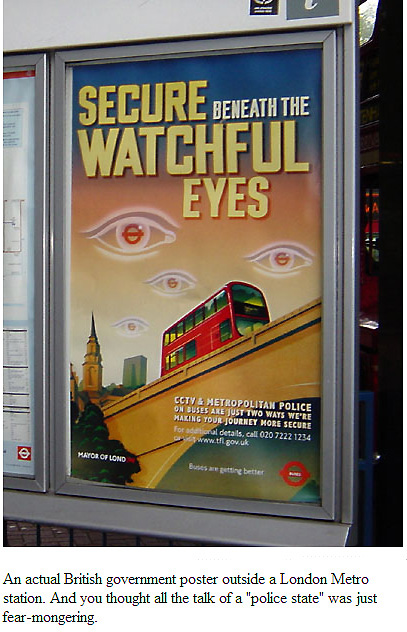

by a QFS member
Seen by over 1 BILLION people!
Books by Signs of the Times
Books by Red Pill Press