|
AFP
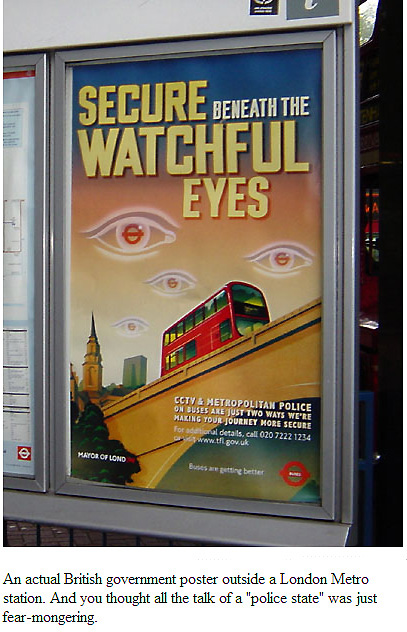
Saturday January 28, 12:54 PM Big Brother-style surveillance is growing
on Britain's roads, where police will have the greatest ability in
the world to scrutinise, control and record the movements of
drivers by the end of the year.
Thousands of cameras reading vehicle number plates and comparing data with a central data base will analyse some 35 million pieces of information per day.   Comment:
"This is an intrusion in the privacy of every driver in this country, and it makes everyone become a presumed suspect."And that's the whole idea: if everyone knows they are a presumed suspect, they will live in constant fear. So far, it is working. In all the countries around the world where terrorism and crime are being used to justify spying on the population and the removal of civil liberties, how many citizens have stood up together and declared that enough is enough?? |
|
by Carlos Miller
The Raw Story January 27, 2006 Infiltrated by feds, antiwar group turns
on photographer
The first time federal agents infiltrated the Broward Antiwar Coalition was in July 2003, two months before a planned protest against President George W. Bush, according to one member of the South Florida activist group. The second time was in September 2003, two months before the infamous Free Trade Area of the Americas meeting in downtown Miami, which resulted in several lawsuits against the Miami Police Department for using excessive force against protesters. And the third time was less than a year ago, just days before the Organization of American States meeting in downtown Fort Lauderdale, said Ray Del Papa, one of the original members of the activist group. Each time, it was a different person who had joined their group or befriended one of its members, asking prying questions and knowing just a little too much personal information about the activists. Each time, the individual seemed to contradict statements they had made about themselves and their background. And each time, that person would disappear within a few months, never to be heard from again. Comment: "The incident
revealed the untold price of domestic surveillance: that people who
feel they are being spied upon are liable to turn on each
other."
But don't you get it? That's exactly what they want! |
 Hacker's five-line program allowed him to change
electronic election results, leaving no audit trail Hacker's five-line program allowed him to change
electronic election results, leaving no audit trailby Marc L. Songini
Computerworld Jan. 19, 2006 When Herbert Thompson, director of
research at Wilmington, Mass.-based Security Innovation, talks
about e-voting security, he speaks from firsthand experience.
Security Innovation conducts security testing and Thompson is the
co-author of several books, including How to Break Software
Security.
He volunteered to use his expertise in tests to determine whether it's possible to hack electronic voting gear last May and again last month in Leon County, Fla. With fellow security expert Harri Hursti, Thompson took part in the hacking of an optical scan system made by Diebold Elections Systems Inc., allegedly proving that election results could be changed. Thompson spoke recently with Computerworld about e-voting reliability. Diebold declined to make anyone available for an interview on the topic, but a spokesman dismissed the concerns raised by Thompson. Diebold’s response follows Thompson’s comments below. |
Have a question or comment about the Signs page? Discuss it on
the Signs of the Times news forum with the Signs
Team.
Some icons appearing on this site were taken from the Crystal Package by
Evarldo

Remember, we need your help to collect
information on what is going on in your part of the world!
Send your article suggestions to: 
Contact Webmaster at signs-of-the-times.org
Cassiopaean materials Copyright ©1994-2014 Arkadiusz Jadczyk and Laura Knight-Jadczyk. All rights reserved. "Cassiopaea, Cassiopaean, Cassiopaeans," is a registered trademark of Arkadiusz Jadczyk and Laura Knight-Jadczyk.
Letters addressed to Cassiopaea, Quantum Future School, Ark or Laura, become the property of Arkadiusz Jadczyk and Laura Knight-Jadczyk
Republication and re-dissemination of our copyrighted material in any manner is expressly prohibited without prior written consent.

![[Valid Atom 1.0]](/signs/images/valid-atom.png "Validate my Atom 1.0 feed")

The Gladiator: John Fitzgerald Kennedy
John F. Kennedy and All Those "isms"
John F. Kennedy, J. Edgar Hoover, Organized Crime and the Global Village
John F. Kennedy and the Psychopathology of Politics
John F. Kennedy and the Pigs of War
John F. Kennedy and the Titans
John F. Kennedy, Oil, and the War on Terror
John F. Kennedy, The Secret Service and Rich, Fascist Texans
Recent Articles:
New in French! La fin du monde tel que nous le connaissons
New in French! Le "fascisme islamique"
New in Arabic! العدوّ الحقيقي
New! Spiritual Predator: Prem Rawat AKA Maharaji - Henry See
Top Secret! Clear Evidence that Flight 77 Hit The Pentagon on 9/11: a Parody - Simon Sackville
Latest Signs of the Times Editorials
Executing Saddam Hussein was an Act of Vandalism
Latest Topics on the Signs Forum |
Signs Monthly News Roundups!
June 2005
July 2005
August 2005
September 2005
October 2005
November
2005
February 2006
March 2006
April 2006
May 2006
June 2006
July 2006
August 2006
September 2006
This
site best viewed
with Mozilla Firefox

Picture of the Day

by a QFS member
Seen by over 1 BILLION people!
Books by Signs of the Times
Books by Red Pill Press