Smoking
The coordinated, corporate-funded global campaign to ignore, hide, and steal evidence of the harms of industrial chemicals is particularly hypocritical, callous and vicious when it comes to mothers and children. There is an intensified push lately to focus the anti-tobacco crusade on mothers who smoke, and on mothers and kids who may be exposed to second-hand, and even third-hand smoke. ("Third hand" refers to smoke scent left behind on fabrics and so forth.) There are even moves afoot to separate children from their own mothers if the mother happens to smoke. (1) This is serious business.
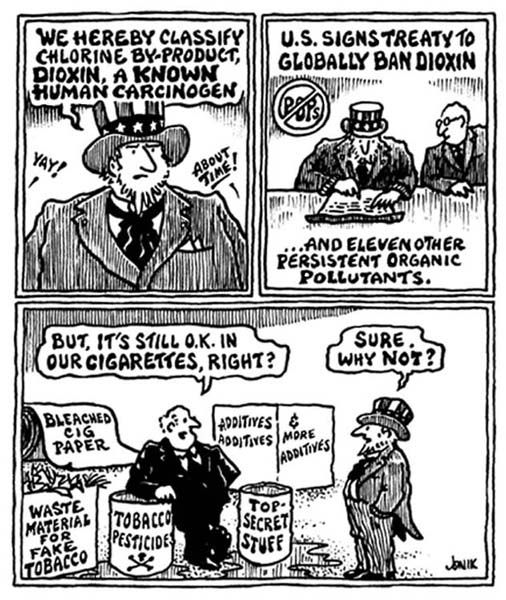
That tobacco is one of the most pesticide-contaminated agricultural products is a topic too big, too complicated, or too itchy to address in most forums, so far. (2)
That's "third-hand" smoke.
A new study conducted by a team of medical researchers and published in the journal Pediatrics, reports there is no safe level of exposure to tobacco, even its invisible toxins.
Comment: Don't worry about the mercury in vaccines. Don't worry about the toxins in what they want us to call food. Don't worry about the poisons in our water, soft drinks, and the list goes on.
Blame the smokers.
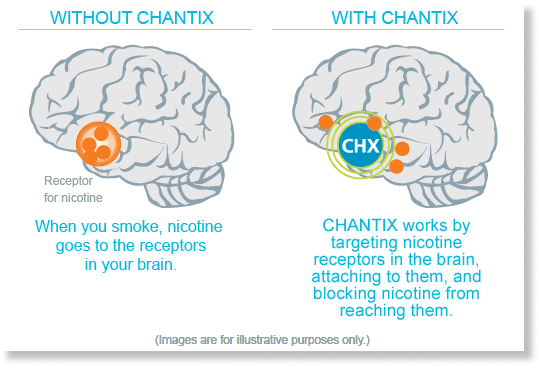
The Champix mechanism, to this reporter's lay reading of the literature, binds to the receptors in your brain that trigger the release of dopamine and eventually suppresses its production. This is similar to the action of SSRIs, which are also receptor agonists, but for seratonin rather than nicotine. So it shouldn't come as that much of a surprise if it had similar psychiatric side-effects to those of Prozac, Effexor, etc. These receptors have some natural function that's being degraded, after all. Hostility? Suicidal thoughts? You pay your money and you take your chance.
Comment: Ever wonder why the anti-tobacco campaign has become such an issue, even though there are much more pressing problems to be solved in this world? This article is very informative.
In the January issue of the journal Pediatrics, Dr. Jonathan Winickoff of Harvard Medical School and his colleagues said parents may try to shield their children from second-hand smoke by rolling down the car window or smoking in the kitchen with the fan on, but the risks of third-hand smoke still exist.
Comment: Oh, puh-lease! The entire point of this article is clearly stated in the final line: "The researchers found higher support for home smoking bans among people who believed that third-hand smoke is dangerous." The anti-smoking Nazis are preparing their final battle -- reaching into the homes of smokers to crush the nasty habit and turn smoking parents into criminals. They are seeking support for such bans.
Please note that the study discussed in the article was an investigation into "parents' attitudes". It was not a study into the real dangers of this so-called third-hand smoke. It is based upon the junk science served up over the last forty years that pretends that second-hand smoke is dangerous. However, the studies done in Sweden that show that children who are raised in homes with smokers have a greater resistance to lung cancer later in life are not mentioned. We wonder why? Well, not really. We know why. Smoking is the poster boy of the new authoritarians, the beachhead established to acclimatize us all into accepting ever greater restrictions on our civil liberties.
Whenever a study on smoking comes from the U.S. Centers for Disease Control and Prevention, run the other way or read the funnies. Consider the claim:
"Secondhand smoke causes an estimated 46,000 heart disease deaths and about 3,000 lung cancer deaths among nonsmokers each year, according to statistics cited by the CDC."One might be tempted to think that the statistics they cite are numbers of actual deaths based upon death certificates. But as Don Oakley shows in his book Slow Burn, these are "statistics" generated by computer models.
But how does the CDC arrive at its calculations from those state reports? At least one enterprising reporter, Nickie McWhirter of The Detroit News, tried to find out. Her article was posted on the Internet by the American Smokers Alliance. She wrote:
I recently read that 435,000 Americans die every year from smoking-related illnesses. That sounds like a rock-hard, irrefutable fact, and pretty scary. How are such statistics determined? I phoned the American Lung Association's Southfield office to find out.
No one there seemed to know. However, a friendly voice said most such numbers come from the National Center for Health Statistics. That's a branch of the National Centers for Disease Control. The friendly voice provided a phone number in New York City. Wrong number. The New York office collects only morbidity [the rate of occurrence of a disease] data, I was told. I needed mortality data [the death rate].
Several bureaucratically misdirected calls later, I spoke with someone in Statistical Resources at NCHS. He said his office collects mortality based on death certificates. Progress! Data is categorized by race, sex, age, geographic location, he said, but not smoking. Never. No progress.
He suggested I phone the Office of Smoking and Health, Rockville, Md., and provided a number. That phone had been disconnected.
Was I discouraged? No! Ultimately, and several unfruitful phone calls later, I found a government information officer in Washington, D.C., with a relatively new phone directory and a helpful attitude. She found a listing for the elusive Office on Smoking and Health in Atlanta.
Bingo! Noel Barith, public information officer, said the 435,000 figure probably came from its computers. S&H generates lots of statistics concerning "smoking-related" stuff, he said. It's all done according to a formula programmed into the computers.
Really? Since I had already determined that no lifestyle data on individual patients and their medical histories is ever collected, how can the computer possibly decide deaths are smoking related? Barith didn't know. Maybe the person who devised this computer program knows. Barith promised to have a computer expert return my call. The next day, SAMMEC Operations Manager, Richard Lawton, phoned. SAMMEC, I learned, is the name of the computer program. Its initials stand for Smoking Attributed Morbidity, Mortality and Economic Cost.
The computer is fed raw data and SAMMEC employs various complex mathematical formulas to determine how many people in various age groups, locations, and heaven knows what other categories are likely to get sick or die from what diseases and how many of these can be assumed to be smoking related.
Assumed? This is all guesswork? Sort of. Lawton confirmed that no real people, living or dead, are studied, no doctors consulted, no environmental factors considered.
Lawton was absolutely lyrical about SAMMEC and its capabilities, however, provided one can feed it appropriate SAFs. What are SAFs?
"That's the smoking attributable fraction for each disease or group of people studied," he said. It sounded like handicapping horses. Lawton began to explain how to arrive at an SAF, using an equation that reminded me of Miss Foster's algebra class.
"Wait a minute!" I commanded. "I don't need to know that. I need to know if the SAFs and all the rest of this procedure yield valid, factual information. To know that we must know if sometime, somewhere, some human being or human beings actually looked at records of other human beings, smokers and nonsmokers, talked to their doctors, gathered enough information from reality to BEGIN to devise a mathematical formula that MIGHT be applied to large groups of people much later, without ever needing to study those people, and could be expected to yield TRUE FACTS within a reasonable margin of error. Who did that? Can you tell me, Mr. SAMMEC expert?" [Caps in original.]
Nice guy, Mr. Lawton, but he didn't have a clue. He said he thought the original work concerning real people, their deaths and evidence of smoking involvement was part of work done by a couple of epidemiologists, A.M. and D.E. Lilienfield. It's all in a book titled Foundations of Epidemiology, published about 1980 by Oxford University Press, he said. SAMMEC came later, based on the Lilienfield's [sic] work. Maybe. He wasn't sure.
I was unable to find the book, or the Lilienfields.
So there you have it. Research shall continue, but so far it has only revealed that no one churning out statistics knows anything about smoking and its relationship, if any, to diseases and death. A computer knows everything, based on mystical formulas of unknown origin, content and reliability. Raw data in, startling statistics out. SAMMEC speaks, truth is revealed! Oh, brave new world. Are there 435,000 smoking-related deaths per year in America? Maybe. I can tell you this with absolute certainty, however: No human beings are ever studied to find out. 32
[32. Nickie McWhirter, "Computer blows out smoking-related death figures with no real human facts." The Detroit News, October 18, 1992. Cited in Don Oakley, Slow Burn, pp 240-42.]
Comment: While it is true that cancer is increasing in the population, as reported in this article, what is NOT true is that it is due to an increase use of tobacco. Nearly all of the researchers in the field (excluding some of those funded by pharmaceutical companies) state unequivocally that nearly ALL cancers are caused by environmental toxins, NOT by smoking tobacco!
Cancer will overtake heart disease as the world's top killer by 2010, part of a trend that should more than double global cancer cases and deaths by 2030, international health experts said in a report released Tuesday.
Rising tobacco use in developing countries is believed to be a huge reason for the shift, particularly in China and India, where 40 percent of the world's smokers now live.
So is better diagnosing of cancer, along with the downward trend in infectious diseases that used to be the world's leading killers.
Comment: According to this article, the increase in cancer has nothing to do with chronic stress, diet, industrial pollution such as pesticides, heavy metals, DDT, cadmium, styrene, dioxin, xylene, mercury, aluminum, fungicides, formaldehyde, dioxins, just to name a few. No, contrary to all available evidence, it must be that these very poor people simply smoke too many cigarettes.
The research, published online last week in the respected journal Nature Genetics, came out of the largest genetic study of lung cancer ever conducted. It involved a team from 18 countries, including the United States, and was organized in part by the International Agency for Research on Cancer in Lyon, France.
Comment: Though the study proved that a certain gene makes people more susceptible to lung cancer, doctors continue the fear-mongering preaching against smoking. With the number of poisons in the air we breath constantly, it is also curious that smoking gets solely the blame, when in fact it can be beneficial for some people.
But there is something slightly different about these farmers.
Almost all of them, I notice as they chase the animals across scree slopes and shove them into wooden pens, are older than you might expect. In fact, there is barely one under pensionable age. Clearly, I was not misled about older Andorrans leading an active life.
Not every citizen of Andorra these days toils up and down mountains as part of their daily existence.
The Hindu
February 17, 2008
New Delhi: Tobacco will now be used for manufacturing cancer and cardiac drugs with the Central Tobacco Research Institute (CTRI) bagging the patent for 'solanesol' -- a medicinal substance extracted from tobacco.
Solanesol, a white crystalline powder derived from tobacco's green leaf, has curative effects against cardiac insufficiency, muscular dystrophy, anaemia, cancer, diabetes, high blood pressure, asthma and liver injury. "Many pharmaceutical companies have approached us for carrying out clinical trials for the usage of solanesol as anti-cancer and anti-diabetic drugs," CTRI Director V Krishna Murthy told PTI.
Solanesol is rich in Coenzyme Q10 -- a physiologically active substance with high pharmaceutical value. "Solanesol has excellent prospects in future as drug and CTRI would soon distribute the rights for production of drugs in the market," Murthy said. A letter granting the patent for solanesol was received by CTRI in October last year from Controller of Patents.
The project of deriving solanesol from tobacco was a collaborative programme between CTRI and Central Drug Research Institute (CDRI), Lucknow. CTRI used chewing tobacco variety Abirmani grown in Tamil Nadu and HDBRG tobacco cultivated in black soils of Guntur in Andhra Pradesh for extracting solanesol


Comment:
Fact one: Pesticide and dioxin contamination comes from the food we eat, the water we drink and the air we breath these days, thanks to the industrial corporations' greediness and absence of conscience.
For the prime example of corporate greediness and absence of conscience we do not have to look any further than Monsanto and its grand dioxin experiment, "Agent Orange."
Consider this in regards to dioxin and the souless, conscienceless corporation Monsanto: Fact two: The Powers That Be are using the war against smokers as another means of individual and societal control.
Fact three: Tobacco smoking does indeed offer health benefits to certain people, though the mainstream scientific community goes to great lengths to conceal this fact, attributing all health problems caused by environmental pollutants to smoking.
This excerpt from the above link in regards to tobacco and health:
From Let's All Light Up! by Laura Knight-Jadczyk: