Health & WellnessS


Bacon n Eggs

Skipping breakfast primes brain to seek high-calorie food, study finds

Image
Brain scans show people who miss meal respond more positively to unhealthy foods than those who have eaten

We are all told that breakfast is the most important meal of the day - and now neuroscientists are starting to understand why. Skipping the first meal of the day not only means you eat more at lunch, research has found, but also means your brain is primed to seek out unhealthier, higher-calorie foods.

Dieters who skip meals often end up gaining weight over the long term, but why this happens is not well understood. Tony Goldstone, of the MRC Clinical Science Centre at Imperial College London, scanned the brains of people who skipped meals and found mechanisms at work that could help explain the conundrum.

Comment: Fried breakfast is healthiest start to day, say scientists
A breakfast of bacon, sausages, eggs, and beans could be the healthiest start to the day, according to new research.

Scientists believe that breakfast programmes the metabolism for the rest of the day, and a fatty meal will help the body break down fat later on.

Carbohydrate rich foods in contrast appear mainly to prepare the body to break down only carbohydrates, the International Journal of Obesity reports.

Dr Martin Young, of the University of Alabama at Birmingham, said: "The first meal you have appears to programme your metabolism for the rest of the day."

"This study suggests that if you ate a carbohydrate-rich breakfast it would promote carbohydrate utilisation throughout the rest of the day, whereas if you have a fat-rich breakfast, you (can) transfer your energy utilisation between carbohydrate and fat."


Cow

How to reduce inflammation with food

wagyu vs kangaroo title
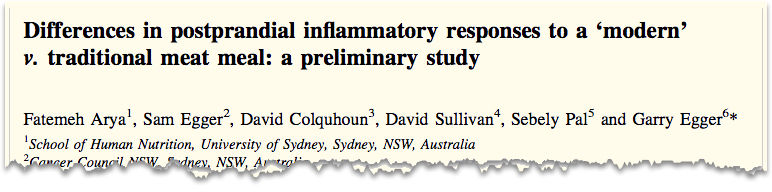
Humans should adapt to foods they have consumed for a great part of their time on earth, and these same foods should pose fewer problems than consumption of similar but newer (in an evolutionary sense) foods. A nice paper from the British Journal of Nutrition I've had lying around for a couple of years awaiting this post looks at the inflammatory changes in people eating an old food versus a newer food and finds the newer food to be more inflammatory.

Bad news and good news re this paper. Bad news is that I haven't posted on it in two years - good news is that it's been so long the full text version of it is now available free.

Before we get into the paper, which studies the consumption of kangaroo, just to get us all in the mood, I'm going to put up a quote from The Protein Power LifePlan. I had to fight our editor tooth and nail to keep these few paragraphs in the book. She thought they were too gross for the average reader. The quote comes from the records of an 1948 expedition to Arnhem Land, a remote part of of the Northern Territory of Australia set aside for the "use and benefit of the aboriginal inhabitants of northern Australia." It's about how the indigenous Australians cook and eat a wallaby.

Mr. Potato

Mind Games: Cyberspace and psychiatric drugs

Image
At least 10 percent of all Americans over six-years-old are currently on antidepressants. That's more than 35 million people, double the number from 15 years ago. Meanwhile, anti-psychotics have eclipsed cholesterol treatments as the country's fastest selling and most profitable drugs, even though half the prescriptions treat disorders for which they haven't been proven effective. At least 5 million children and adolescents use them, in part because more kids are being diagnosed with bipolar disorder.

So, are a growing number of people experiencing psychological troubles? Have we just become better at recognizing them? Or is some other dynamic at work?

One possibility is that the criteria for what constitutes a mental illness or disability may have expanded to the point that a vast number appear to have clinical problems. But there's an even more insidious development: the drugs being used to treat many of the new diagnoses could cause long-term effects that persist after the original trouble has been resolved. That's the case made by Robert Whitaker in his new book, Anatomy of an Epidemic: Magic Bullets, Psychiatric Drugs, and the Astonishing Rise of Mental Illness in America.


Bullseye

Nasty and crazy effects of pesticides

Image
"Unfortunately, pesticides attack your body on several fronts."

When asked by a skeptical friend why you buy organic, do you find yourself tongue-tied? Was it obesity? Or thyroid problems? Why should you buy organic? There are numerous reasons to skip the mainstream supermarket food and shop at an organic grocer, but just one of those reasons revolves around the effects of pesticides.

Unfortunately, pesticides attack your body on several fronts. Keep this list handy the next time you find yourself wondering if you should buy a carton of conventional strawberries rather than organic to potentially save a few pennies. Remember that all of the following conditions will cost you much more than money; the effects of pesticides will cost you your health.

Here are 7 nasty and crazy effects of pesticides.

Syringe

Why does the government care so much about vaccinating you?

Vaccines
© NaturalSociety
The government cares about you being vaccinated. No, they don't necessarily care about the negative effects of the vaccination or your concerns, but they do invest millions of dollars to ensure as many people as possible receive things like the flu vaccine every year. They say they care because they want you healthy, but evidence shows not only do they not care, but vaccinations aren't a good way to maintain health. Why? What's the big motivator for the government to push vaccines like a dealer pushing illegal drugs on the corner?

Like any other drug dealer, there's only ever one real motivation, and it isn't your health.

The Alliance for Natural Health reports that the federal government has recently invested $400 million towards developing vaccines and similar drugs. This money is going to the Big Pharma companies of Novartis, Lonza, and GlaxoSmithKline, among others. They recently gave Sanofi Pasteur $77.4 million to retrofit their vaccine plant, far less than the company is putting towards the changes themselves.

They're doling out taxpayer money by the fortune and giving it to these companies who hide behind what they call "prevention" and "preparedness," never minding the fact that the effects of these vaccines are highly questionable and the flu vaccine still contains mercury - one of the most toxic substances on the planet.

But it gets much, much scarier (and crazier). We recently reported that one biotech company known as ProdiGene, the officials from which actually faced jail time back in 2002 forcontaminating the traditional food supply with 'biopharmaceutical' crops that were growing pharmaceuticals and vaccine components associated with AIDS, diabetes, and diarrhea. As if forcing vaccines on the public and infants isn't enough, we need biofarms too?


Family

Bitter Pills: Parents have their children taken away for refusing to subject them to mainstream medical treatments

Image
© Getty ImagesSensitive issue … NSW has one of the highest rates of child-removal in the Western world
Parents have plenty of rights, but choosing their child's medical treatment doesn't always seem to be one of them - especially when doctors, social workers and the courts take a different view. Mark Whittaker looks into the disturbing issue of forced medicine.

The doctor examined the smattering of sores on the 14- month-old girl. "Some of these chicken pox are infected," he said. "We're going to have to give her an intravenous antibiotic."

"That sounds a bit extreme," the mother, Melissa*, said.

The baby's father's family had a history of bad reactions to antibiotics. "Can we try something topical first?"

"No. It needs to be intravenous. She's really bad."

Arrow Up

Child abuse hospitalizations increased 5% over 12-year period

Image
© Unknown
While child protection agencies have found a dramatic drop in physical child abuse cases over the past decade, a new study shows that the number of hospitalizations for serious injuries resulting from abuse has actually increased.

Data compiled by the National Child Abuse and Neglect Data System, or NCANDS, which draws from files kept by child protective services agencies in the U.S., has shown a 55 percent decrease in total substantiated cases of physical abuse of children from 1992 to 2009.

But Yale researchers John M. Leventhal and Julie R. Gaither found that the number of children hospitalized for serious injuries resulting from child abuse actually increased by 5 percent over that same time period, with 54 percent of these severe abuse cases involving children less than 1 year of age, according to the paper.

Beaker

Worse than DDT: When you eat this, it ends up lingering in your gut


Dr. Don Huber is an expert in an area of science that relates to the toxicity of genetically engineered (GE) foods.

(Alternative terms for GE foods include genetically modified (GM), or "GMO" for genetically modified organism.)

His specific areas of training include soil-borne diseases, microbial ecology, and host-parasite relationships.

Dr. Huber also taught plant pathology, soil microbiology, and micro-ecological interactions as they relate to plant disease as a staff Professor at Purdue University for 35 years.

In part one of this interview, Dr. Huber discussed the shocking discovery of a brand new organism in genetically engineered (GE) crops - an organism that has been clearly linked to infertility and miscarriage in cattle, horses, pigs, sheep, and poultry that are raised on GE feed.

In part one we began the discussion on the hazards of glyphosate, the active ingredient in Monsanto's herbicide Roundup, and its contribution to a new phenomenon referred to as "Sudden Death Syndrome" (SDS).

Here, we continue the discussion on glyphosate.

Cell Phone

Cell Phone Dangers: Loaded with mercury, chlorine, cadmium, health risks

Image
© Activist Post
Not that you'll be eating your cell phone anytime soon, but did you know that it's loaded with toxins like mercury, chlorine, and cadmium? Helping to analyze cell phone dangers, the Ecology Center of Ann Arbor, Michigan teamed up with ifixit.com to take apart and identify components of 36 models of cell phones. They found at least one of the following in every device:
  • Bromine
  • Chlorine
  • Cadmium
  • Lead
  • Mercury
In total, ifixit.com dismantled over a thousand cell phones to test for toxins by utilizing X-ray fluorescence to irradiate and measure the radiation given back by an object. Certain materials - like the toxins - are identified by the signature of radiation the object re-emits.

"Even the best phones from our study are still loaded with chemical hazards," bemoaned Jeff Gearhart, research director of the Ecology Center. He published the results of the study on his website, HealthyStuff.org. "These chemicals [are] linked to birth defects, impaired learning, and other serious health problems."

Beaker

Arsenic, a potent carcinogen found in rice products marketed as "health foods"

Image
© cbsnews.com
If you knew there was arsenic in your food, would you eat it? More importantly, would you serve it to your children?

Recently, Consumer Reports Magazine released their analysis of arsenic levels in rice products, and the results were concerning. Popular rice products including white rice, brown rice, organic rice baby cereal, and rice breakfast cereals, were all found to contain arsenic, a potent carcinogen that can also be harmful to a child's developing brain.
"In virtually every product tested, we found measurable amounts of total arsenic in its two forms. We found significant levels of inorganic arsenic, which is a carcinogen, in almost every product category, along with organic arsenic, which is less toxic but still of concern."
The study not only found a significant amount of arsenic in many rice products on the market, but also that arsenic levels in the blood directly increase with greater rice consumption.(1) Several products tested had more arsenic in each serving than the 5 parts per billion (ppb) limit for adults set by the EPA as safe. (2)

What's worse, many of these arsenic-containing rice products are marketed to children and infants as "health foods", and children are far more susceptible to the dangerous impacts of arsenic exposure. (3, 4, 5) Research suggests that high levels of arsenic exposure during childhood are associated with neurobehavioral problems as well as cancer and lung disease later in life. (6) This means parents must be especially careful to avoid serving their children food with significant levels of arsenic.

Comment: Considering the toxic load of chemicals we are exposed to on a daily basis, why would anyone want to add to this by deliberately consuming a known source?
Plants Bite Back: The Surprising, All-Natural Anti-Nutrients and Toxins in Plant Foods
Arsenic and Old Rice: Should We Worry About a Toxic Chemical in a Popular Food?
World facing 'arsenic timebomb'
A No-Nonsense Look at Toxins and How Your Body Deals with Them