Health & WellnessS


Cell Phone

Frequent cell phone use linked to anxiety, lower grades, reduced happiness in students

Image
© dpaHigh frequency cell phone users tended to have lower GPA, higher anxiety, and lower satisfaction with life (happiness) relative to their peers who used the cell phone less often.
Today, smartphones are central to college students' lives, keeping them constantly connected with friends, family and the Internet. Students' cell phones are rarely out of reach whether the setting is a college classroom, library, recreational center, cafeteria or dorm room. As cell phone use continues to increase, it is worth considering whether use of the device is related to measurable outcomes important for student success, such as academic performance, anxiety and happiness.

Kent State University researchers Andrew Lepp, Ph.D., Jacob Barkley, Ph.D., and Aryn Karpinski, Ph.D., all faculty members in the university's College of Education, Health and Human Services, surveyed more than 500 university students.

Daily cell phone use was recorded along with a clinical measure of anxiety and each student's level of satisfaction with their own life, or in other words happiness. Finally, all participants allowed the researchers to access their official university records in order to retrieve their actual, cumulative college grade point average (GPA).

All students surveyed were undergraduate students and were equally distributed by class (freshman, sophomore, junior and senior). In addition, 82 different, self-reported majors were represented.

Bad Guys

Ignorant crack-smoking Toronto mayor Rob Ford slams Obamacare

Image
Controversial Toronto Mayor Rob Ford slammed President Obama's signature healthcare law during an appearance on a Washington, D.C., sports radio talk show Thursday.

"I don't believe in all this public-funded health care because we gotta pay for it," Ford told WJFK's "The Sports Junkies."

Ford said that in Canada, the country "can't afford" their universal health coverage.

"What you guys are doing down there, I just, I can't get my head around it because it's costing a fortune, and I don't know where you guys are going to find the money, except the taxpayers pockets," he continued.

"And I think people are taxed to death, and I don't mind two-tier healthcare; if you want healthcare, you pay for it. I understand that. And we have general healthcare up here, or OHIP we call it, but, you know, it's gonna cost a fortune for you guys to put in this ObamaCare, and I just don't see how the people are going to be able to afford it, to tell you the truth."

Ford added that he personally liked Obama but that he did not "like his politics."

Comment:
"I don't believe in all this public-funded health care because we gotta pay for it"
Let's get some facts straight here. Obamacare is not "public-funded health care" - it's private insurance-funded Medicaid on steroids, ie more of the same, only worse.

Also, the cost of Canada's universal healthcare coverage pales into insignificance compared with the expenditures its government has had for participating in America's wars, bailing out banksters, and lining the pockets of corrupt politicians like Rob Ford.

How is this crack-smoking, drunkard, abusive, sorry excuse for a human being still in public office??


Laptop

New ADHD diagnostic computer test: Just more lipstick on a pig

Image
“The diagnosis of the alleged ADHD, based on a computer program, is the equivalent of getting a diagnosis from reading Tarot Cards. Regardless of the method, it all comes back to a subjective interpretation of one's behavior, not scientific fact.”
Wikipedia defines the phrase lipstick on a pig as "a rhetorical expression, used to convey the message that making superficial or cosmetic changes is a futile attempt to disguise the true nature of a product." Which brings us to yet another of psychiatry's futile attempts at medical legitimacy...

Just when you thought psychiatric diagnosing couldn't get any nuttier, the Grand Poobahs of we-determine-acceptable-behavior are resorting to relying on a computer test that reportedly "measures motion and analyzes shifts in attention state to give a clear picture of ADHD symptoms."

Remarkably, in this latest attempt to find any objectivity in an ADHD diagnosis, psychiatrists actually reinforce the fact that there is no science to support the alleged mental disorder.

Here's how the ADHD computer allegedly "works." The Pearson, Llc., Quotient device is a computer, equipped with infrared motion-tracking equipment (head and leg straps) that reportedly measures the test-takers movements against a database of results of "real" ADHD patients. Numerous variations of star-shaped images intermittently flash on the screen, requiring the test subject to make the appropriate choice by hitting the space bar. The entire process lasts no longer than 20 minutes and too much recorded movement could justify an ADHD diagnosis.

Health

Bacteria-killing protein could help fight antibiotic-resistant 'superbugs'

Image
© ShutterstockA protein found in bacteriophages — bacterial viruses — has been found to kill E. coli bacteria, offering hope that it could one day fight off antibiotic-resistant bacteria as well.
Imagining a world where previously conquered illnesses - most profoundly the bubonic plague - reemerged as a major health issue could be horrifying for some, and unfortunately, it could one day become a reality, as bacteria develop stronger resistance to antibiotics. Thankfully, there's hope in sight: In a recently published study, researchers describe the discovery of a protein that could kill these so-called superbugs and usher in a new era of antibiotic treatments.

The Centers for Disease Control and Prevention (CDC) released a report in September, bringing attention to three particularly antibiotic-resistant bacteria: Clostridium difficile, Carbapenem-resistant Enterobacteriaceae, and Neisseria gonorrheae. In the report, the CDC emphasized the importance of reducing antibiotic misuse or overuse - either one allows allows bacteria to become increasingly resistant, and these three strains are already resistant to most, if not all, antibiotics. Other bacteria that were labeled as a threat, albeit not as urgent, included various strains of Salmonella, Staphylococcus aureus, Streptococcus pneumonia, and tuberculosis.

The October breakout of Salmonella Heidelberg offers a perfect example of a real-world scenario, highlighting the urgency of developing new antibiotics, and reducing the chances of current antibiotics becoming obsolete. Seven strains of the bacteria, which was traced back to three Foster Farms processing plants in California, sickened 389 people, and caused 40 percent of them to be hospitalized - 20 percent more than a typical Salmonella outbreak, Barbara Reynolds, a CDC spokeswoman, told USA Today. The reason for so many hospitalizations: antibiotic resistance.

Clipboard

FDA says Genetically Engineered food is the same, EPA says different, 6 reasons for labels.

Image
© damemagazine.com
Fourteen years ago, I was in NYC at a conference hosted by one of the big banks, as a financial analyst covering the food industry.

In that position, I learned how the food industry uses artificial ingredients to manage their profitability and meet earnings. But never once, attending conferences in New York City or speaking with traders on the floor of the stock exchange, did our team meet with the chemical companies engineering their products into our food, ingredients that required increased use of a portfolio of chemicals that helped them manage their earnings.

It is a brilliant business model for chemical investors, but for eaters?

At that conference, I also happened to be six months pregnant. At that time, parents around the world were being told about a massive change in the way that food was produced and grown, but parents here in the United States, even those of us covering the food industry, had not been told what was going on.

That is changing.

Water

Coke's conspiracy against tap water

Image
© killercoke.org
Coca-Cola is running a stealth advertising campaign.

Stealth? Why would a corporation as ad-dependent as Coke spend big bucks on advertising that it doesn't want consumers to notice? Shhhh - because the campaign is a surreptitious ploy to enlist restaurants in a marketing conspiracy that targets you, your children, and - of course - your wallet.

Coke calls its covert gambit "Cap the Tap," urging restaurateurs to stop offering plain old tap water to customers: "Every time your business fills a cup or glass with tap water, it pours potential profits down the drain." Cap the Tap can put a stop to that, says Coke, "by teaching [your] crew members or waitstaff suggestive selling techniques to convert requests for tap water into orders for revenue-generating beverages."

Comment: Sounds like more Soda wars for the share of your stomach

The Real Dangers of Soda to You and Your Children
Do the Chemicals That Turn Soda Brown Also Cause Cancer?
The Facts, Statistics and Dangers of Soda Pop
Soda Ingredients Linked to Cirrhosis and Cancer


Arrow Down

Yet another reason to avoid McDonald's - Your chicken order may have an unexpected surprise

McDonald's Chicken
© Prevent Disease
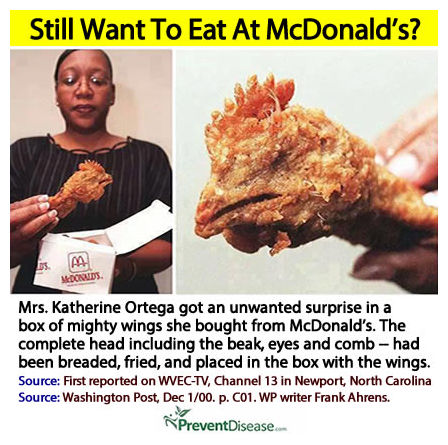
If you're still not convinced you should avoid McDonald's, here is yet another reason. Katherine Ortega took her 5-year-old son to a Newport McDonald's, where they bought a box of fried chicken wings (a special promotion). As she passed them around her dinner table, she realized that one of the wings wasn't a wing at all.

I'll Have A Side Order of Chicken McNoggin Please

What happened to Katherine Ortega in a Newport McDonald's is perhaps one of the most disturbing reports after being verified by the news station WVEC-TV in Newport as well as the Washington Post.

Many McDonald's franchises sell Mighty Wings as part of their Chicken & Fish menu.

One afternoon, Katherine Ortega brought home an order of the McDonald's wings. As she passed them around her dinner table, she realized that one of the wings wasn't a wing! She called WVEC-TV, Channel 13 in Newport News. They thought it was a hoax until they dispatched a cameraman to Ortega's home.

She called WVEC-TV, Channel 13 in Newport News. They thought it was a hoax until they dispatched a cameraman to Ortega's home.

"Our cameraman called in and said, 'The batter on the chicken head is the exact match of all the rest of the pieces of chicken,' " reported WVEC news director Jim Tellus.

Health

Best of the Web: Epidemic of dementia looms with 135 million sufferers seen by 2050

Image

Many governments are woefully unprepared for an epidemic of dementia currently affecting 44 million people worldwide and set to more than treble to 135 million people by 2050, health experts and campaigners said on Thursday.

Fresh estimates from the advocacy group Alzheimer's Disease International (ADI) showed a 17 percent increase in the number of people with the incurable mind-robbing condition compared with 2010, and warned that by 2050 more than 70 percent of dementia sufferers will be living in poorer countries.

"It's a global epidemic and it is only getting worse," said ADI's executive director Marc Wortmann.

"If we look into the future the numbers of elderly people will rise dramatically. It's vital that the World Health Organization makes dementia a priority, so the world is ready to face this condition."

Comment: Alzheimer's is often referred to as type 3 diabetes because it results from insulin resistance in the brain. And like type 2 diabetes, it is entirely preventable and usually curable by following the ketogenic diet.

The Ketogenic Diet - An Overview
Beyond weight loss: a review of the therapeutic uses of very-low-carbohydrate (ketogenic) diets
Ketogenic Diet Reduces Symptoms of Alzheimer's
Ketogenic Diet (high-fat, low-carb) Has Neuroprotective and Disease-modifying Effects
The fat-fueled brain: unnatural or advantageous?
Solve Your Health Issues with a Ketogenic Diet


Heart - Black

Hospital prices soar, and now a stitch tops $500 in U.S. unrestrained profit centered system

Image
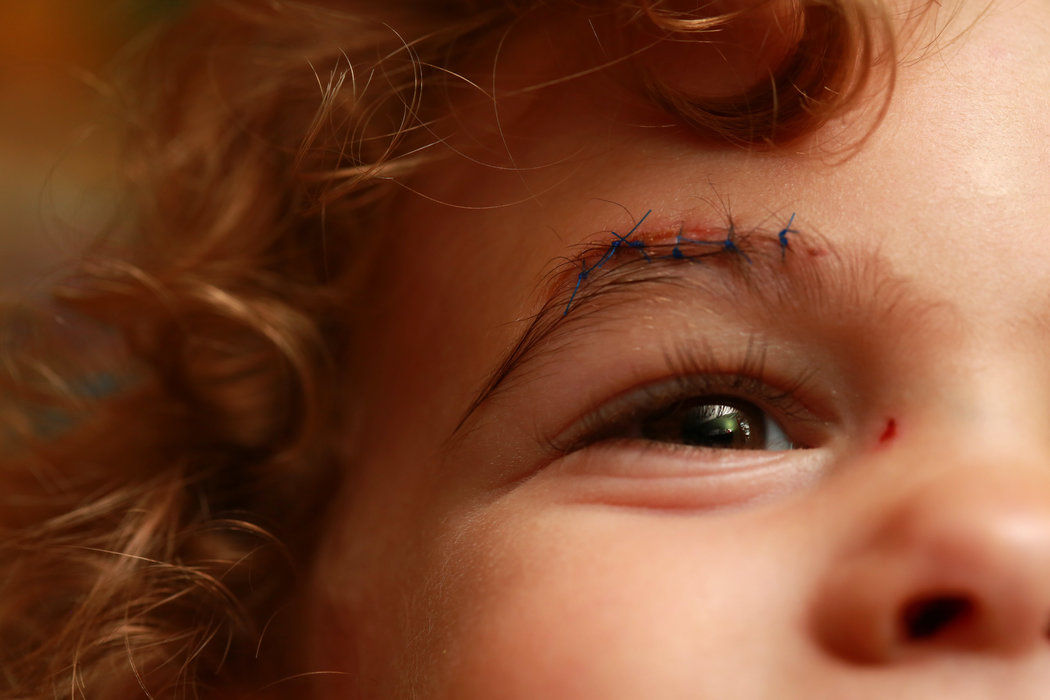
© Fabrizio Costantini for the New York TimesTwo-year-old Ben Bellar of East Lansing, Mich., getting stitches after a fall at home. The bill for his treatment came to more than $2,000.
With blood oozing from deep lacerations, the two patients arrived at California Pacific Medical Center's tidy emergency room. Deepika Singh, 26, had gashed her knee at a backyard barbecue. Orla Roche, a rambunctious toddler on vacation with her family, had tumbled from a couch, splitting open her forehead on a table.

On a quiet Saturday in May, nurses in blue scrubs quickly ushered the two patients into treatment rooms. The wounds were cleaned, numbed and mended in under an hour. "It was great - they had good DVDs, the staff couldn't have been nicer," said Emer Duffy, Orla's mother.

Then the bills arrived. Ms. Singh's three stitches cost $2,229.11. Orla's forehead was sealed with a dab of skin glue for $1,696. "When I first saw the charge, I said, 'What could possibly have cost that much?' " recalled Ms. Singh. "They billed for everything, every pill."

In a medical system notorious for opaque finances and inflated bills, nothing is more convoluted than hospital pricing, economists say. Hospital charges represent about a third of the $2.7 trillion annual United States health care bill, the biggest single segment, according to government statistics, and are the largest driver of medical inflation, a new study in The Journal of the American Medical Association found.

A day spent as an inpatient at an American hospital costs on average more than $4,000, five times the charge in many other developed countries, according to the International Federation of Health Plans, a global network of health insurance industries. The most expensive hospitals charge more than $12,500 a day. And at many of them, including California Pacific Medical Center, emergency rooms are profit centers. That is why one of the simplest and oldest medical procedures - closing a wound with a needle and thread - typically leads to bills of at least $1,500 and often much more.


Info

Monsanto says Roundup is safe. A Scientific study disagreed. Guess who wins?

Image
Even worse, GMOs are now endangering our food supply by killing off butterflies.

Monsanto, maker of the shockingly toxic herbicide Roundup and developer of the GMO Roundup Ready crop seeds, points to a number of studies that claim their pesticide is safe for the environment - though of course these are mostly studies that Monsanto has funded. Unfortunately, scientists who contradict Monsanto, and seek to expose the dangers of GMO crops and Roundup, face censorship and retraction of their studies.

Gilles-Eric Séralini, of the University of Caen in France, had done a number of studies challenging the safety of genetically engineered foods - yet the food safety journal Food and Chemical Toxicology has decided to retract Séralini's 2012 paper that showed GMO corn and Roundup can cause cancer and premature death in rats. The New York Times said the paper has been criticized as "flawed, sensationalistic, and possibly even fraudulent by many scientists, some of whom are allied with the biotechnology industry" [emphasis ours]. But if the research points to there being even the hint of a danger from GMOs and Roundup, surely this should be explored further rather than pilloried!


Comment: Read about the retracting of Séralini's paper: In the face of Monsanto's minions: Researcher refuses to retract GM maize tumor study