
Sources
Wintertime Arctic Sea Ice Growth Slows Long-term Decline: NASA
Dec. 7, 2018
New NASA research has found that increases in the rate at which Arctic sea ice grows in the winter may have partially slowed down the decline of the Arctic sea ice cover.
As temperatures in the Arctic have warmed at double the pace of the rest of the planet, the expanse of frozen seawater that blankets the Arctic Ocean and neighboring seas has shrunk and thinned over the past three decades. The end-of-summer Arctic sea ice extent has almost halved since the early 1980s. A recent NASA study found that since 1958, the Arctic sea ice cover has lost on average around two-thirds of its thickness and now 70 percent of the sea ice cap is made of seasonal ice, or ice that forms and melts within a single year.
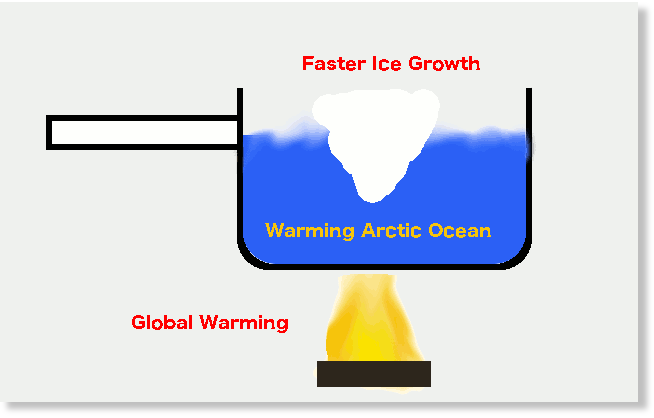
But at the same time that sea ice is vanishing quicker than it has ever been observed in the satellite record, it is also thickening at a faster rate during winter. This increase in growth rate might last for decades, a new study accepted for publication in Geophysical Research Letters found.
This does not mean that the ice cover is recovering, though. Just delaying its demise.
"This increase in the amount of sea ice growing in winter doesn't overcome the large increase in melting we've observed in recent decades," said Alek Petty, a sea ice scientist at NASA's Goddard Space Flight Center in Greenbelt, Maryland, and lead author of the study. "Overall, thickness is decreasing. Arctic sea ice is still very much in decline across all seasons and is projected to continue its decline over the coming decades. "
...
It seems counterintuitive: how does a weakening ice cover manage to grow at a faster rate during the winter than it did when the Arctic was colder and the ice was thicker and stronger?
"Our findings highlight some resilience of the Arctic sea ice cover," Petty said. "If we didn't have this negative feedback, the ice would be declining even faster than it currently is. Unfortunately, the positive feedback loop of summer ice melt and increased solar absorption associated with summer ice melting still appears to be dominant and continue to drive overall sea ice declines."
...






Comment: This must read provides some crucial context for the drive behind the IPCC:
The Dark Story Behind 'Man-Made Global Warming', Those Who Created it - And Why