Earth ChangesS


Newspaper

Journal Nature retracts ocean-warming study

ocean
The journal Nature retracted a study published last year that found oceans were warming at an alarming rate due to climate change.

The prestigious scientific journal issued the formal notice this week for the paper published Oct. 31, 2018 by researchers at UC San Diego's Scripps Institution of Oceanography.

They released a statement published on the journal's website that read in part:

"Shortly after publication, arising from comments from Nicholas Lewis, we realized that our reported uncertainties were underestimated owing to our treatment of certain systematic errors as random errors.

Comment: This is what mathematician Nicholas Lewis wrote about the paper:
On November 1st there was extensive coverage in the mainstream media and online of a paper just published in the prestigious journal Nature. The article, by Laure Resplandy of Princeton University, Ralph Keeling of the Scripps Institute of Oceanography and eight other authors, used a novel method to estimate heat uptake by the ocean over the period 1991-2016 and came up with an atypically high value. The press release accompanying the Resplandy et al. paper was entitled "Earth's oceans have absorbed 60 percent more heat per year than previously thought", and said that this suggested that Earth is more sensitive to fossil-fuel emissions than previously thought. [...]

The findings of the Resplandy et al paper were peer reviewed and published in the world's premier scientific journal and were given wide coverage in the English-speaking media. Despite this, a quick review of the first page of the paper was sufficient to raise doubts as to the accuracy of its results. Just a few hours of analysis and calculations, based only on published information, was sufficient to uncover apparently serious (but surely inadvertent) errors in the underlying calculations. [...]

Because of the wide dissemination of the paper's results, it is extremely important that these errors are acknowledged by the authors without delay and then corrected. Of course, it is also very important that the media outlets that unquestioningly trumpeted the paper's findings now correct the record too. But perhaps that is too much to hope for.
Indeed, that's too much to hope for. MSM have not retracted their articles about this study, such as CNN.


Snowflake Cold

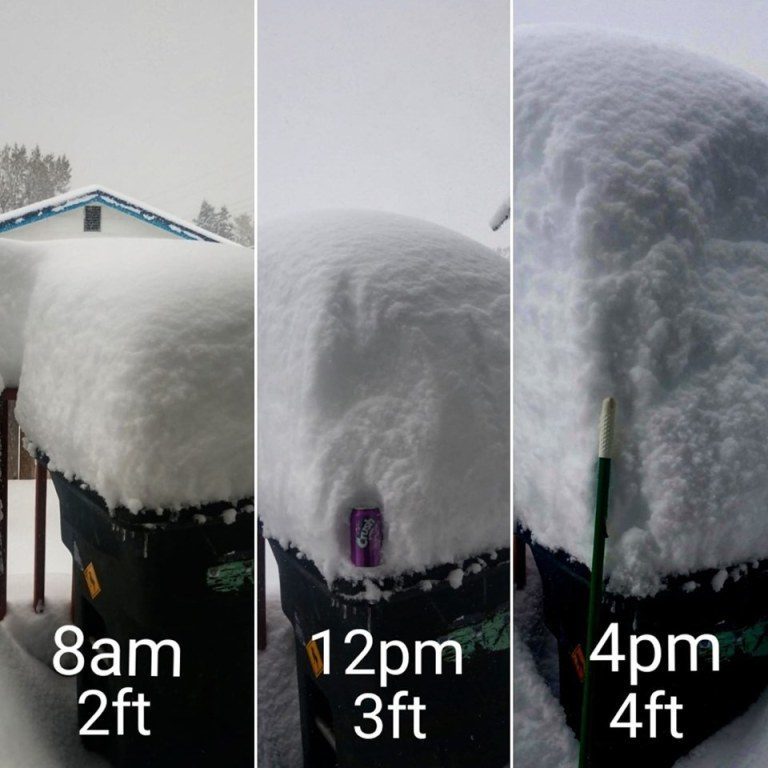
Montana's Glacier National Park getting hammered with snow

snowfall september 2019 glacier national park
© Carlene Whitney SaloisSnowfall accumulation Glacier National Park late September, 2019.
4 feet already recorded

Glacier National Park has received copious amounts of snow following an early-season snowstorm. It looks like full-on winter in the park, and it's still only Septemeber.

The storm has led to the following temporary road closures. The Many Glacier, Two Medicine, and Chief Mt. Roads are closed. The Going-to-the-Sun Road is closed from Avalanche to St. Mary.

Info

Global cooling memories a tale of consensus and political correctness

cartoon
A discussion of the consensus science surrounding global cooling, life on Mars, rejection of Continental Drift, and other delusions and the madness of crowds.


Doberman

Man dies after being attacked by his own dog in Madrid

canine attack
© Angela Antunes / CC by 2.0
A man died after he was attacked by one of his own dogs in Coslada in Madrid on Sunday.

The 47-year old was at home when the animal, a Rottweiler, leapt on him and bit him in the face and thorax, Spanish media reported.

The victim, who reportedly had three guard dogs, was at his property located on an industrial estate with family members when the attack took place.

A call to 112 alerted the emergency services to the incident. When the medical team arrived at the scene they could only confirm the man's death.

As well as the Rottweiler which caused the injuries the man had two other dogs. The Coslada Local Police Canine Unit reportedly transferred all three animals to an animal protection centre.

Cloud Precipitation

More than 100 dead in fresh India flood chaos in Bihar and Uttar Pradesh, India

Main roads are being navigated by boat
More than 100 people have died due to flooding caused by heavy rains in the Indian states of Uttar Pradesh and Bihar, officials have said.

Dramatic images of the impact of flood water on urban life have been coming out of the affected areas.

Railway traffic, vehicular movement, healthcare services, schools and power supply have been disrupted in both states, officials said.

An Uttar Pradesh government report said 93 people have died since Thursday.


Tornado2

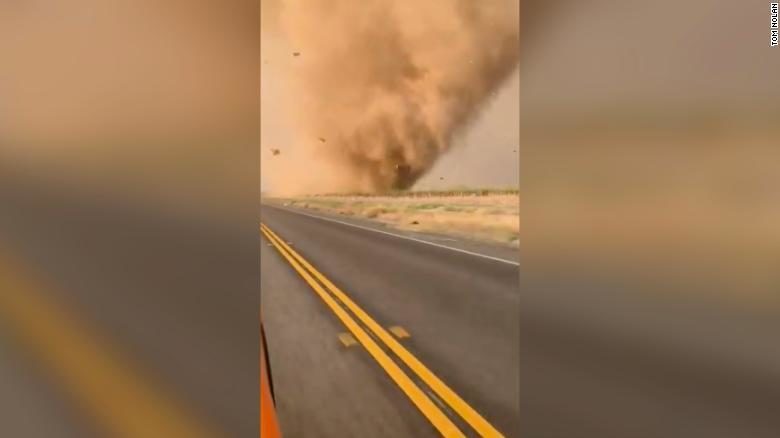
California city hit by series of weird weather events, including tornado and hail

Tornado in Davis, California
© CNN
Weird weather struck Davis, California, over the weekend. The area experienced a tornado touchdown, pounding hail and record low morning temperatures.

The tornado caused a bit of excitement, but apparently no damage.

Shasta Fields told CNN that she and her boyfriend, Tom Nolan, came close to the twister. In video posted on Twitter, Nolan, an amateur storm chaser, can be heard yelling, "Look at you, you are beautiful," as the tornado starts to form.


Snowflake

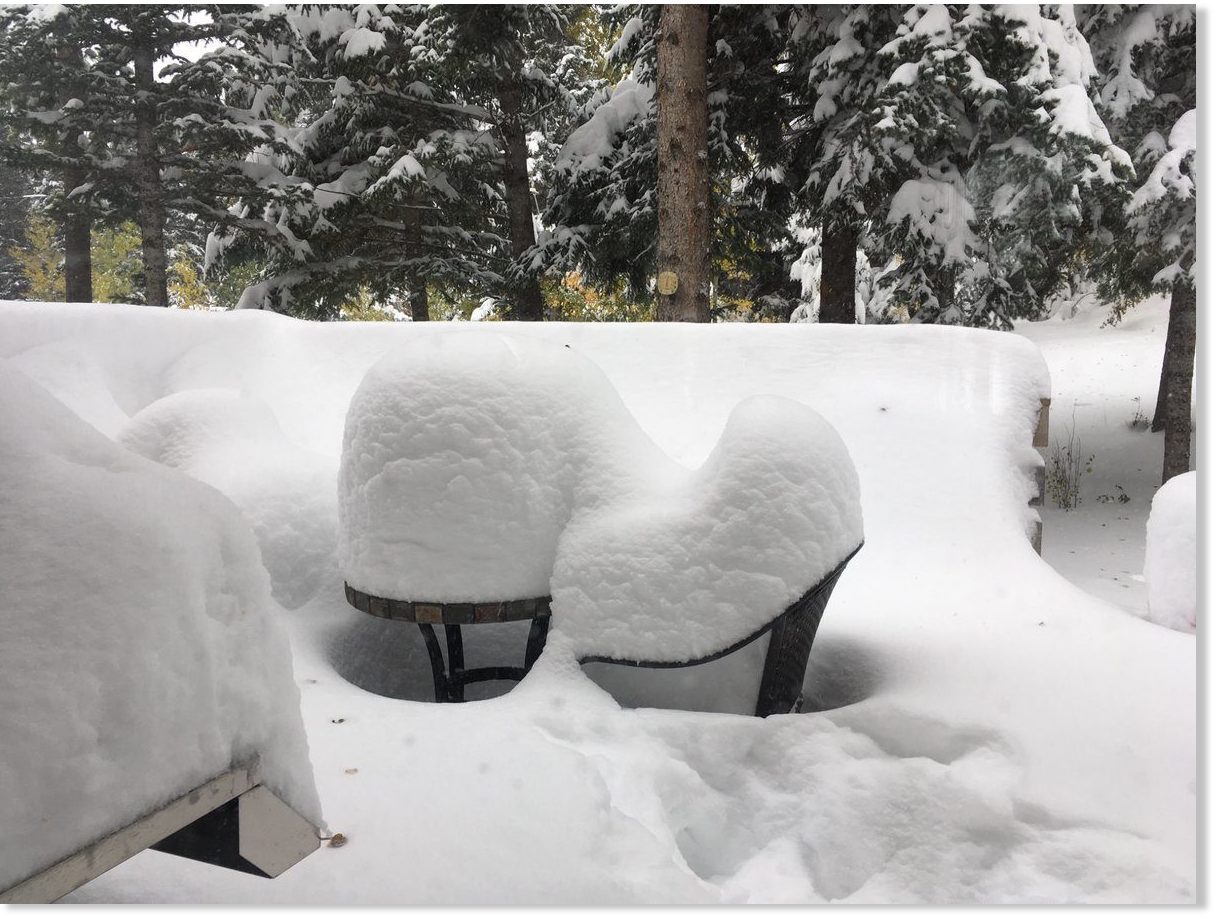
Now snowing heavily in 8 states and 5 provinces in North America - in September

snow
© Karen Manzer ‏
This will be a "Major To Historic Winter Storm in the northern Rockies," warns the National Weather Service.

"A powerful storm system will produce several feet or more of wet, heavy snow; and gusty winds in the Northern Rockies," says the NWS. "Snow is also forecast along the Rocky Mountain Front, portions of the Great Basin, and other northwestern Mountains. Trees with leaves will be vulnerable to damage. Heavy snow and strong winds will make travel difficult to impossible in places."

The trees are still fully loaded with foliage, so the strong winds and heavy, wet snow is expected is to bring down trees and power lines leading to widespread power outages.

As of Sunday morning, accuweather.com weather maps showed snow or snow showers in Washington, Oregon, Nevada, Idaho, Utah, Montana, Wyoming, North Dakota, British Columbia, Alberta, Saskatchewan, Manitoba and Ontario.


Comment: Related: Flake news: Parts of Montana hit by winter storm dumping 3 FEET of snow!! (UPDATE)


Magnify

SOTT Focus: Latest Hot Summer in The Netherlands is Not a Sign of Man-Made Global Warming

Amsterdam rond 1540
Amsterdam around 1540.
Late July this year, the Netherlands recorded all-time high temperatures, but has it ever been that hot before, or even hotter?

Take the summer of 1540. It was particularly hot over all of Europe. As Dutch author Jan Buisman of the book Duizend jaar weer, wind en water in de Lage Landen describes: "Harvest failed, drinking water was hardly available, and diseases were rampant. On top of that, there was also a mouse plague in the Netherlands. A chaplain from the Dutch province of Limburg kept a diary and described how farmers on the land fell dead as a result of the heat while they were mowing."

Many people in Amsterdam succumbed to heat stroke, heart attack or contaminated drinking water. We do not know the exact temperatures of the summer of 1540, but from the described dry rivers, many forest fires and prolonged heat and drought we can assume that these were certainly not lower than during the past summer. Many sources speak of seven months of sun-drenched, dry and hot weather.

The heat lasted so long that the year 1540 was recorded in the history books as the "Great Solar Year". Generations will continue to talk about the hottest summer ever, and for modern climatologists the summer of 1540 is still a fascinating benchmark. The following year, the summer of 1541, by the way, reverted straight back to the typical summers in Amsterdam: cold and wet.


Comment: See also:


X

CO2 Endangerment Finding fails every test

cartoon
The EPA CO2 Endangerment Finding forms the legal basis for climate alarmists to shut down the fossil fuel supply. It is a political document created by the Obama administration, and is unsupportable scientifically.


Seismograph

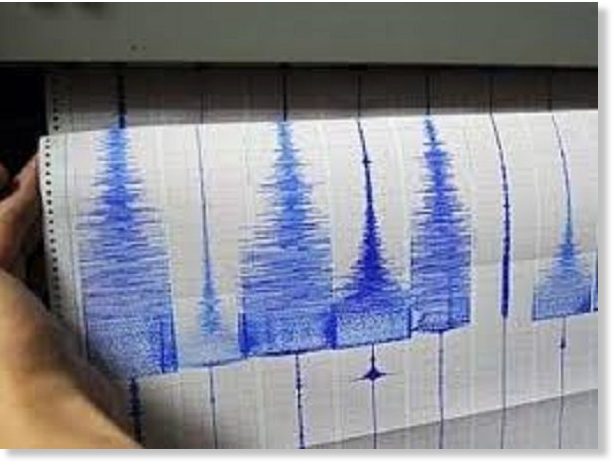
7.2-Magnitude Earthquake Shakes Central Chile - USGS

Graph
The country is situated in a region adjacent to the fast-moving Nazca Plate, which is characterised by high tectonic activity.

A 7.2-magnitude earthquake rocked Chile on Sunday, striking at a depth of 9.8 kilometres, according to the United States Geological Survey. The tremor struck at 15:57 (UTC), 67 kilometres west of the city of Constitucion.