OF THE
TIMES

"Russia deployed this new counter-space weapon into the same orbit as a US government satellite. The US has a responsibility to be ready to protect and defend [...] the space domain and ensure continuous and uninterrupted support to the Joint and Combined Force.Russian Deputy Foreign Minister Sergey Ryabkov rejected the Pentagon's claims as misinformation.
"Washington will continue to balance the need to protect our interests in space with our desire to preserve a stable and sustainable space environment."
"I don't think we should be responding to every fake coming from Washington. The Russian space program is developing 'smoothly' and includes launches of spacecraft for various purposes, including those that solve the issues of strengthening our defense capabilities.
"However, Moscow consistently opposes the deployment of strike weapons in low-Earth orbit. The Americans may say whatever they want, but Russia's policy [on the issue] will not change. If the US really wanted to achieve security in space, the US would have reconsidered its destructive approach and accepted Russia's proposal to develop a treaty on the prevention of an arms race in outer space."
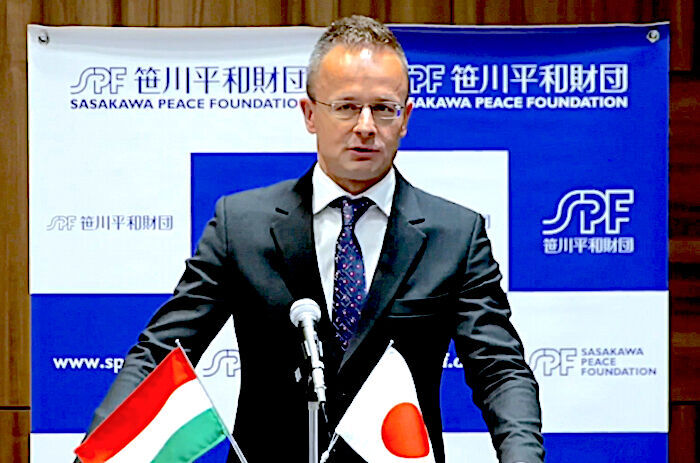
"During the discussion of the first package of sanctions, more than two years ago, I raised the question about the purpose of the measures, and the answer was, to bring Russia to its knees economically and bring the war closer to an end. Is Russia on its knees? Far from it. Are we close to ending the conflict? Definitely not. The sanctions have hurt EU economies instead.
"We are now discussing a 14th package [of sanctions]. Don't you get it? You failed at something 13 times over, and now you're trying to do it for a 14th time? That's a bit against Hungarian logic."
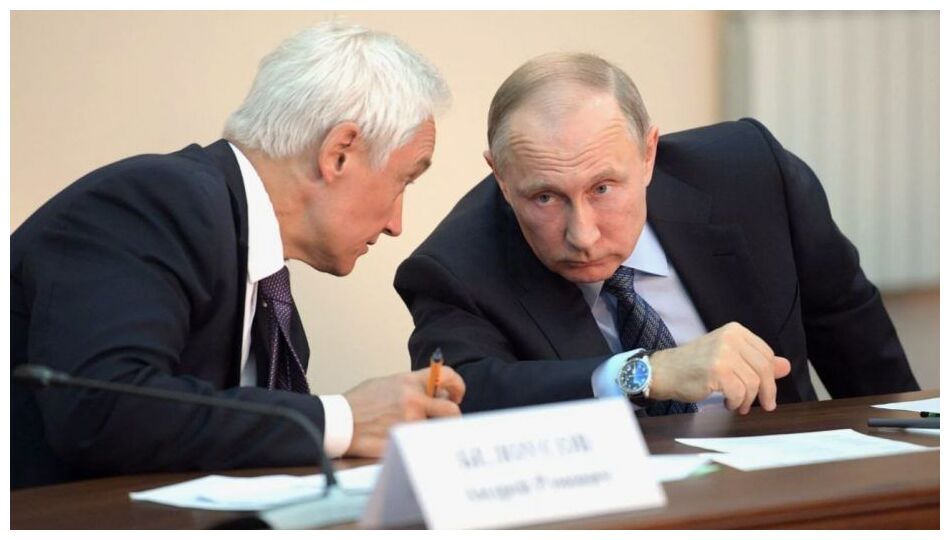
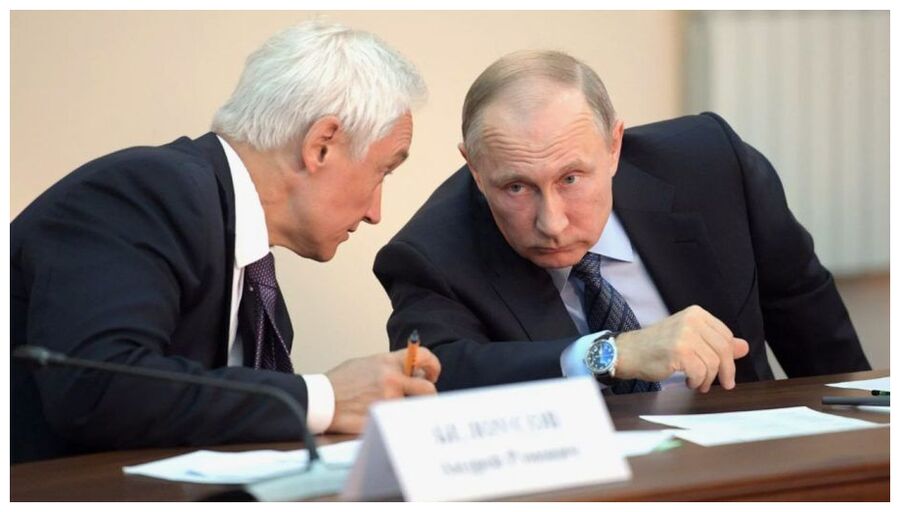
"Russia," Belousov stated, "should follow the path of modernized conservatism... Russia can preserve traditional Western values. The West has abandoned these traditional values and moved on to something else - to an anti-traditional mindset within the framework of postmodernism."One suspects that this circumlocution refers to the woke ideology which is currently ravaging the Western world.
"It is important," he continued, "to preserve traditional Western values, which in a certain sense are the values of Western Christian civilization, European civilization."Now comes the punchline: "Russia can become the guardian of these values. This may sound like a paradox, but it's true. In this respect, it would be wrong to call the West our enemy ... In the West, there are certain elites, and considerable parts of society that are associated with traditional values. And in this respect, they may grasp at this straw, this chance which Russia offers them to preserve some of their values."
"Russia's defeat is not a bad thing because then you know there could really be a change in society. The Russian Federation is comprised of 'many different nations' and they should become separate states after the end of the conflict between Moscow and Kiev.The Constitution of the Russian Federation describes the polity as a multinational state. According to the 2020-2021 census, the country's population speaks 155 different languages, with Russian being the most common.
"I think if you would have more like small nations... it is not a bad thing if the big power is actually [made] much smaller."

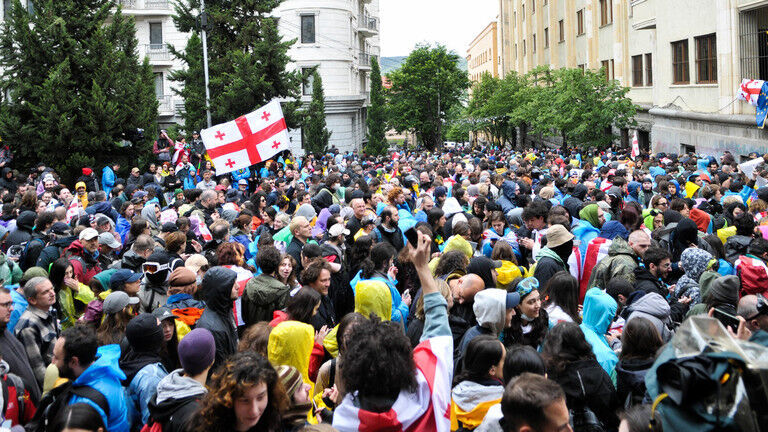
Georgian President Salome Zourabichvili has vetoed the legislation, but parliament is likely to override her decisionThe French Wiki of Salome Zourabichvili is very extensive and she is without doubt very capable. For some main points, here is a Tweet:
During an interview with DW News in May 2022, Zourabichvili stated that Georgia was in full compliance with the international financial sanctions on Russia and wanted a "quicker and shorter path towards integration" into NATO and the EU. She remarked that both France under Macron and Germany under Scholz had shifted their stance which ante-dated the August 2008 Russo-Georgian War and now embraced expansionary policies.[32]2) From the same source, there is:
The bloc is trying to intimidate Georgia over its foreign agents law, Irakli Kobakhidze has saidWhen the PM quotes the commissioner as saying: 'you see what happened to Fico, and you should be very careful', it leaves the impression that the conflict with Ukraine keeps spreading to involve other countries, at the moment still at a low but persistent level of intensity, but where will it end?
Georgian Prime Minister Irakli Kobakhidze has claimed that a European commissioner told him he could end up suffering the same fate as Slovak Prime Minister Robert Fico, who survived an assassination attempt last week.
In a Facebook post on Thursday, Kobakhidze said that the unnamed commissioner warned him during a recent phone call that the West would take "a number of measures" against him if his government pressed ahead with a law requiring foreign NGOs in Georgia to disclose their funding.
"While listing these measures, he mentioned: 'you see what happened to Fico, and you should be very careful'," he wrote.
Fico was shot multiple times as he met with supporters outside a government meeting in the town of Handlova on May 15. He was rushed to hospital, underwent emergency surgery, and is currently recuperating from his injuries. His would-be assassin - a 71-year-old poet who allegedly disagreed with Fico's suspension of military aid to Ukraine - has been charged with attempted murder.
Georgia's parliament passed the 'Transparency of Foreign Influence Act' last week. The law requires NGOs, media outlets, and individuals receiving more than 20% of their funding from abroad to register as entities "promoting the interests of a foreign power" and disclose their donors.
While the act has been vetoed by Georgia's pro-Western president, Salome Zourabichvili, parliament is expected to override the veto.
Despite similar yet more stringent foreign influence laws existing in the US, UK, and other Western nations, Georgia's foreign agent law has been strongly condemned by US and EU officials, with Washington considering unspecified "actions" against Tbilisi and multiple EU members weighing sanctions, according to media reports.
"We have long been accustomed to this kind of insulting blackmail," Kobakhidze wrote. "The parallel drawn with the attempted assassination of Robert Fico reminds us that in the form of the Global War Party, we are dealing with an extremely dangerous force that will do anything to bring chaos to Georgia."
In an interview with Georgia's Channel 1 on Wednesday, Kobakhidze argued that without a transparency law, foreign-funded NGOs operating in the country could easily foment a revolution akin to the US-backed 'Maidan' coup in Ukraine in 2014. "We want transparency... we don't want to leave muddy water in this country, because a 'Georgian Maidan' could lead our country to very serious consequences, to its 'Ukrainization'. We cannot agree with this," he said.
Western officials claim that Georgia's crackdown on foreign influence "undermines democracy"3) See also:
The US is looking into how it could punish Georgia over a 'foreign agents' bill which was recently passed in the country's parliament, Secretary of State Antony Blinken said in a congressional hearing on Wednesday.
Georgia's Transparency of Foreign Influence Act would require non-profit organizations, media outlets, and individuals which derive more than 20% of their funding from abroad to register as entities "promoting the interests of a foreign power" and disclose their income and sponsors or face fines of up to $9,500.
The legislation ignited weeks of violent protests and clashes across the country, which is an applicant to both the EU and NATO.
Georgian President Salome Zourabichvili vetoed the bill on Friday, but the gesture is considered to be largely symbolic, as the Georgian Dream party has a majority in parliament and is expected to overrule it.
"We are looking very hard at what we can do in response to that, and I anticipate we will take actions, the EU is looking at the impact on the accession process for Georgia, so I would anticipate that there will be things to come because of the impact this law may have," Blinken told US lawmakers in Congress.
Blinken said the US is "very concerned" about the legislation, which he described as "right out of Moscow's playbook," and which "clearly counters" the Georgian public's desire for "EU integration."
Despite criticism that the legislation could be used to target the political opposition, the bill does not provide for criminal prosecutions, unlike the US' Foreign Agents Registration Act (FARA), which has been in effect since the 1930s.
The bill was described as "undermining of democracy" by US Assistant Secretary of State for European and Eurasian Affairs James O'Brien on a visit to Tbilisi last week. He warned Georgia of "restrictions coming from the US," and potential sanctions on lawmakers that were involved with the legislation.


Comment: See also: