
© NY Times
In the opening days of this year's St Petersburg International Economic Forum, there were a number of signs that the Kremlin is taking a much tougher line in its relations with the West than hitherto in response to the war mongering rhetoric that has come out of Western Europe in the past week. France, the United Kingdom, Germany and the United States had publicly stated that the weapons they have supplied to Ukraine can be used as the Kievan authorities see fit, meaning that attacks on the Russian heartland with long range missiles coming from their factories and programmed by their specialists are permitted.
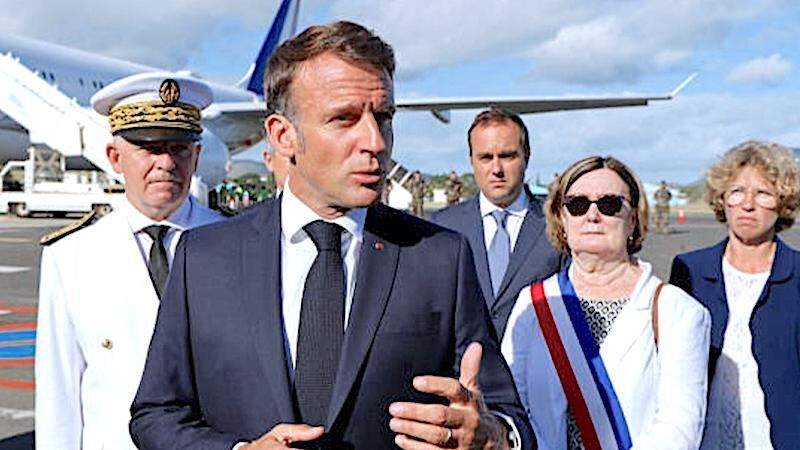
Meanwhile, in the run-up to the 80th anniversary of the Normandy landing commemorative activities in France yesterday, Emanuel Macron had done his very best to enrage the Kremlin by
excluding Russians from the ceremonies and instead by warmly embracing the defender of the Bandera Nazi collaborators, President of Ukraine Zelensky. Macron compounded the insult to Russia by announcing that he will send Mirage 2005 all-purpose fighter jets to Ukraine before year's end and that Ukrainian pilots are now in training in France.

© CNN.comSergei Ryabkov.
The new hard line from Russia was evident already at the start of the week when deputy Foreign Minister Sergei Ryabkov was allowed to speak his piece to the press, condemning the entry of West European powers into what is essentially co-belligerent status in the conflict. Ryabkov, you will remember, was the hard liner from the Ministry back in December 2021 demanding a voluntary roll back of NATO to its 1994 borders through negotiations over a draft document to that effect, lest Russia be compelled to push them back by force.
Then the tough condemnation by Ryabkov was repeated to the press by his boss, Foreign Secretary Sergei Lavrov.
At his meeting with representatives of the leading news agencies from 16 countries on Wednesday, Vladimir Putin sounded a tough note when he said that Russia's response to a possible attack on critical Russian infrastructure in its heartland using the long-distance missiles supplied by the West would be met by an asymmetrical response, namely by Russia's supplying similarly advanced weapons to armed forces that are in confrontation with the United States and are in a position to inflict significant damage on them if properly equipped.
This sounded very much like a plan to arm the Houthis of Yemen, who could take good advantage of Russia's hypersonic ship killing missiles to take revenge on the U.S. aircraft carrier force in their region.
Or to give an assistance to Iraqi and Syrian militias who have been attacking U.S. military bases that are being maintained in their territories illegally.














Comment: Countries not invested in 'US/NATO's' global scheme see the ploy and wisely not participate.