Puppet MastersS

Eye 1

Our Dwindling Email Privacy

What sort of privacy do you expect when you send an email? As Americans increasingly rely on the Internet for communication, Justice Department lawyers increasingly argue that Americans have no right to privacy there - notwithstanding repeated congressional efforts to bolster these rights. A recent case out of Oregon shows how the privacy expectation associated with emails and other Internet communications is being frittered away.

The government sought to subpoena the emails of a suspect in a criminal investigation. It issued a subpoena to Google, but it failed to give notice to the subscriber as the federal rules and statute would appear to require. The purpose of notice is fairly straightforward: it gives the subject the opportunity to contest the subpoena and puts him on notice of the government's investigation. Implementing the protections of the Fourth Amendment, isn't the subscriber entitled to notice? Not in the view of Judge Michael Mosman:

Vader

Saying Yes to State Terror: US Second Circuit Court Affirms Dismissal of Arar Case

"When the history of this distinguished court is written, today's majority decision will be viewed with dismay," writes Guido Calabresi, the former Yale Law dean and a man widely viewed as the most illustrious living member of the Second Circuit Court of Appeals. He is lodging his dissent in a 7-4 decision of the en banc court concluding that a Canadian software engineer named Maher Arar has no right to sue government officials. What has Calabresi so worked up?

MIB

Jundallah versus the mullahtariat

Fasten your seat belts; it's gonna be a bumpy ride. As a crucial subplot of the New Great Game in Eurasia, Balochistan - on both sides of the Iran-Pakistan border - promises turbulence aplenty. Welcome to United States General Stanley McChrystal's self-fulfillment prophecy - "Chaos-istan" in action.

There are few doubts the deadly (as many as 49 fatalities) suicide bombing on Sunday in Pishin, near Sarbaz, in the deserted, impoverished Iranian province of Sistan-Balochistan, was carried out by Pakistani Balochistan-based Jundallah ("Soldiers of God").

This is being billed by Iranian state-controlled media as the worst suicide bombing ever in the country. Key casualties include the number two of the armed forces of the Iranian Revolutionary Guards Corps (IRGC), Brigadier Nour-Ali Shoushtari, a veteran of the Iran-Iraq war of the 1980s, the provincial IRGC commander and assorted Sunni and Shi'ite tribal leaders.

The IRGC - the key component of the dictatorship of the mullahtariat currently in power in Tehran - is seething, to say the least. It is one thing to repress student protests in Tehran; but how could they not see this coming, and how could they not prevent it, considering their allegedly good ground intelligence on Jundallah's support by the US, Pakistan and Saudi Arabia?

Cult

Israel confirms running spy networks in Lebanon

Image
© Unknown
Israel's Deputy Prime Minister Moshe Ya'alon has confirmed that Israel is running intelligence-gathering networks in Lebanon.

"When we are in conflict with an enemy, we gather information about them," Haaretz quoted Ya'alon as saying on Saturday.

"The moment Hezbollah renewed their attacks, we began to collect intelligence. We will stop when Hezbollah disarms itself and the [Israel-Lebanon] border is a border of peace," he added.

In October, two explosions over occurred in southern Lebanon after Lebanon's Hezbollah discovered cables used for spying in the al-Abbad area near an Israeli border post.

USA

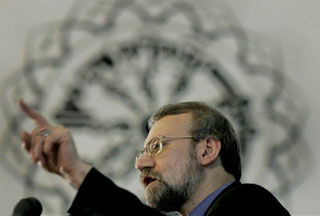
Iranian parliamentary speaker Larijani: US behind terrorist attack in Iran

Image
© UnknownParliament Speaker Ali Larijani
In the wake of a terrorist attack in southeastern Iran, Parliament Speaker Ali Larijani has accused the United States of helping terrorist carry out acts of violence in Iran.

"Reliable evidence shows the US played a role in the recent move," Larijani said referring to the recent bomb blast in Sistan-Baluchistan Province.

At least 41 people, including seven senior commanders of the Islamic Revolution Guards Corps (IRGC), were killed in the bombing on October 18 during a unity gathering of Shia and Sunni tribal leaders in the town of Pishin on the Iran-Pakistan border. The Jundallah terrorist group claimed responsibility for the deadly attack.

Larijani criticized Washington's policies on Iran and said the US acts against Iranian interests despite making offers to hold talks with the country.

Vader

British Justice: 35 MI5 spies line up for trial of Irish 'dissidents'

An extraordinary thirty-five MI5 agents are to be called to court to give evidence evidence behind screens against three men accused of dissident republican activity.

The spies will be allowed to give their evidence behind screens to protect their identities at Belfast crown court.

The court was told that British Crown forces had gathered 90 hours of bugged conversations of the three men.

The charges involve conspiring to possess arms and membership of an illegal organisation. There also charges of making a Portuguese restaurant "available for terrorism".

It is understood that the legal papers are "voluminous" and the tapes will take months to transcribe.

The full trial, which will begin in April, is expected to last three months.

MIB

Ex-CIA agent confirms US ties with Jundullah

A former Central Intelligence Agency officer has confirmed US' relations with the terrorist group Jundullah, despite the CIA knowing that the group has close links with the al-Qaeda.

"American intelligence has also had contact with Jundullah. But that contact, as Iran almost certainly knows, was confined to intelligence-gathering on the country," Robert Baer, a former Middle East CIA field officer wrote on the Time.com, IRNA reported early on Saturday.

However, he noted that the US-Jundullah relationship "was never formalized, and contact was sporadic."

The news comes amid US denial of any involvement in a recent terrorist attack in Sistan-Baluchestan province in southeastern Iran, which Jundullah claimed responsibility for.

Pistol

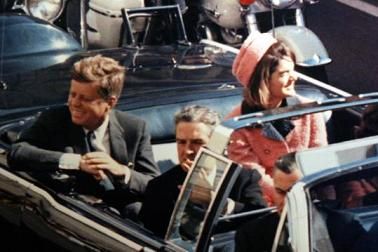
The JFK Assassination: New York Times Acknowledges CIA Deceptions

Image
© Unknown
The New York Times, on October 17, published a page-one story by Scott Shane about the CIA's defiance of a court order to release documents pertaining to the John F. Kennedy assassination, in its so-called Joannides file. George Joannides was the CIA case officer for a Cuban exile group that made headlines in 1963 by its public engagements with Lee Harvey Oswald, just a few weeks before Oswald allegedly killed Kennedy. For over six years a former Washington Post reporter, Jefferson Morley, has been suing the CIA for the release of these documents.1

Sometimes the way that a news item is reported can be more newsworthy than the item itself. A notorious example was the 1971 publication of the Pentagon Papers (documents far too detailed for most people to read) on the front page of the New York Times.

The October 17 Times story was another such example. It revealed, perhaps for the first time in any major U.S. newspaper, that the CIA has been deceiving the public about its own relationship to the JFK assassination.
On the Kennedy assassination, the deceptions began in 1964 with the Warren Commission. The C.I.A. hid its schemes to kill Fidel Castro and its ties to the anti-Castro Directorio Revolucionario Estudantil, or Cuban Student Directorate, which received $50,000 a month in C.I.A. support during 1963.

In August 1963, Oswald visited a New Orleans shop owned by a directorate official, feigning sympathy with the group's goal of ousting Mr. Castro. A few days later, directorate members found Oswald handing out pro-Castro pamphlets and got into a brawl with him. Later that month, he debated the anti-Castro Cubans on a local radio station.

Cow Skull

Best of the Web: US Joins Ranks Of Failed States

failed State USA
© Jupiter Images
The US has every characteristic of a failed state.

The US government's current operating budget is dependent on foreign financing and money creation.

Too politically weak to be able to advance its interests through diplomacy, the US relies on terrorism and military aggression.

Costs are out of control, and priorities are skewed in the interest of rich organized interest groups at the expense of the vast majority of citizens. For example, war at all cost, which enriches the armaments industry, the officer corps and the financial firms that handle the war's financing, takes precedence over the needs of American citizens. There is no money to provide the uninsured with health care, but Pentagon officials have told the Defense Appropriations Subcommittee in the House that every gallon of gasoline delivered to US troops in Afghanistan costs American taxpayers $400.

"It is a number that we were not aware of and it is worrisome," said Rep. John Murtha, chairman of the subcommittee.

According to reports, the US Marines in Afghanistan use 800,000 gallons of gasoline per day. At $400 per gallon, that comes to a $320,000,000 daily fuel bill for the Marines alone. Only a country totally out of control would squander resources in this way.

While the US government squanders $400 per gallon of gasoline in order to kill women and children in Afghanistan, many millions of Americans have lost their jobs and their homes and are experiencing the kind of misery that is the daily life of poor Third World peoples. Americans are living in their cars and in public parks. America's cities, towns, and states are suffering from the costs of economic dislocations and the reduction in tax revenues from the economy's decline. Yet, Obama has sent more troops to Afghanistan, a country half way around the world that is not a threat to America.

Magnify

Rumours of Western support for Iranian dissident militia groups have broad backing

Iranian accusations of Western backing for Jundallah, the Sunni rebel group, may not be as fanciful as they seem.

Tehran often blames the United States and Britain for any internal unrest, including the uproar after President Ahmadinejad's disputed re-election. But rumours of support for dissident militia groups such as Jundallah have far broader backing.

The group, which also calls itself the Iranian People's Resistance Movement, was founded in 2002 and started its armed campaign in 2005. Its main cause is defending Shia Iran's Sunni minority, concentrated in its poorest province, Sistan-Baluchistan.