© Berkeley Labs
As everyone who lives in the San Francisco Bay Area knows, the Earth moves under our feet. But what about the stresses that cause earthquakes? How much is known about them? Until now, our understanding of these stresses has been based on macroscopic approximations.
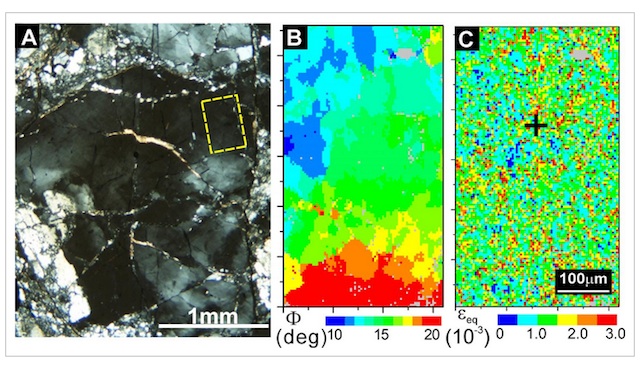
Now, the U.S. Department of Energy (DOE)'s Lawrence Berkeley National Laboratory (Berkeley Lab) is reporting the successful study of stress fields along the San Andreas fault at the microscopic scale, the scale at which earthquake-triggering stresses originate.
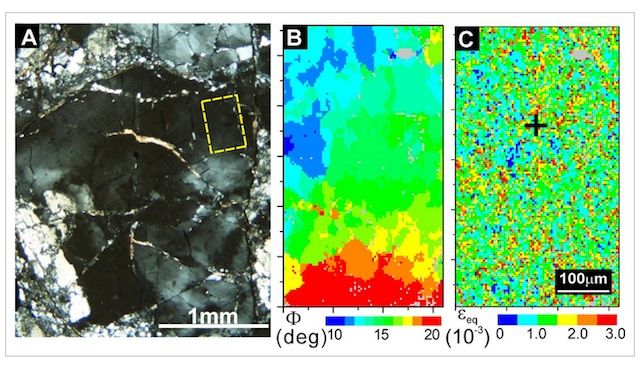
Working with a powerful microfocused X-ray beam at Berkeley Lab's Advanced Light Source (ALS), a DOE Office of Science User Facility, researchers applied Laue X-ray microdiffraction, a technique commonly used to map stresses in electronic chips and other microscopic materials, to study a rock sample extracted from the San Andreas Fault Observatory at Depth (SAFOD). The results could one day lead to a better understanding of earthquake events.
"Stresses released during an earthquake are related to the strength of rocks and thus in turn to the rupture mechanism," says Martin Kunz, a beamline scientist with the ALS's Experimental Systems Group.
"We found that the distribution of stresses in our sample were very heterogeneous at the micron scale and much higher than what has been reported with macroscopic approximations. This suggests there are different processes at work at the microscopic and macroscopic scales."
Kunz is one of the co-authors of a paper describing this research in the journal
Geology. The paper is titled "Residual stress preserved in quartz from the San Andreas Fault Observatory at Depth." Co-authors are Kai Chen, Nobumichi Tamura and Hans-Rudolf Wenk.
Most earthquakes occur when stress that builds up in rocks along active faults, such as the San Andreas, is suddenly released, sending out seismic waves that make the ground shake. The pent- up stress results from the friction caused by tectonic forces that push two plates of rock against one another.










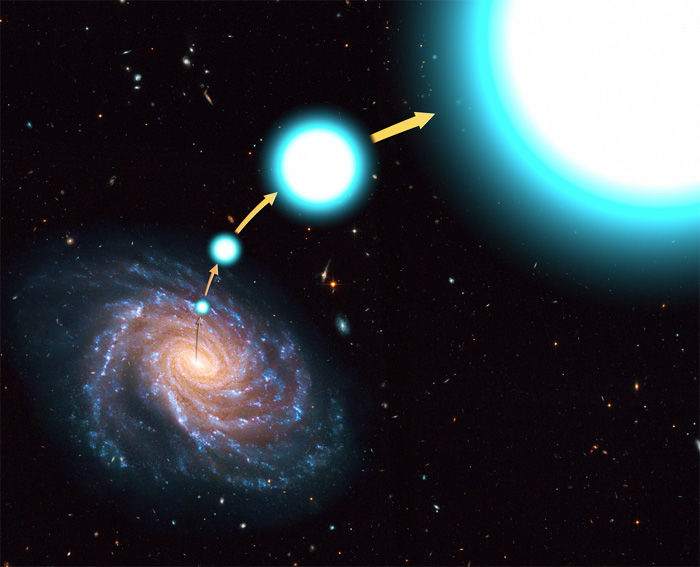





Comment: There is no specific evidence that traces trajectories back to a central black hole, but, to date, there are no other explanations for a mechanism that would impart so much kinetic energy onto a star. The theory is a star could slingshot out of a binary star system if the stellar duo swung close to a central black hole. The hole's gravitational tidal forces would break apart the duo's gravitational coupling. One of the pair would plunge toward the black hole. The other would fly with matching velocity in the opposite direction, away from the black hole. So far, 16 of these hypervelocity stars are known, the first detected in 2005. The single giant black hole propulsion theory is supported by observations that show the stars seem spaced sequentially, like a series of fired cannonballs. It is speculated that a sun like ours, under these conditions, would carry its planetary system with it.