Science & TechnologyS


Info

Fake Science? Researchers at Yale determine who falls for 'fake news'

CNN fake news
Who falls for fake news sites? Yale University professors Gordon Pennycook and David Rand engaged in a study that sought answers on the question that "poses a threat to democracy." While political conviction played a role - and Trump voters had a different profile in certain measurements than did Clinton supporters - what differentiated people's susceptibility to embrace fake news sites most was their ability or willingness to engage in analytical thinking.

The persuasiveness of fake news sites can be summed up in one statistic: In 2016 the "likes" on Facebook was actually greater for the top 20 fake news items than the top 20 real news items. This can be a significant problem. "Inaccurate beliefs pose a threat to democracy and fake news represents a particularly egregious" avenue to propagate those beliefs, Pennycook and Rand wrote in a report released last week.

Info

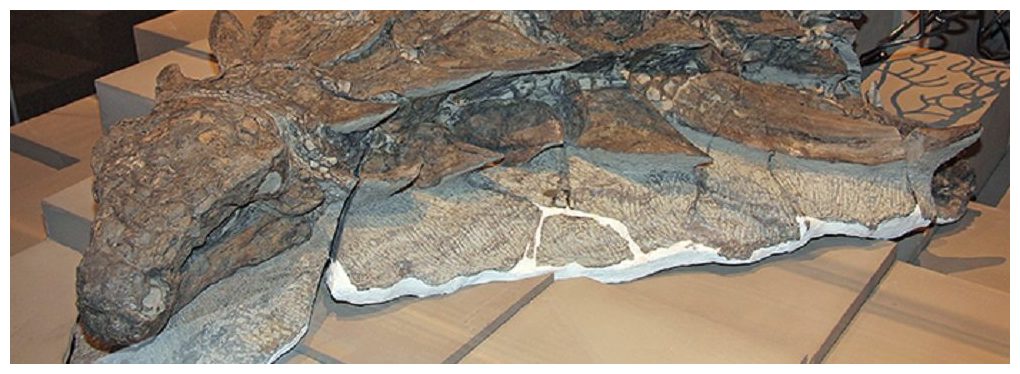
Best preserved nodosaur has skin, horn and pigments

Best-preserved nodosaur
© ICR Org
The world's best-preserved nodosaur stirred wide interest when it went on display at the Royal Tyrell Museum in Canada in May 2017. Its skin scales, fearsome shoulder spikes, and possibly even skin colors prompted fossil pigment expert Jakob Vinther to tell National Geographic that it "might have been walking around a couple of weeks ago. I've never seen anything like this."1 New details published in Current Biology back up that statement.2

Apparently, this specimen is different enough from other nodosaurs to warrant its own genus and species name: Borealopelta markmitchelli. It had secondary organic molecular structures called kerogen that form when primary proteins break down and mix underground.

In a May 12 interview, Issues, Etc. radio host Todd Wilken asked me about this fossil, "So it's very possible here that we're not looking at a fossil, strictly speaking-not a stone cast of what was once there as living matter-but a mummified specimen of a dinosaur?" I replied, "It's possible, but there haven't been any technical reports out yet."3

Well, now a technical report is out, and it shows not quite as pristine a preservation as an Egyptian mummy, but it reveals nodosaur skin scales with kerogen's energy-packed chemical bonds still intact.4 Though lab studies have not yet measured the expected shelf life for kerogen, this specimen still contains organic chemistry fragile enough to challenge the fossil's vast age assignments. Microbes feed on kerogens, but even with no microbes in sight, kerogens still have plenty of potential chemical energy that inevitably reacts with other chemicals in an incessant chemical breakdown. Though they may be tough, kerogens cannot last forever-and should not last anywhere close to the 112 to 125 million years assigned to this fossil.

Saturn

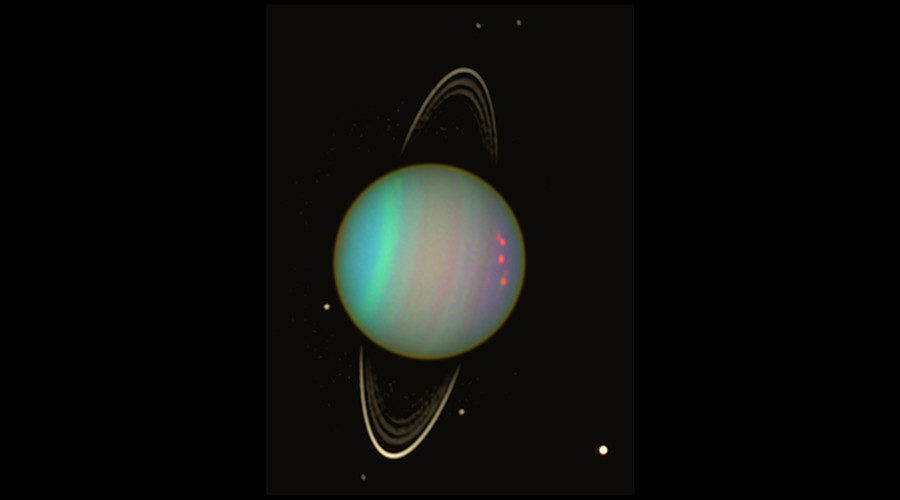
'Floating moon': Study reveals new details about Uranus satellite Cressida

Uranus
© NASA
Uranus' moon Cressida would float if placed in water, according to new research, which has recorded the first measurements of the satellite's mass and density.TrendsSpace exploration

Robert Chancia of the University of Idaho and colleagues calculated Cressida's density and mass using variations in an inner narrow ring of the planet as Uranus passed in front of a distant star.

The analysis came from both ground-based and Voyager stellar and radio occultations of the Uranian rings, spanning the period from 1977-2002.

Info

Rotor-propelled microbots could fight deadly cancers inside the body - study (VIDEO)

Motorized nanobots
© Rice University / YouTubeAn artist's impression of one of the motorized nanobots.
Nanotechnology could soon be used to directly combat disease within the human body - a breakthrough that promises revolutionary new treatments for the most deadly forms of cancer.

The study, published in the journal Nature, outlines how an international team of researchers from Rice, Durham, and North Carolina State universities worked together to test single-molecule nanomachines, a collection of rotor-propelled microbots capable of easily tunneling through the membranes of targeted cells to administer drugs.

In one test conducted at Durham University in the UK, the nanomachines took as little as three minutes to tunnel through the wall of a prostate cancer cell. The machine killed the cancer cell instantly.

Galaxy

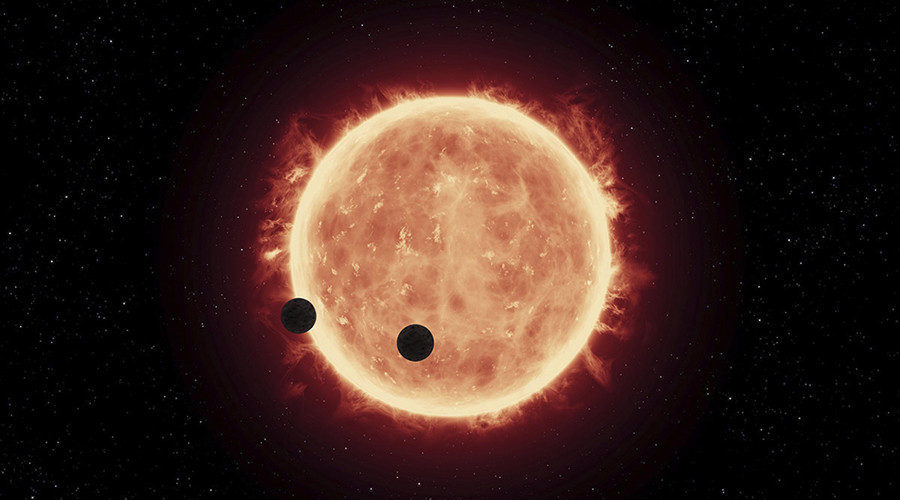
Evidence of water found on TRAPPIST-1 exoplanets

exoplanets
© NASA / Global Look PressThree of the seven exoplanets orbiting TRAPPIST-1 are thought to have large amounts of water.
The search for life on other planets is gaining fresh impetus with new research suggesting planets in the TRAPPIST-1 system could harbor substantial amounts of water.

The dwarf star TRAPPIST-1 is more than 39 light years from Earth and was discovered along with three orbiting Earth-sized planets in 2015. In February this year, four more exoplanets were found orbiting the star, with three thought to lie in the 'habitable zone.'

In a study published in the Astronomical Journal, an international team of researchers led by Swiss astronomer Vincent Bourrier of the University of Geneva Observatory studied the effect of ultraviolet light on the atmosphere of all seven of the system's exoplanets.

Meteor

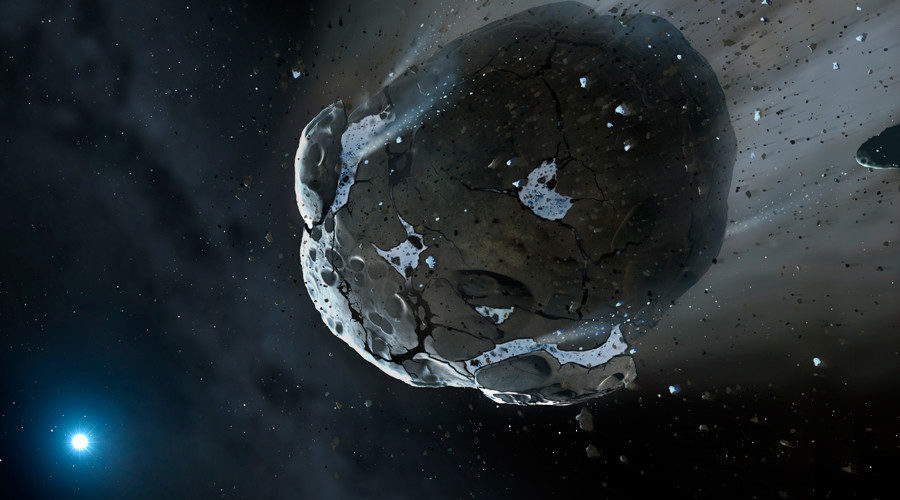
16 stars passing 'Oort cloud' could fire cosmic matter throughout our galaxy - study

Asteroid
© Mark A. Garlick / AFP
Star trajectory numbers published in a new study suggest that up to 16 stars could come close enough to our galaxy to send potentially dangerous cosmic matter, like comets, crashing into Earth.

The prospect of unsettled space material smashing into our planet is enough of a fear for agencies like NASA to start ramping up planetary defense systems.

The US space agency has already dedicated a division to track near-Earth objects and there is a plan to carry out an asteroid redirection tests with the European Space Agency (ESA) in the next five years.

Astronomer Coryn Bailer-Jones of the Max Planck Institute for Astronomy has now crunched the numbers on the possibility of stellar encounters with the solar system - and a collision is possible.

Galaxy

Mysterious fast radio bursts from deep space go hyperactive

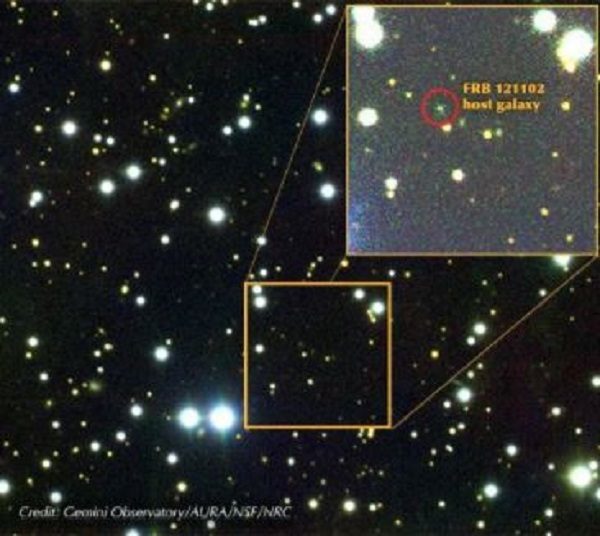
FRB 121102
FRB 121102 originates from a distant dwarf galaxy.
The unexplained signals from the other side of the universe known as fast radio bursts are a rarely observed phenomenon and only one of them has been picked up more than once. Now scientists engaged in the search for extraterrestrial intelligence say that lone repeating fast radio burst (FRB) is being heard twittering away.

FRBs are bright, millisecond-long pulses of radio signals from beyond the Milky Way that were first identified only a decade ago. Suggested explanations include everything from neutron star outbursts to alien civilizations using some form of directed energy to propel a spacecraft.

One burst first observed in 2012, named FRB 121102, was later found to repeat in 2015. On Saturday, UC Berkeley postdoctoral researcher Dr. Vishal Gajjar used the Breakthrough Listen backend instrument at the Green Bank Telescope in West Virginia to target FRB 121102 once again. After observing for five hours and across the entire 4 to 8 GHz frequency band, Gajjar and the Listen team analyzed the 400 terabytes of data gathered and found 15 new pulses from FRB 121102.

Comet

Phoenicids: Solving the mystery of a rare meteor shower that disappeared for 60 years

Phoenicids
© Travelers Today
For the first time, scientists have predicted the activity of a comet based on observations of its trailing meteoroids - and in doing so have solved the mystery of how a meteor shower called the Phoenicids was barely seen from Earth for almost 60 years.

Unlike some of the particularly famous annual meteor showers enjoyed by stargazers across the globe, the Phoenicids were discovered in a spectacular meteor storm that rained down just once in 1956 - and then for several decades, the fireworks virtually disappeared.

Until 2014, that is, when a team of researchers from the Graduate University for Advanced Studies (SOKENDAI) in Japan - including one of the veterans behind the 1956 observation - again witnessed the Phoenicids light show, thanks to astronomical data going as far back as the 1800s.

The Phoenicids meteor shower - named after the Phoenix constellation - was first seen around the world on 5 December 1956, including observations made by a team on the first Japanese Antarctic Research Expedition in the Indian Ocean.

The shower, which produced a storm of hundreds of meteorites, treated onlookers to exploding fireballs and burning fragments tearing across the sky in a range of colours from reddish to yellow. But this intense display was never seen again in the years that followed, prompting scientists to wonder just where exactly the Phoenicids had come from and disappeared to.


Info

Russia's state-run bank to hire computer savvy teens to develop blockchain technology

Teens
© Jochen Tack / Global Look Press
Head of Russia's state-run Vnesheconombank (VEB) Sergey Gorkov plans to set up a division staffed by teenagers at the center for blockchain research run by the bank.

"Together with the National University of Science and Technology (MISiS), we will create a whole department for teenagers. Young people aged 14-17 will work there, developing their skills at blockchain," Gorkov said at a forum being held in Yaroslavl.

He said VEB was launching a Russia-wide Hackathon, a web platform where computer programmers and others involved in software development can take part in the international "Ready for the Future" championship.

Attention

Professors issue warning tech is superseding human decisions and it's not great

AI letters
© Pinterest
Scholars create program to test software for bias and discrimination

In the future, your future might depend on a series of carefully calculated zeros and ones. As technology improves, humans become less involved in decisions that affect our lives - and that isn't exactly a good thing.

As artificial intelligence gains ground, college professors at the University of Massachusetts-Amherst have developed a program to test software for bias and discrimination. Yes, racial discrimination. But more than that. Healthcare decisions. Loan decisions. Heck, even how Amazon decides package-sending rates.

"Today, software determines who gets a loan or gets hired, computes risk-assessment scores that help decide who goes to jail and who is set free, and aids in diagnosing and treating medical patients," according to the program's developers. With that, it's critical "software does not discriminate against groups or individuals," argue researchers, adding that their field of study is "undervalued" and "countless examples of unfair software have emerged."

In a scholarly article published for an upcoming software engineering conference, computer scientists Alexandra Meliou and Yuriy Brun, who created the program along with PhD student Sainyam Galhotra, detail the "growing concern" of software discrimination.

In the paper, the two professors forecast the evolving and increasing influence software will have on human life in the future, and argue software currently plays an outsized role in society. "Going forward, the importance of ensuring fairness in software will only increase," the paper states. The scholars used examples that illustrate bias against the wealthy and the downtrodden.


Comment: As stated, AI already has bias without discernment. It offers mechanical responses mimicking a small but powerful segment of society that can't distinguish emotions, experience empathy or offer common human responses. Similar in profile, AI stands to become a function of, a useful tool for, and a supplementary numerical increase to that pathological profile wielding the power of decision.