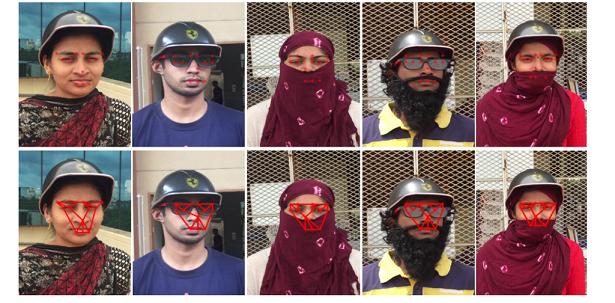
An image from the recent study, showing how the neural networks estimate “facial keypoints” even when the face is covered.
Facial recognition is becoming more and more common, but ask anyone how to avoid it and they'll say: easy, just wear a mask. In the future, though, that might not be enough.
Facial recognition technology is under development that's capable of identifying someone even if their face is covered up - and it could mean that staying anonymous in public will be harder than ever before.
The topic was raised this week after research published on the preprint server arXiv
describing just such a system was shared in a
popular AI newsletter. Using deep learning and a dataset of pictures of people wearing various disguises, researchers were able to train a neural network that could potentially identify masked faces with some reliability. Academic and sociologist Zeynep Tufekci
shared the work on Twitter, noting that
such technology could become a tool of oppression, with authoritarian states using it to identify anonymous protestors and stifle dissent.The paper itself needs to be taken with a pinch of salt, though. Its results were far less accurate than industry-level standards (when someone was wearing a cap, sunglasses, and a scarf, for example, the system could only identify them 55 percent of the time); it used a small dataset; and experts in the field have criticized its methodology.
"It doesn't strike me as a particularly convincing paper," Patrik Huber, a researcher at the University of Surrey who specializes in face tracking and analysis, told
The Verge. He pointed out that the system doesn't actually match disguised faces to mugshots or portraits, but instead used something called "facial keypoints" (the distances between facial features like eyes, noses, lips, etc) as a proxy for someone's identity.



















Comment: Air Strike in Syria: "We got a f***in' problem!"
In the days after part 2 of McKeigue's piece was published, the UN concluded that Syria was responsible for the Khan Sheikhoun attack:
- UN report on Syrian chemical attack was 'attempt to undermine Assad victory in Deir ez-Zor'
- Desperate propaganda: UN says Syrian Government forces used chemical weapons more than two dozen times
A read-through of McKeigue's analysis above should disabuse anyone of the notion that the UN report has a shred of objectivity about it.