Science & TechnologyS


Info

The eyes are drawn to meaning, not distracting objects, in the visual field

visual attention test
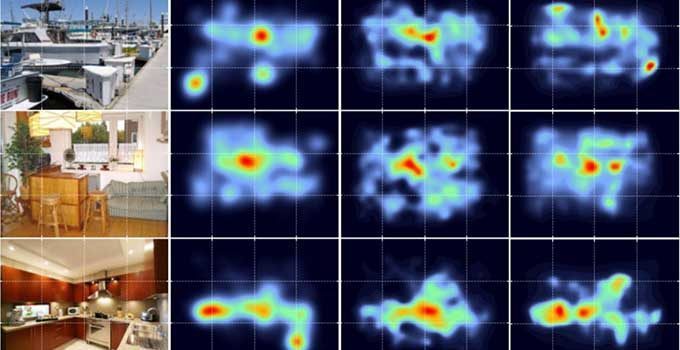
Your visual attention is drawn to parts of a scene that have meaning, rather than to those that are salient or "stick out," new research from the Center for Mind and Brain at the University of California, Davis reveals. The findings overturn the widely-held salience model of visual attention.

Our eyes perceive a wide field of view in front of us, but we only focus our attention on a small part of this field. How do we decide where to direct our attention, without thinking about it?

The dominant theory in attention studies is "visual salience," Professor John Henderson, who led the research, said. Salience means things that "stick out" from the background, like colorful berries on a background of leaves or a brightly lit object in a room.

Life Preserver

Man in persistent vegetative state for 15 years shows signs of consciousness after vagus nerve stimulation

Stimulation of the vagus nerve allows patient who had been in a persistant vegetative state for 15 years to track objects with his eyes and respond to simple requests
Brain VNS stimulation
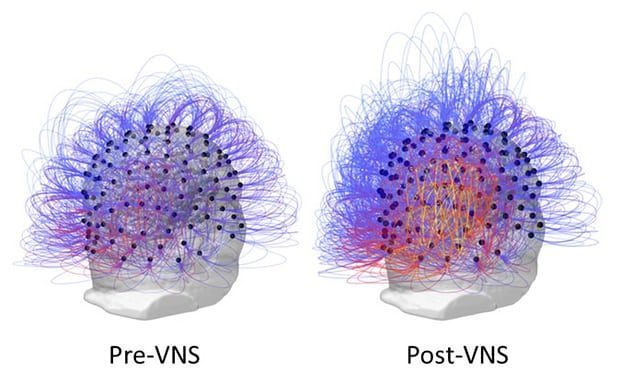
© Corazzol et al.On the right, the warmer colours indicate an increase in connectivity following vagus nerve stimulation among brain regions responsible for planned movements, spatial reasoning and attention.
A 35-year-old man who had been in a persistant vegetative state (PVS) for 15 years has shown signs of consciousness after receiving a pioneering therapy involving nerve stimulation.

The treatment challenges a widely-accepted view that there is no prospect of a patient recovering consciousness if they have been in PVS for longer than 12 months.

Since sustaining severe brain injuries in a car accident, the man had been completely unaware of the world around him. But when fitted with an implant to stimulate the vagus nerve, which travels into the brain stem, the man appeared to flicker back into a state of consciousness.

He started to track objects with his eyes, began to stay awake while being read a story and his eyes opened wide in surprise when the examiner suddenly moved her face close to the patient's. He could even respond to some simple requests, such as turning his head when asked - although this took about a minute.

Comment: The vagus nerve is extremely critical to your overall health and is intimately tied in with multiple organs and systems of the body. It has has fibers that innervate virtually all of our internal organs. The management and processing of emotions happens via the vagal nerve between the heart, brain and gut, which is why we have a strong gut reaction to intense mental and emotional states. More information:


Cell Phone

Russia's snoop-proof Taiga phone launches

Taiga phone
© InfoWatchInfoWatch's Taiga phone
A Russian security company run by Kaspersky Lab's co-founder is introducing a smartphone that prevents Google and other apps from snooping on users, seeking to capitalize on the country's tensions with the U.S.

The Taiga phone, designed by Moscow-based InfoWatch Group and named after desolated forests in Siberia, runs its own Android-based firmware that lets apps run on the device but stops them from collecting data. The phone also has a built-in agent that gives the administrator -- such as a corporate IT department -- control over what apps will work on the device and what content the user can access or share.

"Most smartphone apps collect certain data on users and send it to outside servers," said Natalya Kaspersky, head of InfoWatch. "When people use personal phones at work, their corporate emails, documents and job-related photos come under threat of being -- maliciously or accidentally -- leaked to third parties."

Info

Vegetative state patient becomes minimally conscious after vagus nerve stimulation

Pre and Post Vagus nerve stimulation
© Current BiologyInformation sharing across all electrodes before and after vagus nerve stimulation. On the right, the warmer colors (yellow/orange) indicated an increase of connectivity among posterior parietal regions.
After lying in a vegetative state for 15 years, a 35-year-old male patient in France appears to have regained minimal consciousness following months of vagus nerve stimulation, researchers report today in Current Biology.

The patient, who suffered severe brain damage in a car crash, had shown no signs of awareness or improvement before. He made no apparent purposeful movements and didn't respond to doctors or family at his bedside. But after researchers surgically implanted a device that stimulates the vagus nerve, quiet areas of his brain began to perk up-as did he.

His eyes turned toward people talking and could follow a moving mirror. He turned his head to follow a speaker moving around his bed. He slowly shook his head when asked. When researchers suddenly drew very close to his face, his eyes widened as if he was surprised or scared. When caregivers played his favorite music, he smiled and shed a tear.

The reignited activity bumped his clinical status from vegetative to minimally conscious-an improvement, but still a severely disabled condition. Nevertheless, it gives the researchers optimism that this type of nerve stimulation could help treat other patients with severe brain damage and impaired consciousness. The fact that he was in a vegetative state for so long beforehand makes the results even more convincing, they argue. (The likelihood of regaining consciousness after a single year in an unresponsive state is rather dismal.)

Info

Meteorite impacts may have created Earth's tectonic plates

Meteorites hitting the early Earth
© Mark Stevenson/UIGAn artist’s impression of meteorites hitting the early Earth.
Meteorite impacts might have kick-started the Earth's tectonic plates and boosted the planet's magnetic field, according to a study from Australia's Macquarie University.

The research, led by Craig O'Neil from the university's Planetary Research Centre, and published in the journal Nature Geoscience, offers a scenario to illuminate what happened during the first 500 million years of the Earth's existence - a period known as the Hadean, or, more poetically, the geologic dark ages.

To date, the question of whether the young planet featured moving tectonic plates has been moot, primarily because almost nothing of its early crust remains.

Some scientists have proposed that grains of zircon, dating to before 4.1 billion years ago, are evidence of early, active tectonics. Others, however, are more convinced by geochemical data indicating that in its formative years the Earth was encased in a motionless "lid", with moving tectonic plates emerging later.

Tectonic plates were until recently thought to be unique to Earth, at least within the solar system. However, research by scientists at the University of California, Los Angeles, in 2012, using satellite imagery, established that Mars also experiences plate movement, although on a smaller scale.

Robot

As if human dentists weren't scary enough, robot dentist performs first successful implant surgery

robot dentist
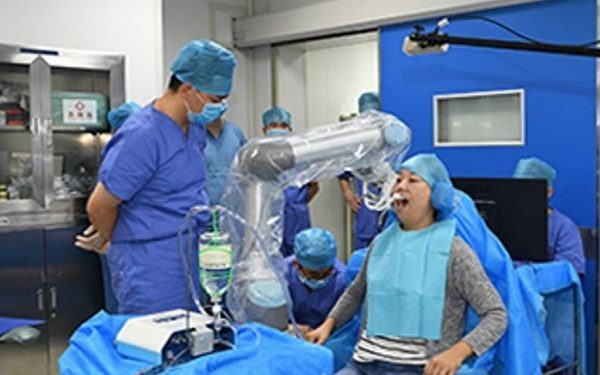
A robot dentist has carried out the first successful autonomous implant surgery by fitting two new teeth into a woman's mouth, mainland media has reported.

Although there were human medical staff present during the operation, they did not play an active role while it was being carried out.

The one-hour procedure took place in Xian, Shaanxi, on Saturday, according to Science and Technology Daily.

The implants were fitted to within a margin of error of 0.2-0.3mm, reaching the required standard for this kind of operation, experts said.

The technology was designed to overcome mainland China's shortage of qualified dentists and frequent surgical errors.

Comment:


R2-D2

Putin expresses concern about AI tech to Yandex head - "When will AI eat us?"

putin yandex
© Sergey Guneev / Sputnik
Vladimir Putin may secretly be on the side of Elon Musk in their indirect debate over the threat posed by artificial intelligence (AI). As Arkady Volozh, the head of Yandex, pitched him on the technology's potential, the Russian president inquired about when AI 'will eat us'.

The question seemed to baffle the head of Russia's biggest tech firm, who was giving Putin a tour on the company's Moscow HQ on Thursday.

"I hope never", he replied after taking a pause to gather his thoughts. "It's not the first machine to be better than humans at something. An excavator digs better than we do with a shovel. But we don't get eaten by excavators. A car moves faster than we do..."

But Putin seemed unconvinced. "They don't think," he remarked.

Galaxy

NASA's asteroid chasing spacecraft "Osiris-Rex" swings by earth en route to space rock

NASA spacecraft asteroid
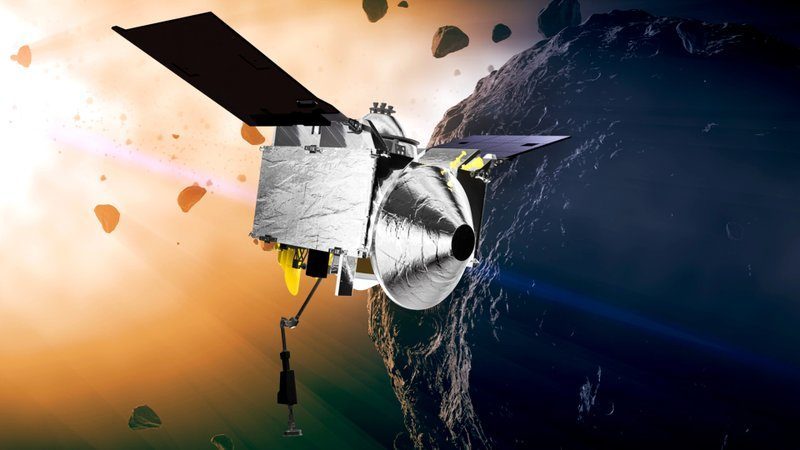
NASA's asteroid-chasing spacecraft swung by Earth on Friday on its way to a space rock.

Launched a year ago, Osiris-Rex passed within 10,711 miles (17,237 kilometers) of the home planet early Friday afternoon - above Antarctica. It used Earth's gravity as a slingshot to put it on a path toward the asteroid Bennu.

Osiris-Rex should reach the small, roundish asteroid next year and, in 2020, collect some of its gravel for return to Earth. If all goes well, scientists should get the samples in 2023.

Friday's flyby was a quick hello: The spacecraft zoomed by at about 19,000 mph (31,000 kph). NASA took precautions to ensure Osiris-Rex - about the size of an SUV - did not slam into any satellites.

People 2

Phrenology is IN! Study asks if people with wide faces have a higher sex drive than those with narrow faces

Woman in bed
The shape of your face may say a lot about your sexuality, according to a new study
New research published in the journal Archives of Sexual Behavior suggests that the size and shape of your face may predict your sex drive and how likely you are to cheat on your partner.

Recently, behavioral and psychological researchers have taken an interest in facial morphology - that is, how the shape of the human face may correlate with certain attitudes, behaviors, and personality traits.

For example, some studies have suggested that in men, a high facial width-to-height ratio (FWHR) may signal aggressiveness, unethical behavior, and even psychopathy.

New research - led by Steven Arnocky, of Nipissing University in Ontario, Canada - examines the role of men and women's FWHR in sexual relationships, infidelity, and mate selection.

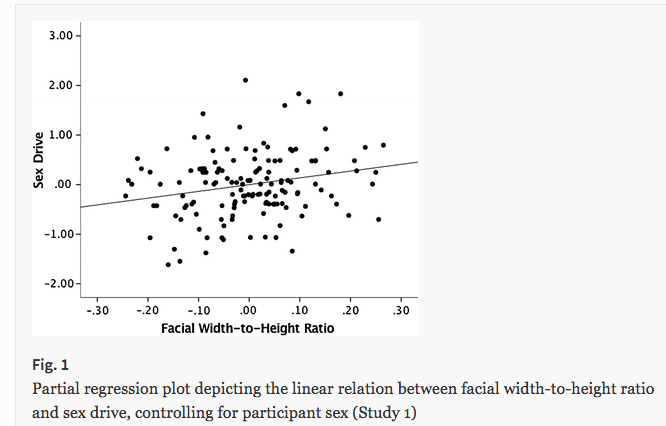
Comment: It's good to remember in studies like this that they're only ever talking about correlations and trends (usually slight ones). It's not as if every person with a wide face has a higher sex drive. Here's the study's results in graph form:
sex drive graph
So even if people with wide faces are somewhat more likely to have higher sex drives, big deal. There are people with wide faces with low sex drives, narrow faces with high sex drives. Researchers will come up with some evo-psych explanation, but that doesn't mean they're necessarily true, or that the correlation is really meaningful. It's an interesting trend, but people most likely will latch onto a headline like this and turn it into a new phrenology.

Interestingly, this isn't the only recent study to examine facial characteristics as it relates to sexuality:

Gaydar: Stanford U. creates computer algorithm that can distinguish straight from gay


Blue Planet

Research suggests gravity waves have influence over weather and climate

asteroid earth
In fluid dynamics, gravity waves are waves generated in a fluid medium or at the interface between two media when the force of gravity or buoyancy tries to restore equilibrium. An example of such an interface is that between the atmosphere and the ocean, which gives rise to wind waves. -source

From Goethe University in Frankfurt

Gravity waves form in the atmosphere as a result of destabilizing processes, for example at weather fronts, during storms or when air masses stroke over mountain ranges. They can occasionally be seen in the sky as bands of cloud. For weather forecast and climate models, however, they are mostly "invisible" due to their short wavelength. The effects of gravity waves can only be taken into consideration by including additional special components in the models. The "MS-GWaves" research unit funded by the German Research Foundation and led by Goethe University Frankfurt has meanwhile further developed such parameterizations and will test them in the second funding period.