Science & TechnologyS


Info

New 'blob' of hot, rising rock detected below part of the U.S. Northeast.

New England
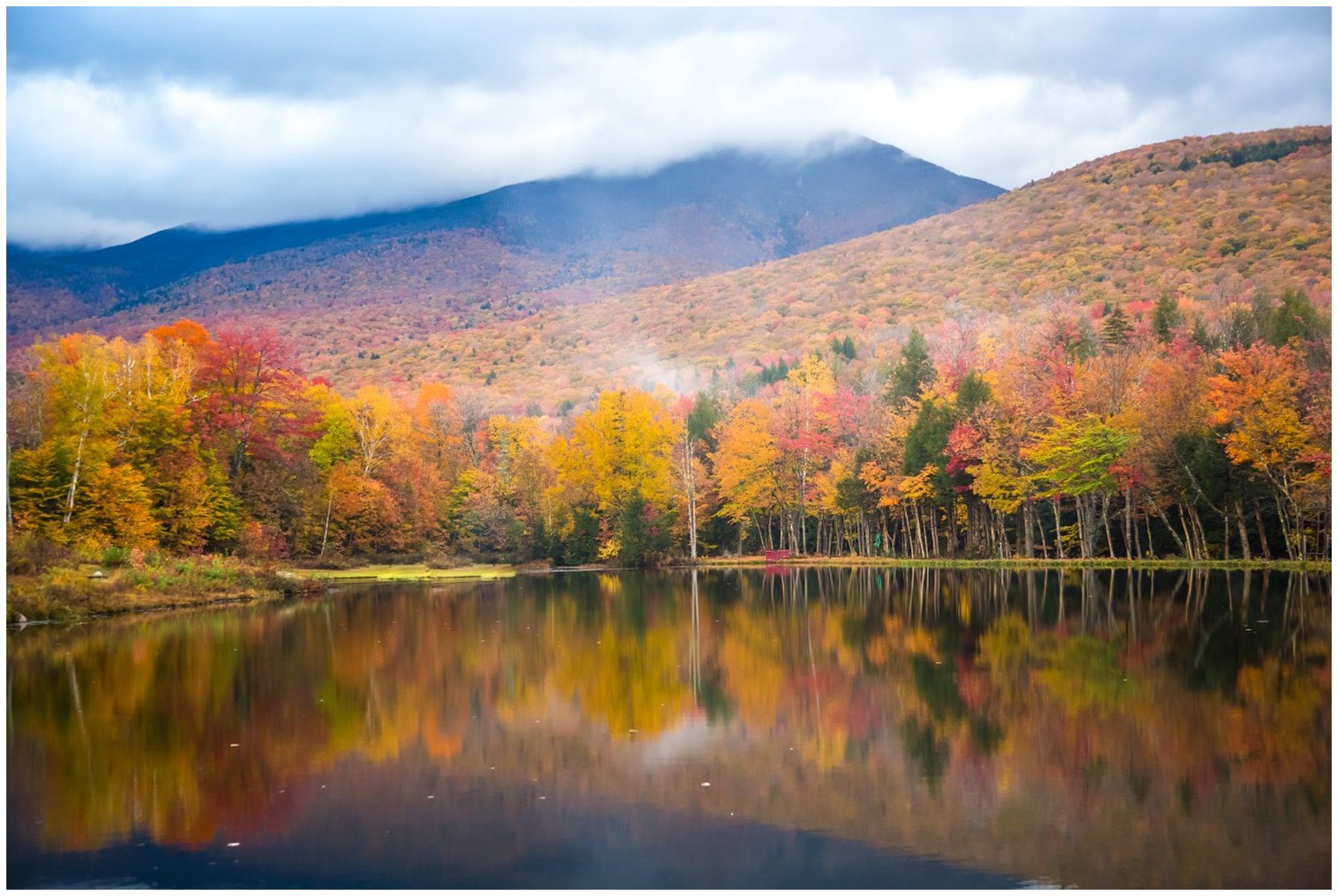
© ShutterstockA hot blob of rock seems to be rising toward the surface beneath the North American tectonic plate, under a part of New England.
The continental rock underlying the east coast of North America is pretty boring, tectonically speaking. The last dramatic geological goings-on there happened around 200 million years ago, and most change since then has been from glacial, wind and water erosion.

But a project that helped image the layers of rock below the continent with unprecedented clarity has helped reveal a small, unusual feature that seems to be a relatively new "blob" of hot, rising rock below part of the U.S. Northeast.

Exactly what caused this blob and whether other similar blob structures might lurk under other continents isn't clear, said study co-author Vadim Levin, a Rutgers University geophysicist, but it raises plenty of interesting questions. The work on the blob was published online Nov. 29 in the journal Geology and presented Monday (Dec. 11) at the annual meeting of the American Geophysical Union in New Orleans.

The unusual feature had been spotted before, when scientists used the seismic waves that routinely ricochet through the Earth's interior to reveal some of the structures hidden below our feet. Such waves travel at different speeds and angles through different types of rock, including rocks of different temperatures and rock moving in different directions. The small feature below the Northeast showed up as an area of unusually high temperature, but the pictures were pretty fuzzy.

Fireball

Researchers identify new mechanism that helps explain why meteors explode in the atmosphere

Chelykabinsk meteor
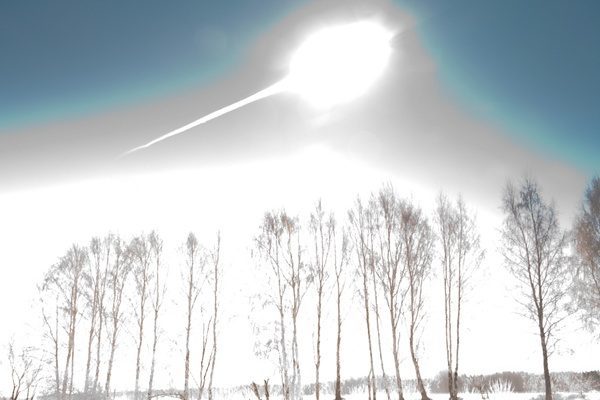
© M. Ahmetvaleev/NASA APODPhotographer Marat Ahmetvaleev was taking panoramic photos of the winter landscape when he captured this beautiful image of the Chelyabinsk meteoroid as it exploded over Russia in 2013.
On February 15, 2013, a near-Earth asteroid with a diameter of 66 feet (20 meters) entered Earth's atmosphere traveling at around 40,000 miles per hour (60,0000 km/h). Within a few seconds, the cosmic projectile detonated 12 miles above the Chelyabinsk region of Russia, releasing as much energy as about 30 Hiroshima atomic bombs. This created a gigantic fireball - known as a superbolide - that caused shock waves to propagate outward for dozens of miles, damaging several thousand buildings and injuring 1,500 people.

Though the progenitor of the explosion had an initial mass of over 10,000 metric tons, only about 0.1 percent of that mass is believed to have reached the ground, indicating that something in the upper atmosphere not only caused the rock to explode, but also caused it to disintegrate much more than expected.


Meteor

Scotland: Geologists discover 60-million-year-old meteorite strike and new mineral forms

Isle of Skye
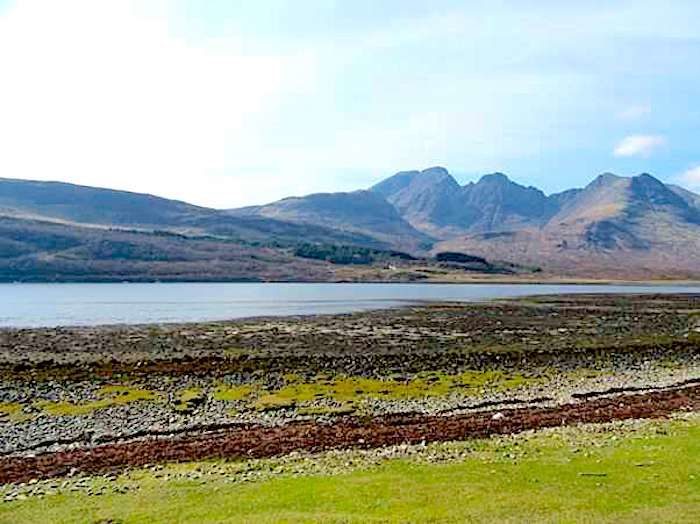
© Simon DrakeSite 1 is above the tree line in the mid-ground far side of Loch Slapin, Isle of Skye, Scotland
Geologists exploring volcanic rocks on Scotland's Isle of Skye found something out-of-this-world instead: ejecta from a previously unknown, 60 million-year-old meteorite impact. The discovery, the first meteorite impact described within the British Paleogene Igneous Province (BPIP), opens questions about the impact and its possible connection to Paleogene volcanic activity across the North Atlantic.

Lead author Simon Drake, an associate lecturer in geology at Birkbeck University of London, zeroed in on a meter-thick layer at the base of a 60.0 million-year-old lava flow. "We thought it was an ignimbrite (a volcanic flow deposit)," says Drake. But when he and colleagues analyzed the rock using an electron microprobe, they discovered that it contained rare minerals straight from outer space: vanadium-rich and niobium-rich osbornite.
Quartz layer
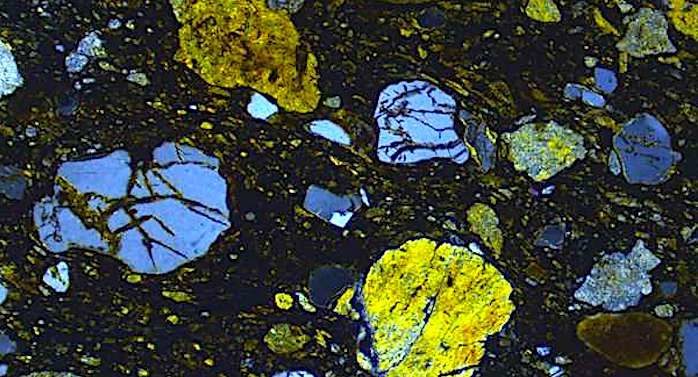
© Simon DrakeThin section view of meteoritic ejecta deposit site 1. Note fractured quartz and pervasive fabric. Field of view 4 mm XPolars.
These mineral forms have never been reported on Earth. They have, however, been collected by NASA's Stardust Comet Sample Return Mission as space dust in the wake of the Wild 2 comet. What's more, the osbornite is unmelted, suggesting that it was an original piece of the meteorite. The team also identified reidite, an extremely high pressure form of zircon which is only ever associated in nature with impacts, along with native iron and other exotic mineralogy linked to impacts such as barringerite.

Saturn

Saturn: Giant storms cause palpitations in atmospheric heartbeat

Saturnphases
© University of LeicesterSaturn's 'Great Springtime Storm' in visible light.
Immense northern storms on Saturn can disturb atmospheric patterns at the planet's equator, finds the international Cassini mission in a study led by Dr Leigh Fletcher from the University of Leicester. This effect is also seen in Earth's atmosphere, suggesting the two planets are more alike than previously thought.

Despite their considerable differences, the atmospheres of Earth, Jupiter, and Saturn all display a remarkably similar phenomenon in their equatorial regions: vertical, cyclical, downwards-moving patterns of alternating temperatures and wind systems that repeat over a period of multiple years.

Mars

Earthworms would survive in Martian soil

worm red soil
© sciencealert.comFuture Martians?
Mars is looking more habitable all the time. Well you know, aside from the lethal atmosphere. And the cosmic radiation Martian colonists would be subjected to along the way. And the general soul-crushing inhospitality of the planet itself. Aside from all that, though, Mars would make a pretty sweet new place for us to build all the great stuff we have on Earth: endless parking lots, landfills full of old iPhones, privately-owned prisons, and of course Starbucks franchises. Lots of Starbucks franchises. Is the colonization of Mars realistically possible in our lifetime, though?

Getting there isn't the problem; we already have the rocket technology to get us well past Mars. The question lies in the ability of colonists to actually sustain themselves once safely on the Martian surface. Luckily, several studies published over the past year have given hope to the starry-eyed visionaries who believe we are on the verge of being able to colonize the Red Planet. First, an experiment concluded that potatoes can grow in simulated Martian soil under high-pressure, low-oxygen conditions, lending hope that the starchy staple crop could be grown by Mars colonists.

Another study by a team of Dutch scientists found that crops grown in (simulated) Martian soil are safe to eat. Now, a new crowdfunded study by those same scientists at Wageningen University & Research in the Netherlands claims that earthworms can survive and even reproduce in Martian soil.

For more on this article, go here.

Fire

Study claims chemical tipping point of magma determines explosive potential of volcanoes

Bubbly magma in laboratory
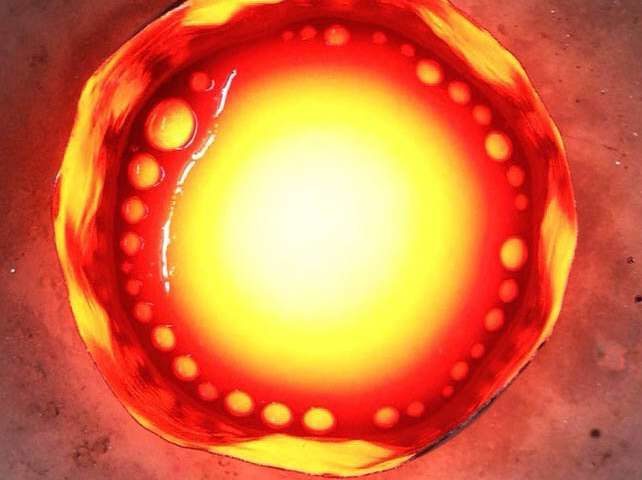
© Danilo Di GenovaBubbly magma in laboratory used as starting material for the viscosity experiments.
Volcanic eruptions are the most spectacular expression of the processes acting in the interior of any active planet. Effusive eruptions consist of a gentle and steady flow of lava on the surface, while explosive eruptions are violent phenomena that can eject hot materials up to several kilometres into the atmosphere.

The transition between these eruptions represents one of the most dangerous natural hazards.

Understanding the mechanisms governing such transition has inspired countless studies in Earth Sciences over the last decades.

In a new study led by Dr Danilo Di Genova, from the University of Bristol's School of Earth Sciences, an international team of scientists provide evidence, for the first time, that a subtle tipping point of the chemistry of magmas clearly separates effusive from explosive eruptions worldwide.

Moreover, they demonstrate that variabilities at the nanoscale of magmas can dramatically increase the explosive potential of volcanoes.

Dr Di Genova said: "The new experimental data, thermodynamic modelling and analysis of compositional data from the global volcanic record we presented in our study provide combined evidence for a sudden discontinuity in the flow behaviour of rhyolitic magmas that guides whether a volcano erupts effusively or explosively.

"The identified flow-discontinuity can be crossed by small compositional changes in rhyolitic magmas and can be induced by crystallisation, assimilation, magma replenishment or mixing.

Bug

'Bound by blood': 'Dracula' tick entombed in amber, gorged on 99mn yo dinosaurs

Skull
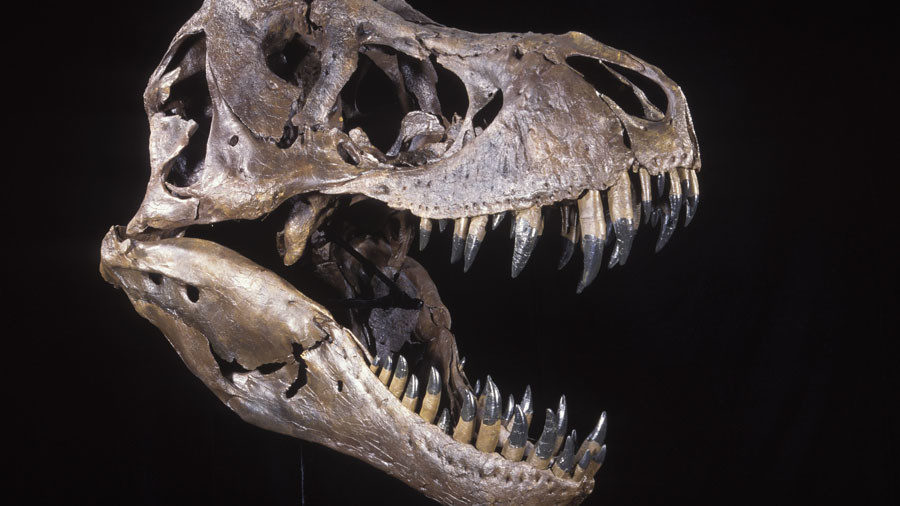
© Francois Gohier / Global Look Press
Ticks, long the scourge of your favorite pooch, have been terrorizing animals for eons. Scientists have discovered a previously-unknown type of the irritable arachnid - which sucked on the blood of dinosaurs - entombed in near-100-million-year-old amber.

If this all sounds a little familiar, that's because it is. Think Michael Crichton's classic '90s bestseller 'Jurassic Park' and its sequels, which spawned a series of blockbusters by Steven Spielberg.

In the books and films, eccentric theme park owner and dinosaur buff John Hammond, played by Richard Attenborough, clones a number of dinosaurs by extracting their DNA from a mosquito encased in ancient amber, predictably disaster ensues.

Not that these actual scientists have any illusions of that particular outcome materialising. "It seems that modern techniques are unable to extract DNA, or at least sufficiently well-preserved DNA, from amber inclusions (organisms trapped in amber)," study author Ricardo Pérez-de la Fuente said, according to Reuters. "DNA does not stand the passing of time, of millions of years, when entombed in amber."

Comment: See also: Extinct 'hell ant' with metal horns & trap jaw found inside amber (PHOTOS)


Book

Freud was a fraud!

Freud
© Science-Based Medicine
Psychiatry is arguably the least science-based of all the medical specialties, and Freudian psychoanalysis is arguably the least science-based psychotherapy.

Freud's theories have been widely criticized as unscientific, and treatment of mental disorders has increasingly turned to psychotropic medications and effective therapies like cognitive behavioral therapy (CBT).

Freud's impact on 20th century thought is undeniable, but he got almost everything wrong. He was not only not scientific; he was a liar and a fraud. A new book, Freud: The Making of an Illusion, by Frederick Crews, may put the final nail in his coffin.

Crews had access to material not available to previous biographers. The extensive early correspondence between Freud and his fiancée, Martha Bernays, has only recently been released, and it is very revealing of Freud's character flaws, his sexist attitudes, and his regular use of cocaine.

Freud was trained as a scientist, but he went astray, following wild hunches, willfully descending into pseudoscience, covering up his mistakes, and establishing a cult of personality that long outlived him.

His early work in science was scattershot and lacked follow-through. He "deftly criticized premature conclusions reached by others but never crucially tested any of his own hypotheses." He was lazy, reluctant to collect enough evidence to make sure a finding was not an anomaly; he generalized from single cases, even using himself as the single case. In an early article "On Coca" he demonstrated poor scholarship, omitting crucial references, citing references from another bibliography without reading them, and making careless errors (misstating names, dates, titles, and places of publication).

Fish

What's causing deafness in farmed salmon?

salmon farm
© WikimediaFaster growing salmon in farms are three times more likely to have the deformity.
The odds are that every second farmed salmon we eat has lost much of its ability to hear.

Although fish senses aren't usually a consideration when they're on a plate, researchers now know that deafness in farmed salmon is due to a deformity in the ear, caused by accelerated growth in aquaculture.

The findings, published in the Journal of Experimental Biology, raise significant welfare issues and may also explain the poor survival of farmed hatchlings in conservation programs.

Scientists from the University of Melbourne looked at salmon farmed in Norway, Chile, Scotland, Canada and Australia and found the deformity was widespread.

The study's lead author, Ms Tormey Reimer, says when they went looking for the cause of the deformity they found that the fastest-growing fish were three times more likely to be afflicted than the slowest, even at the same age.

Microscope 1

Digitizing DNA - what could possibly go wrong?

computers to analyze DNA
© Sergey Nivens/Shutterstock.com
Biology is becoming increasingly digitized. Researchers like us use computers to analyze DNA, operate lab equipment and store genetic information. But new capabilities also mean new risks - and biologists remain largely unaware of the potential vulnerabilities that come with digitizing biotechnology.

The emerging field of cyberbiosecurity explores the whole new category of risks that come with the increased use of computers in the life sciences.

University scientists, industry stakeholders and government agents have begun gathering to discuss these threats. We've even hosted FBI agents from the Weapons of Mass Destruction Directorate here at Colorado State University and previously at Virginia Tech for crash courses on synthetic biology and the associated cyberbiosecurity risks. A year ago, we participated in a U.S. Department of Defense-funded project to assess the security of biotechnology infrastructures. The results are classified, but we disclose some of the lessons learned in our new Trends in Biotechnology paper.