Science & TechnologyS


Ice Cube

Researchers plan expeditions to Larsen C ice shelf to investigate newly exposed marine life

Larsen C ice shelf
© NASA EARTH OBSERVATORY, JOSHUA STEVENS, LANDSAT DATA, USGSWIDENING GULF: A Delaware-sized iceberg calved when a crack in the Larsen C ice shelf reached the Weddell Sea this year. In this satellite image from September, rifts are visible in the ice and clouds cast a shadow on the new iceberg.
In 2015, glaciologist Daniela Jansen reported that a large rift was rapidly growing across one of the Antarctic Peninsula's ice shelves, known as Larsen C. When the shelf broke, she and colleagues predicted, it would be the largest calving event in decades.


It was. In July, a Delaware-sized iceberg split off from Larsen C (SN: 8/5/17, p. 6). And researchers knew practically the moment it happened.

After Jansen's 2015 paper, a U.K.-led group called Project MIDAS began keeping close track of the rift, aided by new data delivered every six days from a pair of European polar-orbiting satellites known as Sentinel-1. Jansen, of the Alfred Wegener Institute in Bremerhaven, Germany, and glaciologist Adrian Luckman of Swansea University in Wales were among the MIDAS team members who reported their observations on the team's blog.

To the scientists' surprise, the news media, perhaps anticipating a climate change moment, began to track the trackers. When interviewed, the researchers repeatedly noted that ice shelves calve naturally, and that any link between the new rift and climate change is complicated at best. But the crescendo of public interest still rose, particularly during the spring and summer of 2017 as the final break loomed.

Galaxy

Astronomers discover 7 exoplanets roughly the size of Earth

TRAPPIST-1
© JPL-CALTECH/NASASEVEN IN ONE GO: The small, cool star TRAPPIST-1, illustrated here, hosts a bevy of Earth-sized planets. There could be many more stars like it worth studying.
Discoveries of planets around distant stars have become almost routine. But finding seven exoplanets in one go is something special. In February, a team of planet seekers announced that a small, cool star some 39 light-years away, TRAPPIST-1, hosts the most Earth-sized exoplanets yet found in one place: seven roughly Earth-sized worlds, at least three of which might host liquid water (SN: 3/18/17, p. 6).

These worlds instantly became top priorities in the search for life outside the solar system. "TRAPPIST-1 is on everybody's wish list," says exoplanet astronomer Lisa Kaltenegger of Cornell University. But the planets and their dim star have also stoked a raging debate about what makes a planet habitable in the first place.

Comment: See also:


Info

Quantum memory with record-breaking capacity

Faculty of Physics, University of Warsaw
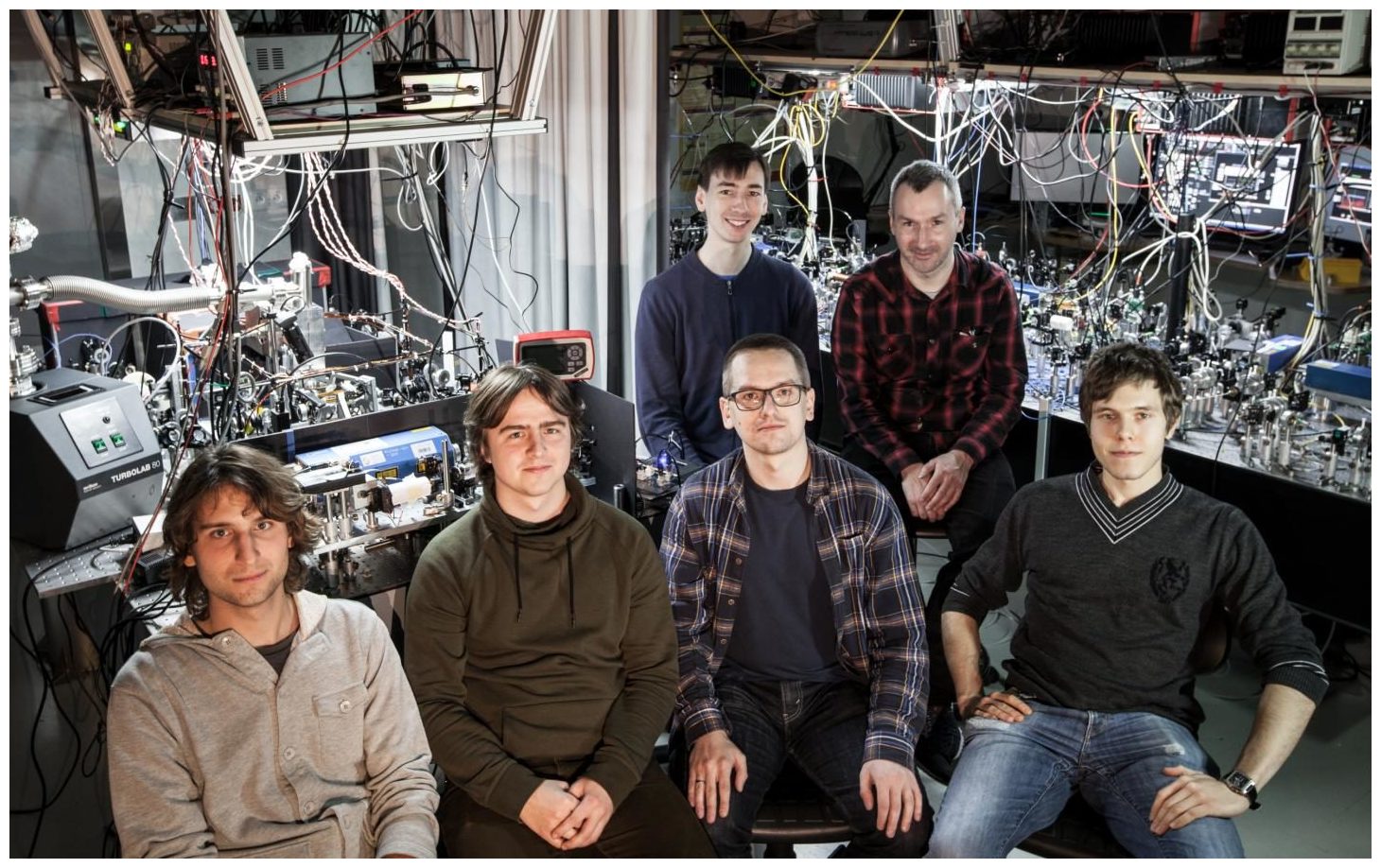
© UW Physics, Mateusz Mazelanik
The emerging domain of parallelized quantum information processing opens up new possibilities for precise measurements, communication and imaging. Precise control of multiple stored photons allows efficient handling of this subtle information in large amounts. In the Quantum Memories Laboratory at Faculty of Physics, University of Warsaw a group of laser-cooled atoms has been used as a memory which can store simultaneously up to 665 quantum states of light. The experimental results have been published in a prestigious Nature Communications journal.

Every information processing task requires a memory. As any classical computer cannot exist without a RAM memory, quantum computer could not be built without a quantum memory. Quantum memory is a device capable of storage and on demand retrieval of quantum states. The key parameter of such memory is its capacity, in other words the number of qubits (quantum bits) which the memory can effectively process. Simultaneous operation on many qubits is a key to efficient quantum parallel computation, providing new possibilities in the fields on imaging or communication.

Regardless of significant efforts, the on demand generation of many photons remains a key challenge for many experimental groups dealing with quantum information. For a recently widely-used method of multiplexing many single-photon emitters into one network the complexity of experimental systems grows unfavorably with its advantages. Using a quantum memory on the other hand one can generate a group of a dozen photons within seconds rather than years. Among many methods of encoding information about single photons in a quantum memory the spatial multiplexing aided by a single-photon sensitive camera stands out as an effective way to obtain high capacity at low cost.

Info

Quantum droplets are the most dilute liquids

quantum liquid droplet
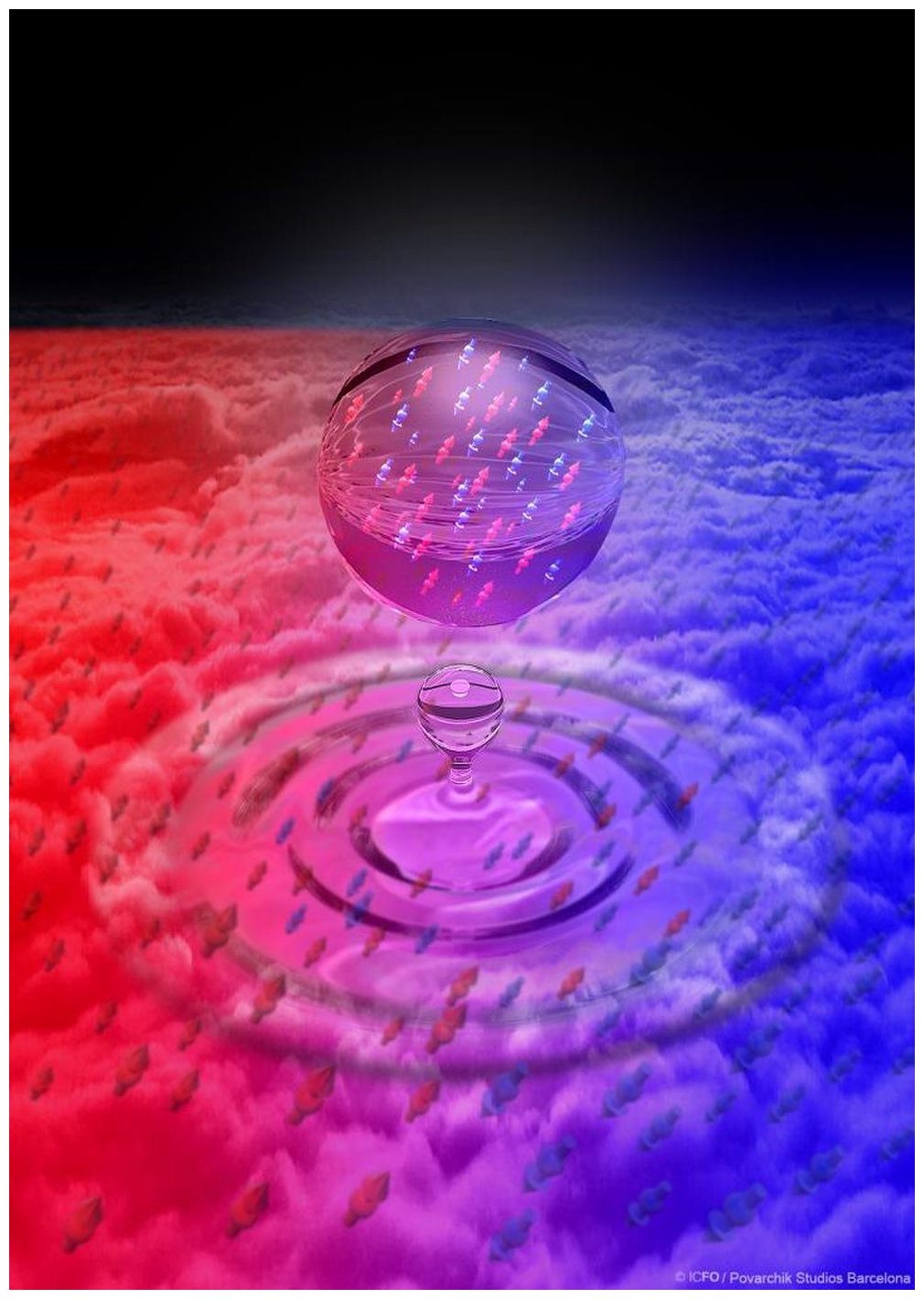
© ICFO/Povarchik Studios BarcelonaThis artist's rendering depicts a quantum liquid droplet formed by mixing two condensates of ultracold potassium atoms.
A team of physicists in Barcelona has created liquid droplets 100 million times thinner than water that hold themselves together using strange quantum laws.

In a paper published Dec. 14 in the journal Science, researchers revealed that these bizarre droplets emerged in the strange, microscopic world of a laser lattice - an optical structure used to manipulate quantum objects - in a lab at the Spanish Institut de Ciències Fotòniques, or Institute of Photonic Sciences (ICFO). And they were true liquids: substances that maintain their volume regardless of external temperature and form droplets in small quantities. That's as opposed to gases, which spread to fill their containers. But they were far less dense than any liquid that exists under normal circumstances, and maintained their liquid state through a process known as quantum fluctuation.

The researchers cooled a gas of potassium atoms cooled to minus 459.67 degrees Fahrenheit (minus 273.15 degrees Celsius), close to absolute zero. At that temperature, the atoms formed a Bose-Einstein condensate. That's a state of matter where cold atoms clump together and start to physically overlap. These condensates are interesting because their interactions are dominated by quantum laws, rather than the classical interactions which can explain the behavior of most large bulks of matter.

Question

The physicist's physicist ponders nature of reality

EdWitten
© Jean Sweep/Quanta MagazineEdward Witten at the Institute for Advanced Study in Princeton, New Jersey
Among the brilliant theorists cloistered in the quiet woodside campus of the Institute for Advanced Study in Princeton, New Jersey, Edward Witten stands out as a kind of high priest. The sole physicist ever to win the Fields Medal, mathematics' premier prize, Witten is also known for discovering M-theory, the leading candidate for a unified physical "theory of everything." A genius's genius, Witten is tall and rectangular, with hazy eyes and an air of being only one-quarter tuned in to reality until someone draws him back from more abstract thoughts.

During a visit this fall, I spotted Witten on the Institute's central lawn and requested an interview; in his quick, alto voice, he said he couldn't promise to be able to answer my questions but would try. Later, when I passed him on the stone paths, he often didn't seem to see me.

Physics luminaries since Albert Einstein, who lived out his days in the same intellectual haven, have sought to unify gravity with the other forces of nature by finding a more fundamental quantum theory to replace Einstein's approximate picture of gravity as curves in the geometry of space-time. M-theory, which Witten proposed in 1995, could conceivably offer this deeper description, but only some aspects of the theory are known. M-theory incorporates within a single mathematical structure all five versions of string theory, which renders the elements of nature as minuscule vibrating strings. These five string theories connect to each other through "dualities," or mathematical equivalences. Over the past 30 years, Witten and others have learned that the string theories are also mathematically dual to quantum field theories - descriptions of particles moving through electromagnetic and other fields that serve as the language of the reigning "Standard Model" of particle physics. While he's best known as a string theorist, Witten has discovered many new quantum field theories and explored how all these different descriptions are connected. His physical insights have led time and again to deep mathematical discoveries.

Microscope 1

SOTT Focus: Conflict of Interest in Scientific Research And Our Own Personal Bias

Conflict of interest
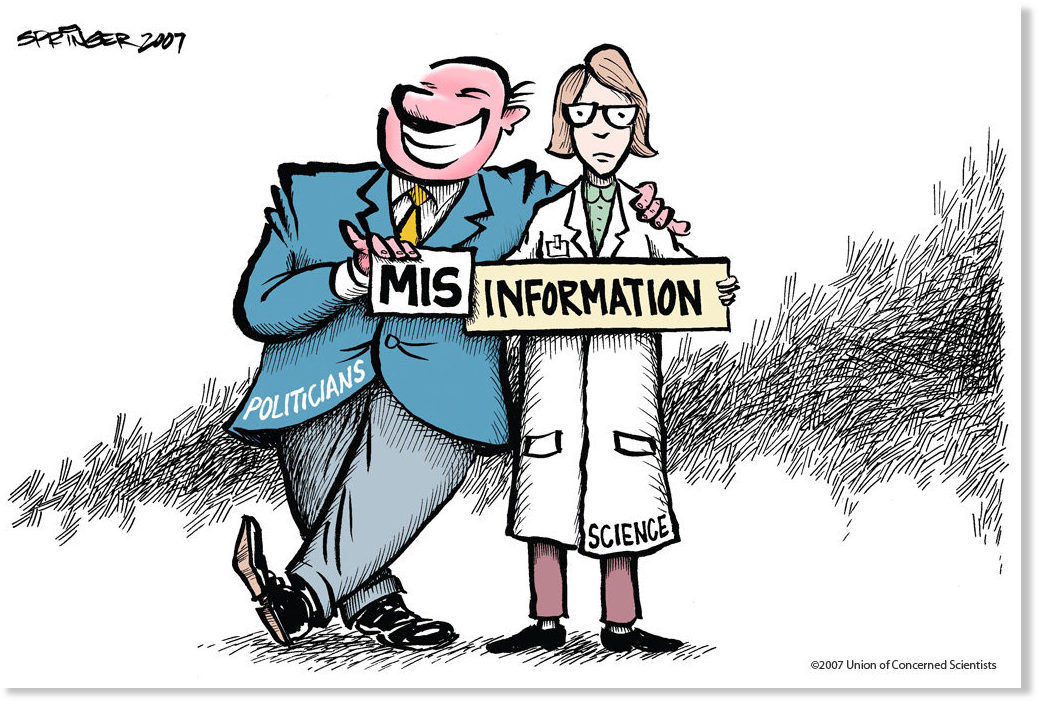
A recent study published on Springer Link discusses conflict of interest in scientific research, an area long overdue for concise and unbiased study. It has long been recognised that researchers may be influenced by the sponsors of their research. There are many reasons for this including the pressure to publish and the need for repeat research funding to further ones career.

The typical portrayal of scientists in the media is of unbiased individuals on a quest for truth, only considering hard facts, uninfluenced by personal feelings, searching for the unvarnished truth. Reality however seems to be somewhat different.

Laptop

Alternate reality: Mozilla's Mr. Robot promo backfires after it installs a Firefox extension without permission

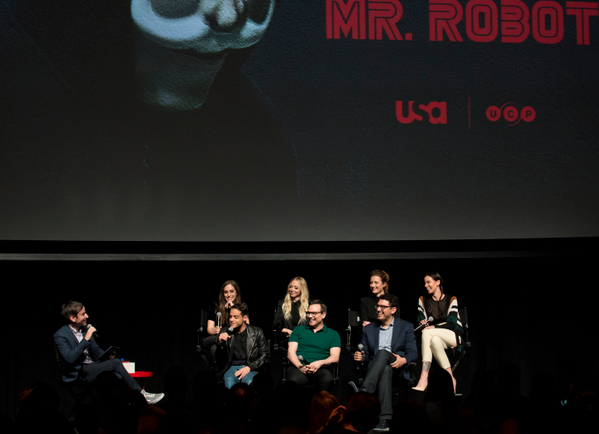
Mr Robot conference
If you're a Firefox user, you may have noticed a weird new extension that suddenly showed up in your browser this week.

The extension is called "Looking Glass 1.0.3" and this is its description: MY REALITY IS JUST DIFFERENT FROM YOURS. Now that sounds ominous. It's really not, though. It's a promotional campaign between Firefox and the TV series Mr. Robot that brings an alternate reality game to your browser. This must have sounded like a great idea when somebody pitched it to Mozilla, but the backlash has been fierce.

Meteor

'Potentially hazardous' 5km-wide Asteroid 3200 Phaethon to pass close to Earth tomorrow

Asteroid
© Zee News
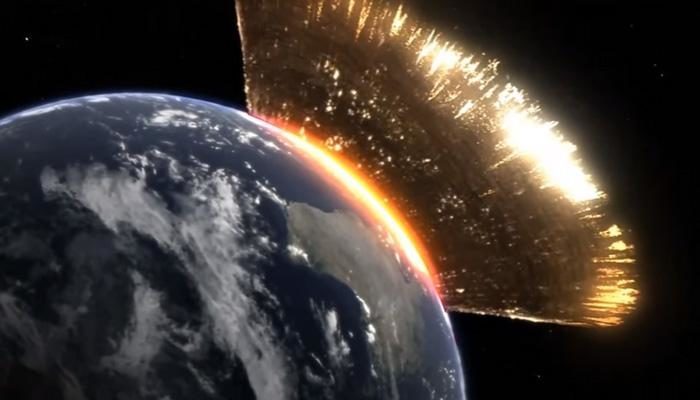
Just days after the Geminid meteor shower, the asteroid from which it comes, 3200 Phaethon, will pass close to Earth.

What is it?

Asteroid 3200 Phaethon, discovered in 1983, is named for its close proximity. Phaethon was a Greek mythology figure who almost burned Earth because he drove a chariot of fire too close.

The asteroid is best known for being the parent body of the Geminid meteor shower, but NASA also calls it a mystery because they have several theories as to why it produces meteors, but they're not sure which is correct.

Is it going to be at a safe distance?

Absolutely. Though the asteroid itself is classified as potentially hazardous, this particular fly-by is at a safe distance of almost 6.5 million miles, scientists say.

Comment: See also:


Galaxy

NASA teams up with Google AI discovering mini version of our own solar system

Kepler-90 planets
Nasa has found an entire solar system with as many planets as our own.

The discovery of a new planet around the Kepler-90 star, which looks like our own sun, means the distant solar system has a total of eight known planets. And those planets look like those in our own neighbourhood: rocky planets orbit close to the star, with gas giants further away.

The star and its family of planets were already known about, having been detected by the Kepler space telescope. But the breakthrough came when astronomers found the new world, which was done using Google's artificial intelligence technology.

Galaxy

Moscow physicists develop new theory on what happens inside black holes

black hole
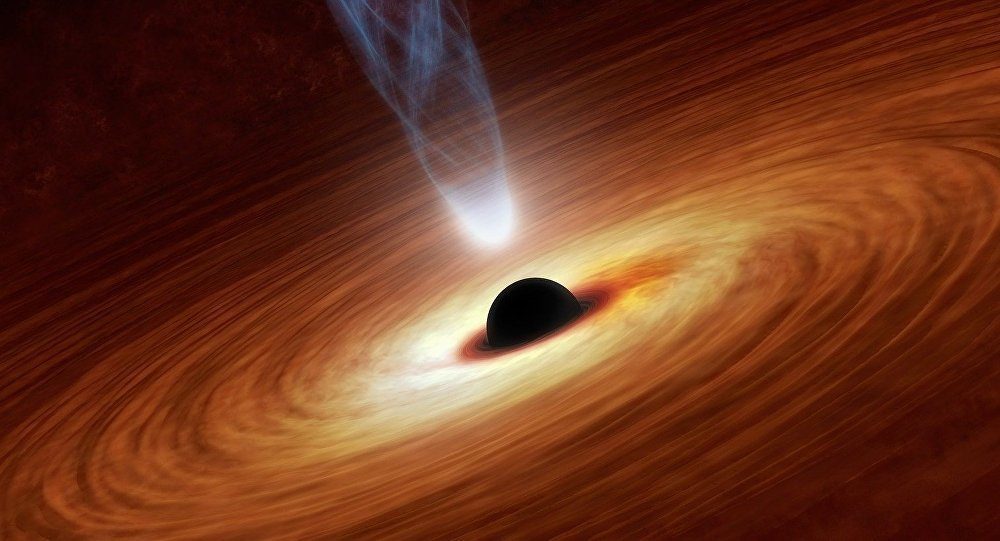
Physicists from Moscow's Steklov Institute of Mathematics have come up with a testable theory on how matter behaves inside a black hole.

The researchers' work, published in the September 2017 issue of the Journal of High Energy Physics, also proposes a theory that would reconcile quantum physics and the theory of general relativity, which describes gravity.

"We used an approach based on the holographic principle [of string theory]," study coauthor Mikhail Khramtsov said, according to the press service of the Russian Science Foundation.