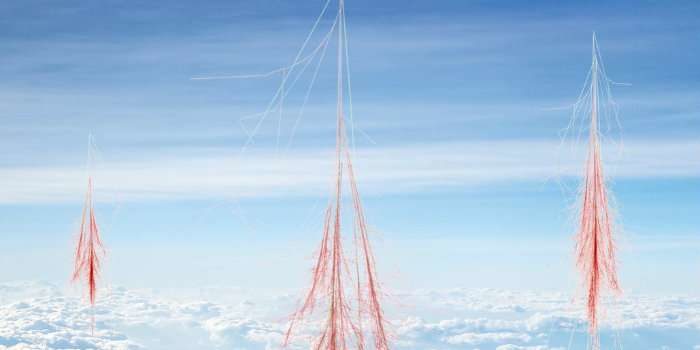
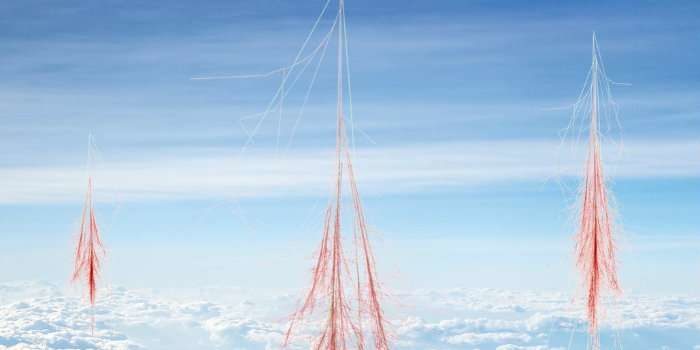
© H. Svensmark/DTUCosmic rays interacting with the Earth's atmosphere producing ions that helps turn small aerosols into cloud condensation nuclei -- seeds on which liquid water droplets form to make clouds.A proton with energy of 100 GeV interact at the top of the atmosphere and produces a cascade of secondary particles who ionize molecules when traveling through the air. One 100 GeV proton hits every m2 at the top of the atmosphere every second.
Cosmic rays are streams of very high energy particles in space that stem from activity on high energy stars like the sun. They can also originate in sources beyond our solar system, like exploding stars and distant galaxies. The cosmic rays cause electronic problems in satellites and other space instruments and their effects on the human body are seen as negative, but it is not clear to what extent.
Now, a team of researchers found these ions (charged particles) could filter through our atmosphere and trigger cloud formation, which could have profound effects on the day-to-day climate.
The researchers from the Technical University of Denmark said these cosmic rays could be the reason for several climatic anomalies across Earth's history.
"Finally, we have the last piece of the puzzle explaining how particles from space affect climate on Earth," said Dr Henrik Svensmark, lead author of the study in a
press release on EurekAlret.
"It gives an understanding of how changes caused by solar activity or by supernova activity can change climate."Cloud condensation nuclei or CCNs are typically 0.2 µm, or 1/100th the size of a normal cloud droplet. This provides the small but precise surface needed for water vapor to settle and become liquid water, which is integral in cloud formation. Water requires a non-gaseous surface to make the transition from a vapor to a liquid. These CCNs are formed by aerosols like smog, haze, fog, dust and smoke.
The team studied the effects of cosmic rays on a simulation of Earth's atmosphere, recreated inside a cloud chamber, which mimics the planet's upper atmosphere inside a controlled lab setting where these interactions can be studied up close.

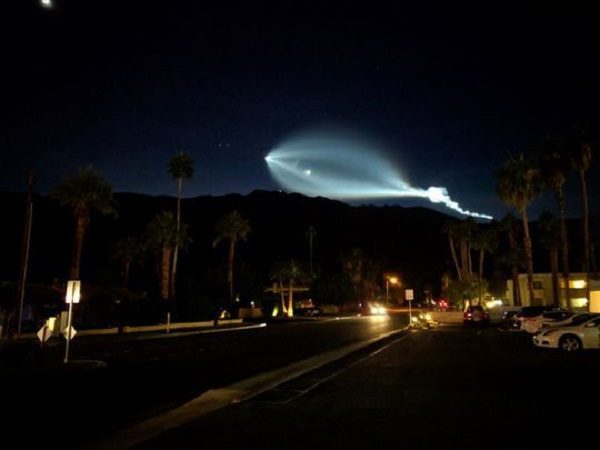

















Comment: More on SpaceX: