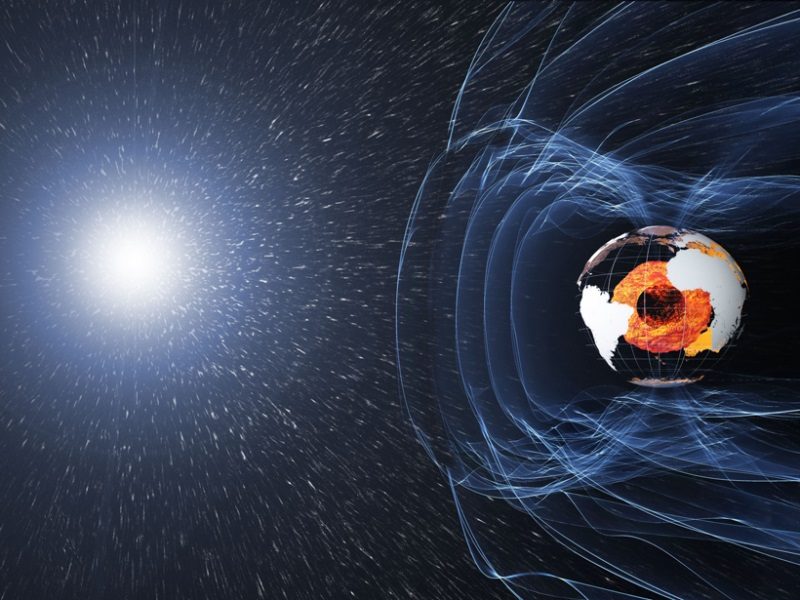
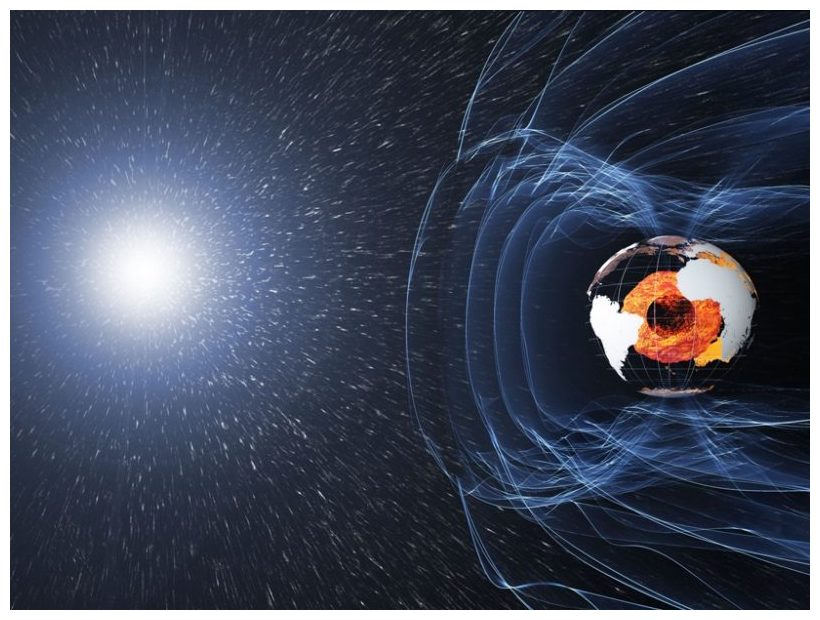
© ESA/ATG MedialabAn illustration of Earth’s magnetic field lines, which are generated by the planet’s swirling liquid outer core and curve as they get buffeted by the solar wind.
The fact that planet Earth is essentially a giant magnet is not a great secret: A compass works because either end of its magnetized needle is constantly being drawn toward the North and South poles. Scientists believe that the Earth's magnetization is caused by a sea of liquid metal flowing past its solid iron core, creating electric currents and, in turn,
magnetic fields.
The Earth's magnetic fields extend to the
ionosphere-a
layer of plasma and neutral gases about 50-500 kilometers above Earth's surface-and the
magnetosphere, which starts at the outer edges of the ionosphere and stretches many thousands of miles into space. Magnetic fields from Earth and the Sun affect
the behavior of charged particles in the magnetosphere.
Earth's magnetic field is highly conductive and carries charged particles in a predictable fashion along field lines (giving rise to aptly titled
field-aligned currents). Starting in the early 1900s, scientists conceptualized an exchange of energy and momentum between the
solar wind (a stream of charged particles
emitted by the Sun that flows throughout the solar system) and our planet's own magnetic field.

















Comment: Internet Growth Follows Moore's Law