Science & TechnologyS


Eye 1

"Unfortunate risk": Uproar over contraceptive app after 37 users fall pregnant

Phone ap
© NaturalCycles / YouTube
A Swedish contraceptive app designed to let women know when it's 'safe' for them to have unprotected sex has been reported to the country's medical regulator after dozens of its users fell pregnant.

The Södersjukhuset hospital in Stockholm lodged a complaint with the Swedish Medical Products Agency, or Läkedelsverket, after staff performed abortions on 37 users of the NaturalCycles app over a four-month period last year.

The company claims the app, which tracks changes in body temperature over the course of a woman's menstrual cycle to predict 'safe' days for unprotected sex, is 93 percent effective under typical use - a higher level of effectiveness than some more traditional contraceptives, according to the the company's website. Speaking to tech news website Di Digital Thursday, co-founder Elina Berglund described the technology as "about as safe as the pill."

In a statement to RT.com, NaturalCycles spokesman Harry Cymbler said unwanted pregnancy is an "unfortunate risk" with any contraception and he is confident the regulator will clear the company of any blame. "If you have a popular form of contraception such as Natural Cycles, then you also have to expect a certain amount of unwanted pregnancies from users using this method," Cymbler said.

Galaxy

Milky Way's stellar 'rainbow' captured in stunning Hubble image

Milky Way
© NASA
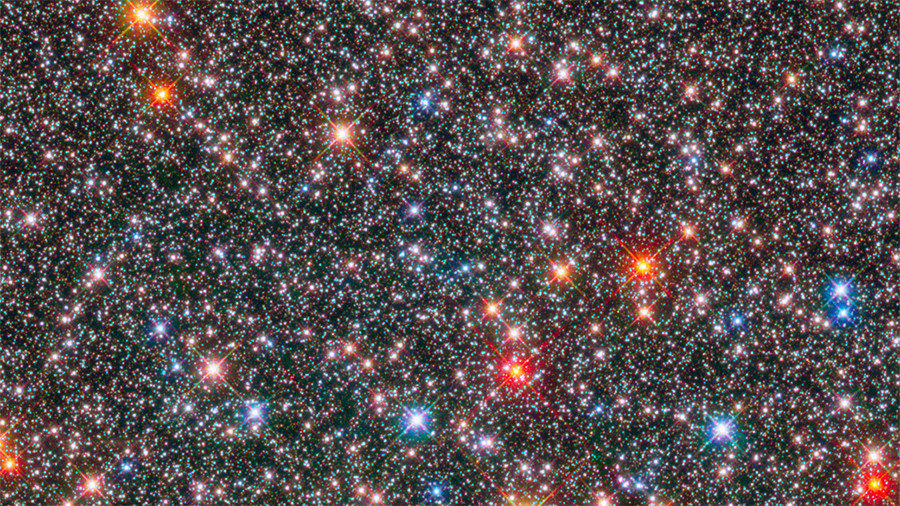
The beauty of the Milky Way has been revealed anew in another stunning image captured by NASA's deep space Hubble Telescope.

The image exposes the strong mix of stars of different ages within the heart of the Milky Way, giving it a sequined, colorful look reminiscent modern and impressionist artwork.

Satellite

Mystery deepens over fate of $1B missing spy satellite as Pentagon refuses to disclose information

SpaceX launch Zuma
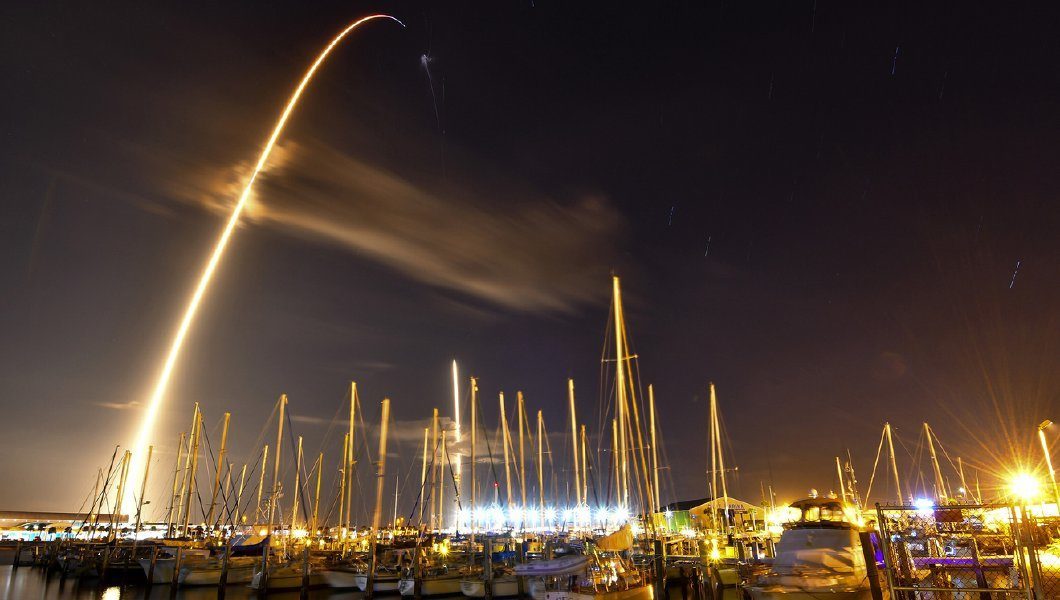
© Malcolm Denemark/Florida Today via APOn Sunday, SpaceX launched a secret satellite codenamed Zuma on its first flight of the new year. Since then, no one knows what has happened to it.
Where is Zuma? What is Zuma? What went wrong with Zuma?

The Pentagon is not saying anything about the fate of the military payload, code-named "Zuma," that was launched this week and may have crashed soon after, and neither is anyone else.

"I would have to refer you to SpaceX, who conducted the launch," said Dana White, chief Pentagon spokesperson when questioned about the unexplained mystery Thursday, four days after the satellite did or did not go into orbit, or more likely ended up falling back to Earth and plunging into the ocean.

A reporter for Bloomberg, who was among the first to report that something had gone awry with Sunday's launch, was aghast that Pentagon briefers were refusing to give even the barest details about the highly-classified mission.

"I'm sorry. This is a billion-dollar satellite. It's been four days. Was it a success or a failure?" pressed Bloomberg's Tony Capaccio. "And what's the fate of the satellite?"

Comment: Bloomberg reports SpaceX is denying responsibility for the failure of the satellite, claiming that "Falcon 9 performed as expected". If confirmed by investigators, it leaves open possibilities such as a failure in the coupling that was supposed to release the satellite from the rocket. A spokesman for Northrop Grumman, the satellite manufacturer, declined to comment on the coupling due to the classified nature of the mission.

The launch failure could revive debates about SpaceX's rivalry for military contracts with United Launch Alliance which was the sole provider for the Pentagon until Elon Musk challenged what he called an unfair monopoly.

See also: Highly classified US spy satellite launched by SpaceX expected to be 'total loss' after failure to launch into orbit


Arrow Up

Little-known 2012 volcanic eruption was actually the largest in over a century say scientists

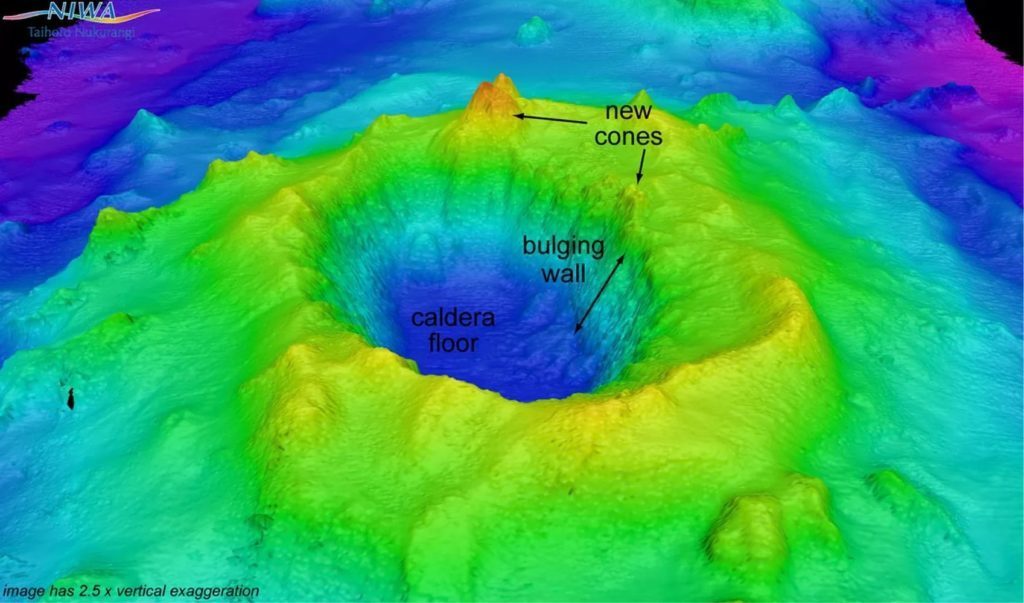
An echosounder image showing the undersea volcano called Havre Seamount
© NIWA/GNS Science.An echosounder image showing the undersea volcano called Havre Seamount, including a new cone that formed during the July 2012 eruption.
In July 2012, geologists noted the eruption of a previously little-known volcanic area called Havre Seamount, located off the coast of New Zealand. Now, after analyzing the data more thoroughly, they say it was one of the largest eruptions in modern history - we just didn't realize it because it took place underwater.

The eruption of the Havre Seamount was not initially noticed by scientists. Havre Seamount was only discovered in 2002, and researchers weren't even aware that the area was volcanic. But as it erupted, it offered passengers on an airline flight over the Southwest Pacific an unusual display: a raft of porous, floating rock (known as pumice), as big as 150 square miles - that's 50% bigger than the surface of Paris.

Maggie de Grau was a passenger on that flight. Like many others on that plane, she took photos of the strange phenomenon, which she proceeded to email to Dr. Scott Bryan, a senior research fellow at Queensland University of Technology. The raft grew even more, and Bryan contacted some of his colleagues, ultimately discovering that a few military pilots had also witnessed the event days and weeks after the eruption. An officer in the Royal Australian Navy was quoted as saying that it was "the weirdest thing [he had] seen in 18 years at sea." It was at that point that scientists knew they had something much bigger on their hands.

"We knew it was a large-scale eruption, approximately equivalent to the biggest eruption we've seen on land in the 20th Century," said Rebecca Carey, a volcanologist at University of Tasmania and Co-Chief Scientist on the expedition.

Comment: Back in 2015 off the US North West coast, a submarine volcano named 'Axial Seamount' erupted stunning scientists.

With increased volcanic activity on land (connected with a minute slowdown in planetary rotation) a comparable escalation of their underwater counterparts seems logical.


Nebula

Astronomers catch supermassive black hole emitting a 'double burp' after feasting on hot gas

black hole burps
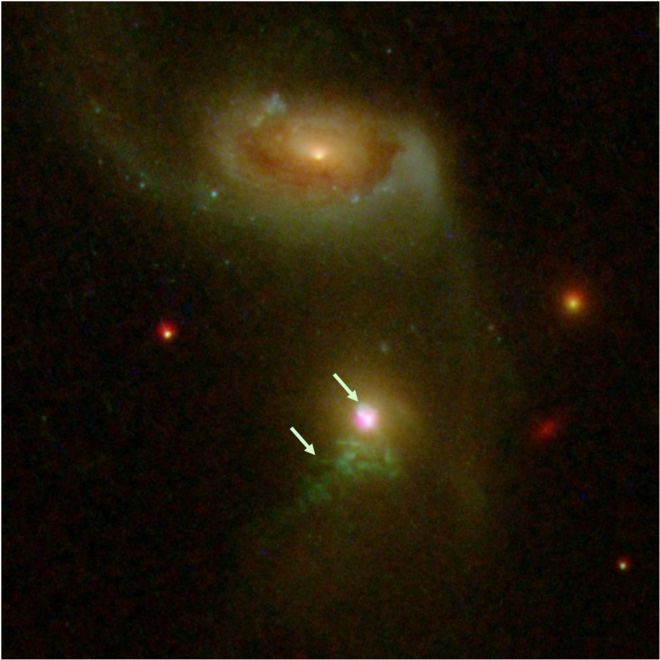
© NASAArrows point to the the two burps of gas coming from the black hole; the top arrow points to the newer burp and the bottom arrow points to the older one
Astronomers have caught a massive black hole letting out a "double burp" after bingeing on hot gas.

When cosmic gas comes near one of these sinkholes, it gets sucked in - but some of the energy is released back into space in the form of a burp.

Now, the Hubble and Chandra space telescopes have detected a new belch emerging from a black hole located about 800 million light-years away.

But they saw a remnant of another belch that occurred 100,000 years earlier.

"Black holes are voracious eaters, but it turns out they don't have very good table manners," Julie Comerford, from the University of Colorado, Boulder, told the 231st American Astronomical Society meeting in Washington DC.

Comment: Further reading:


Mars

Massive subsurface ice sheets offer potential water source for future explorers of Mars

Martian ice deposit
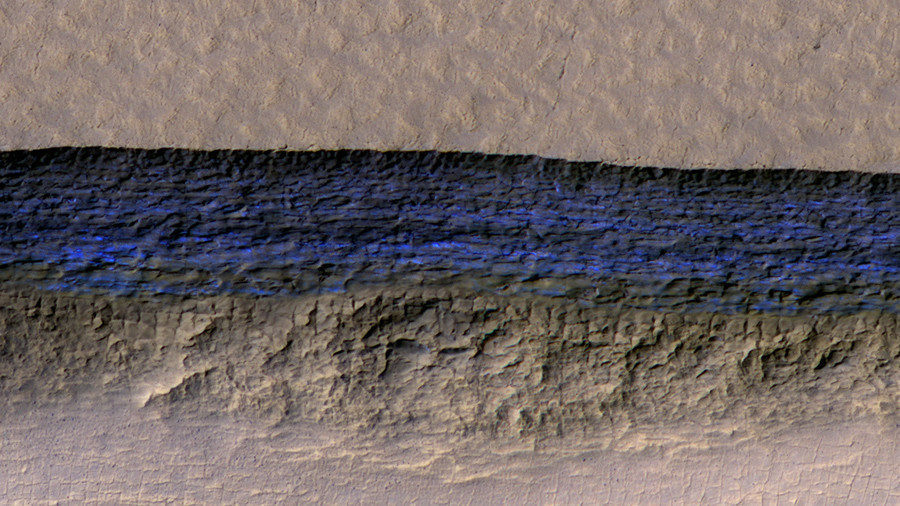
© NASAUnderground Martian Ice Deposit Exposed at Scarp
Mars has ice sheets more than 100 meters deep hiding beneath its red dust, offering a potential water source for future explorers of the Red Planet, according to new research.

A team of scientists, led by Colin Dundas, a geologist at the US Geological Survey, analyzed data from the Mars Reconnaissance Orbiter (MRO), specifically looking at eight areas where erosion occurred.

The results revealed massive subsurface ice sheets on the planet extending from just below the surface to a depth of at least 100 meters (328ft).

The remarkable ice cliffs appear to contain distinct layers, which could preserve a record of Mars' past climate, according to the report.

Comment: Further reading:


Nebula

Astronomers are honing in on the source of puzzling fast radio bursts

radio burst
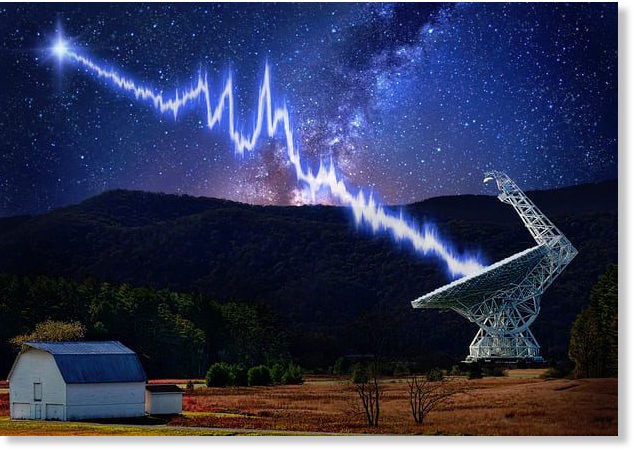
© Illustration: Danielle Futselaar/Shutterstock.comAn artist’s impression of a flash from FRB 121102 traveling toward the the Green Bank Telescope.
Pulses may be from a neutron star cocooned by a strong magnetic field - though experts are not ruling out more unorthodox explanations such as alien ships

Astronomers appear to be closing in on the source of enigmatic radio pulses emanating from space that have become the subject of intense scientific speculation.

Previous candidates for the origin of the fleeting blasts of radiation - known as fast radio bursts, or FRBs - have included exploding stars, the reverberations of weird objects called cosmic strings or even distant beacons from interstellar alien spaceships.

Now, new observations provide backing for a scenario involving a rapidly rotating neutron star cocooned by an ultra-powerful magnetic field. The explanation is more orthodox than some of the alternatives offered, but could point astronomers towards some of the most extreme magnetic environments in the known universe.

Comment: See also:


Eye 1

US Army wants new AI tool for social media surveillance and analysis

pentagon social media analysis
© Bob Strong / Reuters
The US Army wants a new intelligence tool able to understand social media posts in languages including Russian, Arabic and French. It must also be able to answer on its own - just like those pesky "Kremlin bots" we hear about.

The description of what the US military wants from the future software is outlined in a request for the submission of white papers published on the Federal Business Opportunities website on Wednesday.

The self-improving AI tool is meant to work with text, voice, images and other content on social media in Arabic, French, Pashtu, Farsi, Urdu, Russian and Korean. It should understand colloquial phrasing, spelling variations, social media brevity codes and emojis, and also recognize various dialects.

The content will be automatically analyzed for sentiment - at minimum distinguish positive, neutral and negative emotions and preferably tell anger, pleasure, sadness and excitement. It should also have the "capability to suggest whether specific audiences could be influenced based on derived sentiment."

Radar

GPS glitches in downtown Moscow near Kremlin are 'teleporting' people to the Gulf of Guinea

Kremlin, Moscow
© CC BY-SA 2.0 / Aleksei
A glitch in GPS service is causing problems in downtown Moscow, magically teleporting drivers and pedestrians to the Gulf of Guinea in the Atlantic Ocean. The website VC.ru reported the first malfunctions on January 6, which have apparently confused some rideshare services and resulted in fares in the hundreds of thousands of rubles.

Yandex.Taxi confirmed that the glitch has caused some isolated problems with fares, and the company says it's dealing with these cases directly. The car-sharing service BelkaCar has also warned clients that downtown Moscow's malfunctioning GPS service could affect rates, and the company is advising people to contact customer support if they encounter problems.

Muscovites have reported GPS anomalies in the downtown area (especially near the Kremlin) since 2016. In the past, global-positioning devices have been spoofed to think they're suddenly located at one of Moscow's airports. Bloggers have suggested that the Federal Protective Service is operating special equipment to confuse GPS service around the Kremlin.

Question

Proof of fourth dimension?

Fourth Dimension
© YouTube
What is the fourth dimension?

It depends on who you talk to-some people think it's the dimension of time, like in Donnie Darko. Others think it's another dimension of space, like the designer of the game Miegakure.

No one's quite sure - the fourth dimension mystifies even scientists like Michio Kaku, who said he felt like Alice in Wonderland after reading up on it. However, two new studies published in Nature have started to give a better picture of the fourth dimension.

Two teams of physicists created two separate experiments that simulated what the quantum Hall effect would look like in four dimensions by using only 3-D (and some nearly 2-D) materials. Essentially, the scientists figured out how to visualize fourth-dimensional phenomena in our lower, simpler third dimension.

The applications of this are still incredibly abstract, but there may be some sci-fi levels of payoff once we wrap our heads around the fourth dimension, according to Mikael Rechtsman, one the authors of the new papers: "Maybe we can come up with new physics in the higher dimension and then design devices that take advantage the higher-dimensional physics in lower dimensions."