Science & TechnologyS


Info

Exoplanets discovered rotating at "perfect fifth" intervals

Divine musical scales
© Photo 12/UIG via Getty ImagesIn 1619 Johannes Kepler calculated the "divine" musical scales of the planets in the solar system. Now citizen science has found a strong musical equivalence in a chain of newly discovered exoplanets.
With the help of citizen scientists, exoplanet hunters have made one of their most unusual discoveries yet: a system called K2-138 that contains five planets orbiting in near-perfect resonances so close to their star that all five orbits are less than 13 days.

Orbital resonances occur when planetary orbits are spaced so that they circle their star in numerically related patterns. In the case of K2-138, this resonance is close to 3:2, which means that each planet makes three circuits of the star in the time it takes the next one out to make two. That is, the outer planet's orbit is 50% longer than the inner one's.

Such resonances are common in the planetary systems discovered by NASA's Kepler space telescope (which seeks exoplanets by looking for dips in the brightness of distant stars that occur when planets cross in front of them, blocking part of their light). That's because Kepler has discovered a great many compact planetary systems, in which planets would gravitationally interfere with each other if their orbits were not somehow synchronised.

But K2-138 is the most dramatic example of this yet, with five planets - all between 1.6 and 3.3 times the size of the Earth - moving like clockwork in a succession of 3:2 resonances. Specifically, their orbits are 2.35, 3.56, 5.40, 8.26, and 12.76 days, forming an unbroken chain of close-to-3:2 resonances - the longest such chain ever discovered. Moreover, there are hints of a sixth planet, which, if it exists, would orbit in about 42 days.


Monkey Wrench

Gates Foundation hired PR firm Emerging Ag to manipulate UN over Gene drives

Gene drives
© Quanta Magazine
The Bill and Melinda Gates Foundation this year paid a PR firm called Emerging Ag $1.6 million to recruit a covert coalition of academics to manipulate a UN decision-making process over gene drives, according to emails obtained through Freedom of Information requests.

Gene drives are a highly controversial new genetic extinction technology. They have been proposed as potentially able to eradicate malarial mosquitoes, agricultural pests, invasive species, as well as having potential military uses.

Emerging Ag calls itself "a boutique international consulting firm providing communications and public affairs services." Its president and founder is Robynne Anderson, a former international communications director of CropLife, the global lobby group for the biotechnology, seed, and pesticide industries.

Comment: Alarming indeed! Top funder of controversial gene editing tech is the Pentagon
The US military is the world's top funder of a controversial gene editing technology capable of altering global ecosystems. Emails obtained by an environmental advocacy group show that the Pentagon has been secretly funding 'gene drive' studies.

Over 1,200 emails obtained through a freedom of information request by the ETC Group, a research and advocacy organization that focuses on ecological and agricultural issues, shed new light on gene drive research conducted by the shadowy Defense Advanced Research Projects Agency (DARPA).

The US Department of Defense has pumped at least $100 million into a controversial technology known as "gene drives" - $35 million more than previously reported - making the US military the top funder and developer of the gene-modifying tech.

The technology is capable of splicing DNA strands in order to insert, alter, or remove targeted traits, and "drive" them through a population by ensuring all the offspring of the targeted organism inherit the alteration. Proponents of the gene-editing technology say it can be used to wipe out malaria-spreading mosquitoes, for example. Critics point out that the method could have unforeseen environmental consequences.


Bulb

Chernobyl disaster site repurposed for solar energy project (PHOTOS)

Solar energy
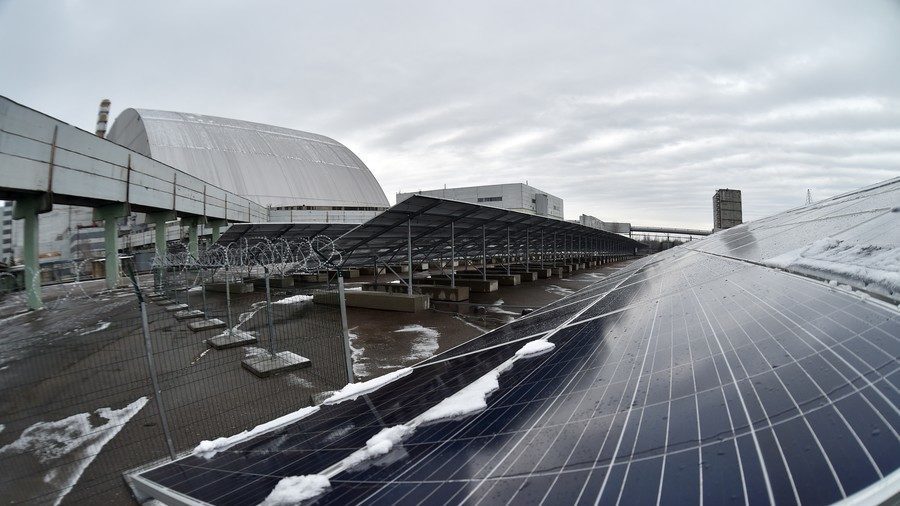
© GENYA SAVILOV / AFPA photo shows photovoltaic panels on the new one-megawatt power plant next to the New Safe Confinement over the fourth block of the Chernobyl nuclear plant on December 12, 2017.
Some 100 meters from the giant metal sarcophagus that contains the infamous Reactor Four at the Chernobyl nuclear plant, a new solar project has been built, providing hope of salvaging something positive from the disaster zone.

The 3,800 photovoltaic panels installed in a 16,000 square-meter (3.95-acre) area are expected to produce a total of one megawatt of energy for the local grid - enough power for roughly 2,000 homes reports Science Alert. The Shelter Object, the aforementioned sarcophagus installed last year to replace the rapidly-eroding original concrete shield, has reduced radiation levels to a tenth of their previous amount, affording developers the opportunity to repurpose the nuclear wasteland.

"This territory obviously cannot be used for agriculture, but it is quite suitable for innovative and scientific projects," Ostap Semerak, Ukrainian Minister of the Environment, told AFP in 2016. Ukrainian authorities have opened up roughly 25 square kilometers for solar project developments with 60 proposals currently under consideration. Another 4.2-megawatt solar power plant was recently completed within the irradiated zone in neighboring Belarus.

Comment: See also: Radioactive exclusion zone plagued by thrill-seekers & looters in Chernobyl


Cell Phone

Sex totalitarianism: Dutch blockchain company creates app 'for giving consent'

Fabrice Lerouge
© Getty ImagesFabrice Lerouge
Dutch blockchain firm LegalThings announced the launch of an app enabling people to request formal consent before going to bed with someone. Does your date really want to get it on? Find out whether you click with a single click.

"Sex should be fun and safe, but nowadays a lot of things can go wrong," the company says on its website.

Comment: Completely insane.

In itself, it makes perfect sense: every time the ideologues create new 'crimes', new 'solutions' fix the problem (which they created)... until those solutions give rise to new problems which need further solutions. And on and on it goes in our descent into hell.


TV

Life imitates art: Pizza Hut's 'Black Mirror announcement,' pole dancing robots & other strange takeaways from CES 2018

e-Palette
© ReutersThe e-Palette fully self-driving electric concept vehicle at CES, Las Vegas
Pizza Hut's announcement it will use autonomous vehicles to deliver pizza is the latest example of life imitating 'Black Mirror,' and one of many bizarre products unveiled at the Consumer Electronics Show in Las Vegas.

Toyota unveiled the new concept, named e-Palette, at the Consumer Electronics Show in Las Vegas on Monday. The vehicle will act as a mobile store, a ride-sharing car or a delivery service. Pizza Hut, Uber and Amazon are among the companies to team up with automaker.

Rocket

Falling rocket booster explodes near a town in China

Fortunately, no one appears to be hurt
Long March 3B Chinese rocket
© UnknownThe Long March 3B
Following a launch on Friday local time, a Chinese rocket booster fell near a small town in southwest China, where it exploded and caught fire, GBTimes reports. It was one of four strap-on boosters used on China's Long March 3B rocket, which had lofted two satellites into orbit before the crash. People living in the town Xiangdu, located in China's Guangxi region, caught video of the booster as it fell perilously close to buildings and then erupted in flames.

The Long March 3B takes off from China's Xichang Satellite Launch Center, located in the country's Sichuan province. Unlike most major launchpads in the US, the center is located many hundreds of miles from China's coastline, so rockets launched from the site have to fly over land to get to orbit. That means when the rocket sheds parts during a flight, such as the strap-on boosters that give the vehicle extra thrust, these parts will fall in a designated drop zone over land. And many towns might be located in that zone.

Comet 2

Dynamic space: Rotation of Comet 41P makes inexplicably slows down

Comet 41P
© Chris Schur/Schurs AstrophotographyComet 41P/Tuttle-Giacobini-Kresák glides beneath the galaxy NGC 3198 on March 14, 2017, two weeks before the object's closest approach to Earth.
National Harbor, Md. - A small comet broke a rotation-speed record in a big way: New work reveals that an icy rock known as 41P dramatically slowed its spin at an unprecedented rate in 2017, spinning down at about 10 times the pace of the next-ranked comet.

This comet, whose full name is 41P/Tuttle-Giacobini-Kresák, experienced "the largest but also the fastest change that has ever been seen in a comet rotation," said Dennis Bodewits, an associate research scientist at the University of Maryland (UMD) in College Park.

Bodewits presented his team's findings Wednesday (Jan. 10) during a press conference held here at the 231st meeting of the American Astronomical Society.

Comment: What could have acted on it? It need not have been something it came close to. And they used to say space was 'stable'...


Health

Orangutans know herbal medicine

orangutan
© Borneo Nature FoundationOrangutans were filmed creating their own ointment from leaves to treat aching limbs.
Orangutans may have secret medical knowledge that most humans don't know about, after great apes were filmed turning plants into ointment to soothe their aches and pains.

A study found the animals chewing plants into lather then using this paste on their limbs.

The plants are also used by the orangutan's indigenous human neighbours in the forest.

The bizarre discovery, spotted during more than 20,000 hours of filming by the Borneo Nature Foundation, has researchers wondering if apes may know of medicinal plants that could be used by humans.

In the clips, apes were spotted using their own herbal medicines in the Sabangau Forest in Central Kalimantan, Indonesian Borneo.

Comment:


Info

Scientists create creepy tin foil robot baby to study risks of "bio junk" on dirty floors (VIDEO)

Tinfoil baby
© Purdue University
A baby-shaped tin foil monster slowly drags itself across a filthy carpet. No, not a scene from a horror film - it's an experiment designed by scientists to gauge how much dirt infants collect as they crawl across the floor.

Researchers at Purdue University in Indiana created the miniature robot to study how much dirt, pollen, bacteria, and other "bio junk" is collected by crawling infants.

Black Cat 2

High-tech Dr. Dolittle: Scientists want to use AI to translate animal-speak into human language

happy dog
© David Baileys / Getty Images/iStockphotoAI technology could improve animals' wellbeing and even save their lives.
What if your pet dog or cat could talk instead of barking or meowing? You'd know just how much Rover loves you - and maybe how sorry Fluffy is about that mess on the carpet.

We all know that's not about to happen. But recent advances in artificial intelligence and machine learning suggest the longstanding dream of being able to converse with animals - in a limited fashion - could become a reality.

With the help of AI, scientists are learning how to translate animals' vocalizations and facial expressions into something we can understand. Recent advances include an AI system that listens in on marmoset monkeys to parse the dozen calls they use to communicate with each other and one that reads sheep's faces to determine whether an animal is in pain.

Taking note of the research, an Amazon-sponsored report on future trends released last summer predicted that in 10 years, we'll have a translator for pets.

Comment: Some low-tech interpretations of dog behavior: