Science & TechnologyS


Pi

Practical applications for math: Students create mathematical formula for the perfect roast potato

mathematically perfect potatoes
© Olexiy Bayev/ShutterstockMathematically perfect potatoes (not pictured)
Students have created a mathematical formula that they believe can be used to cook the perfect roast potato.

Pupils from the Edge Hotel School at the University of Essex collaborated with the Samuel Whitbread School in Bedfordshire to develop what they've named the "Edge Hotel School Method".

While calculating the exact measurements needed to whip up a tasty spud may be more time-consuming than simply popping some potatoes in the oven, apparently it's all worth it for the end result.

Comment: Next time your kids tell you they don't need to study math, cook them up a batch of mathematically perfect potatoes! Argument settled!


2 + 2 = 4

China Has Tested CRISPR Procedures on at Least 80 People

genetic material
© CCO
China has tested gene editing on dozens of people according to a new report that shows Beijing is outpacing the US in applying the controversial technique to live humans.

At least 86 people in China have undergone a gene editing procedure, a Wall Street Journal examination of 11 Chinese clinical studies found. China's first experiment took place in 2015, WSJ notes, when 36 patients with kidney, lung, liver and throat cancers had cells removed that allowed researchers to selectively edit the DNA of those cells and plant them back into people's bodies in an effort to combat their cancer.

Laptop

$1.2 billion worth of cryptocurrencies stolen by hackers over last decade

bitcoin
© Sputnik/ Vladimir Astapkovich
In the last 10 years, hackers have stolen $1.2 billion worth of the cryptocurrencies bitcoin and ether, according to Lex Sokolin, global director of fintech strategy at Autonomous Research LLP.

"It looks like crypto-hacking is a $200 million annual revenue industry," Sokolin said, adding that cybercriminals have stolen more than 14 percent of the bitcoin and ether supply over the last decade, Bloomberg reported.

Blue Planet

'Undersea Mordor' found off Australia

Underwater volcanos
© P. Reynolds, S. Holford, N. Schofield, A. RossResearchers discovered 26 underwater volcanoes that date to 35M years ago near Australia.
Today in news best suited for sneaky little Hobbitses and Shire-folk, scientists unveiled a map of a faraway volcanic realm that has a distinct look of Mordor about it. Unfortunately for any ring bearers, the molten landscape has probably been hidden underwater for millions of years.

The "Tolkienesque" region of submarine volcanoes buried beneath the sea south of Australia was discovered by a team of researchers from the University of Adelaide in Australia, the University of Aberdeen in Scotland, and the Commonwealth Scientific and Industrial Research Organization (CSIRO) in Australia.

The team employed 3D seismic reflection, a geo-mapping technique that uses seismic waves to measure subsurface structures. With this technology, the researchers identified 26 separate volcanoes buried roughly 820 feet (250 meters) beneath seabed sediment. Some of the ancient volcanoes reach up to 2,000 feet (625 m) in height and are surrounded by several lava features never before studied underwater, the study said.

Megaphone

Linux creator blasts Intel over 'garbage' fix for critical CPU bug

intel
© Ralf Hirschberger / Global Look Press
Patches released by Intel Corp. to fix highly malicious Spectre and Meltdown vulnerabilities affecting its CPUs turned out to be faulty, the company admitted, urging customers to stop installing them until further notice.

Earlier this month, security researchers at Google Project Zero disclosed that data processed by the majority of modern CPUs, be they desktop computers or smartphones, could be vulnerable to critical exploits they called 'Spectre' and 'Meltdown.' Tech companies reportedly had months to prepare, and since the public announcement of the vulnerabilities, Intel released at least three patches - before discovering that their fix led some PCs to reboot unexpectedly.

On Monday, Intel announced that it "identified" the"root cause" of the problem and will soon send out another patch to fix the faulty fix. The technology giant also provided a list of Intel-based platforms that are impacted by the issue.

"We have now identified the root cause for Broadwell and Haswell platforms, and made good progress in developing a solution to address it," Intel Executive Vice President Navin Shenoy said in a blog post, adding that the company already provided the patch to its partners to check if the solution was found. "We will make a final release available once that testing has been completed."

Alarm Clock

Facebook introduces new unit of time called the 'flick'

clock face
© Loren Zemlicka
Seconds, minutes and hours won't become obsolete, but the social network giant has a new kind of clock for techies.

If Facebook gets its way, maybe the next time you want your friend to hold the door for a second, you'll say, "Hang on for 705,600,000 flicks."

Well, OK, you probably won't. But you could, because Facebook introduced a new unit of time on Monday called the flick. The company thinks it'll be useful for programmers if not for talking to your pal while you run back for your keys.

Ark

Scientific breakthrough in tractor beam technology could levitate humans one day

levitating
© Angga Sidjabat / EyeEm / Getty Images
Levitating humans could be in our future, thanks to a scientific breakthrough in acoustic tractor beam technology, which can now lift larger objects than ever before.

Engineers from the University of Bristol have demonstrated that it's possible to stably levitate objects using the world's most powerful acoustic tractor beams. Their findings were published in the Physical Review Letters on Monday.

Acoustic tractor beams use soundwaves to hold particles in the air. It was previously believed they could only be used to levitate very small objects which were about the same size as a wavelength of sound, but the research demonstrates the potential for far larger objects to be levitated.

"Acoustic researchers had been frustrated by the size limit for years, so its satisfying to find a way to overcome it,"said the study's lead author, Dr Asier Marzo of Bristol's Department of Mechanical Engineering. "I think it opens the door to many new applications."

Info

Super blue blood moon promises a triple whammy of lunar treats on January 31

Blood moon
© Rebecca Naden / Reuters
The Moon will put on quite the show at the end of the month, as a very rare, "super blue blood moon" will appear in the skies on January 31.

A super blue blood moon happens when three different lunar events happen at once - a supermoon, a blue moon and a blood moon combining to offer sky gazers a triple whammy of lunar treats.

A supermoon happens when the moon's perigee - when its orbit is closest to earth - occurs at the same time as a full moon. It makes the Moon seem much larger than normal, by about 14 percent, NASA explains.

A blue moon appears when there are two full moons in one month. Despite the saying, "once in a blue moon," these moons turn out about once every 2.7 years.

Info

Smart critters - Crows make hooked tools

New Caledonian crow
© James St ClairA New Caledonian crow with a freshly fashioned hook.
The manufacture and use of tools has long been touted as a line of demarcation between humans and non-human animals: our technological prowess is what makes us human, it was thought. But research over the last few decades has blurred that line, as tool manufacture and use, and even the use of tools to make other tools (known as meta-tool use), has been reported in an increasing number of species.

Meta-tool use has been seen in numerous primate species, but among nature's most prolific tool-makers and users are the corvids: members of the Corvidae family, such as ravens, magpies and, importantly, crows. Crows in Japan and California, for example, have been observed to use cars lined up at traffic lights to crack open difficult nuts.

In 1996 Gavin Hunt at the University of Auckland reported in Nature the remarkable discovery that New Caledonian crows (Corvus moneduloides) manufactured and used tools while trying to catch prey. The tools had features previously seen only in early human cultures after the Lower Palaeolithic period, which ended 200,000 years ago. They were remarkably standardised, came in distinct types with distinct shapes, and, importantly, used hooks.


Meteor

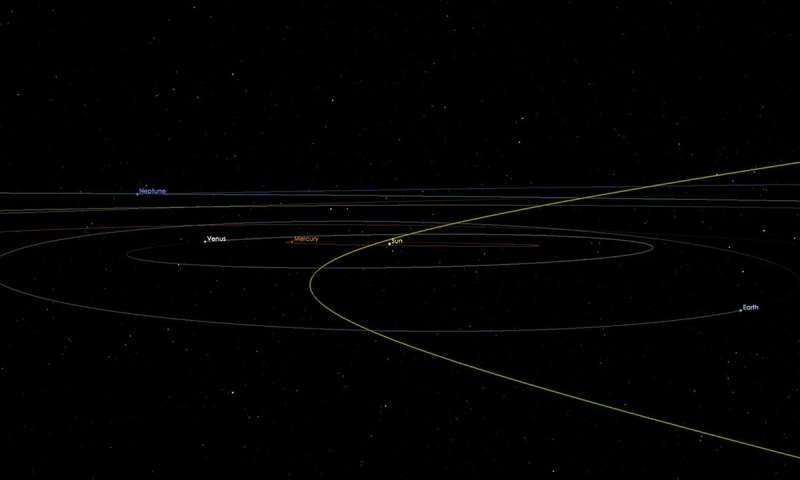
Potentially Hazardous Asteroid 2002 AJ129 to make fly-by February 4th

asteroid 2002 AJ129
© NASA/JPL-CaltechAsteroid 2002 AJ129 will make its closest approach to Earth on Feb. 4, 2018, at 1:30 p.m. PST (4:30 p.m. EST). At the time of closest approach, the asteroid will be no closer than 10 times the distance between Earth and the moon.
Asteroid 2002 AJ129 will make a close approach to Earth on Feb. 4, 2018 at 1:30 p.m. PST (4:30 p.m. EST / 21:30 UTC). At the time of closest approach, the asteroid will be no closer than 10 times the distance between Earth and the Moon (about 2.6 million miles, or 4.2 million kilometers).

2002 AJ129 is an intermediate-sized near-Earth asteroid, somewhere between 0.3 miles (0.5 kilometers) and 0.75 miles (1.2 kilometers) across. It was discovered on Jan. 15, 2002, by the former NASA-sponsored Near Earth Asteroid Tracking project at the Maui Space Surveillance Site on Haleakala, Hawaii. The asteroid's velocity at the time of closest approach, 76,000 mph (34 kilometers per second), is higher than the majority of near-Earth objects during an Earth flyby. The high flyby velocity is a result of the asteroid's orbit, which approaches very close to the Sun-11 million miles (18 million kilometers). Although asteroid 2002 AJ129 is categorized as a Potentially Hazardous Asteroid (PHA), it does not pose an actual threat of colliding with our planet for the foreseeable future.

Comment: The skies have been noticeably active recently with an alarming number of space rocks: