A team of researchers led by the University of California, Berkeley's Helen Wills Neuroscience Institute has tracked the progress of a thought through the brain, showing how a region called the prefrontal cortex coordinates activity to help us act in response to a perception. The team's
results appear in the journal
Nature Human Behavior.
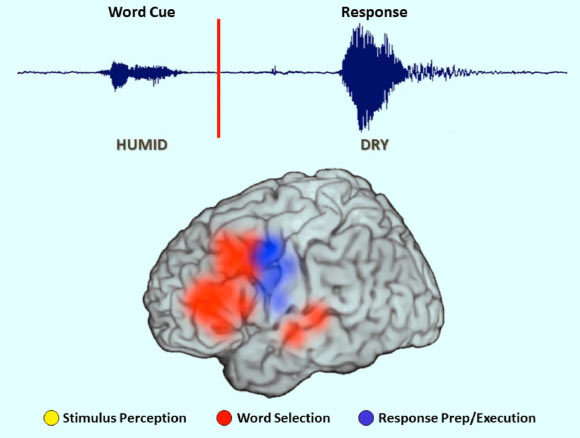
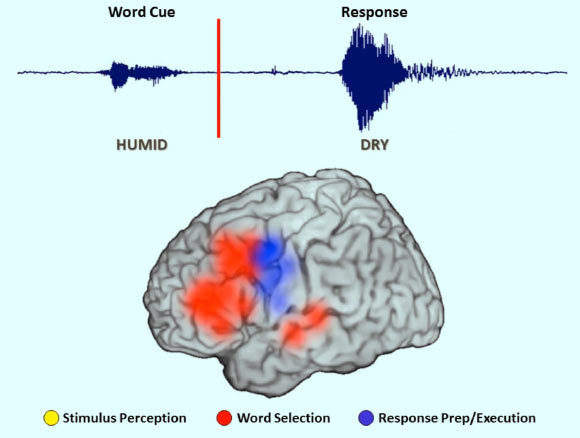
© University of California, Berkeley.Haller et al tracked the brain as it generated an antonym: the brain required 2-3 seconds to detect (yellow), interpret and search for an answer (red) and respond (blue), with sustained prefrontal lobe activity (red) to coordinate all areas of the brain involved.
Recording the electrical activity of neurons directly from the surface of the brain, lead author Dr. Avgusta Shestyuk and colleagues found that for a simple task, such as repeating a word presented visually or aurally, the visual and auditory cortexes reacted first to perceive the word.
The prefrontal cortex then kicked in to interpret the meaning, followed by activation of the motor cortex in preparation for a response.
During the half-second between stimulus and response, the prefrontal cortex remained active to coordinate all the other brain areas.
For a particularly hard task, like determining the antonym of a word, the brain required several seconds to respond, during which the prefrontal cortex recruited other areas of the brain, including presumably memory networks not actually visible.













Comment: See also: Better than Star Wars: Chemists invent technology for making animated 3-D table-top objects by structuring light