Science & TechnologyS


Magnify

Photographing a single atom and other entries for UK science competition (PHOTOS)

This Photo of a Single Trapped Atom Is Absolutely Breathtaking
At the very centre of the image above is something incredible - a single, positively-charged strontium atom, suspended in motion by electric fields.

Not only is this an incredibly rare sight, it's also difficult to wrap your head around the fact that this tiny point of blue light is a building block of matter.

Tiny specks of energy just like this one are at the centre of so much of the stuff around us, and the thought that we can see this one makes our hearts hurt.

In case you're struggling to get a close-enough view to see what we're talking about, the team over at Gizmodo has done the zoom work for you.

Comment: See Also:


Fire

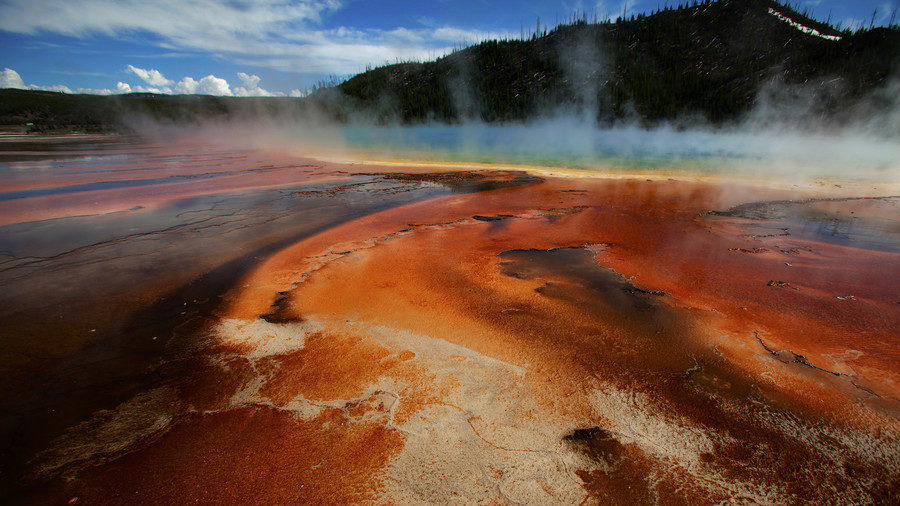
Yellowstone super volcano under strain from pressure in magma chamber

Yellowstone National Park
© Jim Urquhart / ReutersYellowstone National Park
A process known as deformation, where subsurface rocks subtly change shapes, is occurring beneath the surface of Yellowstone which alerts experts.

Researchers state deformation occurs when there is a change in the amount of pressure in the magma chamber and experts are keeping an eye on the development.

Seismologists from UNAVCO, a nonprofit university-governed consortium, are using "Global Positioning System, borehole tiltmeters, and borehole strainmeters" to measure minute changes in deformation at Yellowstone.

Comment: All signs point to great changes occurring on our planet, to think that Yellowstone's behaviour is shifting along with it wouldn't be too much of a stretch of the imagination, and the data shows that it is: Also check out SOTT's monthly documentary: SOTT Earth Changes Summary - January 2018: Extreme Weather, Planetary Upheaval, Meteor Fireballs


Wolf

Scientists artificially inseminate Mexican wolf at US zoo to help species back from the brink of extinction

Mexican wolf Broookfield zoo
© Antonio Perez / Chicago TribuneA Mexican wolf at Brookfield Zoo in Brookfield on Feb. 7, 2018. Brookfield Zoo is working to further advance the science of artificial reproduction to help save an endangered species.
The scene mirrors one popular in most medical television dramas: A sedated patient lies on a table as practitioners, their hands gloved, bustle about handling tubes and tongs, vials and syringes. Computer monitors, flickering with real-time vital information, hum in the background of beeping machines, walkie-talkie static and urgent voices.

And though the procedure being done this day, artificial insemination, is fairly typical, the patient, Zana, a Mexican wolf living at the Brookfield Zoo, is anything but.

For the first time in the state, scientists from the Chicago Zoological Society and a team assembled by the Reproductive and Behavioral Sciences Department at the St. Louis Zoo used artificial insemination in an effort to improve the genetic diversity of the Mexican wolf population, which has been endangered since 1976. At that time, only seven of these wolves were left in the wild, experts said.

Decades later, and more than 1,000 miles away from the species' original habitat in the Southwestern U.S. and Mexico, scientists at Brookfield are deploying new reproductive tools and technologies to advance the recovery of the Mexican wolf. Artificial insemination is among the latest of these. Scientists say it holds promise for the Mexican wolf - which now has a population of over 280 in 55 zoos and other institutions and an estimated 150 living in the wild - as well as other species at the fringes of extinction.

Question

Enriched uranium found floating above Alaska

WB-57
© NASAA NASA WB-57 plane, like the one that located the mystery particle.
On 3 August 2016, 7km above Alaska's Aleutian Islands, a research plane captured something mysterious: An atmospheric aerosol particle enriched with the kind of uranium used in nuclear fuel and bombs.

It's the first time scientists have detected such a particle just floating along in the atmosphere in 20 years of plane-based observations.

Uranium is the heaviest element to occur naturally on Earth's surface in an appreciable amount. Normally it occurs as the slightly radioactive isotope uranium-238, but some amount of uranium-235, the kind humans make bombs and fuel out of, occurs in nature. Uranium-238 is already rare to find floating above the Earth in the atmosphere. But scientists have never before spotted enriched uranium, a sample uranium containing uranium-235, in millions of research plane-captured atmospheric particles.

"One of the main motivations of this paper is to see if somebody who knows more about uranium than any of us would understand the source of the particle," scientist Dan Murphy from NOAA told me. After all, "aerosol particles containing uranium enriched in uranium-235 are definitely not from a natural source," he writes in the paper, published recently in the Journal of Environmental Radioactivity.

Murphy has led flights around the world sampling the atmosphere for aerosols. These tiny particles can come from polution, dust, fires and other sources, and can influence things such as cloud formation and the weather. The researchers spotted the mystery particle on a flight over Alaska using their "Particle Analysis by Laser Mass Spectrometry" instrument. They considered that perhaps the signature came from something weird, but evidence seems to point directly at enriched uranium.

Sherlock

Scientists embark on a Valentine's Day mission to explore a 120,000 year old marine ecosystem

Ice shelf
© ReutersESA satellite image of an iceberg which broke away.
A team of scientists is due to embark on a Valentine's Day mission to explore a mysterious Antarctic marine ecosystem hidden for the last 120,000 years.

The area only became accessible when a one trillion-ton iceberg, four times the size of London, broke from the Larsen C ice shelf last July. The international team, led by the British Antarctic Survey (BAS), will set out for their base on the Falkland Islands off the coast of Argentina on February 14.

As part of their mission, the team will spend three weeks aboard the RRS James Clark Ross research vessel, navigating their way through icy waters, to reach the remote location. Once there, scientists will use cameras and a specially designed sledge to collect animals on the seafloor as well as plankton, microbes, sediments and water samples.

Fire

Massive lava dome lurks underneath Japan's Ōsumi Islands

japanese volcano
© Hydrographic and Oceanographic Department/Japan Coast Guard)
An ancient underwater volcano responsible for one of the largest known super-eruptions in history looks to be busy making silent, fiery preparations for its inevitable return.

The Kikai Caldera, located to the south of Japan's main islands, devastated a large swathe of the Japanese archipelago when it spewed upwards of 500 cubic kilometres (120 cubic miles) of magma during the Akahoya eruption some 7,000 years ago - and scientists have just confirmed evidence of new volcanic activity under the crater.

Researchers at Kobe University have detected a giant lava dome that exists below the Kikai Caldera, holding a volume of more than 32 cubic kilometres (almost 8 cubic miles) of trapped magma - a buildup that could reveal clues as to when Kikai's next super-eruption may be unleashed.

Beaker

Researchers discover mineral in Earth's mantle could make the internet 1,000-times faster

Perovskite mineral
© Nature CommunicationsPerovskite was first discovered in the Ural Mountains of Russia. Researchers say it could now hold the key to ultra-fast communications.
A "miracle material" found deep within the Earth's mantle could hold the key to ultra-high-speed communications and computing, researchers say.

Scientists from the University of Utah discovered that a type of perovskite - a mineral first discovered in the Ural Mountains of Russia - could be the "vital component" for next-generation communications systems.

The research, which appeared in a paper published in the journal Nature Communications on November 6, describes how perovskite could be layered onto a silicon wafer in order to create a system that uses the terahertz spectrum. This bandwidth uses light instead of electricity to transfer data and could boost computing and internet speeds by up to 1,000 times.

Info

Cosmopsychism: Is the universe a conscious mind?

 Universe
In the past 40 or so years, a strange fact about our Universe gradually made itself known to scientists: the laws of physics, and the initial conditions of our Universe, are fine-tuned for the possibility of life. It turns out that, for life to be possible, the numbers in basic physics - for example, the strength of gravity, or the mass of the electron - must have values falling in a certain range. And that range is an incredibly narrow slice of all the possible values those numbers can have. It is therefore incredibly unlikely that a universe like ours would have the kind of numbers compatible with the existence of life. But, against all the odds, our Universe does.

Here are a few of examples of this fine-tuning for life:
  • The strong nuclear force (the force that binds together the elements in the nucleus of an atom) has a value of 0.007. If that value had been 0.006 or less, the Universe would have contained nothing but hydrogen. If it had been 0.008 or higher, the hydrogen would have fused to make heavier elements. In either case, any kind of chemical complexity would have been physically impossible. And without chemical complexity there can be no life.
  • The physical possibility of chemical complexity is also dependent on the masses of the basic components of matter: electrons and quarks. If the mass of a down quark had been greater by a factor of 3, the Universe would have contained only hydrogen. If the mass of an electron had been greater by a factor of 2.5, the Universe would have contained only neutrons: no atoms at all, and certainly no chemical reactions.
  • Gravity seems a momentous force but it is actually much weaker than the other forces that affect atoms, by about 1036. If gravity had been only slightly stronger, stars would have formed from smaller amounts of material, and consequently would have been smaller, with much shorter lives. A typical sun would have lasted around 10,000 years rather than 10 billion years, not allowing enough time for the evolutionary processes that produce complex life. Conversely, if gravity had been only slightly weaker, stars would have been much colder and hence would not have exploded into supernovae. This also would have rendered life impossible, as supernovae are the main source of many of the heavy elements that form the ingredients of life.
Some take the fine-tuning to be simply a basic fact about our Universe: fortunate perhaps, but not something requiring explanation. But like many scientists and philosophers, I find this implausible. In The Life of the Cosmos (1999), the physicist Lee Smolin has estimated that, taking into account all of the fine-tuning examples considered, the chance of life existing in the Universe is 1 in 10229, from which he concludes:
In my opinion, a probability this tiny is not something we can let go unexplained. Luck will certainly not do here; we need some rational explanation of how something this unlikely turned out to be the case.
The two standard explanations of the fine-tuning are theism and the multiverse hypothesis. Theists postulate an all-powerful and perfectly good supernatural creator of the Universe, and then explain the fine-tuning in terms of the good intentions of this creator. Life is something of great objective value; God in Her goodness wanted to bring about this great value, and hence created laws with constants compatible with its physical possibility. The multiverse hypothesis postulates an enormous, perhaps infinite, number of physical universes other than our own, in which many different values of the constants are realised. Given a sufficient number of universes realising a sufficient range of the constants, it is not so improbable that there will be at least one universe with fine-tuned laws.


Archaeology

What ancient footprints may tell of the life of children in prehistoric times

prehistoric footprints
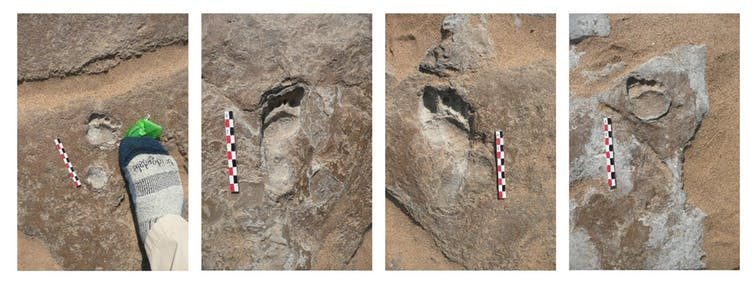
© Matthew BennettNamibian footprints.
Western society has a rather specific view of what a good childhood should be like; protecting, sheltering and legislating to ensure compliance with it. However, perceptions of childhood vary greatly with geography, culture and time. What was it like to be a child in prehistoric times, for example - in the absence of toys, tablets and television?

In our new paper, published in Scientific Reports, we outline the discovery of children's footprints in Ethiopia which show how children spent their time 700,000 years ago.

We first came across the question of what footprints can tell us about past childhood experiences a few years back while studying some astonishingly beautiful children's footprints in Namibia, just south of Walvis Bay. In archaeological terms the tracks were young, dating only from around 1,500 years ago. They were made by a small group of children walking across a drying mud surface after a flock of sheep or goats. Some of these tracks were made by children as young as three-years-old in the company of slightly older children and perhaps young adolescents.

Comment: Clearly the footprints are subject to the archaeologists interpretation but it does make one wonder:


Snowflake Cold

Study shows the sun will be unusually cool by 2050

cooling sun
© Xinhua/Then Chih WeySun makes a silhouette of the cable car as it sets in Singapore on Jan. 31, 2018.
The sun might be unusually cool by 2050, according to a new study.

Based on the cooling spiral of recent solar cycles, scientists from University of California, San Diego believe the next "grand-minimum" is just decades away, during which the sun will be 7 percent cooler.

A grand-minimum, according to the study, is a period of very low solar activity, which will lead to lower temperature on earth.

During the grand-minimum in the mid-17th century, named Maunder Minimum, the temperature dropped low enough to freeze the Thames River.

However, the cooling is not uniform around the globe. Despite the chilling weather in Europe during the Maunder Minimum, other areas such as Alaska and southern Greenland warmed.

Comment: Those scientists are still drinking the global warming kool-aid. There's considerable evidence for the link between the sun's cycle and ice ages. See also: