A pair of mysterious meteorites discovered in Antarctica is baffling scientists who are struggling to determine the origin of the space rocks.
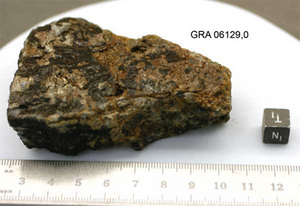
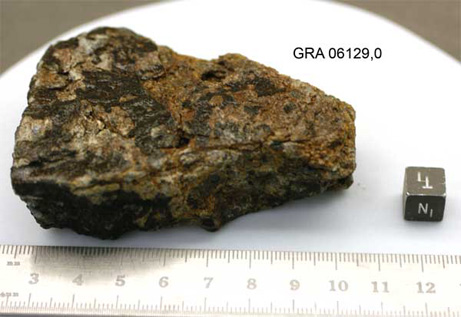
The meteorites, dubbed GRA 06128 and GRA 06129, were found in the Graves Nunataks region of Antarctica in 2006 (see
an interactive map of Antarctica).
|
| ©Nasa
|
| A meteorite dubbed GRA 06129 is one of two space objects that has scientists stymied. Experts initially thought the meteorites shared their origins with the moon or perhaps Venus, but those theories have now been discounted.
|
Two rocks found together in Antarctica are chunks of a dwarf planet that was smashed apart early in the solar system's history, detailed studies suggest. Other remnants of the proto-world may still be floating around in the asteroid belt, and might be identifiable by the spectrum of the sunlight they reflect.
EPFLThu, 13 Mar 2008 16:34 UTC
Researchers from EPFL and Caltech have made an important neurobiological discovery of how humans learn to predict risk. The research, appearing in the March 12 issue of the Journal of Neuroscience, will shed light on why certain kinds of risk, notably financial risk, are often underestimated, and whether abnormal behavior such as addiction (e.g. to gambling or drugs) could be caused by an erroneous evaluation of risk.
Planning entails making predictions. In an uncertain environment, however, our predictions often don't pan out. And erroneous prediction of risk often leads to unusual behaviour: euphoria or excessive gambling when risk is underestimated, and panic attacks or depression when we predict that things are riskier than they really are. To understand these anomalous reactions to uncertain situations, we need to look to the neurobiological mechanisms that underlie how we learn to predict risk. Surprisingly little research has been done in this topic, and we do not yet know precisely how the brain is involved in our estimation of risk.
Scientists have long known that the nervous system receptor known as TRPV1 can affect sensations of pain in the body. Now a group of Brown University scientists has found that these receptors - a darling of drug developers - also may play a role in learning and memory in the brain.
In surprising new research, published in the journal Neuron, Julie Kauer and her team show that activation of TPRV1 receptors can trigger long-term depression, a phenomenon that creates lasting changes in the connections between neurons. These changes in the brain - and the related process of neural reorganization known as long-term potentiation - are believed to be the cellular basis for memory making.
Clara Moskowitz
Space.comWed, 12 Mar 2008 12:35 UTC
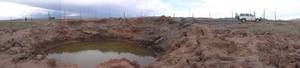
In September 2007 a fireball flew in from space and hurtled though Earth's atmosphere, smashing into the ground in Peru while awestruck witnesses watched. It was the first time people have witnessed space debris forming an impact crater live.
|
| ©Peter Schultz
|
The organic soup that spawned life on Earth may have gotten generous helpings from outer space, according to a new study. Scientists at the Carnegie Institution have discovered concentrations of amino acids in two meteorites that are more than ten times higher than levels previously measured in other similar meteorites. This result suggests that the early solar system was far richer in the organic building blocks of life than scientists had thought, and that fallout from space may have spiked Earth's primordial broth.
The study, by Marilyn Fogel of Carnegie's Geophysical Laboratory and Conel Alexander of the Department of Terrestrial Magnetism with Zita Martins of Imperial College London and two colleagues, will be published in Meteoritics and Planetary Science.
ESAThu, 13 Mar 2008 15:43 UTC
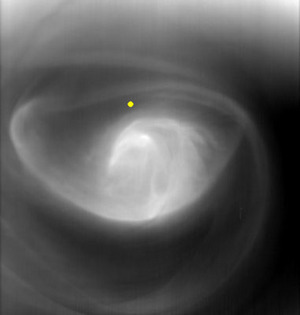
Venus Express has constantly been observing the south pole of Venus and has found it to be surprisingly fickle. An enormous structure with a central part that looks like the eye of a hurricane, morphs and changes shape within a matter of days, leaving scientists puzzled.
The eye of the hurricane is at the centre of a 2000 km-wide vortex. It was discovered in 1974 by the Mariner 10 spacecraft. There is a similar structure on the planet's north pole, which was observed by the Pioneer Venus mission in 1979.
|
| ©ESA/VIRTIS/INAF-IASF/Obs. de Paris-LESIA/Univ. of Oxford
|
This image, of the 'eye of the hurricane' on Venus was taken by the Visible and Infrared Thermal Imaging Spectrometer (VIRTIS) on board Venus Express.
This picture shows a region in the venusian atmosphere about 60 km from the surface, at a wavelength of about 5 micrometres. In this figure, the dipole assumes an eye-like shape and from here until the last image, it is possible to see how its shape evolves rapidly in a span of only 24 hours.
The yellow dot in the image indicates the location of the south pole.
|
A new study examining social behaviour suggests certain individuals are genetically programmed to cheat and often will do... providing they can get away with it.
The researchers looked at slime moulds - microscopic single-cell organisms or amoebae that are forced to cooperate with one another when food is in short supply. Studying slime moulds at the cellular level provides the scientists with a unique insight into the genes that may also influence human behaviour.
The international team, including biologists from The University of Manchester, found that some amoebae have the ability to use cheating tactics to give them a better chance of survival. The research - published in the journal Nature - not only demonstrates that cheating is a natural phenomenon governed by our genes but that it may be widespread among social creatures.
Roger Highfield
Telegraph Mon, 10 Mar 2008 08:21 UTC
Plans are being made for the first experiments to pave the way for a "doomsday ark" on the moon.
The ark would contain DNA, embryos and all the essentials of life and civilisation, to be activated should Earth be devastated by a giant asteroid, a climate flip or nuclear holocaust.
Comment: A dose of hubris and lack of reasoning produces such ideas unfortunately. Instead the money and energy could be used to fund research into NEOs and the collection of historical data on cometary/asteroid impacts on earth, in order to inform the public and prepare them accordingly. This project is a distraction from the
real issues at hand.
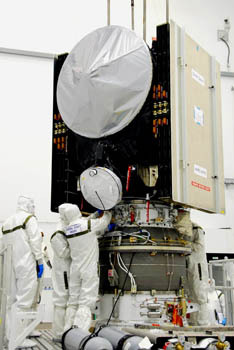
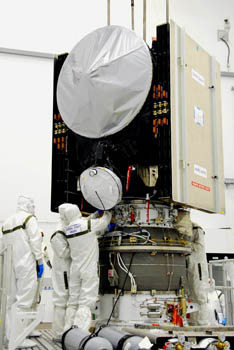
Sometime in August 2011, a boxy
space probe called Dawn will settle into orbit around one of the most underrated and overlooked objects in the solar system, a giant oblong asteroid named Vesta. After lingering for almost 10 months of study, Dawn will depart for Ceres, the biggest asteroid of all. Ceres is so large that it was recently promoted to the rank of dwarf planet, putting it
on a par with Pluto and highlighting its status as a key planetary missing link.
|
| ©NASA
|
| Dawn Probe
|






Comment: A dose of hubris and lack of reasoning produces such ideas unfortunately. Instead the money and energy could be used to fund research into NEOs and the collection of historical data on cometary/asteroid impacts on earth, in order to inform the public and prepare them accordingly. This project is a distraction from the real issues at hand.