
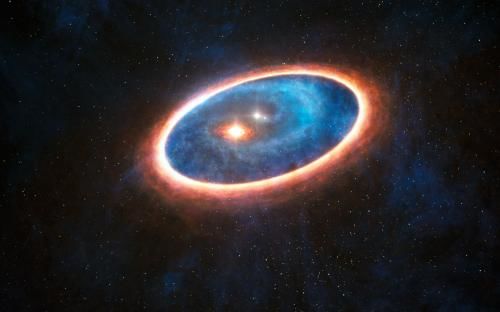
© Credit: ESO/L. CalçadaThis artist's impression shows the dust and gas around the double star system GG Tauri-A. Researchers using ALMA have detected gas in the region between two discs in this binary system. This may allow planets to form in the gravitationally perturbed environment of the binary. Half of Sun-like stars are born in binary systems, meaning that these findings will have major consequences for the hunt for exoplanets.
A research group led by Anne Dutrey from the Laboratory of Astrophysics of Bordeaux, France, and the National Centre for Scientific Research (CNRS) observed the distribution of dust and gas in a binary star system called GG Tau-A. It was recently discovered that one of GG Tau-A's components is itself a double star. This object is only a few million years old and lies approximately 460 light-years from Earth in the constellation Taurus.
Like a wheel in a wheel, GG Tau-A contains a large, outer disk encircling the entire system as well as an inner disk around the main central star. This second inner disk has a mass roughly equivalent to that of Jupiter. Its presence has been an intriguing mystery for astronomers since it is losing material to its central star at a rate that should have depleted it long ago.
While observing these structures with ALMA, the team made the exciting discovery of gas clumps in the region between the two disks. The new observations suggest that material is being transferred from the outer to the inner disk, creating a sustaining lifeline between the two.










Comment: see also:
New study supports binary star system hypothesis
Evidence that Earth like-worlds can form in two star solar systems
Astrophysicists find wide binary stars wreak havoc in planetary systems