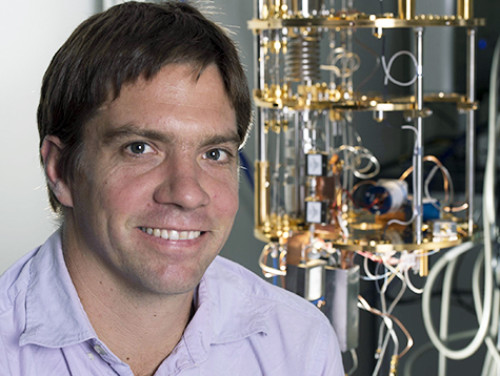
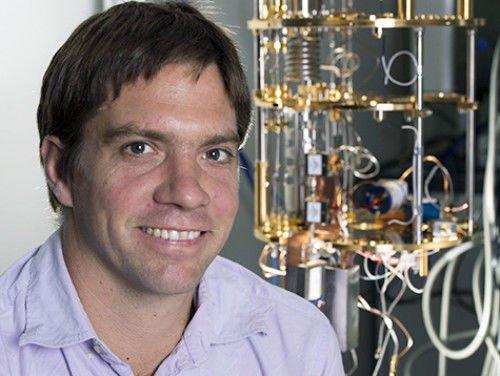
Kater Murch
We're so used to murder mysteries that we don't even notice how mystery authors play with time. Typically the murder occurs well before the midpoint of the book, but there is an information blackout at that point and the reader learns what happened then only on the last page.
If the last page were ripped out of the book, physicist Kater Murch, PhD, said, would the reader be better off guessing what happened by reading only up to the fatal incident or by reading the entire book?
The answer, so obvious in the case of the murder mystery, is less so in world of quantum mechanics, where indeterminacy is fundamental rather than contrived for our reading pleasure.
Even if you know everything quantum mechanics can tell you about a quantum particle, said Murch, an assistant professor of physics in Arts & Sciences at Washington University in St. Louis, you cannot predict with certainty the outcome of a simple experiment to measure its state. All quantum mechanics can offer are statistical probabilities for the possible results.
The orthodox view is that this indeterminacy is not a defect of the theory, but rather a fact of nature. The particle's state is not merely unknown, but truly undefined before it is measured. The act of measurement itself that forces the particle to collapse to a definite state.
In the Feb. 13 issue of
Physical Review Letters, Kater Murch describes a way to narrow the odds.
By combining information about a quantum system's evolution after a target time with information about its evolution up to that time, his lab was able to narrow the odds of correctly guessing the state of the two-state system from 50-50 to 90-10.It's as if what we did today, changed what we did yesterday. And as this analogy suggests, the experimental results have spooky implications for time and causality -- at least in microscopic world to which quantum mechanics applies.




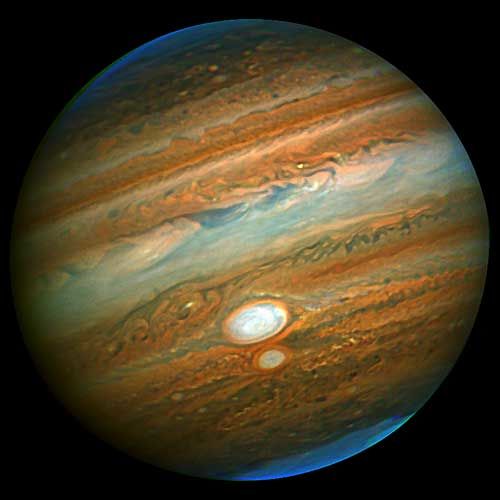










Comment: The Great Red Spot is as tall as the Earth and almost three times as wide. At its narrowest point it is still six times the diameter of the largest hurricane measured on Earth. Despite being 1300 times the volume of earth, Jupiter completes a rotation in about 10 hours, which magnifies the Coriolis Effect responsible for cyclones on planets with atmosphere. Smaller turbulence adds up to produce a giant storm. The Great Red Spot never comes to land so it has no friction or change in temperature due to land mass to weaken the storm. The pressure and temperature variations in Jupiter's atmosphere is huge - up to 10 times that of Earth with massive gas reservoirs that can support such a large storm for a very long time.