
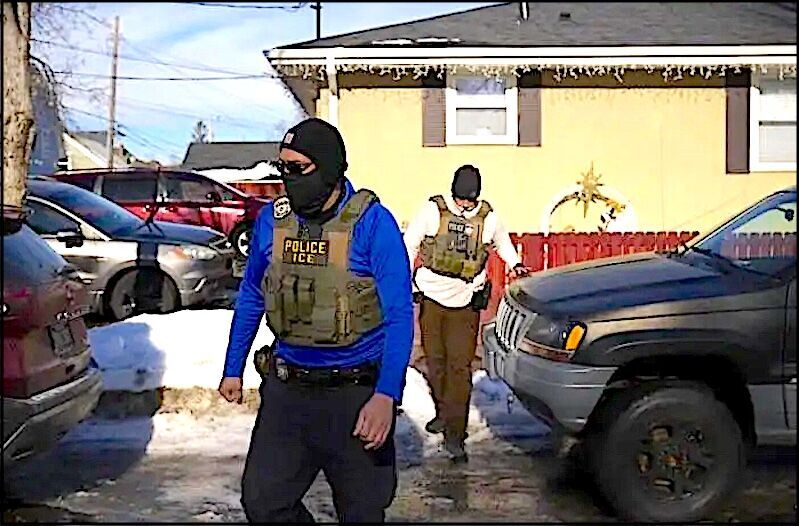
© UnknownICE on the scene
According to the report, Trump has had conversations with his top advisors and First Lady Melania Trump in which he's indicated that he's "become convinced that some of his administration's deportation policies have gone too far, and voters don't like the term 'mass deportation.'"
The desire for an immigration reset is being driven in part by Trump's White House chief of staff, Susie Wiles, who believes the president's immigration team has turned one of his marquee issues into more of a challenging issue ahead of the midterms, the people said. As a result, the administration is attempting to change not only how it talks about the issue — but also what actual enforcement looks like on the ground.
The report also explains that White House border czar Tom Homan has been behind the shift, steering the agency back to basics — prioritizing "bread-and-butter arrests" and focusing on criminal aliens already in local custody and ready for transfer.
Now, another report from the New York Times, reveals that ICE arrests are averaging more than 1,100 per day this year — nearly double last spring's pace of roughly 600 — and that "custodial" arrests are driving those numbers. It's also not surprising that Republican-led states with strong federal-local cooperation generate far more of these transfers, while sanctuary jurisdictions generate far fewer.
Some of the biggest totals are coming out of places like Florida and San Antonio, where there were no headline-grabbing raids.
Meanwhile, Los Angeles and Chicago — cities that were hit with high-profile enforcement operations — have actually seen arrest numbers fall steeply in recent months. Sanctuary cities, however, are largely flat.
The loudest operations weren't always the most productive, and the quietest ones were getting the job done.
The Miami field office — which covers Florida, Puerto Rico, and the U.S. Virgin Islands — logged nearly 10,000 arrests between mid-December and March 10, outpacing Dallas, Atlanta, and San Antonio. Florida has maintained high and steadily climbing arrest numbers all year without a marquee federal operation dominating the news cycle. The work just kept happening. San Antonio followed a similar pattern — consistent and effective.
Los Angeles and Chicago, both cities that saw aggressive, high-profile crackdowns last year, saw arrest numbers peak and then fall. Chicago's field office, which covers six states, hit its ceiling during Operation Midway Blitz between September and December and still sits below the national per capita average. Los Angeles and Denver both peaked last summer and have been trending downward since.High-visibility raids make headlines, but the data points to what the real problem is: sanctuary policies that limit coordination with local police, along with rhetoric from Democrat leaders in those states and municipalities.
"About half of ICE immigration arrests nationwide in 2025 were from what the agency calls 'custodial' arrests, in which ICE takes someone who is already in custody from another law enforcement agency," the report explained.That need for coordination also helps explain why operations on the ground can become more volatile when cooperation breaks down. The consequences of these sanctuary policies, and the rhetoric of Democratic leaders, have been deadly. Two anti-ICE protesters in Minneapolis were killed in January while engaging with immigration agents. Renee Good was shot and killed when she attempted to run over an agent with her car during an ICE operation. Alex Pretti assaulted agents while carrying a loaded gun.
"These arrests were much more common in states led by Republicans, where law enforcement is more likely to cooperate closely with federal immigration authorities." Arrests were "less common in places where 'sanctuary' policies limited local law enforcement from cooperating with ICE and handing over people who have been arrested in connection with other crimes, but may or may not have been convicted."
"We need state and local law enforcement cooperation, so we don't have to have such a presence on the streets," a Department of Homeland Security spokesperson said.
The Trump administration seems to have the answer it needs already to fix the perception problems related to immigration enforcement.



Brave AI context: "Washington, DC experienced significant fluctuations in crime and murder rates from 2020 to 2026, with violent crime peaking in 2023 and declining sharply afterward. The homicide rate reached a high of 274 incidents in 2023, the highest since 2008, before dropping to 126 in 2025—a 32% decrease from 2024—and continuing downward in early 2026, with a 65% year-to-date decline in homicides reported as of March 2026."
Brave AI context: "Violent crime overall followed a similar trend, rising from 2,371 incidents in 2020 to a peak of 3,152 in 2022 and 3,135 in 2023, then falling to 2,804 in 2025. By early 2026, violent crime was down 11% year-to-date, driven by large declines in robbery (-25%), motor vehicle theft (-55%), and property crime (-28% )."