
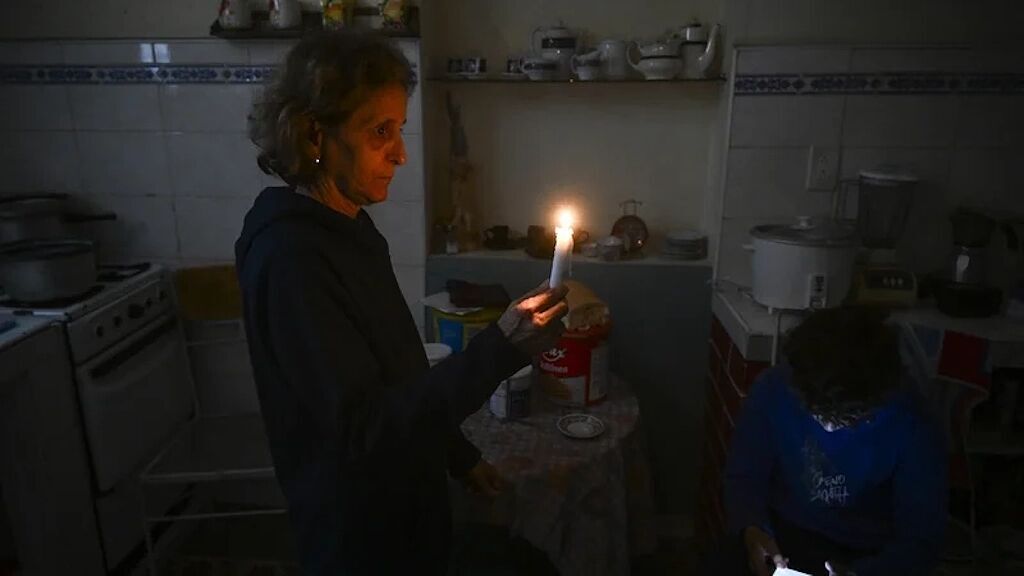
© Yamil Lage—AFP via Getty ImagesA woman holds a candle while a boy checks his cellphone during a blackout in Havana on January 28, 2026.
Cuba's national electric grid has collapsed, the country's grid operator said, leaving around 10m people without power amid a US-imposed oil blockade that has crippled the island's already ailing generation system.
The island's of 9.6 million inhabitants, under a US trade embargo since 1962, has for years been mired in a severe economic crisis marked by extended power cuts and shortages of fuel, medicine and food.
It has now also been cut off from critical oil supplies from Venezuela and from Mexico under the threat of US tariffs.
President Donald Trump's administration has imposed the oil blockade on the Cuban government as Washington presses for regime change, making life harder for people already enduring food shortages and frequent blackouts.
Cuba's communist authorities acknowledged that talks were underway with the United States amid the intense pressure from Mr Trump, who said this month that Cuba was next on his agenda after Iran, predicting that the communist-run island was "gonna fall pretty soon".
Over the weekend Cuba's president made a rare admission that people enduring food shortages and blackouts in his country were unhappy but he condemned violence after an attack on a Communist Party office.
"One can understand the discontent our people feel because of the prolonged blackouts," President Miguel Diaz-Canel wrote on X.
"What will never be comprehensible, justified or admitted is violence," he said after the ransacking of a party office in the town of Moron.
Earlier the Cuban government said that Cubans living abroad will now be allowed to invest and own businesses on the island, unveiling a key reform as the economy struggles under the intense US pressure.
"Cuba is open to having a fluid commercial relationship with US companies" and "also with Cubans residing in the United States and their descendants," Oscar Perez-Oliva, who is foreign trade minister and also deputy prime minister, told NBC News.
The broadcaster said Mr Perez-Oliva will announce the reform to the nation this evening.
Miami has a large community of Cubans who fled after the revolution that brought Fidel Castro to power in 1959 or in subsequent years as hardship dug in on the communist island. These Miami Cubans tend to be virulently anti-regime.








Comment: Marco Rubio is salivating over the prospect of crushing Cuba, even though his family wasn't harmed by the Castro regime. They were economic migrants who left Cuba long before the revolution and lost nothing. Regardless, it's always been his pet project. Venezuela was just a stepping stone. He doesn't care how much human suffering gets him there. In another life he would have been a mafia boss: