
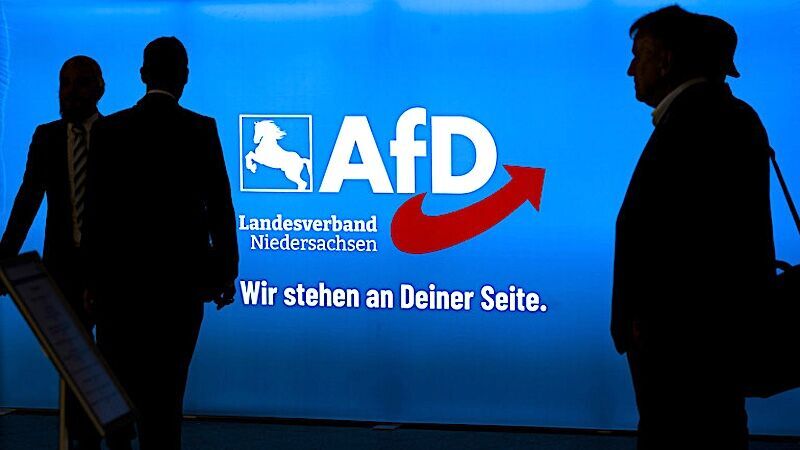
© Julian Stratenschulte/picture alliance/Getty ImagesDelegates and visitors arrive at an AfD Lower Saxony party conference.
Authorities in the German state of Lower Saxony have designated the local chapter of the right-wing AfD party a surveillance priority, citing what they called "extremist" tendencies.
Founded in 2013, Alternative for Germany (AfD) espouses a tough stance on migration and opposes Berlin's support for Ukraine. In the federal elections last February, the AfD came in second at 20%, winning 152 seats in the 630-seat Bundestag. However, the party has been excluded from coalition talks and government formation as part of a policy known as the 'firewall' in German politics.
The AfD's popularity has since grown further regardless, with recent polls indicating that it is supported by around 25% of Germans, on par with Chancellor Friedrich Merz's ruling CDU/CSU.
Speaking during a press conference on Tuesday, Lower Saxony Interior Minister Daniela Behrens cited the "unequivocal" conclusion by the Office for the Protection of the Constitution (BfV), according to which, "the greatest danger to our society stems from right-wing extremism, and the AfD in Lower Saxony... clearly falls within this category."
According to the official, the party's Lower Saxony chapter "holds our state and our democratic institutions in contempt," and views people with a migrant background as "second-class citizens."
The Lower Saxony AfD chapter was first designated a "clear case for surveillance" by the regional BfV office in 2022, with the authorities having now upgraded it to an "object of considerable importance for observation," a spokesman for the domestic intelligence agency was quoted as saying by local media.
Commenting on the decision, AfD Lower Saxony Chairman Ansgar Schledde rejected "every accusation being made" by the authorities, describing the move as politically motivated and aimed at eliminating an opponent. He vowed to challenge the designation in court.
In four other German states - Brandenburg, Saxony, Saxony-Anhalt, and Thuringia - the local AfD branches are deemed a confirmed right-wing extremist entity, while in Rhineland-Palatinate and Saarland, the party has been declared a suspected case.
Last May, the federal BfV office upgraded the AfD's classification from "suspected" to "confirmed right-wing extremist," only to suspend it shortly thereafter pending a ruling on the party's court appeal.



Reader Comments
Brave AI context of "right wing extremism" in the USA: "While "radical right" was the dominant term in U.S. political science for decades, "right-wing extremism" gained wider usage in the 1990s and 2000s, especially as violent acts—such as the Oklahoma City bombing in 1995—drew national attention. The term became increasingly mainstream in media and policy discussions after the 2008 financial crisis, the election of Barack Obama, and the rise of anti-government militias, sovereign citizens, and white supremacist movements." What did HRC call the right supporting Trump, "deplorables".
What does it mean? The globalist power structure was Framing the conservative right as extremist terrorists, which includes Christianity. This would have enabled the HRC regime, if it was elected, to "clamp down on right-wing extremist terrorists".
On a related note - I recently learned about another big lie of German history, this time about concentration camps. Allegedly they were formed in the late '30s and early '40s, and very few Germans know about it.
This is a bold lie. Fact is, the first concentration camps were established in March '33, only weeks after the Nazis took over. The SA and SS thugs immediately began to round up alleged enemies mostly members of banned political parties. They held them in local make-shift concentration camps, often restaurants, vacation homes formerly owned by those banned parties, or community centers. Almost every small town had one, and this went on for years. Only the permanent overcrowding led in the mid- to late '30s to the formation of the huge, outlying facilities we are frequently told about.
And it seems Germany is slipping into the same totalitarian pattern of moral depravity, again.